Ready to integrate Open Banking APIs into your platform?
Finexer gives UK platforms FCA-authorised AIS and PIS access – structured, real-time, API-ready.
When product teams ask me how to use open banking api, they rarely want an OAuth tutorial. They already know authentication exists. What they want to understand is what the API actually delivers inside a real platform – what data comes back, what workflows become possible, and what the integration removes from their current process.
That is what this blog covers.
At Finexer, I work with UK accounting platforms, LawTech tools, EPOS systems, and payroll infrastructure that have integrated Open Banking APIs into their core product workflows. The implementation questions that come up consistently are not about token exchange – they are about data structure, workflow fit, and what changes operationally once bank data flows directly into the system.
This blog is written for Product Managers, Engineering Leads, and SaaS founders evaluating how to use open banking api for real platform workflows – not as a developer reference, but as a practical decision-making guide.
TL;DR
What is open banking api? It is a secure, regulated interface that allows platforms to retrieve bank transaction data via AIS or initiate account-to-account payments via PIS – with explicit user consent. How to use open banking api in practice depends on the workflow. AIS powers reconciliation, verification, and financial analysis. PIS powers Pay by Bank payments and invoice settlement. Finexer provides FCA-authorised AIS and PIS infrastructure covering 99% of UK banks for platforms building these workflows.
Key Takeaways
What is open banking api in simple terms?
An open banking api is a secure interface that allows software platforms to connect to bank systems and retrieve financial data or initiate payments with user consent. In the UK, only FCA-authorised providers can offer open banking api access – ensuring every connection operates within a regulated security framework.
How to use open banking api for data access?
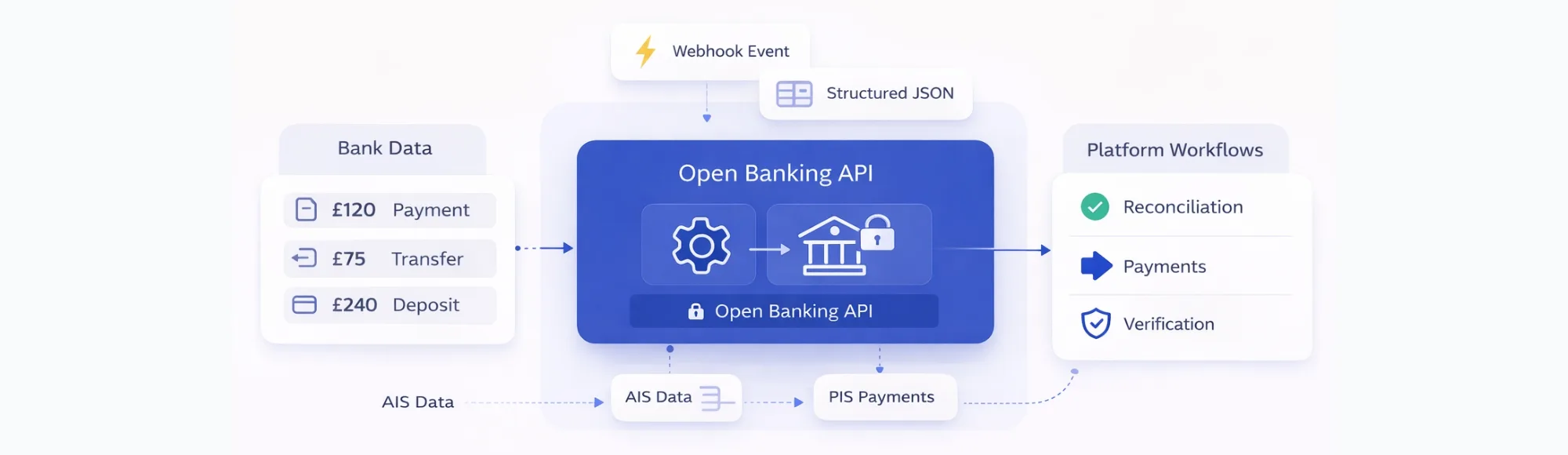
Platforms use AIS open banking apis to retrieve bank transaction history, account balances, and financial activity data directly from a user’s bank account. The platform receives structured JSON outputs that feed directly into reconciliation, verification, and reporting workflows.
How to use open banking api for payments?
Platforms use PIS open banking apis to initiate account-to-account payments directly from a user’s bank account. Pay by Bank invoice payments, supplier disbursements, and checkout payments all use PIS – removing card networks from the payment flow entirely.
What is open banking api infrastructure for platforms?
Open banking api infrastructure is the regulated connectivity layer between a platform and UK banks. Instead of building individual bank connections, platforms integrate once through an FCA-authorised provider like Finexer and access all supported UK banks through a single API.
What does Finexer provide as an open banking api infrastructure?
Finexer provides FCA-authorised AIS for bank transaction data access and PIS for payment initiation – covering 99% of UK banks with real-time webhooks, structured data outputs, and white-label consent flows through a single open banking api integration.
What Is an Open Banking API?
An open banking api is a standardised, secure interface that gives regulated providers programmatic access to bank account data or payment infrastructure – with the account holder’s explicit consent.
Two services define what is open banking api in practice:
AIS – Account Information Services Read-only access to bank transaction data, account balances, and financial history. Platforms retrieve structured financial data directly from the user’s bank without manual uploads or credential sharing.
PIS – Payment Initiation Services Initiates account-to-account payments directly from a user’s bank account. Payments move without card networks – faster and without card processing fees.
Understanding what is open banking api means understanding these two services separately. They serve different workflow needs and are used independently or together depending on what the platform is building.
Open banking authentication explains the consent and SCA flow that underpins both services.
How to Use Open Banking API: The Platform Workflow

Here is how platforms actually use open banking api once integrated – not the OAuth flow, but the operational workflow from the platform’s perspective.
AIS data retrieval workflow:
- Platform requests bank connection via AIS open banking api
- User authenticates with their bank via Strong Customer Authentication
- User grants consent for specific data – transactions, balances, or both
- AIS API retrieves structured transaction data from the bank
- Platform receives JSON output with merchant IDs, amounts, timestamps, category codes
- Data feeds directly into platform workflows – reconciliation, verification, reporting
PIS payment initiation workflow:
- Platform triggers payment request via PIS open banking api
- User authenticates via their banking app using SCA
- Payment is initiated directly from user’s bank account
- Platform receives real-time confirmation via webhook
- Settlement is verified via AIS transaction data
The platform never handles bank credentials. The bank remains the authentication layer throughout both flows.
Banking api integration guide and open banking api integration guide cover the technical implementation steps in detail.
How Should Platforms Evaluate Open Banking API Infrastructure?
| Criteria | Why It Matters | What to Look For |
|---|---|---|
| UK Bank Coverage | Open banking api gaps mean some users cannot connect their bank | 99% UK bank coverage; CMA9 and challenger banks; consistent across institutions |
| Data Structure Quality | Workflow automation requires consistently formatted transaction outputs | Structured JSON; merchant IDs; category codes; standardised schema across banks |
| Real-Time Webhooks | Live workflows need transaction and payment events as they occur | Webhook-driven events; live balance data; real-time payment confirmation |
| AIS and PIS Combined | Platforms needing both data and payments require both in one integration | Single open banking api for AIS and PIS; unified infrastructure layer |
| Transaction History Depth | Verification and reporting workflows need historical data beyond 90 days | Up to 7 years transaction history; configurable lookback periods |
| White-Label Capability | Platform-facing user journeys need to be branded within the product | White-label consent flows; customisable bank connection UI |
How Does Finexer Provide Open Banking API Infrastructure?
Finexer is an FCA-authorised Open Banking provider offering unified AIS and PIS infrastructure for UK platforms – a single open banking api integration covering both bank data access and payment initiation.
What Finexer’s open banking api provides:
- AIS connectivity covering 99% of UK bank accounts
- PIS for Pay by Bank and account-to-account payment initiation
- Real-time webhooks for live transaction and payment events
- Structured JSON outputs with merchant identification and category codes
- Up to 7 years of transaction history for verification and reporting workflows
- FCA-compliant consent flows with granular permissions and instant revocation
- White-label capability for branded bank connection journeys
- Usage-based pricing with no fixed volume commitments
Open banking api guide covers Finexer’s specific API capabilities and data outputs in detail.
What I Feel
The question I get most from product teams is not how to use open banking api technically – it is what changes operationally once it is integrated.
The honest answer is: the manual step between the platform and the bank disappears. Whatever was being collected manually – bank statements, payment confirmations, settlement reports – starts arriving automatically in structured format. The workflow that existed before still exists. It just runs on verified data instead of manually collected files.
That is where the operational value is. Not in the API itself – but in what the platform stops having to do once it is connected.
Common Use Cases
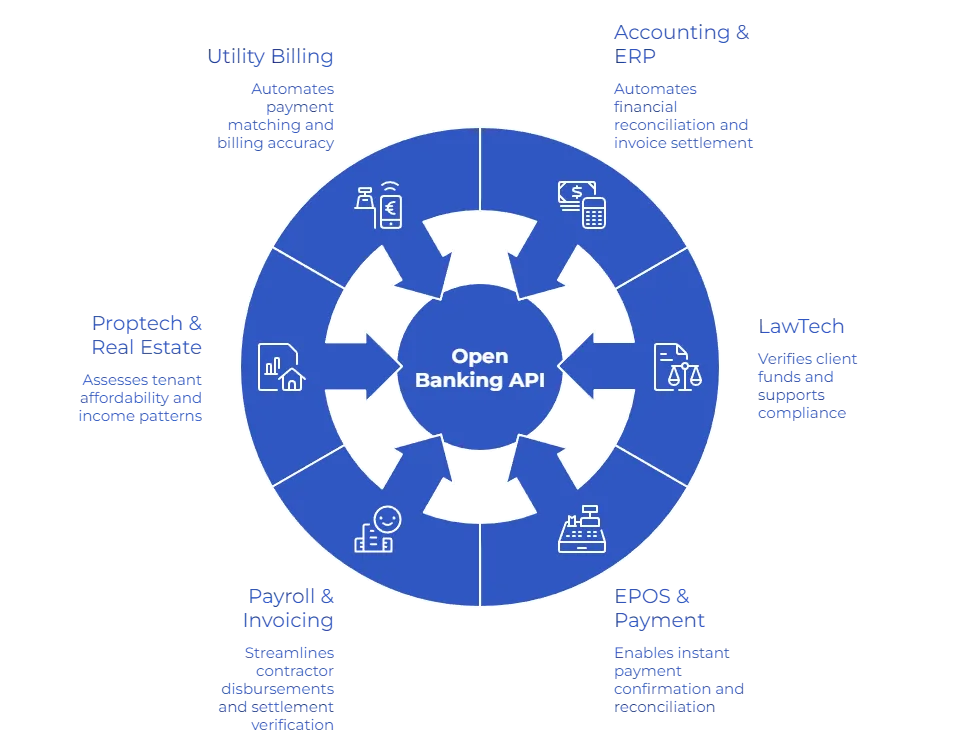
Accounting & ERP Platforms
I see accounting platforms use open banking api to replace CSV bank imports with direct AIS transaction feeds. Reconciliation workflows that previously ran on weekly batch data run automatically against live bank transactions. Invoice settlement confirmation arrives via webhook rather than from a manual payment check – removing the finance team step between payment and record update.
LawTech Platforms
LawTech platforms – including insolvency practices – use AIS open banking api to access verified client bank transaction history for source-of-funds verification and KYC. The audit trail from consent-based API access supports compliance documentation in a way that manually submitted bank statements cannot – because the data provenance is bank-verified, not client-submitted.
EPOS & Payment Platforms
EPOS platforms use PIS open banking api to accept Pay by Bank at checkout and AIS to confirm settlement without waiting for card processor batch reports. Payment confirmation arrives at the point of transaction. Reconciliation runs against bank-verified data the same day – not the next morning.
Payroll & Invoicing Platforms
Payroll platforms use PIS to initiate contractor disbursements directly from within the platform workflow and AIS to verify settlement. What is open banking api for payroll teams? It is the difference between triggering a payment and logging into a bank portal to make one.
Proptech & Real Estate Platforms
PropTech platforms use AIS open banking api to retrieve tenant bank transaction history for affordability assessment. Income pattern analysis, recurring commitment identification, and spending behaviour data arrive in structured format – replacing manual payslip and bank statement requests with consent-based bank data access.
Utility Billing Platforms
Utility platforms use PIS open banking api for Request-to-Pay billing and AIS to verify payment receipt. High-volume billing workflows that previously required manual payment matching run automatically against bank transaction data – reducing ops workload and improving billing record accuracy.
What is open banking api used for in UK platforms?
An open banking api is used to retrieve bank transaction data via AIS or initiate account-to-account payments via PIS – with user consent. UK platforms use open banking apis to automate reconciliation, enable Pay by Bank payments, verify financial history, and power affordability assessment workflows without manual bank data collection.
How to use open banking api without building individual bank connections?
Platforms use open banking api infrastructure providers like Finexer – FCA-authorised providers that maintain bank connections across 99% of UK banks. Platforms integrate once through Finexer’s unified open banking api and access all supported UK banks through structured AIS and PIS endpoints without maintaining individual bank relationships.
Is Finexer suitable for platforms learning how to use open banking api?
Yes. Finexer is FCA-authorised and provides AIS for bank transaction data and PIS for payment initiation through a single open banking api – covering 99% of UK banks with real-time webhooks, structured JSON outputs, and 3-5 weeks onboarding support for platform integration teams.
Start using open banking api with FCA-authorised infrastructure.
About the Author

Yuri
Yuriy Yakushko is the Founder of Finexer, an FCA-authorised Open Banking platform that enables businesses to access real-time bank data and Pay-by-Bank payments through secure API infrastructure. With more than 20 years of experience in fintech and software engineering, he focuses on building scalable financial technology that helps businesses modernise payments and financial data workflows.