
Verify Inside the Journey.
Real-time name match, no document review queue.
A new customer starts onboarding, gets asked for a bank statement, closes the tab to go find one and never comes back. That’s not hypothetical. That’s the default outcome of document-based verification, exactly what instant bank account verification is built to avoid.
TL;DR: Instant bank account verification checks a name against the bank record while the customer is still in the onboarding flow and returns a result on which the platform can act immediately. There is no document to find, no upload and no queue waiting on someone to review it manually.
This guide draws on Finexer’s work as an FCA-authorised Open Banking infrastructure provider (AISP and PISP, FRN 925695), supplying real-time verification to UK platforms across proptech, payroll and accounting where onboarding speed decides whether a sign-up completes at all.
It sits alongside Finexer’s coverage of bank account verification in onboarding more broadly and against a backdrop where UK Open Banking now processes tens of millions of payments a month, having processed 40.16 million payments in June 2026 alone (Open Banking Limited), which means instant bank verification is running on infrastructure that’s already proven at scale.
The platforms that get this right treat verification as part of the journey and not as a gate bolted on afterward. The moment customers have to leave the flow to go find a document, you’ve already lost some of them.
What “Instant” Actually Means Here
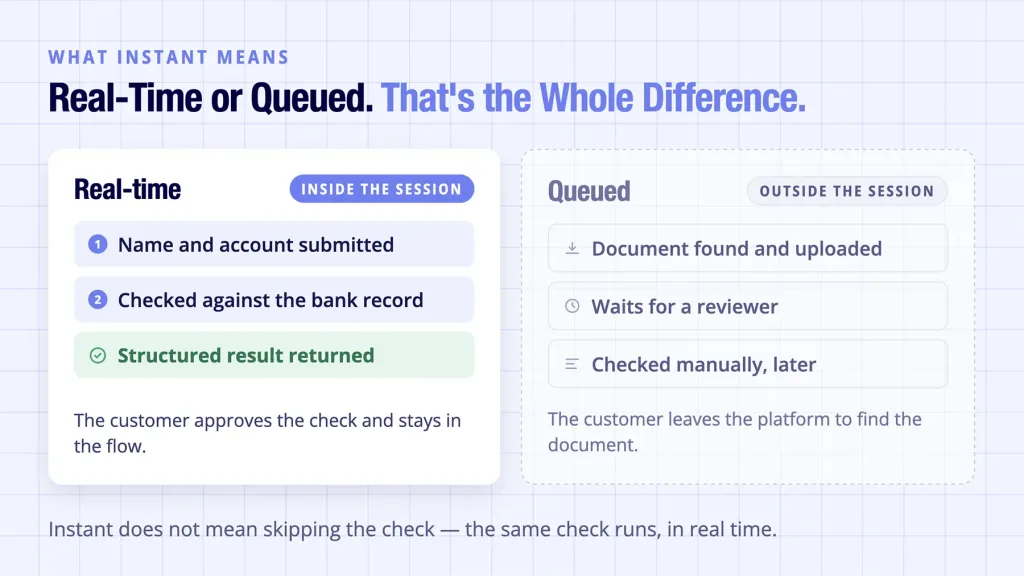
Instant bank verification doesn’t mean skipping the check. It means running it against the bank records in real time and getting back a structured result inside the same session, rather than submitting something for a person to look at later.
The mechanics behind this sit closer to a bank account verification api than they do to a document upload form: the platform submits the expected name and account details, and the check returns a match result while the customer is still there.
That distinction, real-time against queued, is the entire difference between instant bank account verification and every document-based alternative still in wide use. It’s also what separates genuine instant bank verification from checks that are only marketed as instant but still route through a manual step somewhere in the process.
Instant vs Document-Based: Where the Time Actually Goes
Document-based verification isn’t slow because reviewers are inefficient. It’s slow because of what happens before a document even reaches a reviewer.
The stages a check based on a bank statement or letter as proof of banking details has to pass through are as follows:
- The customer is asked for the document.
- They have to locate the document, often outside the platform entirely, in email or a banking app
- They upload it, frequently as a photo or scan of variable quality
- The document sits in a queue until someone is available to review it
- A reviewer manually checks the name and details against what the platform expects
Every one of those steps is a place in which a customer can stop and not come back. Instant bank account verification collapses all five into one: the check runs against the bank record directly and inside the session, with no document changing hands.
| Instant bank account verification | Document-based verification | |
|---|---|---|
| Where the check happens | Inside the onboarding session | Outside the session, in a review queue |
| What the customer does | Approves the check | Finds, uploads and waits |
| Forgery risk | Checked directly against the bank record | Depends on document authenticity, harder to confirm at scale |
| Operational load | Automated result | Manual review capacity required |
Why This Is the Section That Actually Converts
Every additional step in an onboarding flow is a decision point for the customer to stop. A document request is one of the heaviest of those decision points, because it asks someone to leave the platform entirely to go find something.
This isn’t a claim that can be reduced to a single number, because the actual drop-off any platform sees depends on its own audience, product and existing flow. What’s consistent across UK platforms is the pattern itself: the longer a check takes and the more it depends on the customer doing something outside the session, the more people simply don’t finish.
Instant bank account verification doesn’t remove every reason a customer might abandon onboarding. It removes the specific reason tied to document review, which for many platforms is the single largest one.
The Edge Cases That Make This Credible
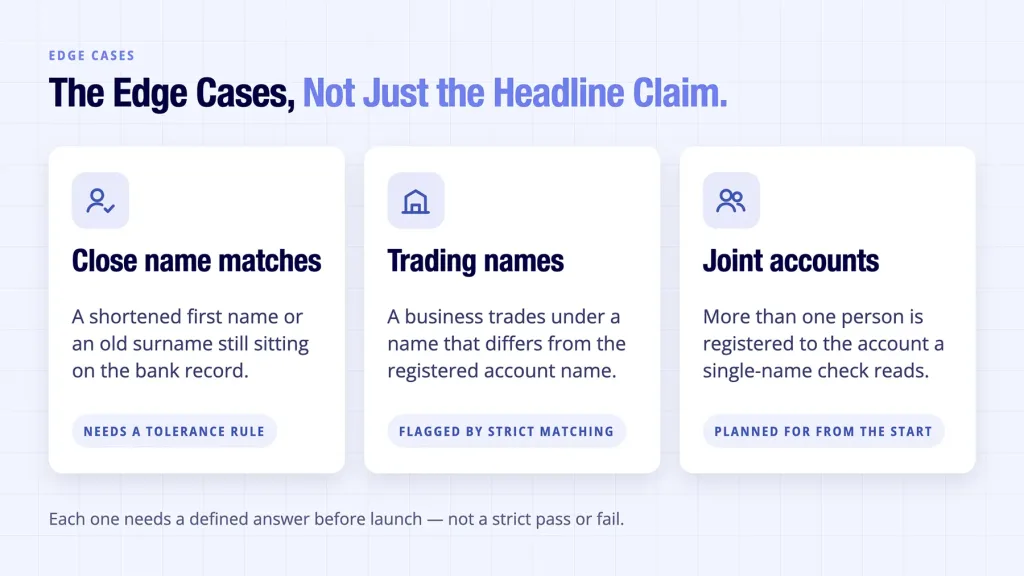
Any verification claiming to be instant and which ignores its own edge cases isn’t being honest about how it actually works. Three cases need a defined answer before launch.
Close name matches happen when a customer’s name is close to, but not identical to, the bank record, such as a shortened first name or an old surname still on file. The account holder name check behind instant verification needs a tolerance rule for this and not a strict pass or fail.
Business accounts with trading names are a genuine gap. A business often operates under a trading name that differs from its registered company name on the bank account, which a strict name match will flag even when the payment is entirely legitimate.
Joint accounts complicate a single-name match by design as the account is registered to more than one person and a check built for one name has to account for that from the start.
Finexer’s Verification Product
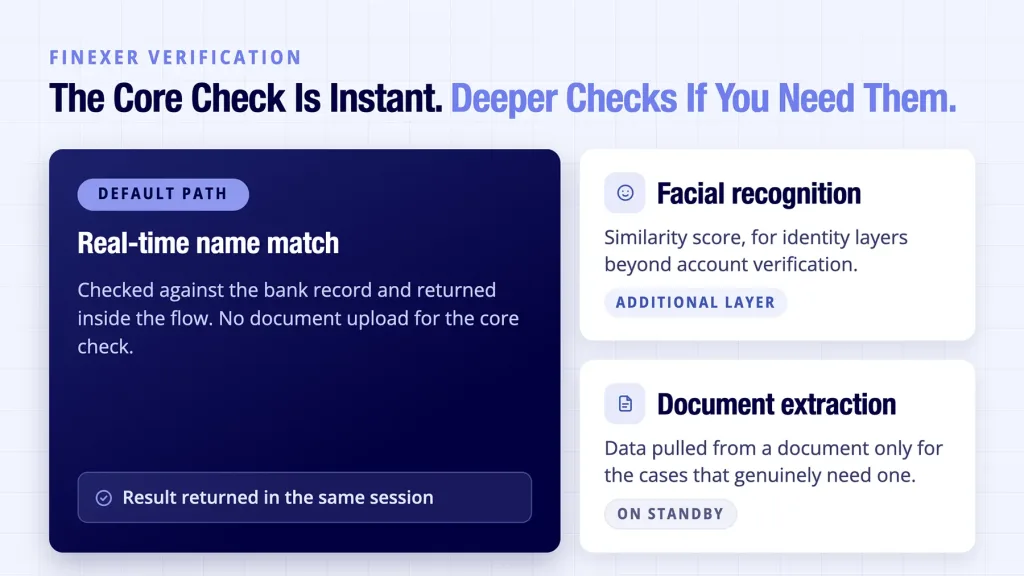
Platforms lose sign-ups at the exact moment they ask a customer to leave the flow and go find a document.
Finexer Verification addresses this with a bank-based name verification result returned inside the flow itself, alongside facial recognition with a similarity score and document data extraction that genuinely necessitates a deeper identity check.
- Real-time name match against the bank record and no document upload required for the core check
- Facial recognition with a similarity score available for identity layers beyond account verification
- Document data extraction on standby for cases that do need it, rather than as the default path
Where This Fits
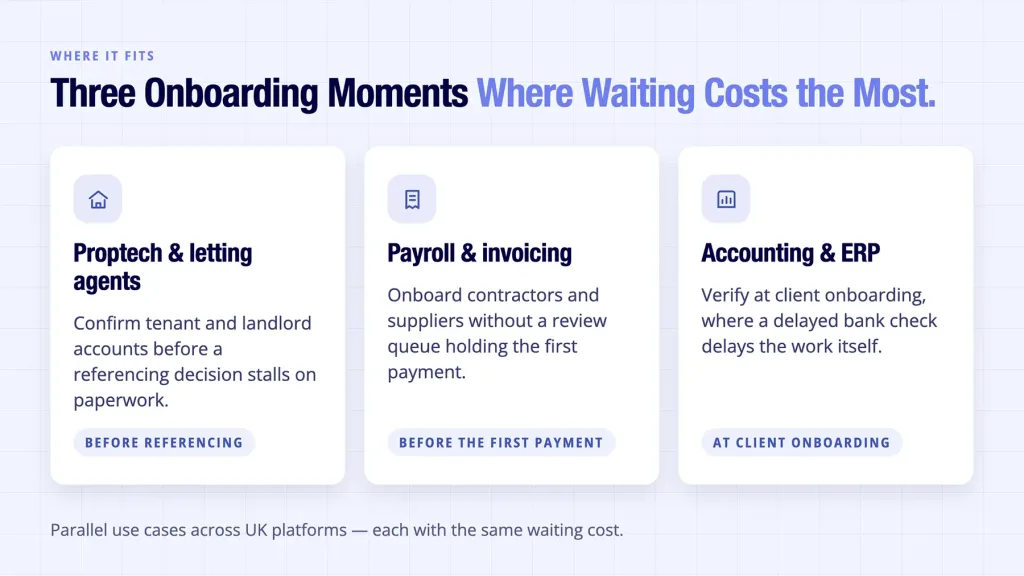
Proptech and letting agents use instant verification to confirm tenant and landlord accounts before referencing decisions stalled on paperwork.
Payroll and invoicing platforms use it to onboard new contractors and suppliers without a manual review queue holding up the first payment.
Accounting and ERP platforms use it at client onboarding, where a delayed bank check often means a delayed start on the actual work.
Does instant verification work for accounts outside the UK?
This guide covers UK bank accounts specifically. Coverage for other markets depends on the provider and the banking infrastructure available there.
What happens if the instant check can’t confirm a match at all?
It returns a no-match result rather than guessing, which lets the platform decide whether to hold the account, ask for a document as a fallback or flag it for manual review.
Is instant verification less secure than a manual document review?
Not inherently. It checks directly against the bank’s own record rather than relying on a document’s authenticity, which removes one specific risk that document review carries. Instant bank verification and document review are checking different things and not competing on the same axis of security.
Can a platform offer both instant and document-based verification?
Yes, and many do, using instant verification as the default path with document upload available as a fallback for the edge cases that need it.
See how Finexer’s Verification product returns a bank-based name match in real time, so onboarding completes in one session instead of waiting on document review.
Explore with AI
About the Author

Ravi Ranjan
Ravi Ranjan is Co founder & CEO of Finexer