2
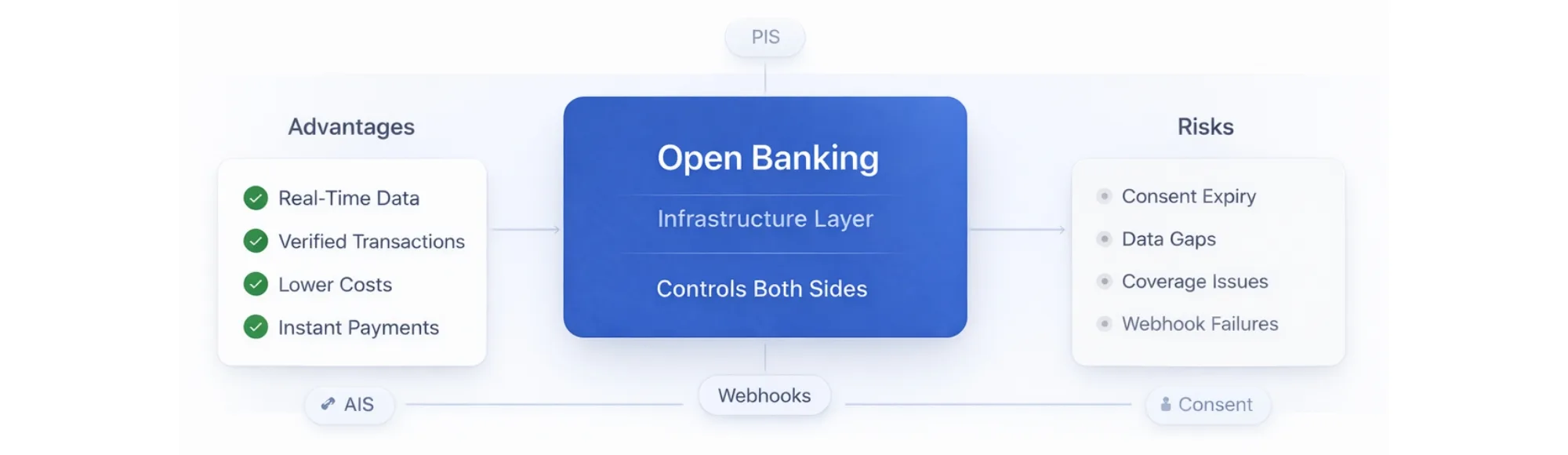
Real advantages. Real risks. Both matter for platforms building on Open Banking.
Finexer builds Open Banking infrastructure designed to solve the risks, not just deliver the benefits.
Open banking advantages are not in dispute. Real-time bank data. Lower payment costs. Bank-authenticated records.
What most content on this topic skips is the other side. The risks of open banking are equally real for platforms building on it – and they are operational problems, not regulatory ones.
At Finexer, I work with product managers, engineering leads, and fintech founders who have read the benefits case and now need to understand what they are actually taking on. The infrastructure decision is not just about what Open Banking gives you. It is about how you manage what it does not guarantee by default.
This blog covers both sides from a platform perspective – what the open banking advantages genuinely deliver, where the risks of open banking create operational problems, and how infrastructure quality determines which side of that trade-off your platform ends up on.
TL;DR
Open banking advantages for platforms include real-time payment confirmation, bank-verified transaction data, lower processing costs, and no chargeback exposure. The risks of open banking include consent expiry disrupting data feeds, bank coverage gaps creating incomplete user records, data inconsistency across providers, and webhook reliability failures. Infrastructure quality – not the Open Banking framework itself – determines whether platforms capture the advantages or absorb the risks.
Key Takeaways
What are the core open banking advantages for platforms?
Real-time bank-verified transaction data, instant payment confirmation via Faster Payments, zero chargeback exposure on Push Payments, and lower processing costs versus card-based infrastructure. These advantages are structural – they come from routing through bank rails rather than card networks.
What are the main risks of open banking that affect platform operations?
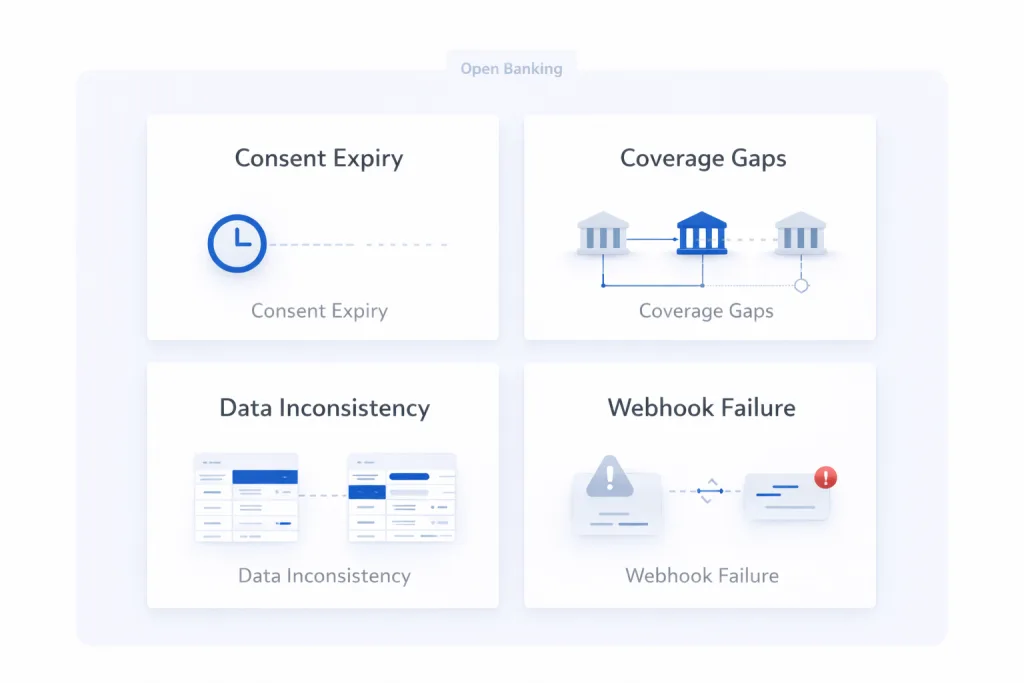
Consent windows expire and must be renewed – disrupting continuous data feeds. Bank coverage gaps mean some users cannot connect their accounts. Data format inconsistencies across banks create normalisation overhead. Webhook delivery failures create data gaps that break downstream workflows.
Are the risks of open banking solved at the framework level or the infrastructure level?
Infrastructure level. The Open Banking framework defines the regulatory standards. The infrastructure provider determines whether data arrives consistently, consent flows are reliable, bank connections are maintained, and failures are handled before they reach the platform.
Which platforms are most exposed to open banking risks?
Platforms running automated reconciliation, continuous income verification, or real-time payment tracking are most exposed – because any gap in data continuity or payment confirmation directly breaks the workflow. High-volume, time-sensitive workflows amplify every infrastructure weakness.
What Are the Real Open Banking Advantages for Platforms?
Why Does Bank-Verified Data Change Workflow Accuracy?
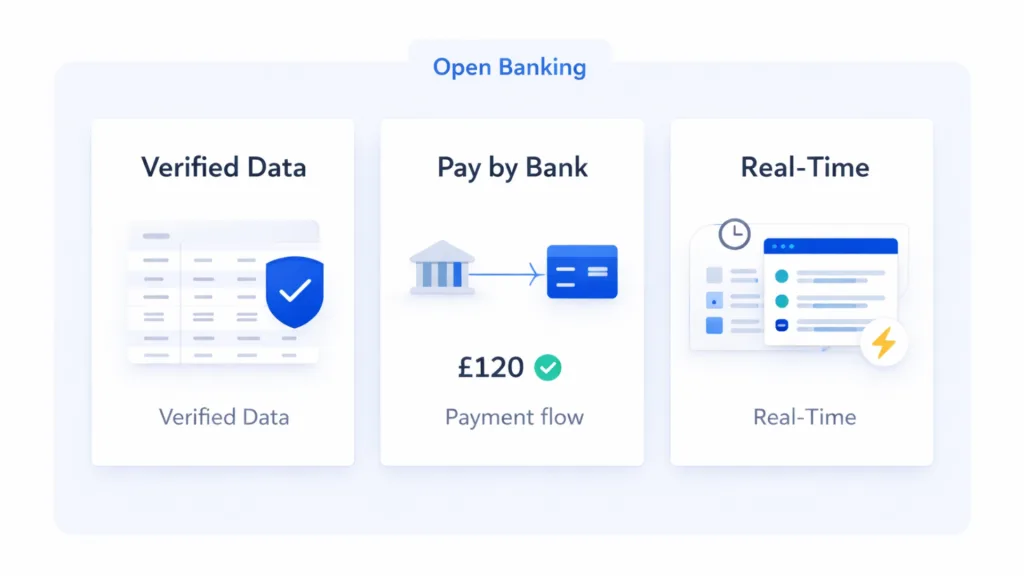
The most significant of the open banking advantages is not speed. It is verifiability.
Bank transaction data retrieved via FCA-authorised AIS comes directly from the financial institution. It reflects what actually happened in the account – not what a client uploaded, not what a CSV export captured on a specific date.
For platforms running reconciliation, income verification, or compliance checks, this distinction is operationally significant. Document-based data can be incomplete, outdated, or manipulated. Bank-verified data cannot.
The essential guide to open banking benefits covers the full benefits case. The verifiability advantage is the one most underestimated at the evaluation stage.
“At Finexer, the platforms that have moved from document-based to bank-verified data do not describe it as a feature upgrade. They describe it as fixing a data quality problem they had not fully quantified until it was gone.” – Ravi, Finexer
What Do Push Payments Give Platforms That Cards Cannot?
Pay by Bank via Faster Payments delivers open banking advantages that card rails structurally cannot match:
- Payment confirmation at point of settlement – not authorisation
- Zero chargeback exposure – Push Payments are irrevocable
- No interchange, scheme, or acquirer fees – single usage-based API cost
- Settlement typically within seconds – not 2-5 business days
According to Open Banking Limited’s progress report, UK Open Banking processed over 31 million payments in March 2025 – 67% growth year-on-year. This volume confirms the advantages are real and already embedded in production payment flows.
What Does Real-Time Data Access Enable That Batch Imports Cannot?
AIS data arrives via webhook as transactions occur. This is structurally different from CSV exports or scheduled batch imports – which capture a point in time, not a continuous flow.
For platforms that need current cash positions, live reconciliation, or real-time income pattern analysis, this is not a marginal improvement. It is the difference between financial workflows that reflect current reality and ones that reflect yesterday’s data.
Open Banking Impact Report analysis shows £8.3bn in economic value already delivered through the infrastructure – driven largely by this real-time data access advantage at scale.
| Open Banking Advantage | What It Delivers | Platform Workflow It Enables |
|---|---|---|
| Bank-verified transaction data | Confirmed financial activity at source – not document-based | Reconciliation, income verification, compliance checks |
| Push Payment confirmation | Real-time settlement confirmation, zero chargeback exposure | Pay by Bank, salary disbursements, invoice collection |
| Real-time data via webhooks | Continuous transaction feed as events occur | Live reconciliation, cash position monitoring, fraud detection |
| Lower payment costs | No interchange, scheme, or acquirer fees on bank payments | High-volume payment workflows where card fees compound |
| Consent-based access audit trail | Full access log with timestamps and consent scope per retrieval | Source-of-funds checks, AML documentation, compliance review |
What Are the Real Risks of Open Banking That Platforms Must Solve?
How Does Consent Expiry Disrupt Platform Data Flows?
Consent in Open Banking is time-limited by design. Users grant access for a defined period. When that period expires, the platform loses access to new transaction data from that account until the user renews consent.
For platforms running continuous workflows – ongoing reconciliation, live income monitoring, real-time payment tracking – consent expiry is one of the most operationally significant risks of open banking.
It does not break the framework. It breaks the workflow that depends on the continuous data feed the framework was providing.
Managing consent expiry requires proactive renewal flows, user communication, and graceful degradation handling when access lapses. Platforms that do not build this from the start discover the risk post-launch.
Why Do Bank Coverage Gaps Create Incomplete Platform Records?
Open Banking coverage in the UK is broad but not universal. The CMA9 banks are mandated. Smaller institutions and some challenger banks may have inconsistent or delayed API support.
For platforms serving users across the full range of UK banking relationships, coverage gaps mean some users cannot connect their accounts at all. Others may connect but return incomplete or delayed data from institutions with lower API quality.
The truth about open banking security and reliability covers the infrastructure reliability factors that determine whether coverage gaps surface as user-facing problems.
The risks of open banking from coverage gaps are not theoretical. They appear as support tickets, incomplete user records, and reconciliation gaps that cannot be explained without knowing which bank the missing transactions came from.
Why Does Data Inconsistency Across Banks Create Normalisation Overhead?
Different UK banks return transaction data in different formats. Counterparty references, merchant descriptions, amount representations, and category structures vary across institutions.
Platforms that integrate directly with multiple providers – or work with providers that do not standardise outputs – inherit this normalisation overhead. Reconciliation logic written for one bank’s transaction format breaks on another’s.
This is one of the risks of open banking that sits entirely at the infrastructure layer, not the framework layer. The Open Banking standard defines the API. It does not mandate identical output schemas across every bank.
What to evaluate when choosing an open banking partner covers the data quality and normalisation questions that determine whether this risk is absorbed or eliminated at the infrastructure level.
Why Do Webhook Reliability Failures Break Automated Workflows?
Real-time data delivery via webhook is one of the open banking advantages. Webhook reliability failures are one of the risks.
When a webhook is not delivered – due to provider infrastructure issues, network failures, or retry logic gaps – the platform does not receive the transaction event. For automated workflows that trigger on transaction receipt, this creates a silent gap.
The gap is not visible immediately. It surfaces during reconciliation review or audit, when a transaction that should have triggered a workflow is found to have not arrived.
Webhook reliability is determined entirely by the infrastructure provider. The Open Banking framework does not guarantee delivery – it defines the mechanism.
“The risks of open banking that catch platforms out are rarely the obvious ones. Consent expiry, webhook gaps, coverage inconsistencies – these are infrastructure management problems that look like framework problems until you understand where the line is.” – Ravi, Finexer
According to GOV.UK’s open banking milestone announcement, the UK Open Banking framework is delivering real consumer and business value. Managing the operational risks is what separates platforms that capture this value reliably from those that experience it inconsistently.
How Does Infrastructure Quality Determine Which Side of the Trade-off You Land On?
For platform builders, the open banking advantages and the risks of open banking are both real. Which one dominates the production experience is determined almost entirely by infrastructure quality.
A provider with full UK bank coverage, standardised JSON outputs, proactive consent management, and reliable webhook delivery eliminates the operational risk surface. The advantages become the daily experience.
A provider with incomplete coverage, inconsistent data formatting, and poor webhook reliability exposes the platform to the risks – not occasionally, but structurally.
Open Banking Limited on how Open Banking helps consumers and businesses sets out the framework-level benefits that infrastructure providers must reliably deliver.
How Does Finexer Address Open Banking Risks While Delivering the Advantages?
Finexer builds FCA-authorised AIS and PIS infrastructure specifically around the risks of open banking that break platform workflows in production.
What Does Finexer’s Infrastructure Provide?
Finexer Open Banking infrastructure – designed for platform reliability.
- FCA-authorised AIS and PIS – verifiable on the FCA register
- Standardised JSON output across virtually every UK bank – no normalisation overhead
- Real-time webhooks with reliable delivery for transaction and payment events
- 99% UK bank coverage – CMA9, challengers, and business banking providers
- Consent management with renewal flow support
- Up to 7 years of transaction history per account
- White-label consent flows under the platform’s own brand
- Usage-based pricing – no fixed minimums
- 3-5 weeks onboarding support
What I Feel
Most content about open banking advantages reads like a press release. Benefits listed. Risks absent.
Most content about risks of open banking reads like a warning. Problems listed. Solutions absent.
The reality for platform builders is somewhere in the middle. The advantages are genuine and significant. The risks are real and manageable – but only if the infrastructure layer handles them before they reach the platform.
The platforms I work with that have the best experience with Open Banking are not the ones that ignored the risks. They are the ones that chose infrastructure that solved them before go-live.
Common Use Cases

Accounting & ERP Platforms
The open banking advantages of real-time transaction data and bank-verified records are directly valuable. The risk is data inconsistency across banks breaking reconciliation logic. Finexer’s standardised output across virtually every UK bank eliminates that normalisation overhead.
Lawtech Platforms
Bank-authenticated transaction history with consent logs delivers the compliance audit trail advantage. The risk is consent expiry creating gaps in source-of-funds documentation. Finexer’s consent management infrastructure supports renewal flows that maintain continuous access.
EPOS Platforms
Push Payment confirmation with zero chargeback exposure is the core advantage. The risk is webhook delivery gaps breaking payment confirmation workflows. Finexer’s webhook infrastructure is built for reliable delivery at transaction volume.
What are the main open banking advantages for UK platforms?
Real-time bank-verified transaction data, instant payment confirmation via Faster Payments, zero chargeback exposure on Push Payments, and lower processing costs versus card infrastructure. These are structural advantages from routing through bank rails rather than card networks.
What are the risks of open banking that affect platform operations?
Consent expiry disrupting continuous data feeds, bank coverage gaps creating incomplete user records, data format inconsistencies across banks, and webhook delivery failures. These are infrastructure management problems – solvable at the provider level, not the framework level.
How do platforms manage the risks of open banking without losing the advantages?
By choosing infrastructure that handles consent renewal, standardises data output across banks, and delivers webhooks reliably. The open banking advantages and risks both exist – which dominates the production experience is determined by infrastructure quality, not the framework itself.
Build on infrastructure that solves the risks.
About the Author

Ravi Ranjan
Ravi Ranjan is Co founder & CEO of Finexer