Coverage across the main UK providers is broadly similar for personal current accounts, so the real differentiator is business and challenger account coverage, plus connection success rate, not the headline bank count. When you’re evaluating open banking bank coverage, the number quoted on a provider’s homepage tells you very little on its own.
Why are headline bank counts a weak way to compare providers?
Most UK Open Banking providers connect to the same core set of major banks for personal current accounts, since these are the institutions with the longest-established, most stable Open Banking APIs. A provider claiming to cover 40, 50, or 60 banks is often counting personal current accounts that every other provider already covers too.
Personal current account coverage is largely commoditised
The differences that actually matter show up once you look past personal current accounts, particularly in business accounts, challenger banks, and how consistently a connection actually completes rather than failing partway through.
Open banking bank coverage differs by account type, not by bank count
| Account Type | What Typically Differs Between Providers |
|---|---|
| Personal current accounts | Minimal difference, nearly universal support |
| Business current accounts | Coverage gaps are common, especially for smaller business banking providers |
| Challenger banks | Varies more than personal current accounts, worth checking directly |
| Credit cards | Often supported for major issuers, inconsistent for smaller ones |
| Savings accounts | Frequently the weakest area of coverage across the market |
What to actually ask a provider about coverage?
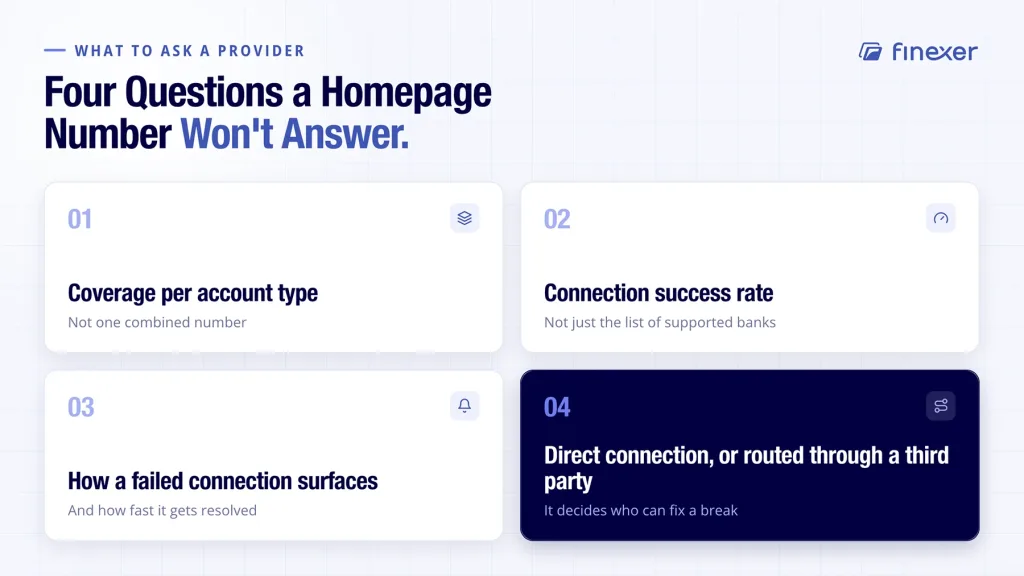
- Ask for coverage stated per account type, not a single combined number.
- Ask for the connection success rate, not just the list of supported banks.
- Ask how a failed connection surfaces to you and your customer, and how quickly it’s resolved.
- Ask whether the provider holds its own connection to each bank or routes through a third party, since this determines who can actually fix a broken connection when one occurs.
If you want the full list of supported institutions rather than how to evaluate a coverage claim, our separate guide on which banks use open banking covers that in detail.
What “coverage” does and doesn’t include?
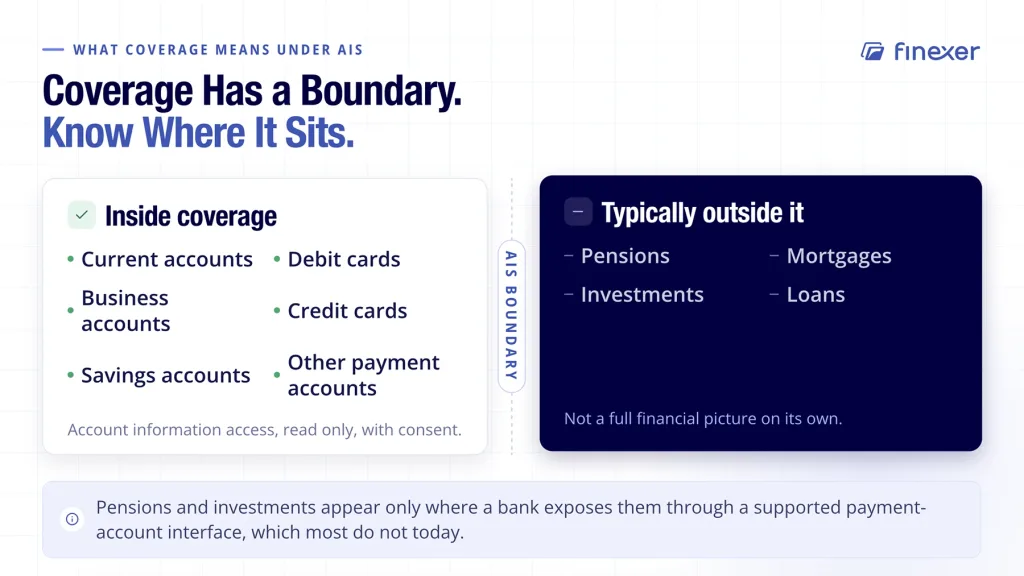
Coverage claims usually refer to account information access under AIS. This typically spans current accounts, business accounts, savings accounts, debit card accounts, credit card accounts, and other payment accounts. Pensions and investment accounts are not included unless a bank exposes them through a supported payment-account interface, which most do not today. This distinction matters if your product needs a full picture of a customer’s finances rather than their day-to-day banking activity.
How does Finexer approach open banking bank coverage?
Finexer provides coverage across almost all major UK banks, including business accounts and challenger banks, which addresses the two areas where coverage gaps most commonly appear. For a lending or embedded finance platform, this means fewer failed onboarding attempts caused by an unsupported business account.
A few figures worth stating precisely:
- Finexer covers most of the UK banks, including business accounts and challenger banks.
- Coverage is UK-only.
This coverage sits behind Finexer’s bank data API, which provides real-time account data through an API rather than manual uploads. If you’re comparing this against a broader shortlist, our guide to open banking solution providers sets out the wider selection criteria, and our breakdown of TrueLayer pricing may help if pricing transparency is part of your evaluation.
Bottom line
Open banking bank coverage isn’t a single number worth comparing at face value. The differences that affect your product sit in business accounts, challenger banks, and connection reliability, not in how many banks appear on a homepage. Ask for coverage broken down by account type before you sign.
See how Finexer’s bank data API supports your platform’s account coverage needs.
Explore with AI
About the Author

Ravi Ranjan
Ravi Ranjan is Co founder & CEO of Finexer