
Choosing the right Pay by Bank provider can influence payment costs, customer experience, and operational efficiency. The right provider reduces payment friction, cuts fees, and settles instantly. The wrong one delays your cash, complicates integrations, and frustrates customers.
Most merchants compare pay by bank providers by feature lists alone. This approach misses what actually matters: authentication reliability, settlement consistency, and API quality under volume.
If you’re assessing the technical side in more detail, our guide on what separates a production-ready Pay by Bank API explains the capabilities worth evaluating before you integrate.
This guide walks you through the evaluation criteria that separate production-ready providers from the rest.
Key Takeaways
- Open Banking payments reached 37.46 million transactions in March 2026, making Pay by Bank one of the fastest-growing payment methods in the UK
- Settlement is near-instant via Faster Payments, but authentication flows (SCA and biometric) vary by provider
- API reliability, transaction volume limits, and fee structures should drive your choice, not feature count
- Small business adoption is rapidly increasing as pay by bank providers improve the ease of integration. Learn how small business adoption is being driven by simpler merchant payment solutions and Open Banking.
What Is Pay by Bank and Why Merchants Should Evaluate Providers?
Pay by Bank is a payment method where customers authenticate directly with their bank via open banking consent, then transfer money to you. Payments move directly between bank accounts via Open Banking and Faster Payments, without card networks. Just bank-to-bank transfer via Faster Payments.
This mechanic matters because it changes what you should ask of pay by bank providers. You’re not evaluating payment processors. You’re evaluating infrastructure that handles bank authentication, settlement routing, and reconciliation.
The UK adopted pay by bank faster than most markets. 17.94 million UK users now have active open banking connections as of March 2026, and monthly transaction volume reached 37.46 million by March 2026. This growth means merchant choice is expanding, but so is the risk of picking the wrong provider.
How Do Pay by Bank Providers Compare?
Here’s where most merchants go wrong: they assume all pay by bank providers offer the same experience. They don’t.
| Evaluation Criterion | What Matters | Red Flag |
|---|---|---|
| SCA / Biometric Authentication | Real-time bank consent, no friction | Delayed authentication screens; fallback to card entry |
| Settlement Speed | Near-instant Faster Payments routing | Batched settlement; delayed fund arrival |
| Transaction Volume Limits | Can you scale when needed? | Per-transaction caps; monthly thresholds |
| Reconciliation & Webhooks | Real-time payment status updates | Batched reporting; no webhook support |
| Merchant Fees | Transparent per-transaction cost | Hidden fees; variable rates by volume |
| API Stability | High uptime; clear error handling | Frequent outages; poor error messages |
Comparing pay by bank providers on these criteria reveals why adoption varies so much. A provider with excellent bank authentication but batched settlement will frustrate customers. One with low fees but API unreliability costs you support tickets.
How Does Bank Authentication Actually Work?
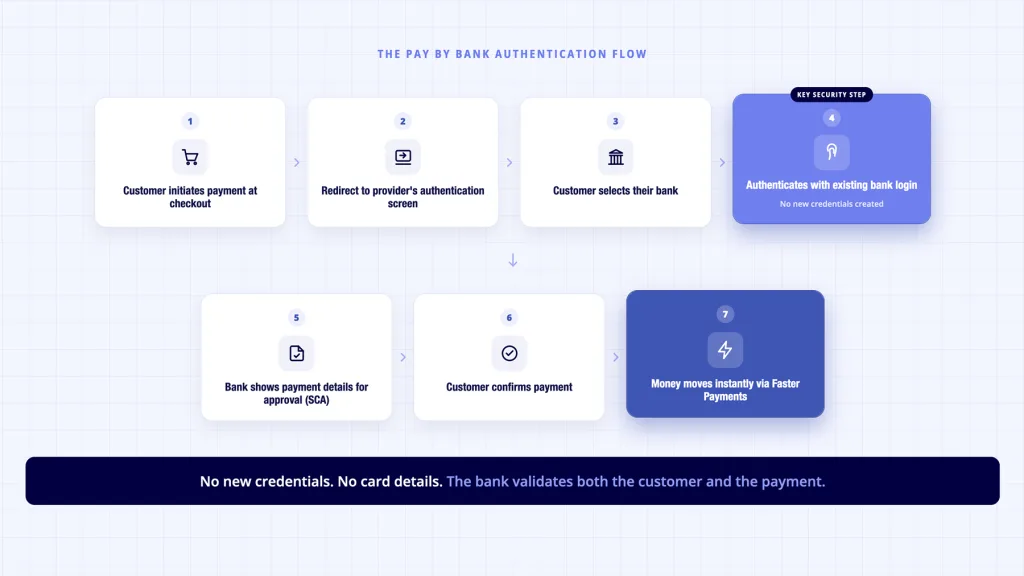
This is where pay by bank differs fundamentally from cards. Understanding the authentication flow helps you evaluate pay by bank providers.
The flow is simple:
- Customer initiates payment on your checkout
- You redirect to your chosen pay by bank provider’s authentication screen
- Customer selects their bank (Barclays, HSBC, etc.)
- Customer authenticates with their bank using their existing login (no new credentials)
- Bank shows the payment details for approval (this is bank authentication, or SCA)
- Customer confirms payment
- Money moves instantly via Faster Payments to your account
The Difference:
Bank authentication is stronger than card verification. The customer’s bank validates both the customer and the payment. This reduces fraud and chargebacks – a major reason merchants prefer pay by bank over cards.
Where do providers diverge?
Some providers require fresh authentication every time (slower but more secure). Some use biometric confirmation (fingerprint, face recognition). Others rely on their bank’s standard Strong Customer Authentication (SCA) flow. The best pay by bank providers offer both and let merchants choose their risk tolerance.
Instant Settlement: How It Works and Why It Matters
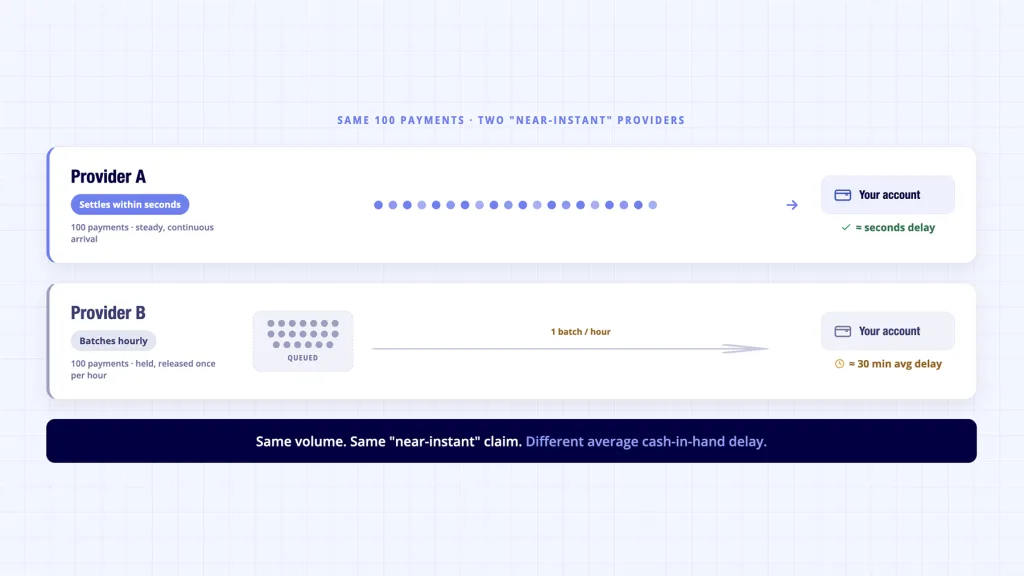
Pay by Bank uses Faster Payments, which settles near-instantly. This is the biggest competitive advantage over cards (which settle in 1-3 days).
But “near-instant” varies by provider. Some settle within seconds. Other providers batch transactions hourly or daily. This difference compounds when you’re processing high volume.
Why does it matter?
If you’re settling once per hour but processing 100 payments per minute, your average cash-in-hand delay is 30 minutes. For high-value B2B payments or marketplaces, this is material.
When evaluating pay by bank providers, confirm their actual settlement SLA (Service Level Agreement). Don’t assume instant means instant. Settlement speed is only part of the picture. Understanding tracking a payment after it’s initiated can help merchants improve payment visibility and operational reconciliation.
Which Pay by Bank Providers Should You Consider?
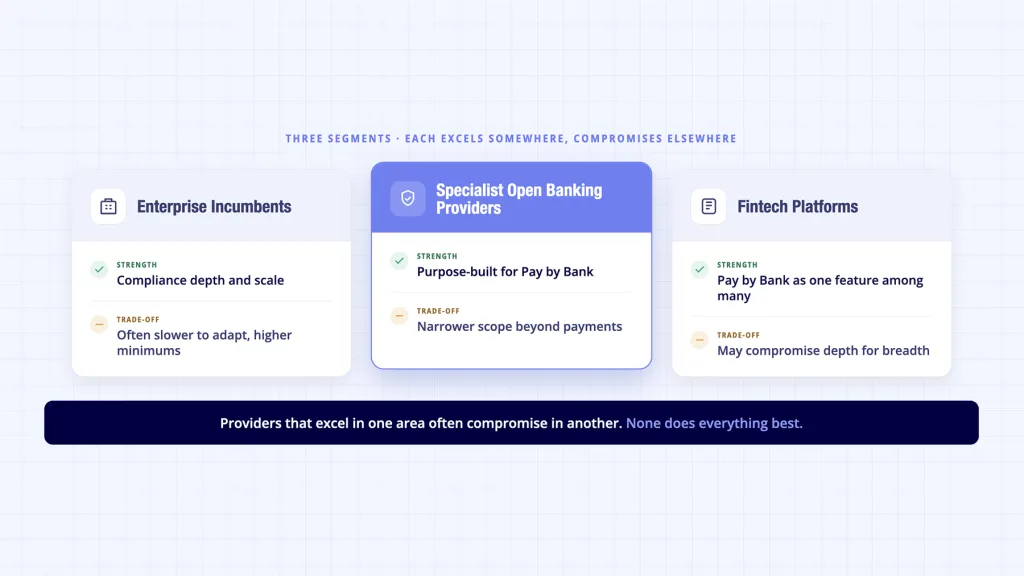
The market for now includes:
- Enterprise incumbents (expanding into open banking)
- Specialist open banking providers (purpose-built for pay by bank)
- Fintech platforms (adding pay by bank as a feature)
Each segment has trade-offs. Enterprise providers bring compliance depth and scale. Specialist providers bring API focus and merchant support. Fintechs bring integration simplicity.
If you’re evaluating providers specifically for finance or bookkeeping workflows, compare the leading PISP platforms for accounting firms.
The common pattern: Pay by Bank providers that excel in one area (e.g., API reliability) often compromise in another (e.g., merchant fee structure). Your job is to match the trade-off to your business model.
Finexer’s Payments Product: Pay by Bank for Mid-Market
Once you’ve shortlisted Pay by Bank providers, the next question is whether the platform can support your business as transaction volumes grow. Beyond payment initiation, merchants need reliable bank connectivity, clear payment visibility, flexible payment capabilities, and infrastructure that scales without increasing operational complexity.
With Finexer’s Payments product, merchants benefit from:
- FCA-authorised Open Banking infrastructure (AISP and PISP), providing a regulated foundation for secure account information and payment initiation services.
- Pay by Bank payment initiation through a single API, helping merchants offer secure account-to-account payments without building direct bank integrations.
- Coverage across almost all major UK banks, including business accounts, enabling a broad customer reach through one integration.
- Real-time payment status updates and webhook notifications, allowing platforms to automate payment tracking and improve operational visibility.
- Bulk payment initiation with individual payment tracking, making supplier payments, payroll, and marketplace payouts easier to manage at scale.
- International payout capabilities across multiple countries and currencies, supporting merchants with cross-border payment requirements.
- PCI DSS-compliant infrastructure, helping businesses build on payment infrastructure designed with security and compliance in mind.
- Developer-friendly APIs, SDKs, and documentation, helping engineering teams integrate and maintain payment workflows more efficiently.
Rather than evaluating providers on fees or settlement speed alone, merchants should also consider how easily a platform fits into their payment operations. A solution that combines regulated Open Banking infrastructure, reliable APIs, and operational tooling can reduce implementation effort while providing a stronger foundation for future growth.
Bottom-line
Choosing among pay by bank providers means evaluating authentication reliability, settlement speed, API stability, and fee transparency. Feature lists don’t capture these differences. Real-world performance does.
The merchant who chooses the right pay by bank provider reduces payment friction, improves cash flow, and cuts fees. The merchant who picks poorly frustrates customers and spends support time managing API quirks.
Use the comparison criteria in this guide to evaluate your shortlist. Test each provider’s sandbox with your actual checkout flow. Confirm their settlement SLA in writing. Check their API uptime history. Then commit.
What is Pay by Bank?
Pay by Bank is a payment method where customers authenticate with their bank, then transfer money directly to you via Faster Payments. It’s faster and cheaper than cards, and uses stronger bank-level authentication instead of card networks.
Is Pay by Bank safe?
Yes. Bank authentication (SCA) is stronger than card verification. Your bank validates both the customer and the payment. Fraud and chargebacks are significantly lower than card payments. Your pay by bank provider’s role is passing that authentication securely.
How is Pay by Bank different from a regular bank transfer?
A regular bank transfer requires the customer to manually enter your bank details and complete the transfer in their banking app. Pay by Bank automates this within your checkout-no manual entry, no leaving your site. Settlement is the same (Faster Payments), but the experience is entirely different.
What happens if a customer requests a refund?
Refunds are initiated by you, not the customer. You send a refund request to your pay by bank provider, which routes it back through Faster Payments. The refund arrives in the customer’s account within hours, not days. Some pay by bank providers batch refunds; the best ones process them individually in real-time.
See how Finexer’s unified payment API handles Pay by Bank, cards, and Direct Debit through a single integration.
Explore with AI
About the Author

Ravi Ranjan
Ravi Ranjan is Co founder & CEO of Finexer