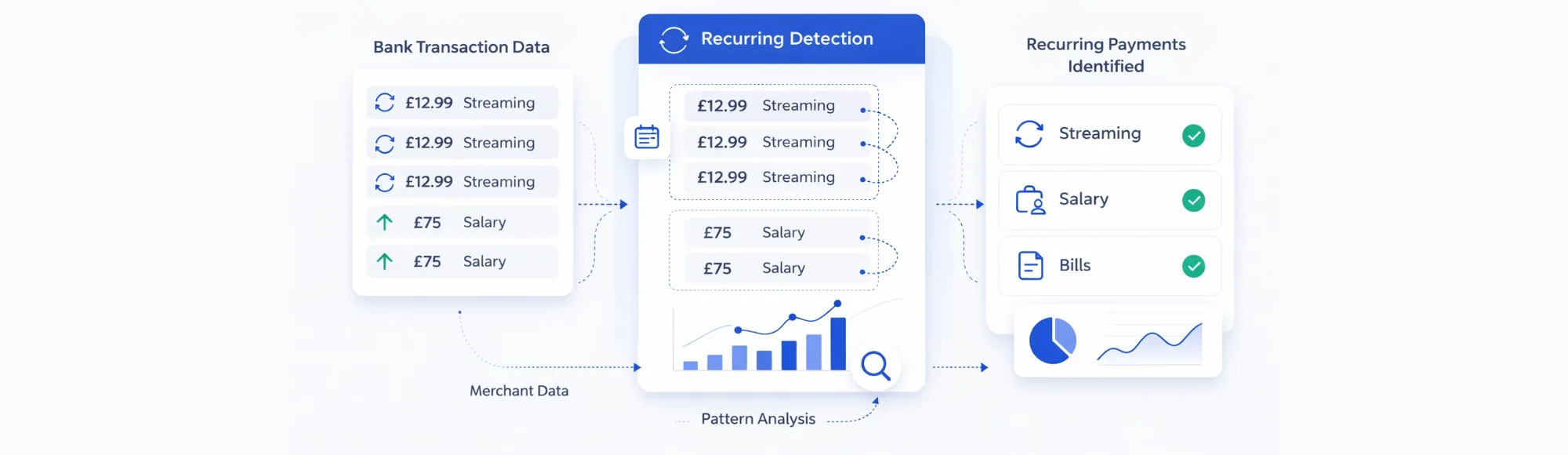
Need reliable bank transaction data for your platform?
Finexer gives UK platforms FCA-authorised AIS access – structured, real-time, API-ready.
Every financial platform eventually needs to answer the same question about a user’s bank account. Which transactions happen repeatedly – and what do they tell us?
Identifying recurring transactions manually is straightforward at low volume. At scale, it breaks. Transaction descriptions vary between banks. Payment dates shift by days. Amounts change slightly. The same subscription appears under three different merchant names depending on which bank processed it.
At Finexer, we work with UK accounting platforms, billing systems, payroll tools, and utility infrastructure that retrieve bank transaction data to analyse recurring financial activity. The detection quality depends entirely on the data layer – structured, continuous, merchant-enriched bank transaction feeds produce reliable recurring transaction identification. CSV imports and batch files do not.
This blog explains what a recurring transaction is, why detection is difficult without structured bank data, and how Open Banking AIS APIs give platforms the data foundation to automate it.
TL;DR
A recurring transaction is a financial transaction that occurs repeatedly over time – subscriptions, salary deposits, rent payments, utility bills. Detecting recurring transactions at scale requires structured bank transaction data with merchant identifiers and pattern history. Finexer provides FCA-authorised AIS infrastructure delivering continuous bank transaction feeds for UK platforms building recurring payment solutions and financial analysis workflows.
Key Takeaways
What is a recurring transaction?
A recurring transaction is a financial transaction that repeats at regular or semi-regular intervals – such as a monthly subscription, weekly salary deposit, quarterly utility bill, or annual insurance renewal. Platforms identify recurring transactions by analysing bank transaction history for patterns in frequency, merchant identity, and transaction amount.
Why is recurring transaction detection difficult without bank data APIs?
Bank statement PDFs and CSV exports provide static snapshots of transaction history. Recurring transaction detection requires continuous transaction feeds with consistent merchant identification. Without structured API data, platforms rely on manual categorisation that breaks at volume and misses pattern variations.
What data points are needed to detect a recurring transaction?
Reliable recurring transaction detection requires merchant identifiers, transaction timestamps, amount data, and transaction category codes – all structured consistently across every bank connection. This is what Open Banking AIS APIs provide that manual data collection cannot.
How do recurring payment solutions use bank transaction data?
Recurring payment solutions use bank transaction feeds to identify existing payment commitments, monitor subscription renewals, detect failed recurring payments, and analyse income patterns. All of these workflows depend on structured, continuous bank transaction data from a reliable AIS connection.
What does Finexer provide for recurring transaction analysis?
Finexer provides FCA-authorised AIS infrastructure delivering structured bank transaction data – including merchant identifiers, category codes, and transaction timestamps – covering 99% of UK banks with real-time webhooks for continuous transaction feed updates.
What Is a Recurring Transaction?
A recurring transaction is a financial transaction that occurs repeatedly over time with a predictable pattern. The pattern may be fixed or variable – but the key characteristic is repetition linked to a consistent merchant, counterparty, or payment type.
Common recurring transaction types platforms analyse:
- Subscription payments – streaming services, SaaS tools, membership fees
- Salary deposits – regular employer income appearing at consistent intervals
- Rent payments – monthly transfers to landlords or property management platforms
- Utility bills – energy, broadband, water – appearing monthly or quarterly
- Loan repayments – fixed recurring outgoings to financial institutions
- Insurance premiums – annual or monthly recurring commitments
Each type has different detection characteristics. Subscriptions typically have fixed amounts and consistent merchant names. Salary deposits have consistent amounts but may arrive on slightly different dates each month. Utility bills vary in amount but follow predictable merchant patterns.
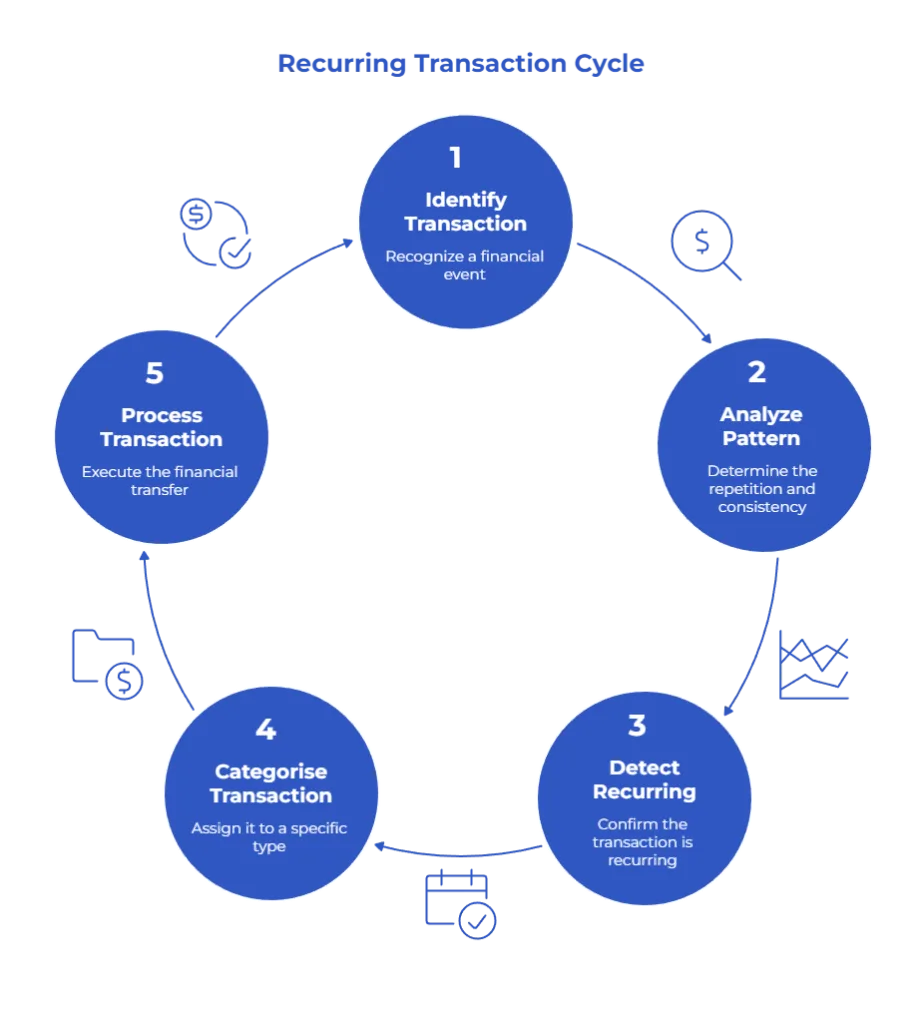
“Recurring transaction detection is a data quality problem before it is an algorithm problem. Inconsistent merchant data produces inconsistent detection results – regardless of how sophisticated the pattern logic is.” – Yuri, Finexer
Why Manual Detection Fails at Scale
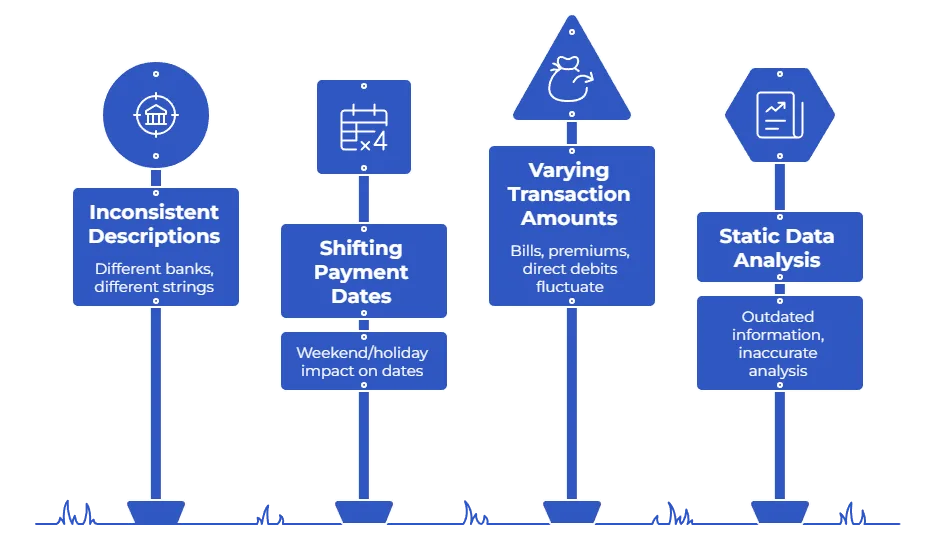
Transaction Descriptions Are Inconsistent Across Banks
The same subscription payment appears under different reference strings depending on which bank processed it. A single streaming service may appear as three different transaction descriptions across different UK banks. Manual categorisation rules break when description strings change – even slightly.
Payment Dates Shift
Salary deposits that typically arrive on the 25th may arrive on the 23rd or 27th depending on weekends and bank holidays. Recurring transaction detection logic that relies on fixed dates produces false negatives for payments that arrived slightly early or late.
Amounts Vary
Utility bills change monthly. Insurance premiums increase annually. Variable direct debits fluctuate. Detection systems that match only on exact amounts miss a significant proportion of genuine recurring transactions.
Static Data Produces Outdated Analysis
Platforms relying on monthly bank statement uploads analyse historical data that is already weeks old by the time it enters the system. A subscription cancelled last week still appears as active in last month’s import. Recurring transaction analysis built on static data cannot reflect current financial commitments accurately.
How Open Banking AIS Enables Reliable Recurring Transaction Detection
Open Banking AIS APIs solve the data quality problem by delivering structured, continuous bank transaction feeds directly from source.
What structured AIS transaction data provides for recurring detection:
- Merchant identifiers that are consistent across transaction descriptions
- Transaction category codes that group similar payment types automatically
- Timestamps with enough precision to identify date-shifted recurring payments
- Amount history per merchant enabling variable amount pattern recognition
- Multi-account data from a single consent-based connection
With this data, platforms can build recurring transaction detection that identifies payment patterns across description variations, date shifts, and amount changes – rather than relying on exact-match rules that break when any variable changes.
Variable recurring payments explained covers VRP payment infrastructure for platforms that need to initiate recurring payments in addition to detecting them.
How Should Platforms Evaluate Bank Data Infrastructure for Recurring Analysis?
| Requirement | Why It Matters for Recurring Detection | What to Look For |
|---|---|---|
| Merchant Identification | Consistent merchant IDs enable pattern matching across description variations | Standardised merchant identifiers; enriched transaction data; consistent naming across banks |
| Transaction Category Codes | Category grouping enables recurring transaction detection across amount and description variations | Structured category codes per transaction; subscription category support; income classification |
| Transaction History Depth | Pattern detection requires sufficient history to identify recurring intervals accurately | Up to 7 years of transaction history; configurable lookback periods |
| Real-Time Transaction Feed | Current recurring transaction status requires live data – not monthly static imports | Real-time webhooks; continuous transaction feeds; event-driven data delivery |
| Multi-Account Coverage | Recurring transactions may appear across multiple accounts for the same user | Multi-account AIS access; cross-account transaction aggregation; 99% UK bank coverage |
| Structured Data Output | Detection algorithms require consistently formatted inputs to run reliably at scale | Structured JSON outputs; consistent schema across all UK banks; amount and timestamp precision |
How Does Finexer Enable Recurring Transaction Detection?
Finexer provides FCA-authorised AIS infrastructure delivering structured bank transaction data for UK platforms building recurring transaction detection and recurring payment solutions.
What Finexer’s AIS provides for recurring transaction analysis:
- Structured bank transaction data from 99% of UK bank accounts
- Merchant identification and transaction category codes per transaction
- Up to 7 years of transaction history for pattern depth and lookback analysis
- Real-time webhooks delivering transaction events as they occur
- Multi-account data access from a single consent-based API connection
- FCA-compliant consent flows with granular permissions and instant revocation
- White-label capability for branded bank connection journeys within platform products
- Usage-based pricing with no fixed volume commitments
How VRP payments reduce churn in UK recurring billing covers the payment initiation side for platforms that need to act on recurring transaction data – not just detect it.
Finexer VRP API explains how platforms combine AIS recurring transaction detection with VRP payment infrastructure.
What I Feel
The platforms that get recurring transaction detection right treat it as a data problem first. The detection logic is secondary.
If merchant identifiers are inconsistent, if transaction history only goes back 90 days, if the data arrives weekly in a CSV – no pattern algorithm produces reliable results. The recurring transaction feed needs to be structured, continuous, and merchant-enriched before detection logic can work at scale.
AIS bank data solves the foundation. What platforms build on top of it is their product differentiation.
Common Use Cases
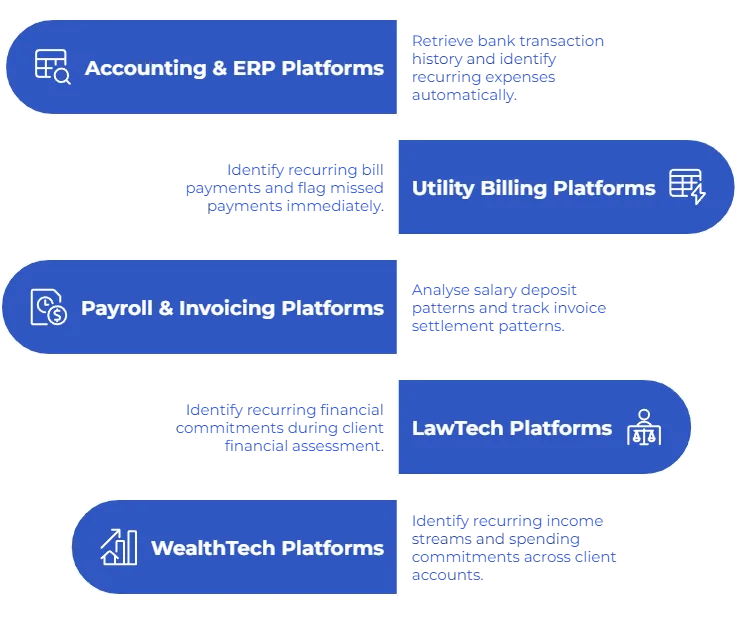
Accounting & ERP Platforms
Accounting platforms use Finexer’s AIS to retrieve client bank transaction history and identify recurring expenses automatically – subscriptions, supplier payments, utility bills. Structured merchant data and category codes map recurring transactions to bookkeeping entries without manual categorisation, reducing the review workload for accountants managing multiple client accounts.
Utility Billing Platforms
Utility platforms use AIS transaction data to identify existing recurring bill payments in customer bank accounts during onboarding – confirming payment history patterns before setting billing structures. Real-time webhooks flag missed recurring payments immediately, enabling early intervention rather than end-of-month reconciliation discovery.
Payroll & Invoicing Platforms
Payroll platforms analyse recurring salary deposit patterns in contractor bank accounts to verify income consistency and payment frequency. Invoice platforms track recurring invoice settlement patterns to identify clients with consistent late payment behaviour – supporting automated follow-up workflows before invoices become overdue.
LawTech Platforms
LawTech platforms – including insolvency practices – use AIS transaction history to identify recurring financial commitments during client financial assessment. Recurring transaction patterns across subscriptions, loan repayments, and standing orders provide a structured view of client financial obligations that supports case analysis and source-of-funds verification.
WealthTech Platforms
WealthTech platforms use AIS bank transaction data to identify recurring income streams and spending commitments across client accounts. Structured recurring transaction data supports financial planning workflows – mapping salary deposits, investment contributions, and recurring expenses into consolidated financial profiles without manual client data entry.
What is a recurring transaction in bank data?
A recurring transaction is a financial transaction that appears repeatedly in bank transaction history – such as a monthly subscription, salary deposit, utility bill, or loan repayment. Platforms detect recurring transactions by analysing patterns in merchant identity, transaction frequency, and amount consistency across bank transaction data retrieved via Open Banking AIS APIs.
How do recurring payment solutions use Open Banking bank data?
Recurring payment solutions use Open Banking AIS APIs to retrieve structured bank transaction feeds with merchant identifiers and category codes. This data enables platforms to identify existing recurring transactions, monitor subscription renewals, detect failed payments, and analyse income patterns – all from a continuous bank data connection rather than static statement uploads.
Is Finexer suitable for platforms building recurring transaction detection?
Yes. Finexer is FCA-authorised and provides AIS infrastructure covering 99% of UK banks – delivering structured bank transaction data with merchant identifiers, category codes, and up to 7 years of transaction history. Platforms integrate Finexer’s AIS to build recurring transaction detection workflows with continuous, real-time bank data feeds.
Build recurring transaction detection on structured, real-time bank data.
About the Author

Yuri
Yuriy Yakushko is the Founder of Finexer, an FCA-authorised Open Banking platform that enables businesses to access real-time bank data and Pay-by-Bank payments through secure API infrastructure. With more than 20 years of experience in fintech and software engineering, he focuses on building scalable financial technology that helps businesses modernise payments and financial data workflows.