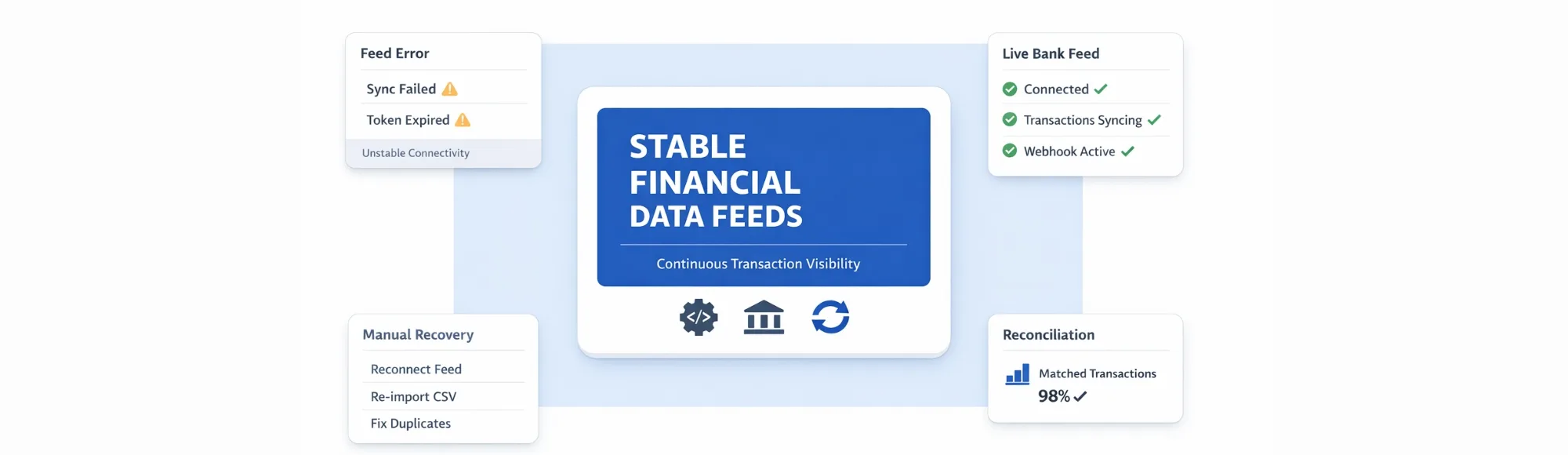
Manual audit trails creating compliance gaps?
Access stable financial data feeds with Open Banking infrastructure.
UK accounting platforms cannot scale automation when financial data feeds break unpredictably. Reconciliation features, ledger updates, and MTD ITSA compliance depend on stable finance feeds providing continuous transaction visibility without sync failures.
Data feed management for accounting platforms requires reliable bank connectivity eliminating duplicate transactions, sync gaps, and reconciliation errors. Traditional approaches using screen scraping create instability that Open Banking infrastructure eliminates.
This explains how UK platforms manage finance feeds for accounting automation, what causes feed instability, and why AIS-based infrastructure reduces operational overhead.
TL;DR
Financial data feed stability determines accounting automation success. Platforms using Open Banking AIS infrastructure eliminate sync failures, duplicate transactions, and reconciliation gaps through consent-based bank connectivity providing structured transaction feeds.
Key Takeaways
Why does feed stability matter for accounting platforms?
Accounting automation fails when financial data feeds break unpredictably. Platforms need continuous transaction visibility enabling reconciliation workflows, ledger updates, and compliance reporting without manual intervention or sync maintenance.
What causes finance feed instability?
Screen scraping breaks when banks update interfaces. Credential-based access creates security exposure. Token expiry disrupts syncs. Manual refresh requirements prevent automation. Missing webhook support delays updates.
How does Open Banking improve feed management?
AIS infrastructure provides consent-based bank connectivity through regulated APIs. Structured transaction feeds arrive continuously via webhooks. FCA-authorised framework ensures stability. Feed reliability improves dramatically.
What should platforms evaluate?
UK bank coverage, webhook support, structured outputs, historical data access, sync reliability metrics, FCA-authorised infrastructure, real-time capability, enrichment accuracy.
Where does Finexer enable stable feeds?
Finexer operates Open Banking connectivity using FCA-authorised infrastructure. Platforms access structured financial data feeds through AIS APIs eliminating sync failures and enabling accounting automation.
Why financial data feed stability determines automation success
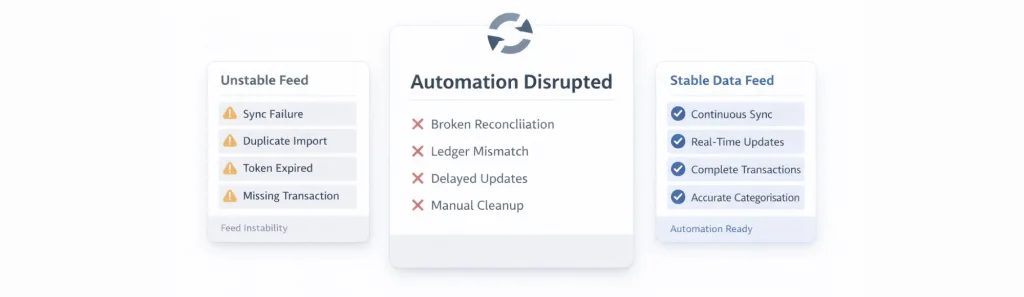
Accounting SaaS platforms building automated reconciliation cannot function when transaction feeds break unpredictably. Users expect continuous financial visibility. Feed failures create support overhead.
Operational problems from unstable finance feeds:
- Broken syncs disrupt reconciliation workflows
- Duplicate transactions require manual cleanup
- Sync gaps create ledger mismatches
- Delayed updates prevent real-time visibility
- Missing transactions cause compliance exposure
- Inconsistent categorisation breaks automation
Platforms managing financial data feeds at scale discover reliability problems compound quickly. Single feed failure affects multiple client workflows. Manual sync recovery consumes engineering capacity.
For platforms requiring real-time financial data, feed stability becomes operational necessity rather than technical preference.
What breaks traditional finance feed management
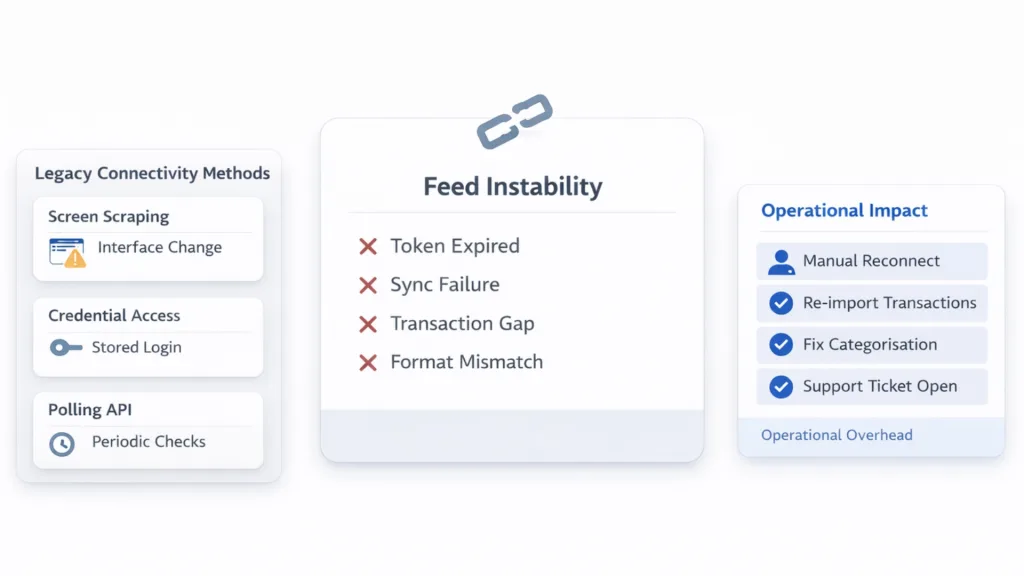
- Screen scraping creates breaking changes: Banks update interfaces regularly without notice. Scrapers break requiring immediate engineering fixes. Users experience unexplained sync stops affecting reconciliation workflows.
- Credential-based access introduces security exposure: Traditional systems require storing user credentials. Banks implement additional authentication barriers. Multi-factor requirements break automated feed access.
- Token expiry disrupts continuous feeds: API tokens expire requiring refresh mechanisms. Refresh processes fail silently. Transaction gaps emerge requiring manual reconnection.
- Missing webhook support delays updates: Polling-based systems check periodically for new transactions. Delays prevent real-time visibility. Feed latency increases operational overhead.
- Unstructured transaction formats: Data arrives in inconsistent formats across banks. Merchant descriptions vary unpredictably. Categorisation automation fails frequently.
How Open Banking AIS improves feed management
- Consent-based feed access: Users authenticate through banking apps granting explicit consent. No credential storage required. Banks manage authentication securely.
- Structured transaction feeds: Consistent JSON format across UK banks. Standardised transaction fields including merchant details. Data arrives enriched enabling automated categorisation.
- Webhook-based real-time updates: Banks notify platforms immediately when transactions occur. No polling delays. Reconciliation workflows trigger instantly.
- Reduced sync failures: Direct API connectivity eliminates scraping. Banks maintain backward compatibility through regulated framework. Manual reconnection eliminated.
- Complete historical access: Transaction history up to 7 years available (bank dependent). New connections retrieve complete feed history automatically.
- Platforms evaluating bank feed software for accountants prioritise AIS-based infrastructure over legacy screen scraping approaches for feed reliability.
Financial data feed infrastructure evaluation
| Criteria | Why It Matters | What to Look For |
|---|---|---|
| UK bank coverage | Feed gaps prevent complete visibility | 99% coverage including challengers |
| Webhook support | Polling creates reconciliation delays | Real-time transaction notifications |
| Structured outputs | Inconsistent formats break automation | Consistent JSON with enrichment |
| Sync reliability | Feed failures disrupt workflows | Proven uptime with FCA authorisation |
| Historical depth | Compliance requires complete records | Multi-year transaction retrieval |
How Finexer enables stable finance feed infrastructure
Finexer operates Open Banking data infrastructure using FCA-authorised connectivity enabling platforms to manage financial data feeds reliably.
Key capabilities:
- 99% UK bank coverage
- FCA-authorised infrastructure
- Real-time webhooks
- Up to 7 years historical data
- Merchant enrichment (100M+ database)
- Transaction categorisation (95%+ accuracy)
- Usage-based pricing
- White-label ready
- 2-3x faster integration
- 3-5 weeks onboarding support
- Saves up to 90% on transaction costs
Platforms integrate finance feed APIs through REST endpoints. Users authenticate via secure Open Banking flows. Structured transaction feeds flow continuously without credential storage.
Real-time webhooks notify platforms immediately when transactions occur. Merchant enrichment provides clean transaction descriptions. Categorisation intelligence enables automated workflow processing.
Critical positioning:
Finexer does not provide accounting software, reconciliation logic, or ETL platforms. Platforms control workflow rules and processing logic.
Finexer provides structured, consent-based financial data feeds through Open Banking infrastructure enabling accounting platforms to manage stable bank connectivity.
What we see in practice
Most accounting platforms underestimate operational complexity of managing finance feeds at scale. Problems emerge rapidly during growth.
Platforms using screen scraping discover feed maintenance consumes increasing engineering capacity. Banks update interfaces without coordination. Sync failures spike unexpectedly. Support teams handle reconnection requests constantly.
Common scaling problems:
- Duplicate transaction handling requires complex deduplication logic
- Sync gap detection needs manual monitoring
- Feed health tracking consumes operational capacity
- User communication about feed issues creates support overhead
Accounting SaaS platforms switching to AIS infrastructure report dramatic operational improvements. Sync failures decrease significantly. Manual reconnection requests drop. Engineering capacity redirects to feature development.
Feed reliability directly impacts customer retention. Users tolerate feature gaps but lose patience with broken connectivity. Stable finance feeds become competitive advantage.
Common use cases
Accounting SaaS platforms:
- Manage continuous bank feeds for client reconciliation
- Eliminate sync failures disrupting workflows
- Provide real-time transaction visibility
- Enable automated ledger updates
- Support MTD ITSA compliance with complete records
ERP systems:
- Integrate reliable finance feeds for cash flow dashboards
- Automate financial reporting with verified data
- Enable real-time visibility across entities
- Support multi-currency reconciliation
- Reduce operational overhead from feed maintenance
Reconciliation automation platforms:
- Process transaction feeds continuously
- Eliminate duplicate transaction handling
- Enable exception-based workflows
- Support automated matching rules
- Maintain audit-ready feed logs
Fintech platforms:
- Build features using stable financial data feeds
- Access real-time transaction streams
- Enable automated categorisation workflows
- Support compliance reporting requirements
- Scale feed management without operational overhead
Bookkeeping automation:
- Replace manual transaction entry with continuous feeds
- Automate expense categorisation using enriched data
- Enable real-time ledger updates
- Reduce support overhead from sync problems
- Maintain complete transaction history
What is data feed management for accounting platforms?
Data feed management for accounting platforms involves maintaining stable, continuous access to bank transaction data enabling automated reconciliation and ledger updates. Platforms using Open Banking AIS infrastructure manage finance feeds through consent-based APIs eliminating sync failures.
How do finance feeds work?
Finance feeds connect accounting platforms to banking institutions through secure APIs. Users authenticate via banking apps granting consent. Platforms receive structured transaction data continuously via webhooks enabling real-time financial visibility and automated workflows.
Why do financial data feeds break?
Traditional feeds break when screen scraping fails, credentials expire, or tokens require refresh. Open Banking AIS infrastructure eliminates these problems using consent-based APIs with FCA-authorised connectivity providing stable transaction streams.
Enable stable financial data feed management with Open Banking infrastructure and continuous transaction visibility.
About the Author

Ravi Ranjan
Ravi Ranjan is Co founder & CEO of Finexer