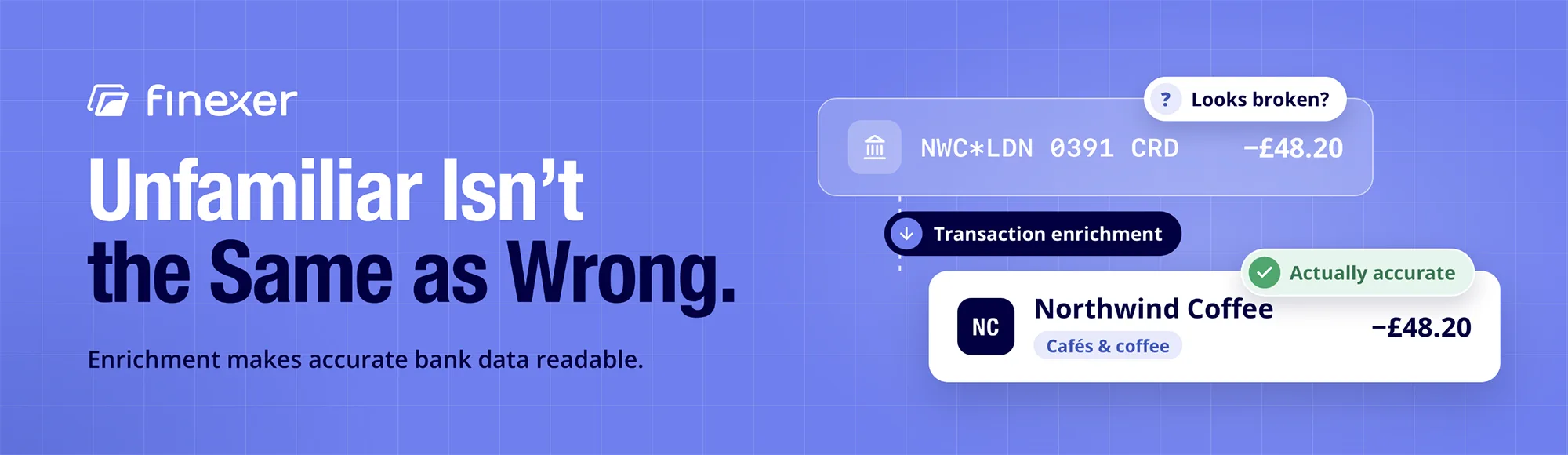
An unfamiliar bank description can make accurate transaction data look broken. What is transaction enrichment? It turns a bank’s description field into structured, usable information, including a recognisable merchant name and category.
If users have to decode a reference, they may treat a correct payment as a problem. Enrichment adds context without changing the underlying transaction. That gap matters in products and workflows.
What does transaction enrichment add?
Transaction enrichment adds intelligence to standard Open Banking data. Fields can include merchant name, legal entity, spending category, billing pattern, location, transaction type and confidence score.
| Standard Transaction Data | Enriched Information |
|---|---|
| Reference | Recognisable merchant |
| Amount and date | Spending category |
| Status and code | Legal entity and confidence |
| Bank description | Billing pattern and location |
The distinction matters: transaction categorisation and merchant identification are related, but they are not the same. Identification answers the question, “Whom did I pay?”. Categorisation answers the question, “What type of spending was it?”.
Why does it matter for financial products?
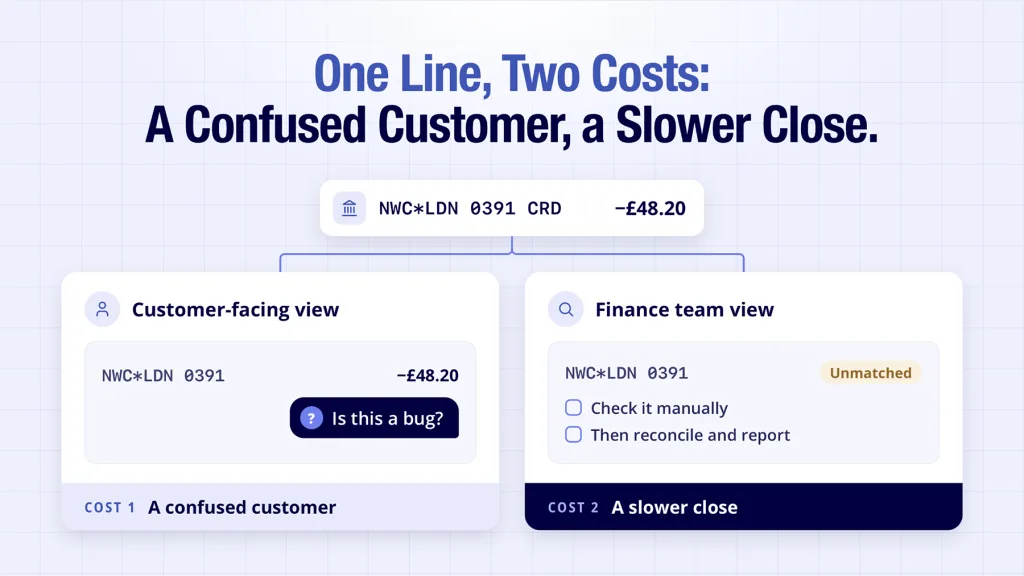
A customer-facing transaction with an unfamiliar descriptor can look like a product defect even when the underlying banking data is accurate. Clear merchant names make statements, dashboards and spending views easier to interpret.
The operational effect can be bigger. When descriptors do not match names used elsewhere, finance teams may spend more time checking transactions before reconciliation or reporting.
This is why transaction data should be treated as more than a date, amount or reference when a platform needs a useful financial experience. Enrichment adds an interpretation layer above the source information.
Is categorisation the same as merchant identification?
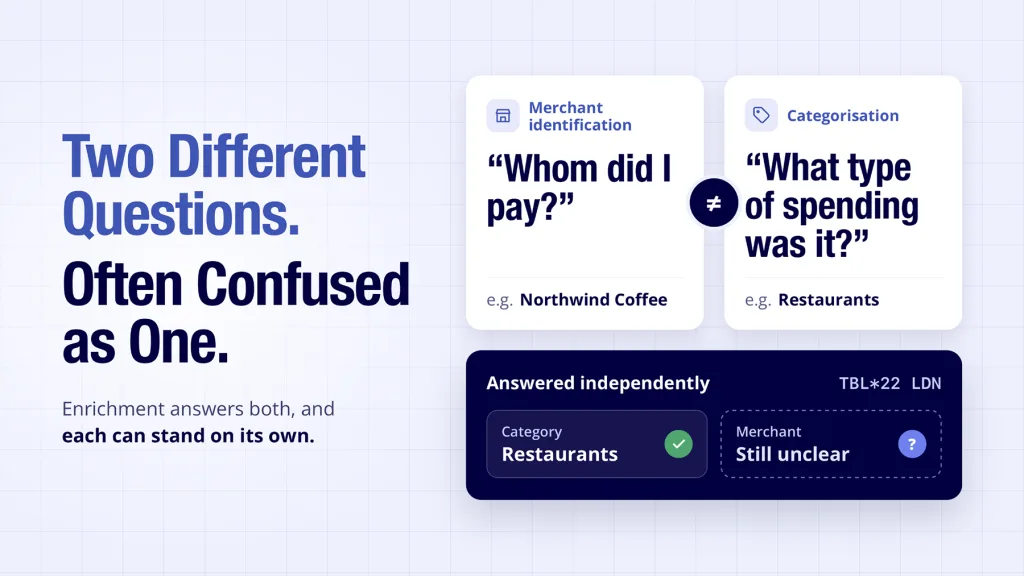
No. Merchant identification links a transaction to a recognisable business. Categorisation assigns that transaction to a spending group, such as groceries, travel or software.
A platform can know that a payment belongs to “restaurants” while still showing an unclear merchant name. Transaction enrichment addresses both questions, which is important when designing financial products.
How does transaction enrichment compare across providers?
Providers take different positions. TrueLayer, Yapily, Tink and Plaid combine banking data capabilities with broader Open Banking services, while specialist providers may focus more narrowly on data intelligence or particular use cases.
For buyers, the useful comparison is not brand size. It is whether the service returns the fields your product needs, how quickly it responds, where it operates and whether enrichment fits the data architecture.
| Approach | Typical Focus | Buyer Consideration |
|---|---|---|
| Broad Open Banking provider | Data and payments | Check enrichment depth |
| Specialist enrichment service | Merchant and category intelligence | Check banking-data integration |
| Build internally | Custom rules and models | Check maintenance burden |
How does Finexer handle enrichment?
Finexer treats enrichment as an intelligence layer on top of standard Open Banking data. Its Enrichment product adds merchant identification and transaction categorisation, while the banking-data layer supplies the source information.
The product returns merchant name, legal entity, spending category, billing pattern, location, transaction type and confidence score per transaction. Finexer states 95%+ categorisation accuracy, sub-100ms response time and a database of 100 million+ merchants.
That can reduce work interpreting transaction descriptions for platforms building accounting, ERP, reporting or other financial products before they reach users. It can also create richer inputs for financial reporting tools and transaction views.
Finexer is an FCA-authorised Open Banking infrastructure provider, with FRN 925695. Its Enrichment product is distinct from Data/AIS, which provides account data, balance data and transaction data.
What should a platform look for?
Before choosing an enrichment approach, ask:
- Does it identify merchants as well as categories?
- Which transaction types does it cover?
- Does it return confidence information?
- Can response time support the product experience?
- Does it fit the platform’s banking-data architecture?
A useful data enrichment api should answer these questions, rather than treating enrichment as a cosmetic label added to a transaction feed. Finexer’s bank data API supplies the banking-data layer behind it.
Which transaction types can data enrichment process?
Card payments, direct debits, bank transfers and standing orders are typical coverage although scope varies by provider.
What does a low confidence score mean?
It signals that the merchant match is less certain, so platforms may want a review step first.
Does accuracy depend on which bank a transaction came from?
Not directly. Enrichment interprets data after it arrives, so accuracy depends more on receiving consistent, standard Open Banking data than on any single bank.
Can enrichment be added to a product that already uses banking data?
Yes. It sits on top of an existing connection rather than replacing it, so it can be added without rebuilding that layer.
Finexer’s Enrichment product adds merchant identification and categorisation to help platforms present clearer financial data.
Explore with AI
About the Author

Ravi Ranjan
Ravi Ranjan is Co founder & CEO of Finexer