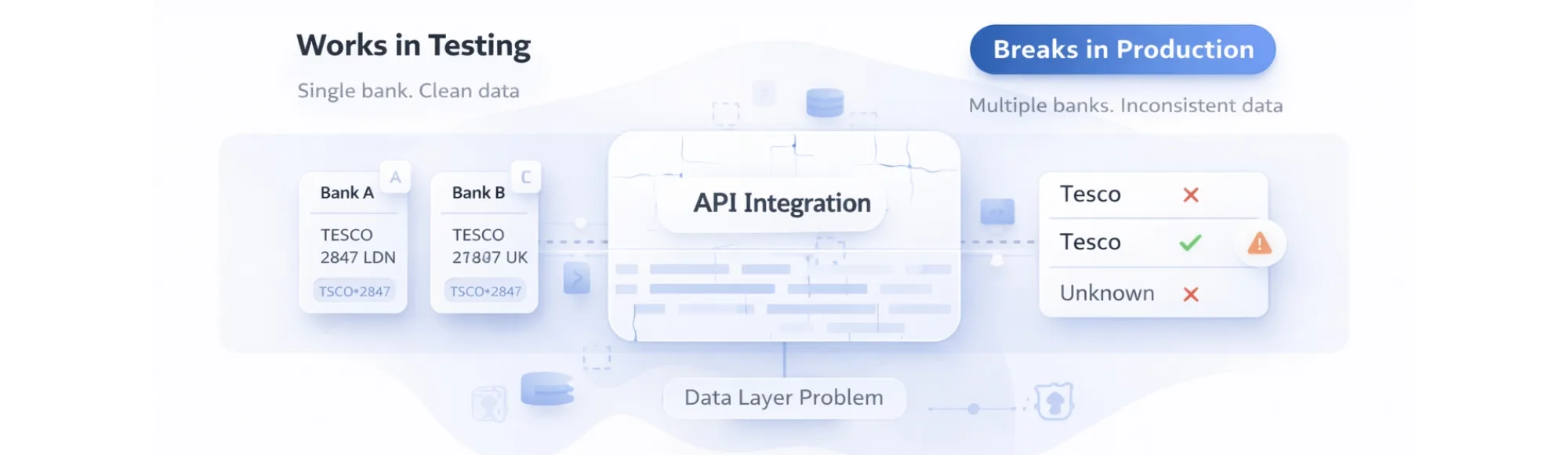
Integration breaks. The data layer is why.
Reliable bank data infrastructure for accounting SaaS, ERP, and Lawtech platforms.
API integration challenges in financial platforms follow a consistent pattern.
The sandbox works perfectly. The staging environment passes every test. The integration goes live. Three weeks later, a transaction arrives in an unexpected format. A bank connection drops without notice. A webhook stops delivering. The reconciliation workflow breaks.
The integration was not wrong. The assumption that bank data arrives consistently was wrong.
In my work building financial API infrastructure at Finexer, I see this pattern across accounting SaaS, ERP platforms, and Lawtech systems. The API integration challenges that matter are not implementation challenges. They are production reliability challenges.
TL;DR
API integration challenges for financial platforms most commonly surface after deployment – not during development. Bank APIs return inconsistent data formats across institutions, connection quality varies by bank and time of day, and webhook delivery is not guaranteed. These are not edge cases. They are structural characteristics of bank API ecosystems. Finexer’s FCA-authorised AIS provides a normalised data layer that abstracts bank-level inconsistency – delivering consistent JSON output, reliable webhooks, and stable connections across almost all major UK banks.
Key Takeaways
What are the real API integration challenges at scale?
The real API integration challenges at scale are data inconsistency, connection instability, and webhook unreliability – not authentication or initial setup. These surface when transaction volume increases, when banks push API updates, and when multiple institutions return the same data in different formats.
Why do bank APIs and integrations work in testing but break in production?
Testing uses controlled data sets against a single bank’s sandbox environment. Production exposes the integration to real variation – different banks return different data schemas, transaction descriptions change format across payment types, and connection reliability varies. The integration breaks on assumptions that are held in testing but do not hold at scale.
What causes data inconsistency across bank API integrations?
Different UK banks implement the Open Banking standard with their own variations. Transaction descriptions, amount formats, merchant reference structures, and error response formats differ across institutions. An integration normalised for one bank’s output format breaks when a second bank returns the same data differently.
How does a reliable data layer prevent post-deployment API failures?
A normalised data layer between the bank APIs and the platform absorbs bank-level inconsistency before it reaches the application. Consistent JSON schema, standardised transaction fields, and managed connection recovery mean the platform receives the same data structure regardless of which bank originated the transaction.
Why Do API Integration Challenges Appear After Deployment?
What Works in Testing That Breaks in Production?
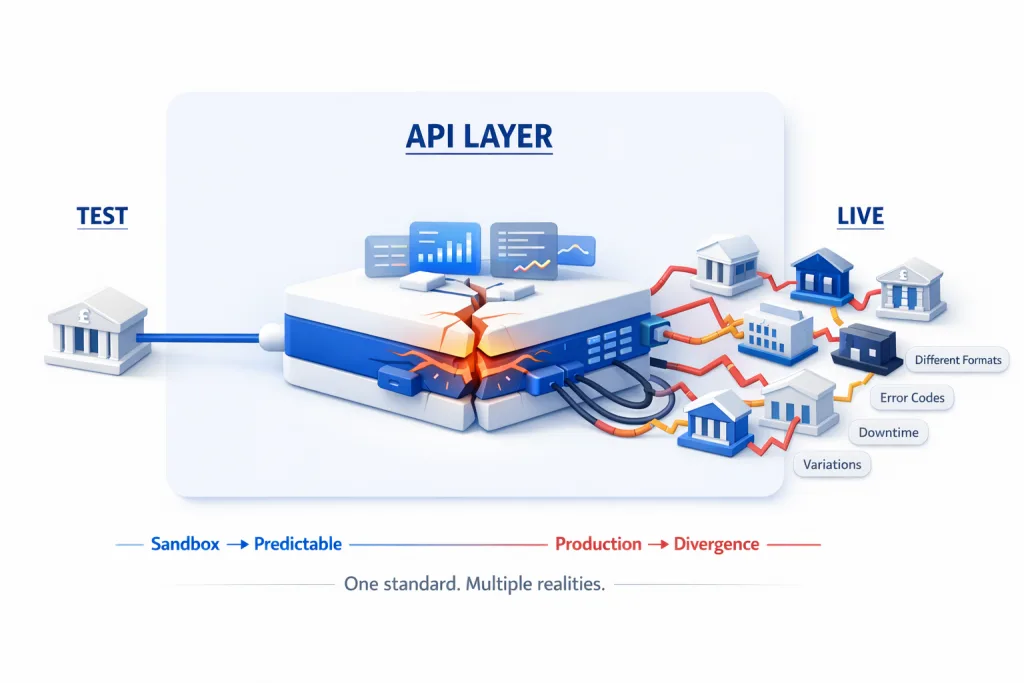
Testing against a sandbox environment is a controlled exercise. The data is predictable. The bank is one. The volume is low.
Production is none of these things.
A UK accounting SaaS integrating with ten banks is integrating with ten different implementations of the same standard. Each bank has its own transaction description format, its own error codes, its own connection behaviour, and its own maintenance windows.
According to Finexer’s guide to Open Banking API integration, the most common post-deployment API integration challenges involve data format divergence across banks – not the authentication or consent flows that dominate pre-launch testing.
“The engineering teams I work with consistently underestimate one thing about bank API integrations: the gap between what the standard says and what each bank actually returns. That gap is where production failures live.” – Yuri, Finexer
What Does Data Inconsistency Look Like in Real Financial Workflows?

Data inconsistency across APIs and integrations creates three production problems:
Broken reconciliation – a reconciliation workflow normalised for Bank A’s transaction format receives Bank B’s variation and produces mismatches. The workflow does not fail. It produces incorrect output silently.
Missing transactions – a webhook integration misses delivery from one bank’s API because retry logic is not implemented. The transaction is in the bank. It is not in the platform. The gap surfaces at month-end.
Category drift – a transaction categorisation rule built on Bank A’s merchant description format fails when Bank B returns the same merchant in a different string. The category fills incorrectly across the affected bank’s transactions.
Bank transaction API infrastructure for UK platforms covers how API infrastructure quality determines whether these data inconsistencies surface as platform failures or are absorbed at the infrastructure layer.
| API Integration Challenge | When It Surfaces | Business Impact | Data Layer Fix |
|---|---|---|---|
| Data format inconsistency | When second or third bank is added | Silent reconciliation errors across affected bank | Normalised JSON schema per transaction regardless of bank |
| Webhook delivery failure | Under volume or during bank maintenance | Missing transactions, gaps in real-time workflows | Managed webhook delivery with retry and fallback |
| Bank connection instability | During bank API updates or outages | Broken data feeds, manual recovery overhead | Connection management and reconnection handled at infra layer |
| Error code variation | When error handling is first tested at scale | Unhandled errors surface as platform failures | Standardised error responses regardless of originating bank |
What Is the Business Impact of API Integration Failures?
How Do Post-Deployment Failures Cost More Than the Original Build?
API integration challenges that surface in production cost significantly more to fix than prevention would have cost.
According to the Open Banking Limited 2025 Impact Report, over 13 million UK users now rely on Open Banking infrastructure for financial services. For platforms integrated into this ecosystem, data consistency across bank connections is not a preference – it is a production requirement.
A broken reconciliation workflow discovered at month-end requires manual review of weeks of transactions. A missing webhook delivery gap requires data reconstruction. A category drift across a bank’s transactions requires retroactive correction across client records.
For ERP platforms, the cost is operational overhead. For Lawtech platforms handling client funds, the cost is compliance exposure. For accounting SaaS, the cost is client trust – because inaccurate data in a client’s accounts traces back to an integration failure the client never knew existed.
According to Sustainable Open Banking API integration for financial platforms, platforms that invest in infrastructure-level reliability during initial integration consistently spend less on production debugging than those that treat the data layer as an afterthought.
What Does Reliable Bank API Integration Actually Require?
Why Adding More Banks Multiplies API Integration Challenges?
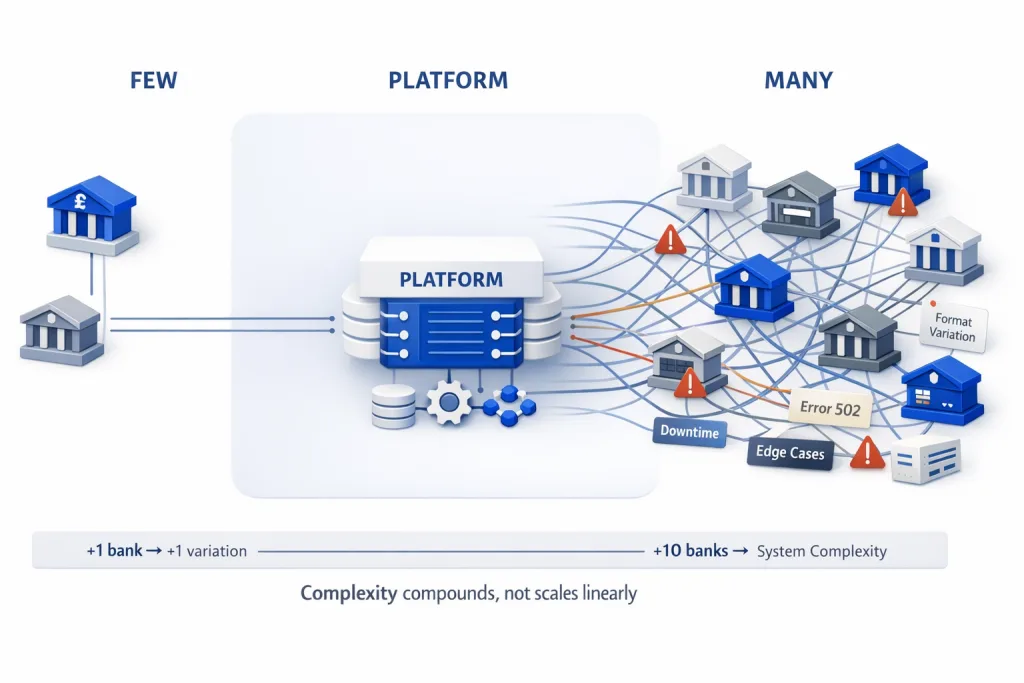
Every bank added to the integration multiplies the surface area for inconsistency.
A platform integrated with three banks has three data format variations, three connection behaviours, three error code sets, and three maintenance windows to manage. The complexity does not add linearly. Each bank introduces edge cases that interact with the others.
Integration architecture at the infrastructure level determines whether adding new banks is manageable or compounding.
Reliable APIs and integrations at scale require a layer that manages bank-level variation before it reaches the platform. That means normalised data output, managed connections, and webhook reliability that does not depend on each bank’s individual implementation quality.
How Does Finexer’s AIS Solve Bank API Integration Challenges?
What Does Finexer’s Infrastructure Provide for Stable Integrations?
The problem: bank APIs return inconsistent data formats, unstable connections, and unreliable webhooks that break financial workflows in production. Finexer’s FCA-authorised AIS solves this by abstracting bank-level variation – delivering consistent, normalised transaction data regardless of which bank originated it.
- Normalised JSON output per transaction – consistent schema across almost all major UK banks
- Managed webhook delivery – reliable real-time transaction events with retry handling
- Stable bank connections – connection management handled at infrastructure level
- Merchant IDs and category codes per transaction – eliminates description-format variation
- Up to 7 years of transaction history – consistent historical data across all connected banks
- Consent logs and access timestamps – full audit trail per retrieval
- White-label consent flows – no bank-branded redirect in the platform UX
- Usage-based pricing, 3-5 weeks to production deployment
B2B payment APIs and Open Banking infrastructure covers how B2B platforms use AIS and PIS infrastructure to handle payment and data workflows reliably at scale.
“API integration challenges in financial platforms are almost always data layer problems. When the data arriving at the platform is consistent and structured – same format, same fields, same schema – the application logic works reliably. The inconsistency is the problem. Finexer absorbs it before it reaches the platform.” – Yuri, Finexer
Banking API integration guide for UK financial platforms covers the integration architecture decisions that determine long-term API reliability for accounting and ERP platforms.
What I Feel
Every engineering team I work with has the same story.
The integration worked beautifully in testing. It went live. Something broke a few weeks later. The debugging took longer than the original build.
The problem was never the code. The problem was the assumption that bank API output is consistent enough to build on without an abstraction layer.
It is not. And that is not a criticism of the banks. It is just the reality of integrating across a fragmented ecosystem with varying implementation quality.
The fix is infrastructure – not better application code.
Common Use Cases
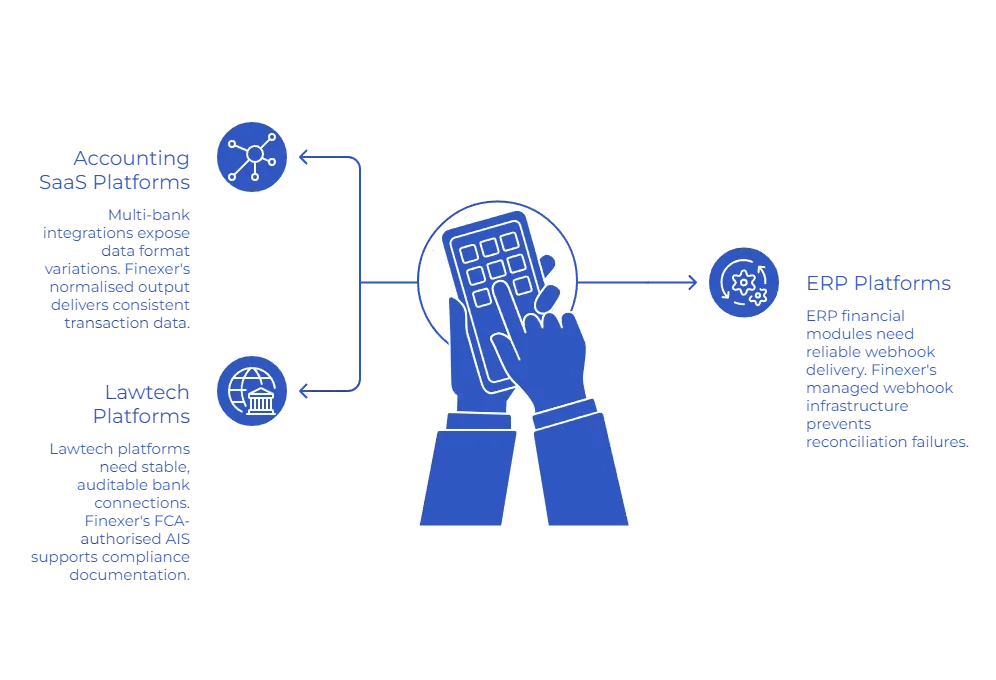
Accounting SaaS Platforms
Multi-bank integrations for client accounts expose every data format variation across the UK banking ecosystem. Finexer’s normalised AIS output delivers consistent transaction data per client account – removing the per-bank normalisation overhead that grows with every new bank added.
ERP Platforms
ERP financial modules processing high transaction volumes need reliable webhook delivery to keep reconciliation workflows current. Finexer’s managed webhook infrastructure delivers transaction events with retry handling – preventing the gaps that produce month-end reconciliation failures.
Lawtech Platforms
Lawtech platforms handling client financial data need stable, auditable bank connections. Finexer’s FCA-authorised AIS provides consent logs and access timestamps per retrieval – supporting the compliance documentation that MLR 2017 obligations require alongside reliable data delivery.
What are APIs and integrations in financial services?
APIs and integrations in financial services are the connections between platforms and financial institutions that enable data exchange and payment initiation. In Open Banking, FCA-authorised AIS and PIS APIs allow platforms to access bank transaction data and initiate payments without direct bank-by-bank integrations.
What are the most common API integration challenges for accounting platforms?
Data format inconsistency across banks, webhook delivery failures, connection instability during bank maintenance, and error code variation are the most common challenges. These surface in production – not in testing – because sandbox environments use controlled data that does not reflect real bank API variation at scale.
How do you ensure bank API integration reliability in production?
Reliability requires a normalised data layer between the bank APIs and the platform. Consistent JSON output, managed webhook delivery with retry logic, and connection management at the infrastructure level ensure the platform receives stable data regardless of individual bank API quality or maintenance schedules.
Build on reliable bank API infrastructure from day one.
About the Author

Yuri
Yuriy Yakushko is a fintech founder and software engineer with over 20 years of experience building financial technology. He’s passionate about creating scalable, secure infrastructure that helps businesses modernise how they access financial data and manage payments.