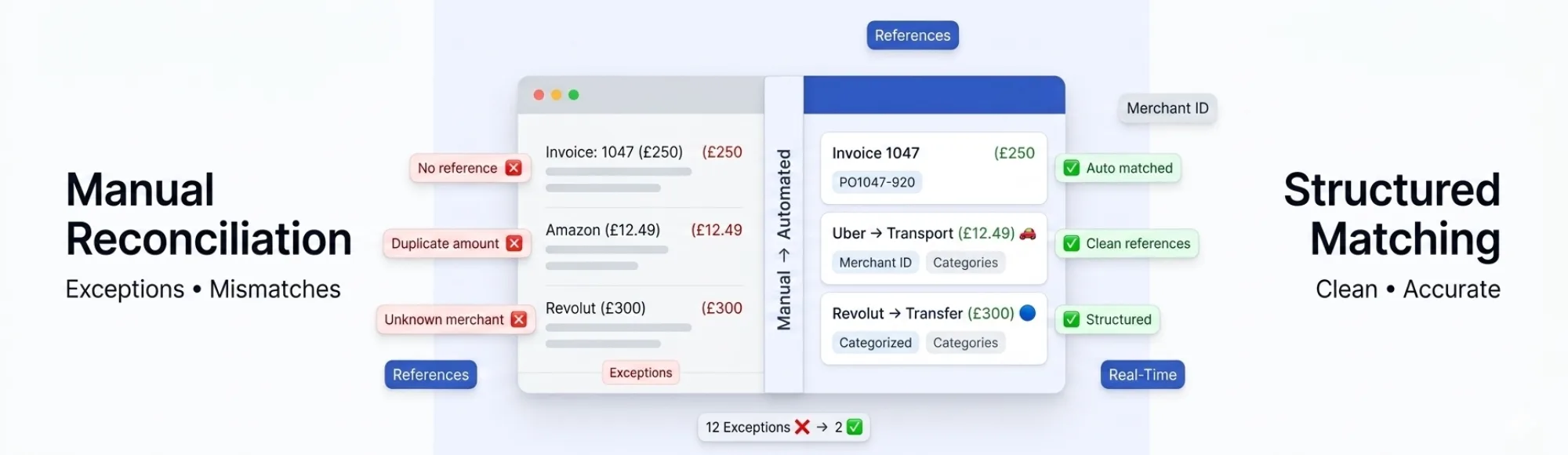
Structured bank data. Consistent formats. Fewer manual corrections.
Real-time bank transaction data for payment reconciliation workflows.
Manual reconciliation payments involve matching financial records against bank transactions – checking dates, amounts, and references line by line.
Most platforms have automation in place. The overhead remains.
The reason is almost never the process. It is the data feeding it.
TL;DR
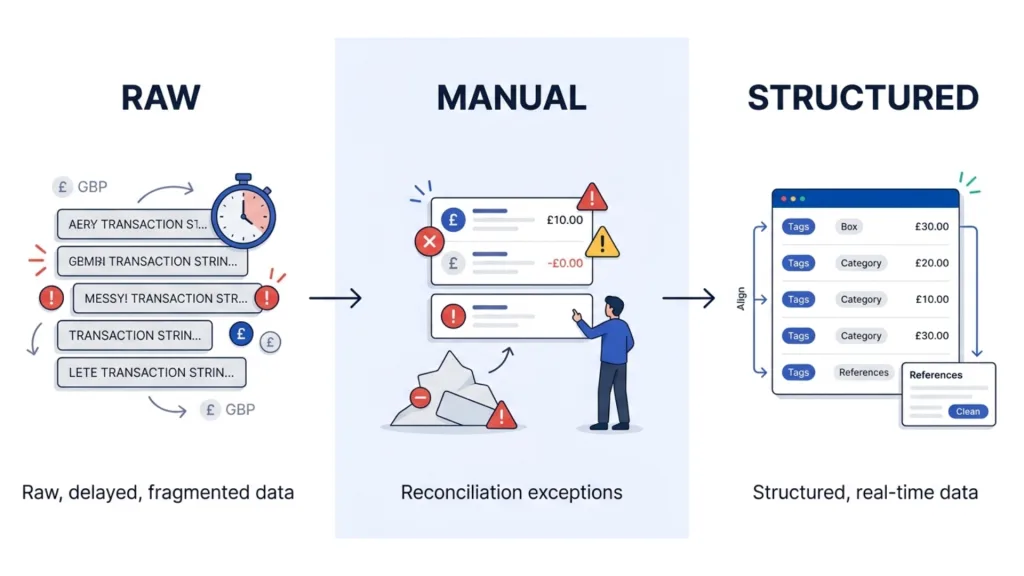
Manual bank reconciliation persists when bank data arrives raw, delayed, or inconsistently formatted. Automation depends on structured input – when it is not, exceptions accumulate and require manual correction. Fixing the data layer reduces manual reconciliation payments more effectively than changing the process itself.
Key Takeaways
What is manual bank reconciliation?
Comparing internal records – invoices, ledgers, payroll – against bank transaction data. Required when automated matching cannot resolve a transaction without human review.
Why does manual bank reconciliation persist with automation?
Automation matches on references, amounts, and dates. When bank data arrives raw or without consistent references, matching fails, exceptions accumulate, and a person reviews them – even in an “automated” workflow.
What does fixing manual reconciliation payments actually require?
- Structured transaction data with merchant IDs and category codes at source
- Consistent payment references mapped to invoices or payroll records
- Real-time data so reconciliation is never against stale figures
Why Does Manual Bank Reconciliation Still Happen?
What Causes Manual Reconciliation Payments to Persist?
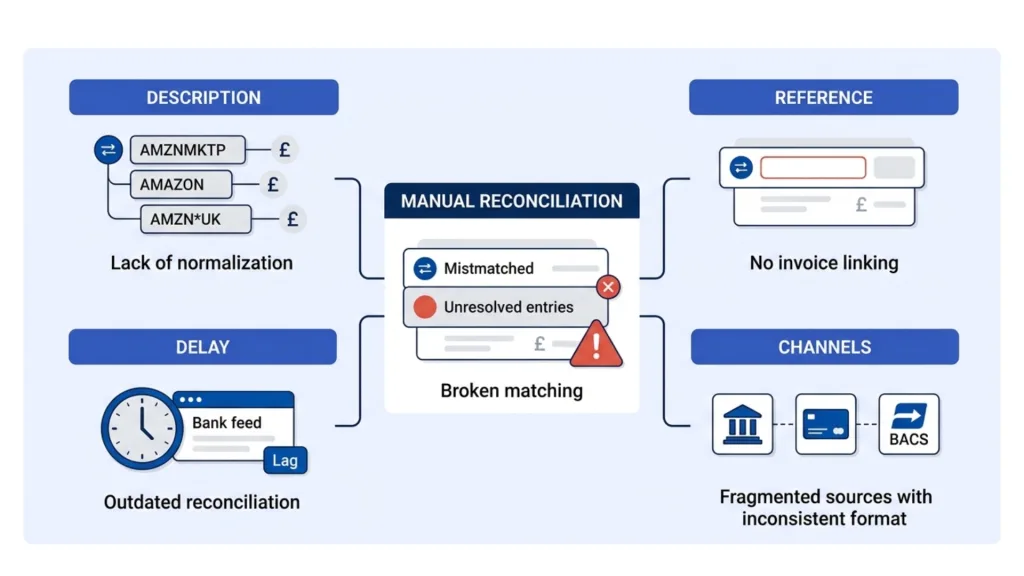
The root cause is data quality – not process design.
Inconsistent transaction descriptions:
- Same merchant, different string per bank (“AMZNMKTP UK”, “AMAZON PAYMENTS”, “AMZN*UK”)
- Automated matching cannot resolve without a normalisation layer
Missing payment references:
- Clients pay without including invoice numbers
- BACS strips reference fields in some bank implementations
- Automated matching falls back to amount + date – which fails on duplicate amounts
Delayed or batched data:
- Daily or weekly bank feed updates mean reconciliation is always against yesterday’s position
- Timing discrepancies get flagged as errors at month-end
Fragmented payment sources:
- BACS, Faster Payments, card, and Direct Debit each produce inconsistent data formats
- Different matching logic per channel increases exception rate
| Data Problem | What Happens | Result |
|---|---|---|
| Inconsistent descriptions | Same merchant, different string per bank | Automated match fails, manual review |
| Missing payment reference | Amount + date matching attempted | Duplicate amounts create false matches |
| Delayed bank feed | Reconciliation against stale balance | Timing discrepancies flagged as errors |
| Fragmented payment sources | Different schema per channel | Higher exception rate, more manual steps |
“The platforms that reduce manual reconciliation payments most effectively are not the ones that implement better automation logic. They are the ones that fix the data arriving at the matching layer – structured descriptions, consistent references, real-time feeds.” – Ravi, Finexer
Manual reconciliation automation for UK financial platforms covers how data quality determines automation success rates in reconciliation workflows.
Payment reconciliation for multiple invoices covers how payment reference consistency affects multi-invoice matching rates.
How Does Finexer Reduce Manual Reconciliation Payments?
What Does Finexer’s AIS Provide for Payment Reconciliation?
Manual reconciliation payments persist when bank data is raw, delayed, or inconsistently formatted. Finexer’s FCA-authorised AIS provides the structured data layer that reduces exceptions at the matching layer – without replacing reconciliation tools.
- Merchant IDs per transaction – consistent counterparty ID across BACS, Faster Payments, and Open Banking
- Category codes at source – income, payroll, supplier, VAT classified before reaching the platform
- Real-time webhooks – reconciliation always against current position, no batch delay
- Payment Links with embedded references – invoice number travels with the payment through Faster Payments
- Structured JSON – consistent schema across almost all major UK banks
- 99% UK bank coverage – high street, challenger, and business accounts
- Usage-based pricing, 3-5 weeks to production with active onboarding support
“When the data arriving at the reconciliation layer is structured – merchant IDs, category codes, references embedded at initiation – the exception rate drops. That is where the manual overhead actually sits.” – Ravi, Finexer
Accounting integration and reconciliation payments covers how bank data integration affects reconciliation accuracy in accounting SaaS and ERP workflows.
Open Banking for managing business payments covers how Open Banking data access improves payment visibility for UK businesses.
What I Feel
Platforms improve matching logic, exception workflows, approval layers.
The process is rarely the problem.
Fix the data – structured descriptions, consistent references, real-time feeds – and the process works. That is where reducing manual reconciliation payments actually happens.
Common Use Cases
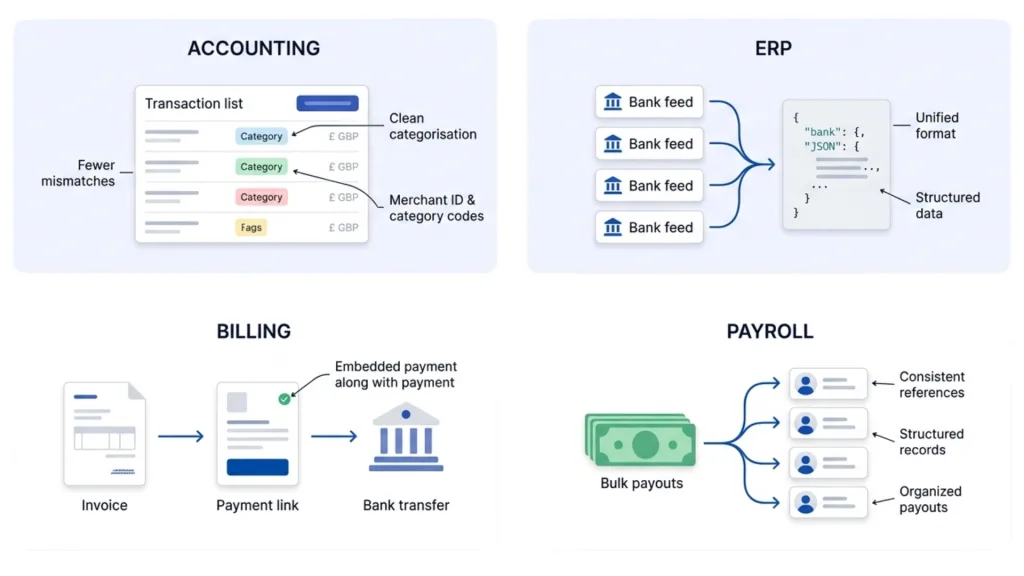
Accounting SaaS
Finexer delivers consistent merchant IDs and category codes at source, reducing exceptions before month-end close.
ERP Systems
Finexer’s structured JSON covers virtually every major UK bank under one format – reducing normalisation overhead at period end.
Billing and Invoicing Platforms
Finexer’s Payment Links embed invoice references in the Faster Payments instruction – the reference arrives with the funds.
Payroll Systems
Finexer’s Bulk Payout delivers structured payout data with consistent per-recipient references, reducing manual matching overhead.
Payroll reconciliation automation for payroll platforms covers how structured bank data reduces manual review in payroll payout reconciliation.
What causes reconciliation exceptions in automated systems?
Reconciliation exceptions occur when automated matching cannot resolve a transaction. Common causes include inconsistent transaction descriptions across banks, missing payment references, duplicate transaction amounts, and delayed bank data creating timing discrepancies. Each unresolved exception requires manual review.
Why does manual reconciliation still happen with automation tools?
Automation matches on structured inputs. When bank descriptions are inconsistent, references are missing, or data arrives in delayed batches, automated matching creates exceptions requiring manual review. Automation does not fix poor input data – it surfaces failures faster. The exception rate drops when the bank data layer is structured at source.
How does Open Banking reduce manual reconciliation payments?
Open Banking AIS provides real-time bank transaction data with structured merchant IDs, category codes, and consistent schemas. Payment initiation embeds payment references in the transaction at initiation. Both reduce the missing-reference and inconsistent-description problems that generate reconciliation exceptions.
Build reconciliation workflows on structured bank transaction data.
About the Author

Ravi Ranjan
Ravi Ranjan is Co founder & CEO of Finexer