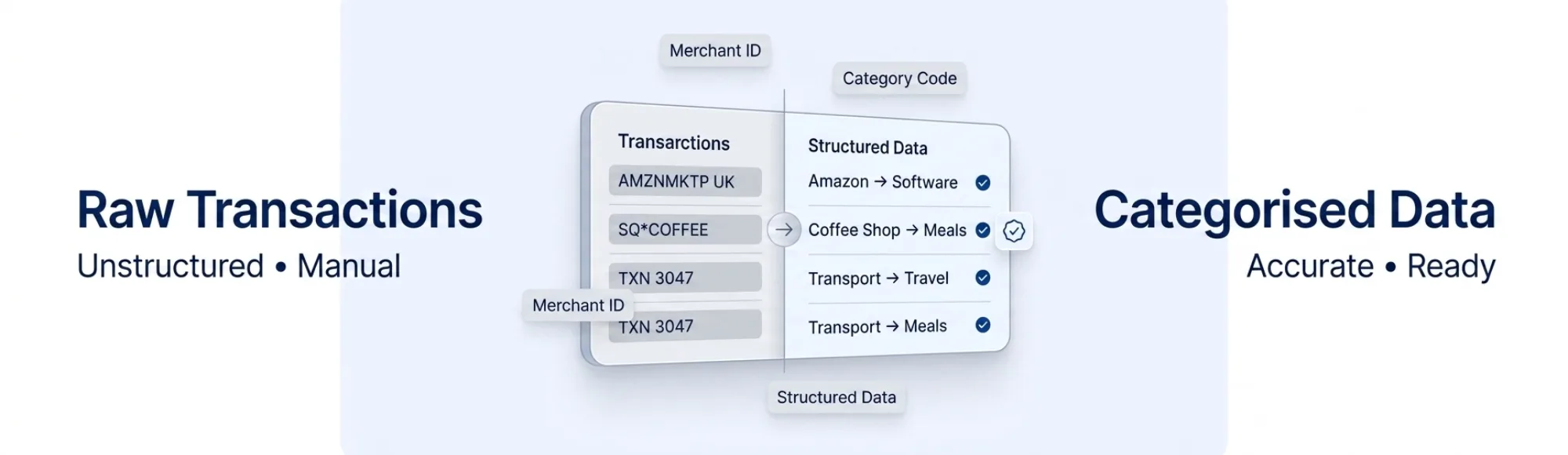
Structured bank data. Category codes at source. Accurate financial records
Bank transaction data infrastructure for accounting SaaS, ERP, and expense management platforms.
Expense categorisation is the process of assigning financial transactions to predefined categories for reporting, analysis, and compliance.
For accounting SaaS, ERP, and expense management platforms, expense categorisation accuracy directly determines the quality of every financial output the platform produces – reports, reconciliation, and HMRC submissions included.
The quality of expense categorisation depends almost entirely on the quality of transaction data feeding it. Structured data produces accurate categorisation. Raw, unformatted bank strings require manual correction at scale.
UK businesses are required to maintain accurate financial records under HMRC guidelines, with expenses deductible only when wholly and exclusively for business purposes. Transaction categorisation that cannot reliably distinguish payroll, rent, utilities, and marketing from one another creates HMRC compliance risk across every client account a platform manages.
TL;DR
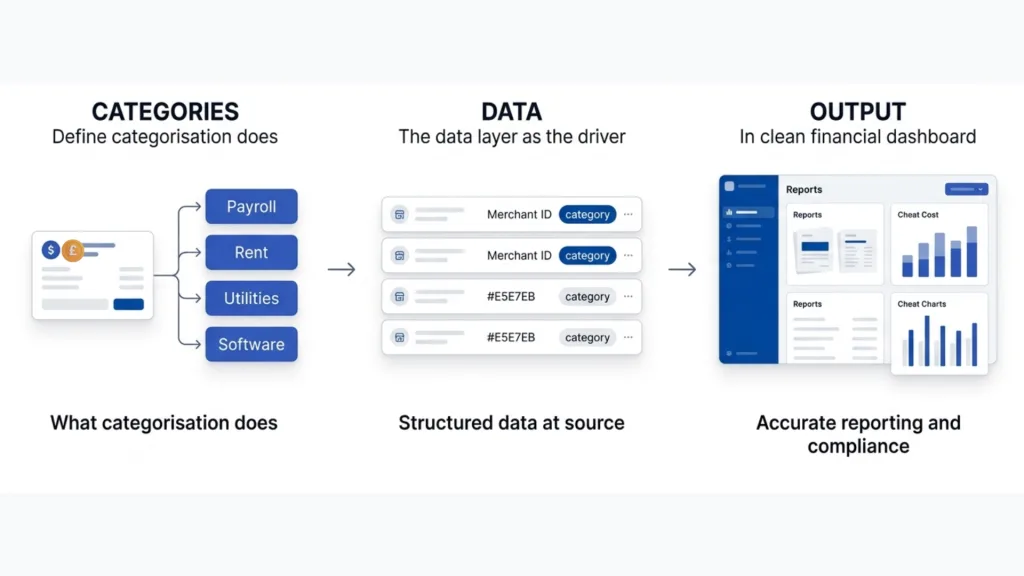
Expense categorisation assigns financial transactions to categories – payroll, rent, utilities, travel, software subscriptions – enabling accurate reporting and compliance. Accuracy improves when transaction data arrives structured at source, with merchant IDs and category codes applied before reaching the platform. Finexer’s AIS delivers structured UK bank transaction data with category codes at source, reducing the manual classification step that creates categorisation errors in accounting SaaS, ERP, and expense management workflows.
Key Takeaways
What is expense categorisation?
Expense categorisation assigns each financial transaction to a predefined category – payroll, premises, utilities, travel, marketing, software – for reporting, tax, and compliance purposes. Accurate expense categorisation enables correct P&L reporting, VAT claim accuracy, HMRC compliance, and reconciliation against budgets and forecasts.
What makes expense categorisation accurate at scale?
Three data inputs:
- Merchant identification – consistent merchant name per transaction regardless of bank or payment channel, so the same supplier maps to the same category every time
- Transaction context – payment type, counterparty, and amount in a consistent format that categorisation rules can reliably match
- Structured data at source – category codes applied before data reaches the platform, eliminating the classification step that introduces manual error
How does transaction categorisation differ from expense categorisation?
Transaction categorisation is the technical process of classifying raw bank transaction strings into structured categories. Expense categorisation applies that classified data to business expense workflows – reporting, budgeting, HMRC compliance, and reconciliation. Transaction categorisation accuracy at the data layer directly determines expense categorisation accuracy at the platform layer.
What Drives Accurate Expense Categorisation?
What Data Does the Categorisation Layer Actually Need?
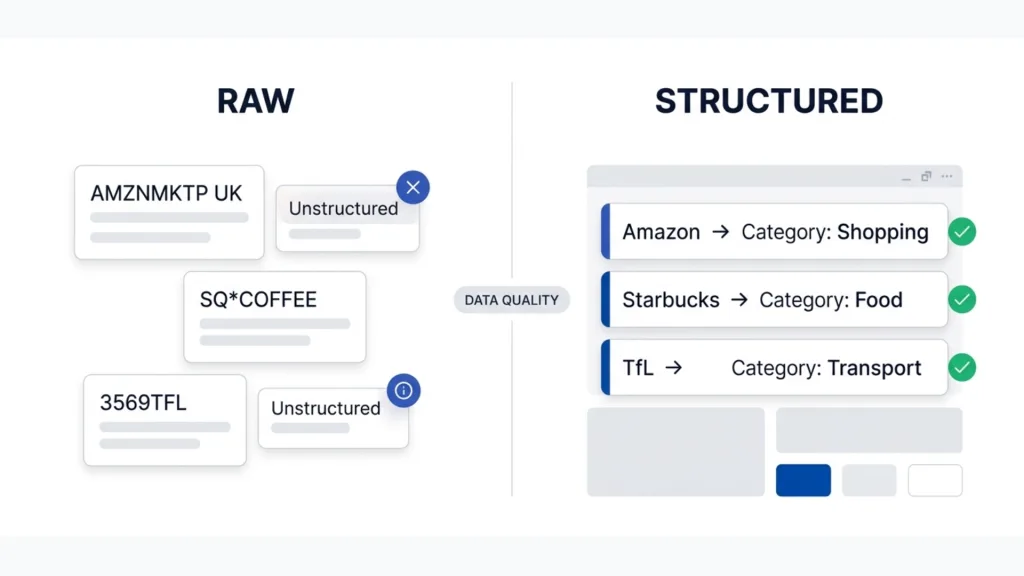
The difference between accurate and inaccurate expense categorisation is almost always in the data arriving at the classification step.
Raw bank transaction strings – “AMZNMKTP UK”, “SQ*COFFEE”, “3569TFL”, “CRVHALFORDS” – carry no inherent category. A platform receiving these must either build and maintain its own classification logic for each string per bank, or accept that some transactions will be miscategorised or pushed to manual review.
Structured transaction data solves this before it becomes a categorisation problem:
- Merchant ID – consistent identifier matched to a verified merchant entity, regardless of how the bank formats the description string
- Category code – spending category applied at source (Groceries, Transport, Utilities, Professional Services, Subscriptions) before the data reaches the platform
- Payment type – BACS, Faster Payments, card, Direct Debit distinguished at the data level so different matching rules apply correctly
When these three inputs are present in the transaction data, expense categorisation rules work reliably. When they are absent, every miscategorised transaction requires manual intervention.
| Data Input | Without Structure | With Structure at Source |
|---|---|---|
| Merchant description | Raw string per bank (“AMZNMKTP UK”) | Verified merchant name + ID applied at source |
| Spending category | Platform must classify manually or build rules | Category code applied before data arrives |
| Payment type | Inconsistent across BACS/FPS/card channels | Structured field per transaction |
| Categorisation result | Manual correction required at scale | Automated matching, low exception rate |
“Expense categorisation accuracy is a data problem before it is a logic problem. A well-built categorisation engine receiving raw, unstructured transaction data will still produce incorrect results. The same engine receiving structured data with merchant IDs and category codes at source works correctly from day one.” – Yuri, Finexer
Automated financial data categorisation for UK platforms covers how structured bank data changes categorisation accuracy for accounting and financial reporting platforms.
Where Does Expense Categorisation Matter Most?
Which Platforms Depend Most on Accurate Transaction Categorisation?
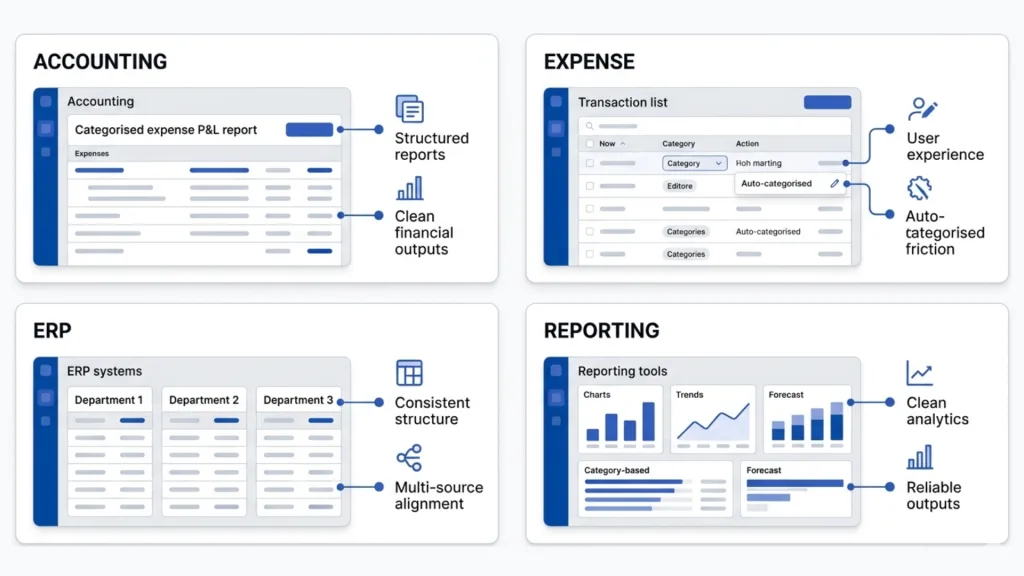
Accounting SaaS:
Expense categorisation drives the accuracy of every client P&L, VAT return, and HMRC submission. Miscategorised transactions create errors that propagate through monthly reports, tax filings, and year-end accounts. Platforms receiving structured transaction data with category codes at source reduce the manual review step before each client report cycle.
Expense Management Platforms:
Transaction categorisation accuracy determines the user experience directly. When a transaction is miscategorised, the user corrects it manually. At scale, this correction burden creates friction that reduces platform retention. Structured transaction data reduces the correction rate – transactions arrive already categorised correctly.
ERP Systems:
Consistent expense categorisation across multiple cost centres, departments, and payment channels requires a common data format. ERP systems receiving structured bank transaction data in a consistent JSON schema across all UK banks eliminate the normalisation step that creates categorisation inconsistency between channels.
Financial Reporting Tools:
Expense categorisation accuracy determines whether trend analysis, budget variance reporting, and cash flow forecasting reflect actual financial activity. Structured transaction data with consistent category codes makes reporting outputs reliable rather than approximate.
Transaction categorisation for UK financial platforms covers how transaction categorisation data quality affects financial reporting accuracy across accounting and ERP platforms.
Real-time bank data for expense claims covers how real-time bank transaction data improves expense claim processing and categorisation for expense management platforms.
How Does Finexer Support Expense Categorisation?
What Does Finexer’s AIS Provide for Transaction Categorisation Workflows?
Expense categorisation accuracy depends on structured transaction data. Finexer’s FCA-authorised AIS provides that data layer for accounting SaaS, ERP, and expense management platforms – without replacing the platform’s own categorisation logic or accounting system.
- Category codes at source – each transaction arrives with a spending category applied before it reaches the platform
- Merchant IDs per transaction – consistent counterparty identification across BACS, Faster Payments, and Open Banking channels
- 100M+ merchant database – 95%+ categorisation accuracy, under 100ms processing latency
- Structured JSON – consistent schema across almost all major UK banks, one format regardless of payment channel
- Real-time webhooks – each transaction delivered at occurrence for continuous categorisation, not batch processing
- Up to 7 years of transaction history – historical data depth for trend analysis and comparative reporting
- 99% UK bank coverage – high street, challenger, and business accounts
- Usage-based pricing, 3-5 weeks to production with active onboarding support
“The expense categorisation use case is where structured data at source makes the clearest difference. When category codes arrive with the transaction, the platform’s categorisation logic has structured inputs to work with. When they don’t, the platform is building classification on top of noise.” – Yuri, Finexer
Expense management automation for UK platforms covers how automated bank data feeds improve expense management workflows for accounting and ERP platforms.
What I Feel
Most expense categorisation problems are blamed on the categorisation logic.
Better rules. Better ML models. Better taxonomy.
The logic is rarely the problem. The transaction data feeding it is the problem.
Expense categorisation built on structured data with merchant IDs and category codes at source works correctly from the start. The same logic built on raw bank strings requires constant maintenance and manual correction. Fix the data layer, and the expense categorisation layer works.
What are the different types of expense categories for UK businesses?
Common UK business expense categories include payroll, rent and premises, utilities, travel and subsistence, marketing and advertising, software subscriptions, professional services, and capital expenditure. HMRC requires expenses to be wholly and exclusively for business purposes to qualify for tax deduction. Consistent transaction categorisation across these categories supports accurate VAT returns and P&L reporting.
Why does expense categorisation accuracy matter for HMRC compliance?
HMRC requires UK businesses to categorise expenses as wholly and exclusively for business purposes to claim tax deductions. Inaccurate expense categorisation – miscoding personal spending as business or misclassifying expense types – creates VAT return errors, incorrect P&L reporting, and potential penalties during HMRC enquiries. Structured transaction categorisation at source reduces these errors before they reach the accounts.
How does Open Banking improve expense categorisation?
Open Banking AIS delivers bank transaction data directly with merchant IDs and category codes applied at source. Each transaction arrives with a structured counterparty identifier and spending category, rather than a raw bank description string. This eliminates the manual classification step that creates expense categorisation errors in accounting SaaS, ERP, and expense management workflows.
Build accurate expense categorisation on structured bank transaction data.
About the Author

Yuri
Yuriy Yakushko is a fintech founder and software engineer with over 20 years of experience building financial technology. He’s passionate about creating scalable, secure infrastructure that helps businesses modernise how they access financial data and manage payments.