
Unified bank data. Consistent transaction feeds. Reconciliation-ready financial infrastructure.
Open Banking AIS and PIS for accounting platforms, ERP systems, treasury teams, and fintech product teams.
The first bank integration is straightforward. The second is where the problems start.
Each bank has its own API behaviour. Its own response time envelope. Its own data format quirks. Its own consent expiry logic. Build multi-bank connectivity by connecting each bank individually, and you are not building infrastructure – you are building a collection of point-to-point integrations that each fail independently.
At Finexer, I work with accounting SaaS platforms, ERP systems, and fintech product teams that have hit this wall. The engineering team built what looked like multi-bank connectivity: connections to three banks. Each worked fine in the sandbox.
In production, one bank’s API started timing out at 3am. Another started returning truncated transaction descriptions. The third changed its authentication flow without notice. The reconciliation layer broke because the data arriving from each bank looked different.
Multi-bank connectivity at operational scale requires more than API access. It requires a layer that normalises bank behaviour, handles failures consistently, and delivers structured data in the same format regardless of which bank processed the transaction.
“The difference between a working demo and a production-grade multi-bank integration is usually about six months of edge cases. Banks behave differently under load. Consent flows expire at different intervals. Data formats shift. The engineering team that thought they were done discovers they have just started.” – Yuri, Finexer
TL;DR
Multi-bank connectivity breaks operationally when each bank integration is built and maintained separately. APIs time out inconsistently. Data formats differ. Consent cycles expire without coordination. Fragmented bank integrations create maintenance overhead that compounds as connection count grows. Reliable multi-bank infrastructure normalises this variability at the connectivity layer – delivering structured, consistent bank data and payment initiation through a single integration. The platform builds once. The infrastructure handles the rest.
Key Takeaways
What is multi-bank connectivity?
Multi-bank connectivity is the ability to access bank data and initiate payments across multiple financial institutions through a unified infrastructure layer. Rather than building and maintaining separate integrations per bank, platforms connect once to a provider that handles bank-specific API variations, consent management, and data normalisation – receiving structured, consistent outputs regardless of which bank is connected.
Why do fragmented bank integrations break in production?
Because each bank behaves differently. API response times vary from under 200 milliseconds to over 5 seconds for the same operation. Data formats differ between banks even for the same transaction type. Consent tokens expire at different intervals. Uptime is not consistent across all banks. Managing this variability per-bank creates engineering and operational overhead that compounds with each additional connection.
What do fragmented bank integrations cost operationally?
Each bank integration that breaks independently creates a separate incident. Reconciliation data becomes unreliable when one bank feed fails while others continue. Finance teams receive incomplete transaction data without knowing which connection dropped. Engineering teams spend time on bank-specific fixes rather than product development. The cost is not per-incident – it is cumulative maintenance overhead.
How does a unified Open Banking layer reduce fragmentation?
By handling bank-specific API behaviour, consent lifecycle management, and data normalisation in one place. The platform integrates once. The connectivity layer manages the variability across banks – retries, format mapping, consent renewal, failure handling. The platform receives structured, consistent outputs. Adding a new bank does not require a new integration build.
Why Does Multi-Bank Connectivity Break in Production?
What Creates the Fragmented Bank Integration Problem?
The Open Banking framework in the UK defines common standards. It does not define identical bank behaviour.
The UK follows the Open Banking Standard. Banks comply at different levels. Some offer rich, high-performance APIs. Others provide the bare minimum for regulatory compliance.
Response times vary considerably – some banks respond in milliseconds, others take seconds. Uptime varies across banks. Some experience connection issues more frequently than others.
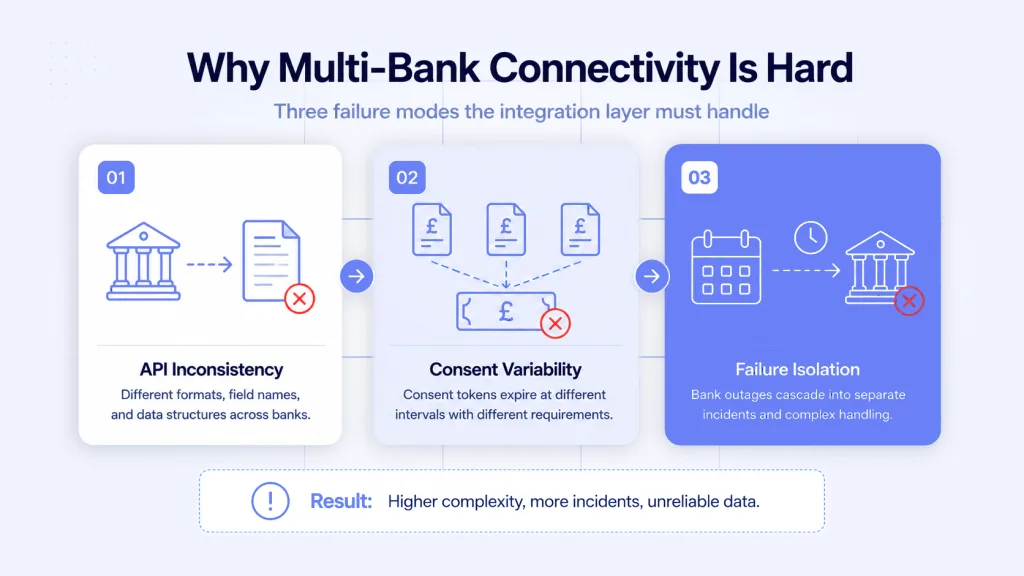
For a platform building multi-bank connectivity, this creates a specific engineering problem. The integration layer must handle:
- API inconsistency. The same transaction data request returns in different formats from different banks. Field names differ. Date formats differ. Reference fields are present in some bank responses and absent in others. Writing matching logic against this requires either bank-specific parsing or a normalisation layer that handles the variability upstream.
- Consent lifecycle variability. Open Banking consent tokens expire. Different banks implement expiry differently – some at 90 days, others at different intervals, some with different re-authentication requirements. A platform managing multi-bank connectivity across clients must track and renew consent per bank per client. Without coordination, one expired token silently breaks a bank feed.
- Failure isolation. When one bank API becomes unavailable, the failure must not cascade into the rest of the platform’s data layer. In a fragmented integration architecture, each bank failure is a separate incident that requires separate handling. Engineering teams end up maintaining bank-specific retry logic, fallback logic, and monitoring per integration.
For accounting platforms and ERP systems evaluating how multi-bank infrastructure affects data reliability, the Open Banking API integration guide covers how connectivity layer design affects data consistency and operational overhead in production environments.
What Does Building Per-Bank Cost in Practice?
What Are the Real Operational Costs of Separate Bank Builds?
The cost of fragmented bank integrations does not appear in a single incident. It accumulates.
A fintech product team connects three UK banks. Each integration takes two weeks to build. Each works correctly in the sandbox. In production, across six months:
- Bank A begins returning truncated transaction references during overnight processing
- Bank B changes its consent re-authentication flow, silently breaking data access for affected clients
- Bank C adds a new field to its API response that the parsing layer does not handle, causing reconciliation failures
Each failure is separate. Each requires a separate investigation and fix. The engineering team that built three integrations is now maintaining three separate failure modes in production.
At 10 banks, this is unsustainable without dedicated infrastructure engineering. At 20, it is a department.
Three places where fragmented bank integrations create the most visible operational cost:
- Reconciliation reliability. When bank data arrives in inconsistent formats, the reconciliation layer must handle per-bank variability at the matching step. A transaction from one bank that has a reference in field A must be matched against a transaction from another bank where the reference is in field B. The matching logic becomes bank-specific rather than universal.
- Client-facing finance platforms. Accounting SaaS platforms connecting client bank accounts face this problem multiplied by client count. A single bank outage or format change affects all clients at that bank simultaneously. Finance teams receive partial data or no data without understanding which connection failed.
- Treasury and cash flow visibility. Finance teams managing multi-bank cash positions need consistent, up-to-date balance and transaction data across all accounts. When individual bank connections fail or return stale data, the consolidated cash position becomes unreliable. Decisions based on stale multi-bank data carry operational risk.
For accounting firms managing multiple client banking relationships through a single platform, the multi-client management for accounting firms guide covers how centralised bank connectivity affects workflow reliability and client data management at scale.
What Does Reliable Multi-Bank Connectivity Actually Require?
How Should Bank Infrastructure Be Structured to Scale?
| Infrastructure Layer | Fragmented (Per-Bank) Approach | Unified Connectivity Layer |
|---|---|---|
| API normalisation | Per-bank parsing logic – maintained separately for each connection | Single format output – normalised regardless of source bank |
| Consent management | Per-bank expiry tracking – separate renewal logic per institution | Centralised consent lifecycle – managed at infrastructure layer |
| Failure handling | Per-bank retry and fallback – each failure mode handled separately | Centralised failure handling – consistent retry and alerting across banks |
| Adding a new bank | New integration build – 2-4 weeks engineering per bank | Configuration change – new bank added at connectivity layer, not platform level |
| Data format | Bank-specific – reconciliation logic must handle variability | Consistent JSON – write matching logic once, works across all banks |
| Maintenance overhead | Scales with bank count – each new bank adds a new failure mode | Overhead does not grow with bank count – variability absorbed at infrastructure layer |
The difference in multi-bank connectivity is not which banks are supported. It is where variability is managed.
In a fragmented multi-bank connectivity approach, variability lives at the application layer. Each bank’s quirks are handled in the platform’s own code. Adding a bank means adding that bank’s quirks. A bank changing its API behaviour means updating that bank’s handling code.
In a unified connectivity layer, variability is handled at the infrastructure level. The platform receives consistent data regardless of which bank generated it. Bank behaviour changes are absorbed at the connectivity layer rather than surfacing as production incidents at the application level.
For platforms evaluating Open Banking connectivity options for accounting and payment workflows, the guide to Open Banking for accountants covers how unified bank connectivity supports accounting workflow reliability compared to per-bank integration approaches.
How Does Finexer Support Multi-Bank Connectivity?
What Does Finexer’s Bank Infrastructure Provide?
Finexer is not a bank. It does not replace ERP systems, build accounting software, or manage treasury operations directly.
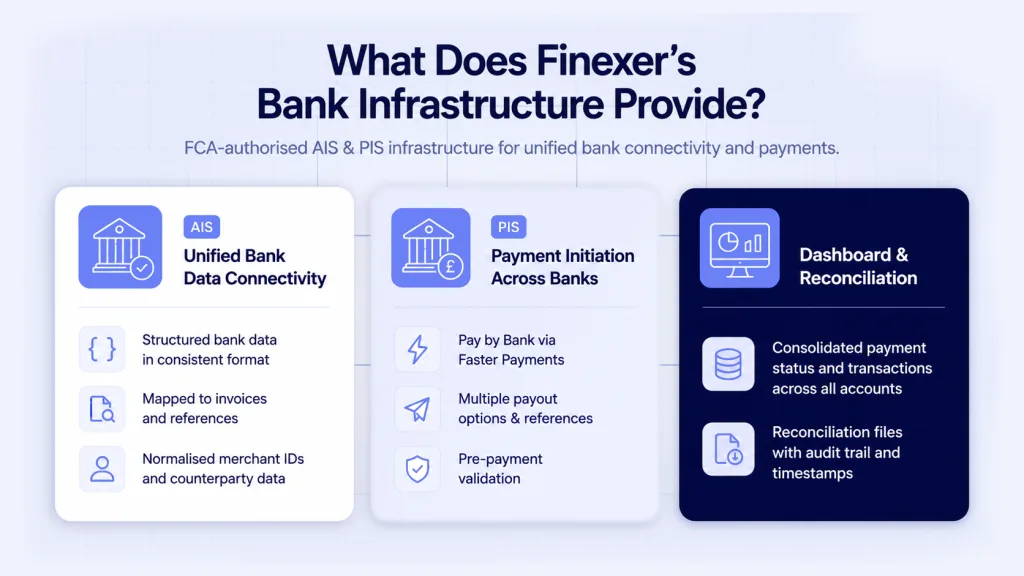
Finexer provides FCA-authorised Open Banking AIS and PIS infrastructure – the bank connectivity layer that accounting SaaS platforms, ERP systems, treasury operations teams, and fintech product teams use to access structured bank data and initiate payments across almost all major UK banks through a single integration.
AIS – unified bank data connectivity:
- Structured transaction data in consistent JSON format – same output regardless of source bank
- Transaction and Invoice Tracker – bank data mapped to invoice and payment references
- Merchant IDs and counterparty data at source, normalised across banks
- Up to 7 years of transaction history, consent lifecycle managed at infrastructure level
- Balance data and account information across connected accounts
PIS – payment initiation across banks:
- Pay by Bank via Faster Payments – near-immediate UK bank-to-bank settlement
- Bulk Payout, Payment Links, and VRP – multiple payout formats, per-payment references
- Pre-payment validation before funds move
Dashboard:
- Consolidated payment status and transaction data across all connected accounts
- Reconciliation file exportable per run, per-payment audit trail with reference and timestamp
Finexer connects to almost all major UK banks – high street, challenger, and business accounts. Adding a new bank for the platform does not require a new integration build – reducing the engineering overhead that grows with each new bank connection in a fragmented approach.
- Usage-based pricing, no setup fees, deployment measured in weeks
- FCA-authorised (FRN 925695)
For a full view of supported UK banks and connectivity coverage, the Finexer bank coverage page covers the institutions supported across AIS and PIS.
What I Feel
Most platforms I work with have attempted multi-bank connectivity by connecting banks one at a time.
It works up to a point. Two or three banks and a small client base can be managed. The team knows which bank behaves in which way. They have added custom handling for the known edge cases.
Then a bank changes something. Or a new enterprise client brings in a bank the team has not connected before. Or consent tokens start expiring in a pattern nobody anticipated.
The operational cost of fragmented bank integrations in a multi-bank connectivity setup is not the initial build. It is the ongoing maintenance as each bank’s behaviour evolves in production – independently and at unpredictable intervals.
Multi-bank connectivity at scale requires treating the variability as an infrastructure problem, not a code problem.
“Platforms that have solved multi-bank connectivity at scale have one thing in common – they stopped treating each bank as a separate engineering problem and started treating bank variability as something the infrastructure layer should absorb.” – Yuri, Finexer
Common Use Cases
Accounting SaaS Platforms
Multi-bank connectivity for accounting SaaS platforms connects client bank accounts from different institutions into a single structured data feed. Transaction data arrives in consistent format regardless of which bank the client uses. Reconciliation logic runs against normalised data rather than bank-specific field mapping.
ERP and Finance Operations Systems
ERP platforms use multi-bank connectivity to manage supplier accounts and corporate banking relationships across institutions through a single layer. Bank-specific API differences are handled at infrastructure level. Cash position consolidation reflects consistent, structured balance and transaction data without per-bank maintenance overhead.
Treasury and Cash Management Teams
Finance teams monitoring cash positions across accounts need reliable multi-bank connectivity and up-to-date data across all connected accounts. A unified connectivity layer provides balance and transaction data in consistent format – reducing the operational risk of decisions made on stale or incomplete multi-bank data.
Fintech Product Teams
Fintech teams embedding bank connectivity into their products need infrastructure that scales without re-engineering per bank. With unified multi-bank connectivity, new bank connections are added at the infrastructure level – not requiring product-level integration work for each institution supported.
What does multi-bank connectivity mean for a finance platform?
For a finance platform, multi-bank connectivity means receiving structured bank data across multiple UK banks without building a separate integration for each one. The connectivity layer handles bank-specific API differences, consent management, and data normalisation. The platform writes matching and payment logic once – against a consistent output format – rather than maintaining per-bank handling code.
Why are bank integrations fragmented?
Because Open Banking standards define what banks must provide, not how they must provide it. Banks comply at different performance levels. API response times, data formats, consent expiry logic, and authentication flows vary between institutions. A platform connecting to multiple banks must handle this variability somewhere – either in its own code per bank, or at a shared infrastructure layer.
What problems do fragmented bank integrations cause?
Per-bank maintenance overhead that scales with connection count. Reconciliation failures when bank data formats differ. Silent data gaps when one bank feed breaks while others continue. Engineering time spent on bank-specific fixes rather than product development. The cost is cumulative – each new bank adds a new set of potential failure modes.
How does Open Banking support multi-bank connectivity?
Open Banking defines the standard for bank API access and provides the regulatory framework for third-party data access with user consent. An FCA-authorised provider uses this framework to connect to many banks, normalising their differences at the infrastructure layer. Platforms integrate once with the provider and receive consistent bank data and payment initiation capability across all supported banks.
See how Finexer supports multi-bank connectivity with unified Open Banking infrastructure across almost all major UK banks
About the Author

Yuri
Yuriy Yakushko is a fintech founder and software engineer with over 20 years of experience building financial technology. He’s passionate about creating scalable, secure infrastructure that helps businesses modernise how they access financial data and manage payments.