Fix the Payment Step First.
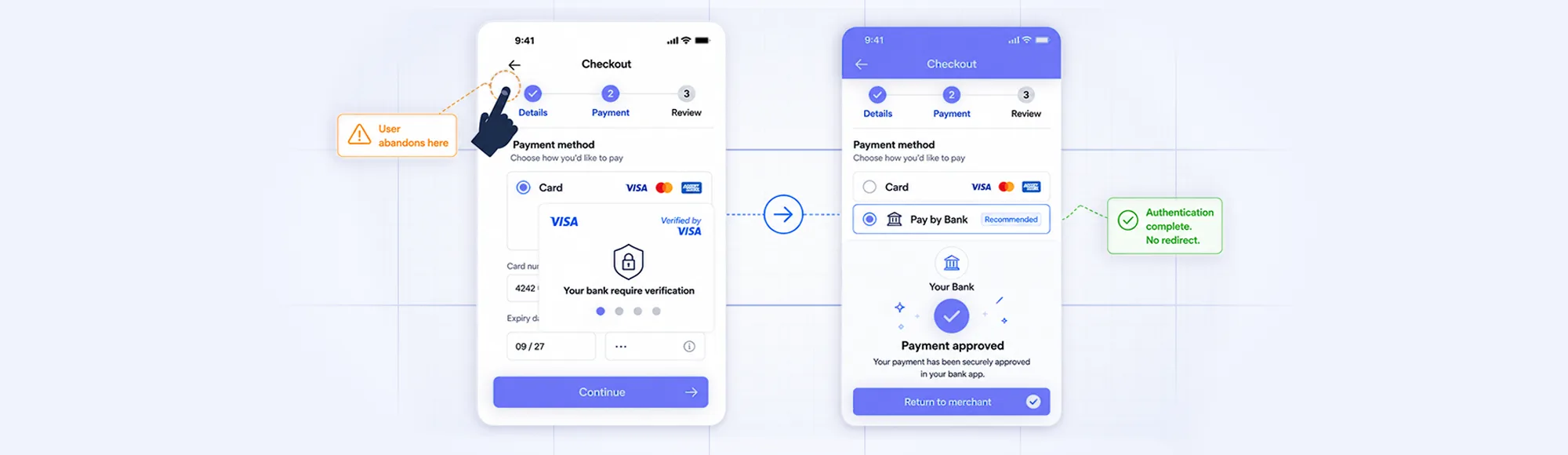
Finexer’s Pay by Bank PIS reduces card form friction, 3DS drop-off, and no-card blockers in one integration.
Here is a conversation I have often.
A platform PM adds Pay by Bank. Their checkout abandonment rate improves slightly. They expected more from fixing the checkout abandonment. They assumed the checkout abandonment rate would drop significantly because they had heard the stat – 70% of users abandon – and assumed adding a better payment method would fix it.
The checkout abandonment rate usually does not move as expected. Not because Pay by Bank is wrong. Because the cause of their abandonment was not the payment method.
This distinction matters. Payment-method changes touch one layer of checkout abandonment reasons. Most platforms have abandonment problems at three or four layers simultaneously.
Getting the checkout abandonment diagnosis right is the difference between a 2% lift and a 15% one.
“The platforms that tend to see the clearest conversion improvement from Pay by Bank are the ones that already addressed their other abandonment causes first. Guest checkout enabled, costs shown upfront, mobile layout sorted. Then Pay by Bank is clean and attributable. Add it before those fixes and the lift is marginal.” – Yuri, Finexer
TL;DR
UK checkout abandonment rate: 70.22% average (Baymard, 50 studies). Top causes: extra costs 48%, account creation 26%, slow delivery 23%, complicated flow 18%. Pay by Bank fixes the payment step – card form friction, 3DS redirect, no card on hand. It does not fix costs, delivery, or account walls. Those need separate decisions.
Why Does the 70% Checkout Abandonment Rate Mask Five Different Problems?
The 70.22% global average checkout abandonment rate (Baymard Institute, 50-study aggregate) is not a single problem. There are five different problems that happen to share a metric.
Treating all checkout abandonment reasons as one problem is why most checkout abandonment rate projects underdeliver. A team adds express checkout, conversion improves by 3%, they declare success. But the 40% who left because shipping was revealed too late – those users are still leaving.
Baymard’s large-scale checkout research separates the checkout abandonment causes clearly. Excluding users who were just browsing with no intent to buy – which accounts for 43% of all abandonment on its own – the remaining causes break down like this:
- Extra costs revealed too late at checkout – 48%
- Required to create an account – 26%
- Slow or unacceptable delivery estimates – 23%
- Checkout process too long or complicated – 18%
- Could not calculate total order cost upfront – 17%
- Did not trust the site with payment details – 13%
- Preferred payment method not available – 13%
Notice where the payment method sits in the checkout abandonment breakdown. Thirteenth percent. Last on the list.
This does not mean payment method choice is irrelevant. It means that if extra costs and forced account creation are unresolved, fixing the payment method moves a fraction of the problem.
Which Checkout Abandonment Causes Does Pay by Bank Directly Fix?
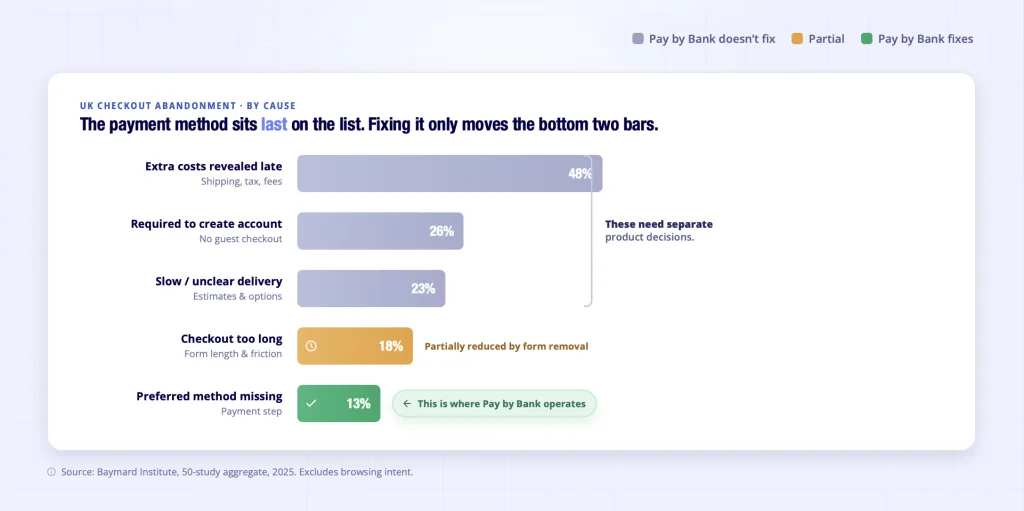
Pay by Bank is a payment initiation mechanism. It sits at the payment step. So the abandonment causes it directly addresses are the ones that happen at the payment step.
Cards form friction. Entering card details manually is the highest-friction moment in most checkout flows. Baymard’s research shows the average checkout form contains 23.48 form elements.
Most users who abandon the card step do not have their card in front of them. A saved card removes that friction entirely. But first-time buyers, infrequent purchasers, and anyone on a device they do not usually shop from face the full form. Number, expiry, CVV, billing postcode. If they type one digit wrong, the card declines. They try again. Some leave.
Pay by Bank removes the card entry step for users who choose it. The user selects their bank and approves in the banking app. No card details needed. No typos.
For a platform running high volumes on mobile – where card entry is demonstrably worse than desktop – this matters. Mobile checkout abandonment runs at approximately 80%, versus 66% on desktop (SellersCommerce, 2025). The gap is almost entirely explained by form friction on small screens. Pay by Bank on mobile routes through the banking app already installed on the device. One tap.
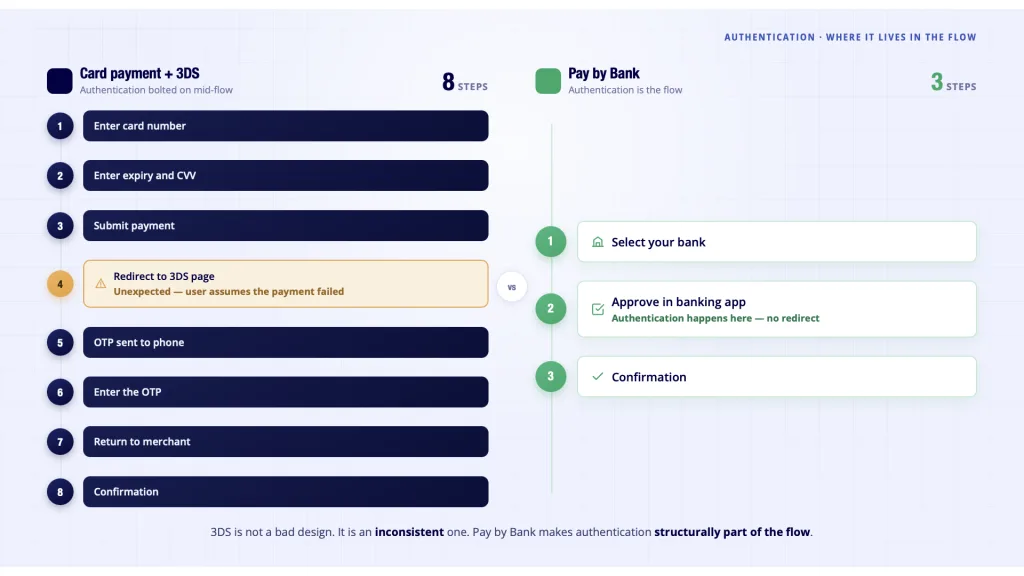
3DS redirect drop-off. Strong Customer Authentication under PSD2 requires card issuers to authenticate higher-risk transactions. TrueLayer’s analysis of multiple SCA card payment flows found that payers typically navigate 10+ steps to complete a purchase – redirect to 3DS page, OTP via SMS or banking app, return to merchant site, confirmation. Users who hit an unexpected authentication screen at the payment stage frequently assume the transaction has failed and abandoned.
Pay by Bank is SCA-compliant from the ground up. The bank app approval IS the authentication. There is no secondary redirect because the whole flow happens within the bank’s own verified environment. For users who choose Pay by Bank, the 3DS redirect does not occur. The authentication is the bank app approval itself.
No card on hand. This cause is most visible in B2B and high-AOV flows. A finance manager authorising a supplier payment may not have the company card in front of them. A purchasing director approving a marketplace order from a different device hits the same problem. Pay by Bank authenticates via bank login – which the user controls directly, from any device. No physical card required.
| Abandonment cause | Share (Baymard 2025) | Does Pay by Bank fix it? | What actually does |
|---|---|---|---|
| Extra costs too high at checkout | 48% | No | Show full cost before checkout begins |
| Forced account creation | 26% | No | Guest checkout option |
| Slow or unacceptable delivery | 23% | No | Fulfilment and carrier decisions |
| Checkout too long or complicated | 18% | Partially – removes card form | Reduce steps, mobile UX redesign |
| Could not see total upfront | 17% | No | Price transparency earlier in flow |
| Card form friction | Within 18% | Yes – removes card entry for users who choose it | Pay by Bank or digital wallet |
| 3DS redirect drop-off | Within 13% | Yes – SCA built into bank flow | Pay by Bank |
| No card on hand (B2B/high-AOV) | Use-case specific | Yes – bank login only | Pay by Bank |
| Site trust concerns | 13% | Only if white-labelled properly | Security signals, brand consistency |
Which Platform Types See the Biggest Impact from Pay by Bank?
Not all platforms have the same abandonment profile. The three causes Pay by Bank addresses – card form friction, 3DS, no card on hand – are not equally distributed.
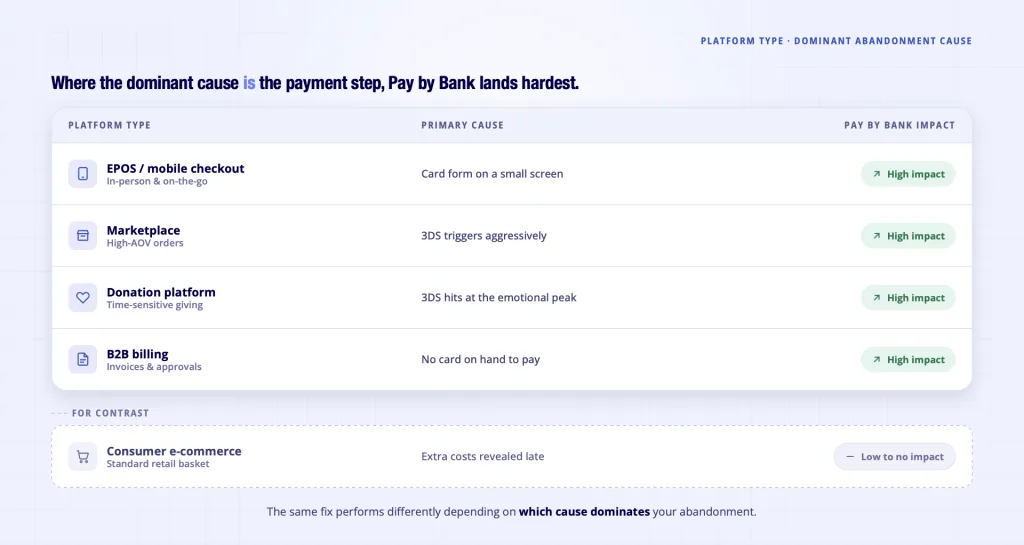
EPOS and high-volume consumer checkouts. A food ordering platform or retail EPOS on mobile is exactly where card form friction and 3DS overlap. The user is on a 390px screen, entering 16 digits, and then gets an unexpected OTP request. A bookings platform running 800 transactions a day saw card checkout abandonment from entry errors accounting for 11% of payment failures before switching to Pay by Bank as a primary option alongside cards. That failure rate dropped to under 2%. For users who chose Pay by Bank, the form problem did not exist – there was no form.
Marketplace platforms with high-AOV transactions. A marketplace PM building checkout for equipment, wholesale orders, or professional services sees 3DS triggers on a significant share of transactions. Card networks flag high-value transactions for authentication most aggressively. One marketplace running average order values of £1,200+ was seeing 3DS trigger on 34% of card transactions, with a 19% drop-off at that step. For users who selected Pay by Bank, there was no 3DS step – the bank app approval is the authentication.
Donation platforms. A £500 one-time donation triggers 3DS on most card networks. The redirect happens at exactly the wrong moment – when the donor has made the emotional decision and is ready to complete. A charity platform processing high-value single donations reported a 22% abandonment specifically at the 3DS step. For donors who chose Pay by Bank, the 3DS redirect did not appear.
B2B billing platforms. The no-card-on-hand cause does not appear in Baymard’s consumer data because it is a B2B-specific pattern. A SaaS billing platform with enterprise clients found that 17% of invoice payment failures came from users who did not have the corporate card accessible at payment time. Pay by Bank routes through business bank login – the authorised user authenticates directly, from any device, without a physical card.
How Does Finexer’s Pay by Bank PIS Integrate Into Checkout?
Finexer is an FCA-authorised Payment Initiation Service Provider. The integration sits inside the platform’s existing checkout flow. Users never leave the platform’s branded experience – there is no Finexer branding visible to the end user.
The specific mechanism: card forms create drop-off through entry friction, 3DS creates drop-off through unexpected redirects, and no-card situations block B2B completion. Finexer’s PIS removes all three through one API integration.
What changes in the checkout:
- Card entry form replaced with a bank selection screen – white-label, platform-branded
- Authentication routes through the user’s own banking app – SCA-compliant, no secondary redirect
- Settlement via Faster Payments – instant confirmation, no card network delay, zero chargeback exposure on Pay by Bank transactions
- Coverage across virtually every UK bank – high street, challenger, and business accounts – through a single connection
What does not change: the extra costs problem, the account creation problem, the delivery problem. Those sit upstream of the payment step and require separate product decisions.
Platforms evaluating the full Pay by Bank payment flow redirect sequence can test it against existing card flows. The Pay by Bank vs card payments breakdown is worth running alongside, particularly for platforms currently absorbing card interchange on high-AOV orders.
The Open Banking payment flow explains implementation specifics for B2B checkout flows where the no-card-on-hand pattern is most common.
Finexer is FCA-authorised AISP and PISP (FRN 925695). PSD2-compliant. Usage-based pricing, commercial terms agreed based on use case. 3 to 5 weeks of hands-on onboarding support.
“The 3DS redirect triggers at the worst possible moment – when the user has already committed. They entered their details, confirmed the amount, and clicked pay. Then an unexpected screen appears and they assume something has gone wrong. For users on Pay by Bank, the unexpected authentication redirect cannot occur. The bank app approval is the authentication – there is no separate step to trigger.” – Yuri, Finexer
What Addresses the Checkout Abandonment Causes Pay by Bank Cannot?
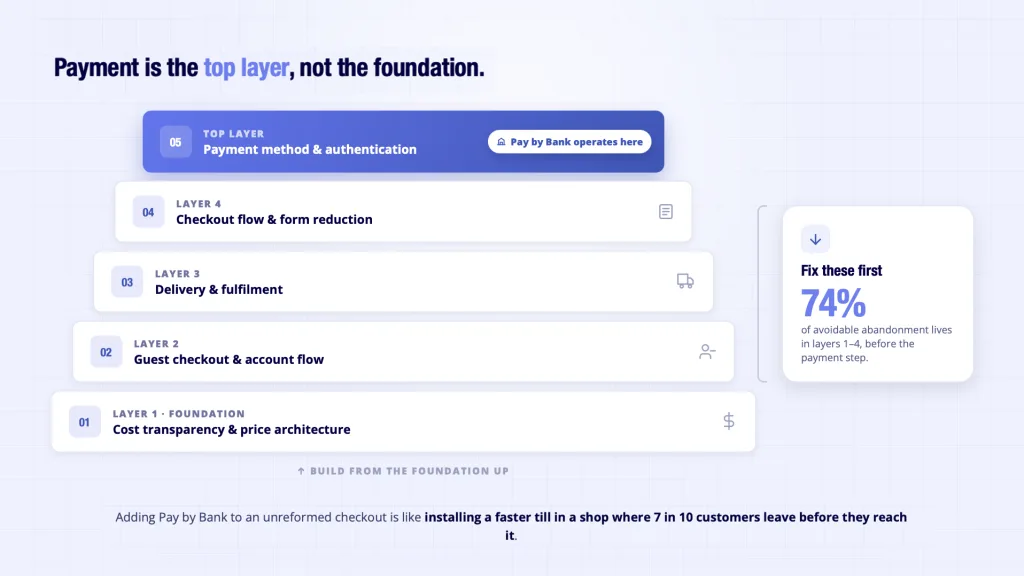
Since Pay by Bank addresses causes representing roughly 13-18% of abandonment, what moves the 48% and the 26%?
Extra costs (48%). Show delivery charges, VAT, and any fees on the product page or basket view – before checkout begins. Users who see the full cost upfront and still proceed to checkout are self-selecting as serious buyers. Users who see a surprise charge at payment step leave. This is not a payment problem and not a checkout abandonment reason Pay by Bank can touch. It is an information architecture decision.
Account creation (26%). Guest checkout as the default option, account creation offered post-purchase. ASOS’s reported data showed a 50% conversion improvement by moving account creation from pre-checkout to post-purchase. This is a product decision, not a payment decision.
Complicated flow (18%). Reduce steps. Baymard’s research shows the average checkout flow contains 23.48 form elements – the optimal is 12-14. Every field you remove is a friction point eliminated. Progress indicators showing “Step 2 of 3” reduce anxiety. These checkout abandonment fixes sit outside the payment layer entirely.
Platforms that have resolved the payment step often find the next friction point is in the broader checkout process optimisation stack – form reduction, progress indicators, mobile layout. Beyond the checkout itself, customer retention and Open Banking explains how payment data connects to longer-term retention patterns.
Does Pay by Bank reduce checkout abandonment rate?
For payment-step causes – yes. Card form friction, 3DS redirect drop-off, and no-card-on-hand situations are removed. For pre-payment causes like hidden costs or forced account creation – no. Those need separate product decisions.
What is the UK checkout abandonment rate in 2026?
The checkout abandonment rate sits between 70% and 78% depending on sector and device. The global Baymard average is 70.22% across 50 studies. UK-specific data from SOTpay (April 2026) puts the figure between 75% and 78%.
What causes the highest checkout abandonment?
Extra costs appearing at checkout – 48% of users abandon when unexpected fees appear late, according to Baymard Institute 2025. This is the largest single cause and is not addressable through payment-method changes.
When does Pay by Bank make the most difference to checkout conversion?
On mobile-first checkouts where card form friction is highest, on high-AOV transactions where 3DS triggers most aggressively, and on B2B flows where the cardholder and the payment approver are often different people.
Losing users at the payment step? Finexer’s Pay by Bank PIS removes card form friction, 3DS drop-off, and no-card blockers in one integration.
About the Author

Yuri
Yuriy Yakushko is a fintech founder and software engineer with over 20 years of experience building financial technology. He’s passionate about creating scalable, secure infrastructure that helps businesses modernise how they access financial data and manage payments.