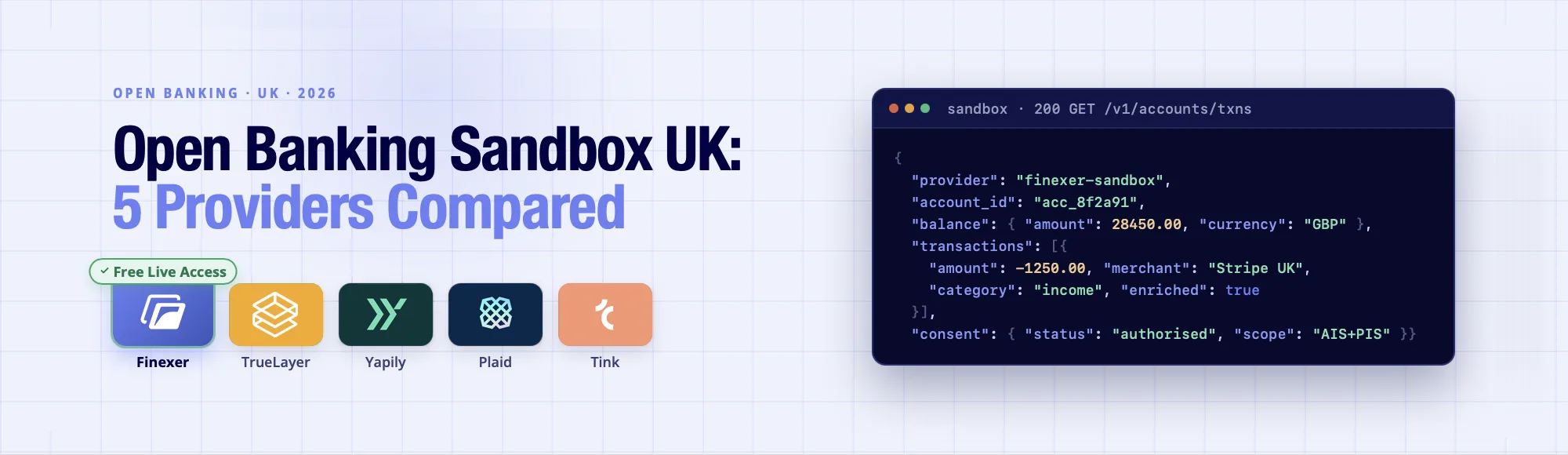
Test Open Banking Free.
Free sandbox and free live access – no sales call needed.
Most engineering teams evaluating an open banking sandbox spend their first week waiting. Waiting for sandbox credentials. Waiting for a sales callback. Waiting for onboarding documentation that should have been in the developer portal on day one.
That friction is not accidental. Several providers use sandbox access as a qualification filter. If a team will not wait a week for test credentials, they are unlikely to sign a contract. For teams under delivery pressure, that kills evaluation momentum before a single API call is made.
This is a direct comparison of five UK-relevant open banking sandbox environments – Finexer, TrueLayer, Yapily, Plaid, and Tink – on the criteria that matter before committing engineering time to an integration: how you get access, what you can test, and what the path to production looks like.
“The sandbox is where you find out whether a provider’s documentation matches their actual API behaviour. Teams that skip thorough sandbox testing and go straight to a sales conversation find the surprises later – in production, under load.” – Yuri, Finexer
TL;DR
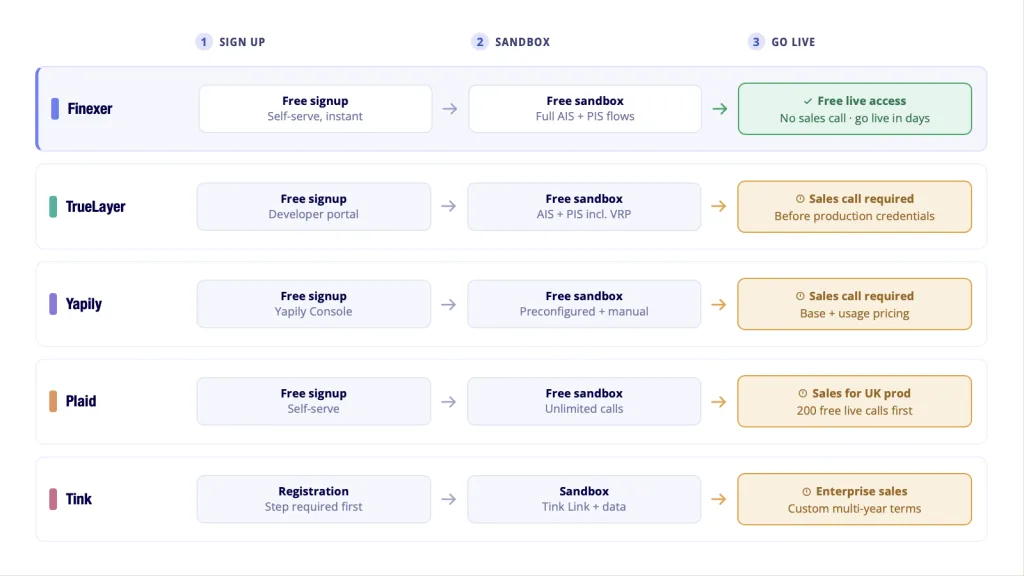
Open banking sandbox UK access ranges from instant self-serve to fully sales-gated. Finexer offers free sandbox and free live access – the one provider in this comparison where you can test and go live without a commercial conversation first. TrueLayer and Yapily both offer free sandbox signup. Plaid has a free unlimited sandbox tier. Tink is enterprise-gated after sandbox.
What Is an Open Banking Sandbox?
An open banking sandbox is a test environment that simulates live bank connections without touching real accounts or funds. Engineering teams use it to build, test, and validate API integrations before going to production – consent flows, account data retrieval, payment initiation, webhook handling, and edge cases.
A well-built sandbox does three things:
- Simulates realistic bank responses including error states, timeouts, and authentication failures
- Covers both AIS (account information) and PIS (payment initiation) flows end-to-end
- Has a path to production that does not require rebuilding the integration from scratch
The gap between sandbox and production is where most integrations run into real friction. A sandbox that uses different data structures from the live API wastes the engineering time spent there.
For UK platform teams, the open banking sandbox UK question has an additional dimension: does the sandbox cover the CMA9 plus the broader set of challenger banks and building societies that matter for production coverage?
How Do These 5 Open Banking Sandbox Environments Compare?
Each provider is assessed on five criteria: access, AIS coverage, PIS coverage, bank simulations, and path to production.
1. Finexer
Sandbox access: Free, instant, self-serve. Sign up at finexer.com – no sales call required. Credentials available immediately.
AIS coverage in sandbox:
- Live balance, transactions, and account details in structured JSON
- Transaction Enrichment: merchant identification and categorisation (95%+ accuracy, under 100ms, across 100M+ merchants) – testable end-to-end in sandbox
- Transaction Tracker: invoice matching via Open Banking AIS – Finexer’s highest-demand feature, fully testable before going live
- Up to 7 years of account history available post-onboarding for reconciliation and audit
- Webhook delivery near-immediately on new transactions, with retry logic built in
- Timestamped consent logs for audit trail requirements
PIS coverage in sandbox:
- Single payment initiation via Faster Payments – instant settlement, testable end-to-end
- Bulk and batch payouts for payroll disbursements and supplier payment runs
- Payment links for checkout integration
- Webhook-based confirmation with stable per-payment references
- No card network involved – no card-style chargeback mechanism on A2A payments
Bank simulations: Mock environments covering the CMA9 and major challenger banks. SCA flows, redirect handling, consent, failed authentication, timeout scenarios, and duplicate webhook delivery all simulatable.
What Finexer does not cover: Card acceptance, multi-currency account holding, consumer remittance, or EU-direct PIS (EUR settlement uses a separate licensed payout partner arrangement).
Path to live: Free live access alongside the free sandbox. FCA-authorised AISP and PISP (FRN 925695). Usage-based pricing, no minimums, commercial terms agreed based on use case. 3 to 5 weeks of hands-on onboarding support.
Best for: UK-first platforms needing AIS and PIS from a single FCA-authorised integration, with production-equivalent sandbox flows and no commercial gate before going live.
Teams ready to test end-to-end without a sales conversation can start with Finexer’s free sandbox immediately.
2. TrueLayer
Sandbox access: Free, self-serve. Developer portal signup with email – credentials arrive within minutes.
AIS coverage: Strong – accounts, transactions, identity, balance. Data API v3 is the current production version and the sandbox mirrors it closely.
PIS coverage: Strong – single immediate payments, Variable Recurring Payments (VRP), commercial VRP. TrueLayer was among the first UK providers to go live with commercial VRP.
Bank simulations: Mock bank environments available. SCA flow, redirect handling, and webhook delivery are all testable. Error states and retry scenarios available.
Path to live: Free sandbox, production via sales conversation. TrueLayer operates on usage-based pricing – public estimates place fees between 0.3 and 1.5 percent per transaction. A sales conversation is required before production credentials are issued. TrueLayer has raised $322M to date and is FCA regulated.
Best for: Teams building Pay by Bank checkout or VRP-based recurring billing, particularly where EU coverage alongside UK matters.
3. Yapily
Sandbox access: Free, self-serve via Yapily Console. Account creation and sandbox credentials available immediately after creating a free Console account.
AIS coverage: Strong across UK and European institutions. Preconfigured sandboxes available for major banks – Yapily recommends Modelo Sandbox, provided by the Open Banking regulators and actively maintained. Non-preconfigured sandboxes require submitting registration certificates and bank-specific credentials manually.
PIS coverage: Available in sandbox – payment initiation flows and Hosted Pages (white-label payment UI). VRP is part of the product set.
Bank simulations: Preconfigured sandboxes available immediately for standard testing. Non-preconfigured bank sandboxes require manual setup steps and may need a developer account with the specific bank.
Path to live: Production pricing via sales conversation. Yapily’s commercial model includes base costs plus usage-based fees.
Best for: Infrastructure-first platforms wanting white-label control and flexibility across UK and European banks.
4. Plaid
Sandbox access: Free, self-serve. Unlimited sandbox calls at no cost. Plaid’s sandbox is the standard way to learn Link and auth patterns before any production commitment.
AIS coverage: Strong globally – account data, transactions, identity, income verification. UK coverage includes major high street banks. Plaid’s primary differentiator in the UK market is AIS and identity/income verification.
PIS coverage: Available in the UK. Plaid is FCA-authorised as both AISP and PISP in the UK. PIS is part of the UK product set, but AIS and verification are the primary use cases.
Bank simulations: Simulated UK institutions and webhook testing. Free tier covers unlimited sandbox calls plus 200 live calls per product before paid volume pricing applies.
Path to live: UK production requires a custom sales conversation. Pricing is not publicly listed. $8 billion valuation (Bloomberg, February 2026).
Best for: Teams building lending, affordability, or income verification products, or platforms with US-UK dual-market requirements.
5. Tink
Sandbox access: Available via Tink developer portal. A registration step is required before sandbox credentials are issued.
AIS coverage: Strong across Europe and UK. Tink connects to 3,400+ financial institutions across 18 European markets. Core strength is account data, transaction categorisation, and enrichment. Visa-owned since 2022 (€1.8 billion acquisition).
PIS coverage: Available – account-to-account payments. AIS and data products are Tink’s primary differentiation in practice.
Bank simulations: Tink Link (their pre-built UI) testable in sandbox. Data quality and categorisation features accessible.
Path to live: Enterprise-gated production. Custom pricing and multi-year agreements with SLAs. A sales conversation is required before production access.
Best for: Enterprise-scale platforms or large financial institutions needing multi-country European coverage and sophisticated data enrichment at volume.
What Does the Open Banking Sandbox UK Comparison Show?
| Provider | Sandbox Access | AIS (UK) | PIS (UK) | Bank Simulations | Path to Live |
|---|---|---|---|---|---|
| Finexer | Free, instant self-serve | ✓ Full + Enrichment + Tracker | ✓ Full + Bulk + Links | CMA9 + challengers, SCA + edge cases | Free live access, no sales call needed |
| TrueLayer | Free, self-serve (minutes) | ✓ Full | ✓ Full incl. VRP + commercial VRP | Mock banks, SCA, webhooks, error states | Sales conversation required for production |
| Yapily | Free, self-serve (Console) | ✓ Full UK + EU | ✓ incl. Hosted Pages | Preconfigured + manual bank sandboxes | Sales conversation required, base + usage |
| Plaid | Free, self-serve (unlimited) | ✓ Strong UK + global | ✓ UK FCA-authorised | Simulated UK institutions, webhooks | Sales for UK production, 200 live calls free |
| Tink | Available (registration step) | ✓ Strong UK + EU (3,400+ banks) | ✓ Available | Tink Link UI, data enrichment | Enterprise-gated, custom pricing via sales |
What Should You Test in an Open Banking Sandbox Before Going Live?
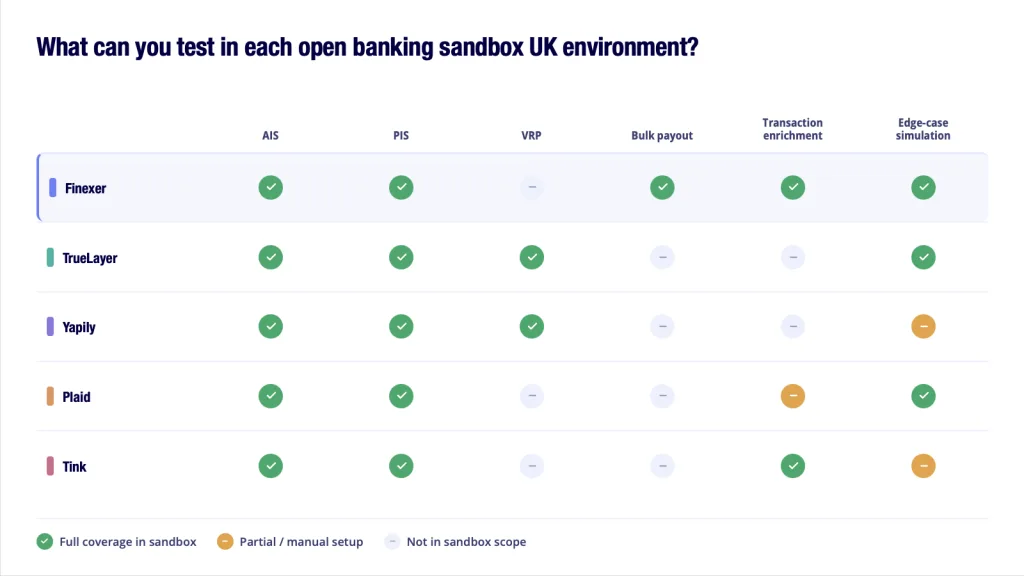
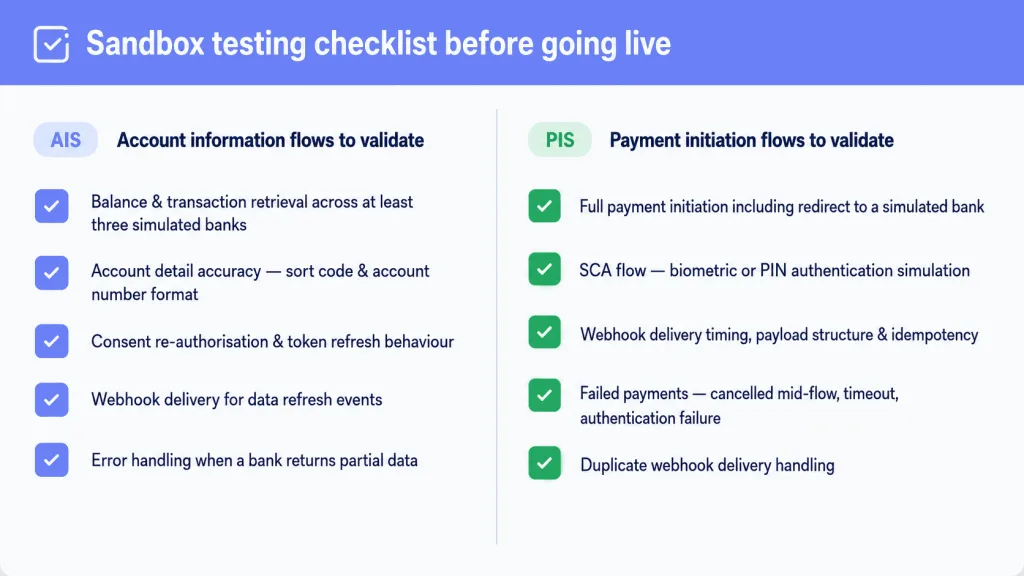
The sandbox checklist that matters most for UK platform teams building on AIS or PIS:
AIS flows to validate:
- Balance and transaction retrieval across at least three simulated banks
- Account detail accuracy (sort code, account number format)
- Consent re-authorisation and token refresh behaviour
- Webhook delivery for data refresh events
- Error handling when a bank returns partial data
PIS flows to validate:
- Full payment initiation including redirect to simulated bank
- SCA flow – biometric or PIN authentication simulation
- Webhook delivery timing, payload structure, and idempotency
- Failed payment scenarios: cancelled mid-flow, timeout, authentication failure
- Duplicate webhook delivery handling
Integration quality signals to check:
- Does the sandbox API response structure match production documentation exactly?
- Are error codes consistent between sandbox and production?
- Can you trigger edge cases (bank timeout, partial response) or only happy-path flows?
A sandbox that only validates the happy path leaves the hard work for production. For a deeper technical walkthrough of consent, redirect, and webhook layers, Open Banking API integration walks through the full engineering flow for UK platforms.
What Do Engineering Teams Find When They Switch Providers?
Engineering teams evaluating open banking providers typically start with TrueLayer or Yapily because of developer mindshare in the UK. The sandbox experience at both is solid. The friction arrives when a team finishes sandbox testing, has confidence in the integration, and then hits a sales qualification process before going live.
For teams with tight delivery timelines, that gap between sandbox-complete and production-ready is a real operational problem.
The more practical question for most UK platform teams is: what is the smallest working integration that gets to a live transaction? For Open Banking API providers with direct UK FCA authorisation and free live access, that gap narrows from weeks to days.
For teams evaluating specifically for payroll or disbursement use cases, payment initiation API for payroll breaks down bulk PIS capability across providers at the API level.
Why Does the Path From Sandbox to Live Matter More Than the Sandbox?
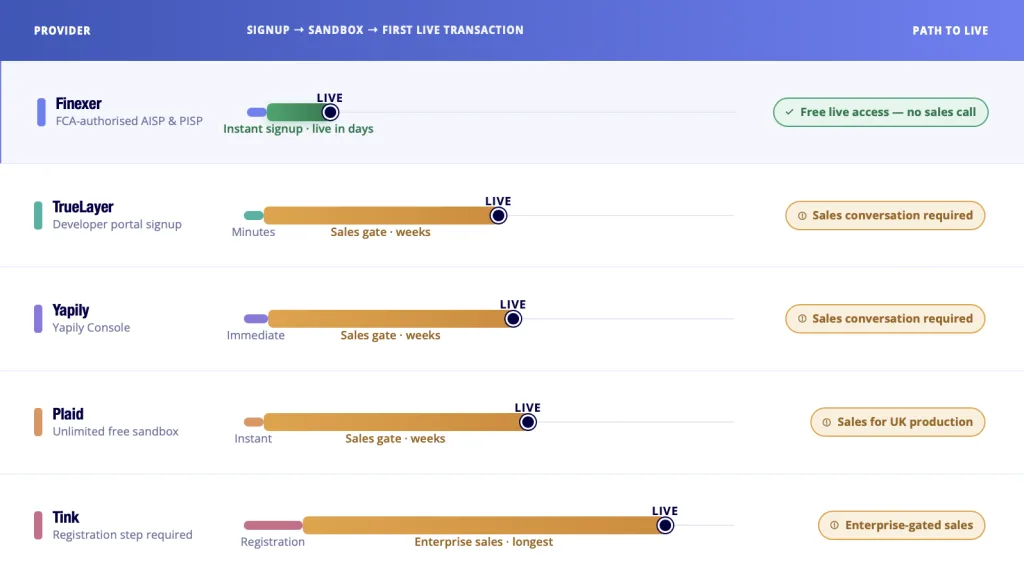
Every provider on this list offers a sandbox. The question worth asking is: after the sandbox, what happens next?
For most providers, what happens next is a sales conversation. That is a reasonable business requirement. But for teams at an early stage, or evaluating two or three providers in parallel, it adds weeks of delay before a single live transaction runs.
Finexer’s approach is different in one specific way: free live access alongside the free sandbox. Test in sandbox. Move to live. The commercial conversation about pricing at volume happens when there is volume to discuss – not before you have written a single line of integration code.
This matters in two ways:
For early-stage teams: The dependency on a sales cycle is removed from the build timeline. A team can sandbox-test on Monday and run their first live transaction on Friday, under Finexer’s FCA licence, without waiting for a contract.
For teams evaluating multiple providers in parallel: Finexer is the one option in this comparison that lets that evaluation continue through to a live transaction without a commercial gate.
What the Finexer open banking sandbox UK environment covers:
- Almost all major UK banks – high street, challenger, and business accounts
- AIS: balance, transactions, account details, transaction enrichment (95%+ accuracy), invoice matching via Transaction Tracker
- PIS: single payment initiation via Faster Payments, bulk and batch payouts, payment links, webhook confirmation
- SCA simulation: redirect, biometric, and PIN flows
- Edge cases: failed authentication, cancellation, timeout, duplicate webhooks
FCA-authorised (FRN 925695). PSD2-compliant. Usage-based pricing, no minimums. White-label PIS flows available. 3 to 5 weeks of hands-on onboarding support to production.
“The question I hear most from platform engineers after sandbox testing is when they can run a real transaction. With most providers, that question starts a sales process. With Finexer, it starts an onboarding conversation – a very different kind of meeting.” – Yuri, Finexer
What is an open banking sandbox?
A test environment simulating live bank connections without touching real accounts. Developers use it to validate consent flows, account data retrieval, payment initiation, and webhook handling before production. The best open banking sandbox environments mirror production API structure exactly – differences between sandbox and live responses are a common source of integration surprises.
Is the open banking sandbox free?
Finexer, TrueLayer, Yapily, and Plaid all offer free sandbox access. Tink requires a registration step before credentials are issued. Free sandbox does not typically mean free live access – most providers require a sales conversation before production credentials. Finexer offers free live access alongside its sandbox.
Which open banking sandbox is best for UK developers?
Depends on the use case. For AIS and PIS on UK bank rails with the fastest path to live, Finexer is the most developer-friendly in this comparison. For Pay by Bank and VRP, TrueLayer has strong PIS coverage. For white-label infrastructure, Yapily is well-structured. For identity and income verification, Plaid leads.
Can I test both AIS and PIS in the same open banking sandbox?
Yes – Finexer, TrueLayer, and Yapily all offer combined AIS and PIS in sandbox. Plaid covers both but PIS is not its primary UK use case. Tink covers both but skews AIS in practice. Testing them together matters if your platform needs data access and payment initiation in the same production flow.
Skip the sales queue – test the open banking sandbox UK with Finexer’s free sandbox.
About the Author

Yuri
Yuriy Yakushko is a fintech founder and software engineer with over 20 years of experience building financial technology. He’s passionate about creating scalable, secure infrastructure that helps businesses modernise how they access financial data and manage payments.