
Make every financial decision using today’s data, not yesterday’s.
Connect your business to FCA-authorised Open Banking infrastructure for current financial data and account-to-account payments.
Growing businesses rarely fail because they lack ambition.
They struggle because decisions are made using information that’s already out of date. Yesterday’s bank balances. Yesterday’s reconciliations. Yesterday’s cash position.
When finance teams, lenders and payment operations rely on historic information, opportunities are missed and risks become harder to spot.
Key Takeaways
Open banking for businesses changes that.
Instead of waiting for manual statement downloads or spreadsheet imports, authorised software can retrieve current banking information, with the account holder’s consent, through regulated APIs. The result is better visibility across cash flow, payments and lending without changing banks or replacing existing finance systems.
Businesses are not adopting Open Banking because it is new.
They are adopting it because it helps solve measurable commercial problems.
Ravi Ranjan, Co-founder & CEO, Finexer
“Businesses rarely struggle because they don’t have financial data. They struggle because the data arrives too late to influence the decisions that matter. Open Banking changes when information becomes available, not merely where it comes from.”
If your finance team still depends on exported bank statements, delayed reconciliations or manual payment matching, Open Banking offers a better way to work.
This guide explains how open banking for businesses supports better cash-flow visibility, lower payment costs through Pay by Bank, quicker lending decisions and stronger financial operations. It also covers what to look for when evaluating an Open Banking provider for long-term growth.
It draws upon publicly available guidance from the Open Banking Implementation Entity (OBIE), the Financial Conduct Authority (FCA) and current industry adoption data, alongside Finexer’s experience building regulated Open Banking infrastructure for software platforms, payment providers and financial applications.
Why Businesses Are Investing in Open Banking
For many organisations, the conversation has moved beyond regulatory compliance.
The question is no longer whether Open Banking works. It is whether current financial information can improve commercial decisions enough to justify implementation.
For many businesses, the answer is yes.
Whether the priority is reducing manual reconciliation, collecting invoice payments, strengthening lending applications or improving cash-flow planning, Open Banking allows authorised software to work with current banking data instead of waiting for scheduled statement downloads.
The commercial case is becoming stronger as adoption increases across the UK.
According to the Open Banking Implementation Entity (OBIE), the UK now has more than 14 million active Open Banking payments and data users, with usage continuing to grow across consumers and businesses.
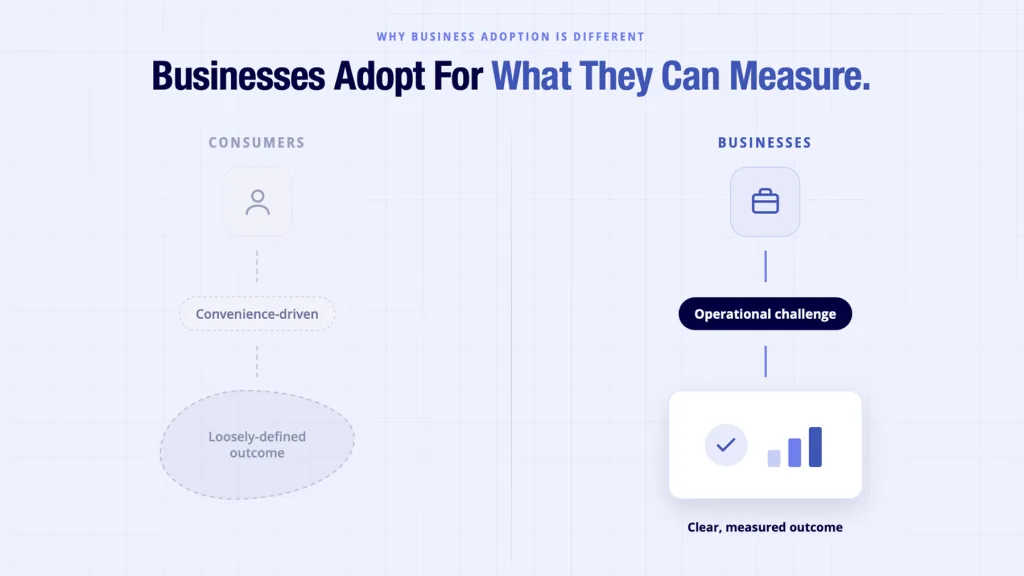
Rather than focusing on a direct comparison between consumer and business adoption rates, which varies by study, the stronger story is that organisations increasingly adopt Open Banking because the commercial outcomes are measurable: improved financial visibility, quicker payment confirmation and more efficient finance operations.
Official adoption statistics are available from the Open Banking Implementation Entity.
For businesses evaluating new financial infrastructure, the more relevant question is not how many organisations already use Open Banking.
It is what those organisations gain from using it.
Typical commercial outcomes include the following:
- Better cash-flow visibility.
- Lower administrative effort.
- Faster payment confirmation.
- Current account information inside finance software.
- Better-informed lending applications.
- Less manual reconciliation.
These improvements explain why open banking for businesses is increasingly viewed as operational infrastructure rather than an optional finance tool.
What Open Banking for Businesses Actually Means
At its core, open banking for businesses allows FCA-authorised providers to access banking information or initiate account-to-account payments after receiving explicit customer consent.
Instead of exporting CSV files, emailing bank statements or manually entering transactions into accounting software, banking information can flow directly into authorised business systems.
That includes the following:
| Business Activity | Traditional Banking | Open Banking for Businesses |
|---|---|---|
| Account balances | Manual login or exported statements | Current balances through secure APIs |
| Payment collection | Cards or manual bank transfers | Pay by Bank where appropriate |
| Reconciliation | CSV imports and manual matching | Structured transaction data |
| Cash-flow reporting | Historic reports | Current financial information |
| Lending | Manual document submission | Permission-based account sharing |
Open Banking does not replace business banking.
It allows the banking information businesses already have to work more effectively across the software they already use.
For organisations considering open banking for small businesses, that distinction matters.
The objective is not to introduce another banking platform.
It is to improve how financial information supports everyday commercial decisions.
Where Businesses Are Putting Open Banking to Work
Open Banking is no longer confined to fintech.
Businesses across multiple sectors use authorised banking data to improve financial visibility, reduce manual work and connect banking information with the systems that support day-to-day operations.
Examples include:
| Industry | Typical Use Case |
|---|---|
| Accounting | Automated reconciliation and client reporting |
| ERP | Current banking data supporting planning and forecasting |
| Lending | Permission-based affordability assessments |
| Payroll | Account verification and payment workflows |
| Property technology | Rent collection and tenant payments |
| B2B platforms | Seller payouts and payment reconciliation |
The implementation differs by sector, but the objective remains consistent: bring current banking information closer to the point where financial decisions are made.
For example, Proptech businesses specifically can improve rent collection and payment reconciliation by integrating Open Banking into property management workflows.
Similarly, law firms adopting this can improve client account reconciliation and payment verification.
The same applies to accounting firms, where authorised banking data reduces manual bookkeeping across multiple client accounts.
Where Finexer Fits
Adopting Open Banking is only part of the equation.
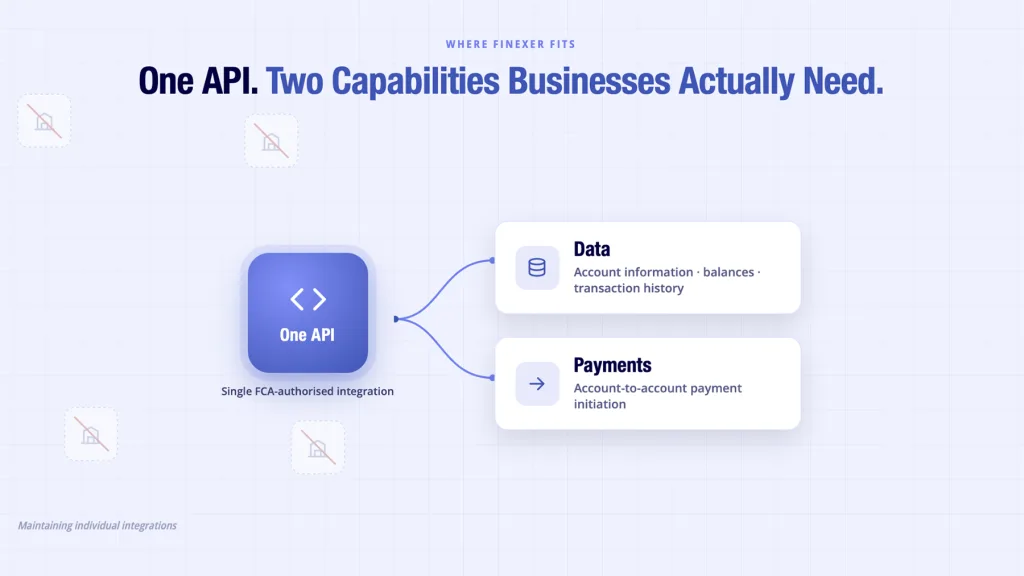
Businesses also need infrastructure that connects securely to UK banks without maintaining individual integrations.
Finexer provides regulated Open Banking infrastructure for businesses, software platforms and financial applications.
If your priority is authorised account information, balances and transaction history, Finexer’s Data product provides access through a single API.
If your priority is account-to-account payments, the Payments product supports regulated Payment Initiation Services over the UK’s Faster Payments network.
When evaluating providers, businesses should also understand how financial data aggregators compare before choosing an infrastructure partner.
When assessing an Open Banking provider, consider:
- UK bank coverage.
- FCA authorisation.
- API documentation.
- Implementation time.
- Commercial pricing.
- Developer support.
Finexer also offers capabilities designed for organisations moving from evaluation to implementation, including:
- FCA-authorised Account Information Services (AIS) and Payment Initiation Services (PIS).
- One integration for both data access and Pay by Bank.
- Broad UK bank coverage.
- Usage-based pricing that scales with adoption.
- White-labelled payment and consent journeys.
- Dedicated implementation support from onboarding through production.
- API-first architecture for software platforms and financial applications.
Selecting the right provider is about more than connectivity.
It is about choosing infrastructure that supports current requirements while giving your engineering and product teams room to build new financial experiences as your business grows.
Is Open Banking Right for Your Business?
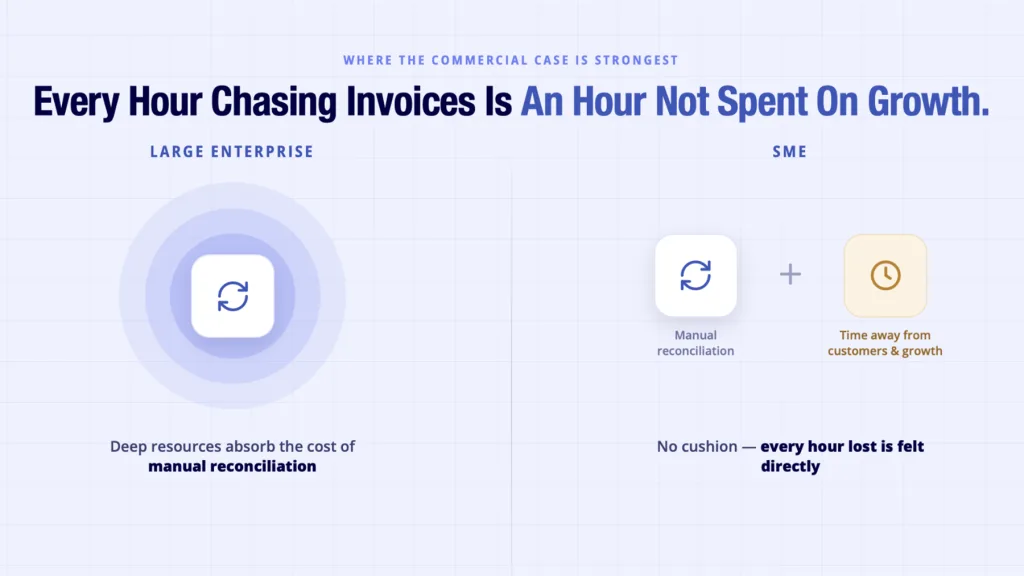
Open banking for businesses delivers the greatest value where finance teams repeatedly deal with manual processes or delayed financial information.
It is particularly valuable for organisations that:
- Collect high volumes of invoice payments
- Reconcile transactions every day
- Need better cash-flow visibility
- Apply for business lending regularly
- Build financial software or connected platforms
For many SMEs, open banking for small businesses is becoming an expected capability rather than an emerging technology.
The aim is not to change how businesses bank.
It is to improve how banking information supports everyday decisions.
Do businesses need to change banks to use Open Banking?
No. Open Banking works alongside existing business bank accounts. Businesses continue banking with their current provider while authorising approved software to access account information or initiate payments where appropriate.
How should businesses compare Open Banking providers?
Look beyond headline bank coverage. Evaluate FCA authorisation, API quality, implementation support, pricing, payment capabilities, documentation and the provider’s ability to support future product requirements.
Can Open Banking work alongside existing accounting or ERP software?
Yes. Many organisations connect Open Banking to accounting platforms, ERP systems and finance software instead of replacing them. The objective is to improve the flow of authorised financial data into existing business processes.
What should businesses prepare before implementing Open Banking?
Implementation is typically smoother when organisations identify the systems that will consume banking data, define consent journeys, involve finance and engineering teams early, and agree how success will be measured after deployment.
Turn Better Financial Data Into Better Business Decisions
The businesses gaining the greatest advantage from Open Banking are not changing banks.
They are replacing delayed financial information with current, permission-based data that improves payments, lending and day-to-day financial operations.
See Finexer in Action
Discover how Finexer helps businesses connect to UK Open Banking through one FCA-authorised integration for data and payments.
Explore with AI
About the Author

Ravi Ranjan
Ravi Ranjan is Co founder & CEO of Finexer