
Discover what really protects your financial data and what doesn’t.
Most concerns about Open Banking don’t come from security weaknesses.
They come from misconceptions about consent, data sharing and control.
Understanding the difference helps businesses evaluate Open Banking with greater confidence.
Key Takeaways
Many businesses still hesitate to adopt Open Banking because they believe they lose control of their financial data once they give consent.
In reality, the UK’s Open Banking framework was built around customer control, permission-based access and regulated APIs.
This guide separates common myths from the facts, helping business owners understand what Open Banking security actually does, and does not, promise.
Introduction
If someone asked to log in to your bank account using your username and password, you’d probably refuse.
If they wanted permanent access to every transaction you’ve ever made, the answer would almost certainly be no.
Yet many business owners assume that’s exactly how Open Banking works.
It isn’t.
Despite years of adoption across the UK, misconceptions about open banking security continue to shape buying decisions.
Some businesses believe they lose control of their banking data.
Others assume Open Banking stores their credentials or shares information without limits.
These concerns are understandable, but they don’t reflect how the framework actually operates.
Much of the scepticism comes from confusing today’s regulated Open Banking ecosystem with older techniques such as screen scraping, where users handed over their online banking credentials to third-party applications.
Modern Open Banking was designed specifically to move away from that model.
Understanding that distinction is often the difference between dismissing Open Banking and recognising why it has become a trusted part of the UK’s financial infrastructure.
Ravi Ranjan, Business Lead at Finexer
“The biggest misunderstanding about Open Banking security isn’t that people think hackers can access their bank accounts. It’s that many still believe giving consent means giving away control. In reality, consent exists precisely because control stays with the customer.”
This blog draws on the UK Open Banking framework, FCA regulatory guidance and publicly available industry research.
Rather than focusing on technical implementation, it addresses the questions businesses most commonly ask before adopting Open Banking: Who controls my data? What happens after I give consent? Can I change my mind?
The aim is to explain these concepts in plain language without assuming technical knowledge.
Why Do These Myths Still Exist?
Open Banking has been part of the UK’s financial landscape for several years, yet awareness hasn’t always kept pace with adoption.
Research consistently shows that many consumers and business owners still don’t fully understand how Open Banking protects financial information.
That knowledge gap creates room for outdated assumptions, particularly among organisations that remember earlier methods of connecting financial applications to bank accounts.
In many cases, people aren’t questioning the technology itself; they’re comparing it with systems that no longer define how regulated Open Banking works.
That’s why discussions around open banking security often begin with myths rather than facts.
Myth 1: “Open Banking Gives Companies Permanent Access to My Bank Account”
This is probably the most common misconception and one of the easiest to disprove.
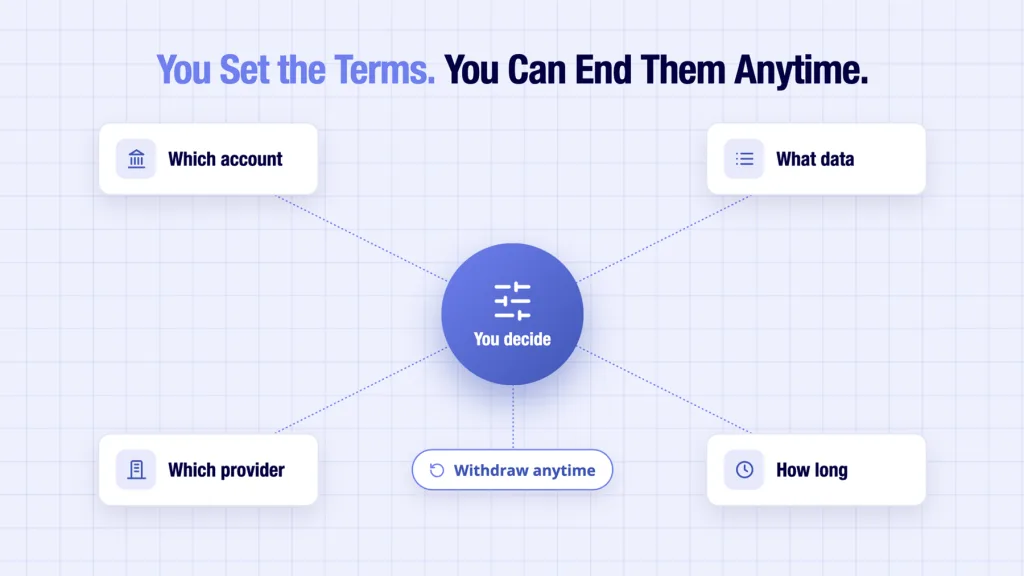
When you use an Open Banking service, you don’t hand over unrestricted access to your bank account.
Instead, you decide:
- which account can be accessed;
- what information can be shared;
- which regulated provider receives it; and
- how long that permission remains valid.
Nothing happens without your explicit approval.
Equally important, consent isn’t permanent.
You can withdraw permission through your bank or the authorised provider, after which access ends.
Open Banking was designed so that customers remain in control throughout the process, rather than surrendering access indefinitely.
This permission-based model is one of the defining characteristics of open banking api security.
Rather than relying on shared passwords, regulated APIs allow specific data to be shared only after consent has been granted for an agreed purpose.
That distinction is central to understanding why Open Banking differs from older account-access methods.
Myth 2: “My Banking Password Is Shared with Third Parties”
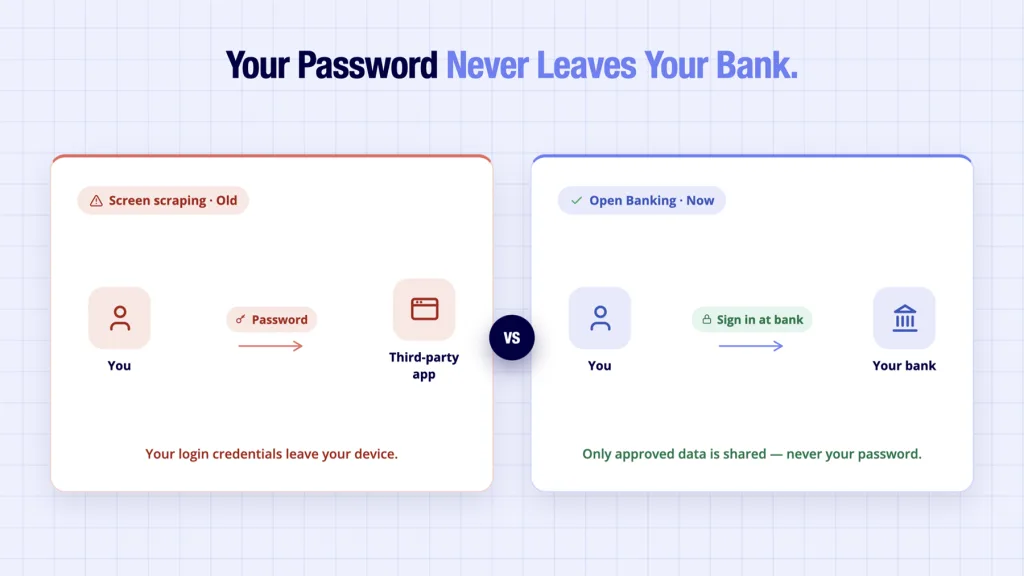
This myth dates back to the early days of financial aggregation, when some services relied on screen scraping.
Users entered their online banking credentials into third-party applications, which then logged into their bank accounts on their behalf. That approach understandably raised security concerns because account credentials were being shared.
Open Banking was introduced to replace that model.
When a business connects to an Open Banking service, authentication takes place on the bank’s own website or mobile app. The customer signs in directly with the bank, not with the third-party provider.
The Open Banking provider never sees, stores or requests the customer’s online banking username or password.
Instead, once authentication is complete, the bank grants access through regulated APIs based on the consent the customer has provided.
This distinction sits at the heart of open banking api security.
Instead of sharing login credentials, businesses share only the information they have explicitly authorised a regulated provider to access.
If you’d like a more technical explanation of how APIs, authentication and permissions work together, read Open Banking API security.
Myth 3: “Once Data Is Shared, Banks Can’t Protect It”
Some businesses assume that giving consent means their bank loses responsibility for protecting their financial information.
That’s not how the Open Banking framework operates.
Open Banking providers must meet strict regulatory and security requirements before they can access customer data.
Banks continue to authenticate customers, manage permissions and provide secure access through regulated APIs.
Consent does not remove security controls.
It defines the scope of what can be shared, with whom, and for how long.
If consent expires or is withdrawn, the provider’s access also ends.
This is one of the reasons Open Banking is widely regarded as a significant improvement over older account-connection methods.
Rather than allowing unrestricted access, the framework limits access to what the customer has authorised.
Myth 4: “Every Open Banking App Can See Everything”
Many people picture Open Banking as an “all-or-nothing” system.
They assume that once permission is granted, every connected application can view every account and every transaction.
In reality, consent is specific.
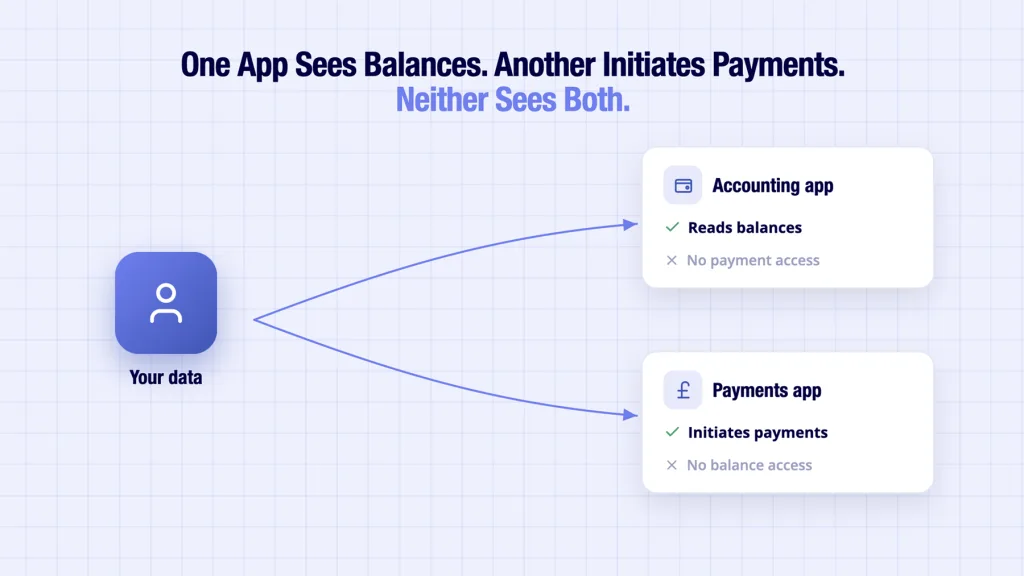
A business may authorise one application to retrieve account balances while another is permitted only to initiate payments.
Neither automatically gains unrestricted access to every financial detail.
This principle of limited, purpose-based access helps businesses remain in control of their information.
Different providers receive different permissions depending on the service they offer.
That means using one regulated Open Banking application does not automatically give another provider access to the same data.
If you’re still wondering is Open Banking safe, we’ve answered that question in greater detail here.
Myth vs Reality
| Myth | Reality |
|---|---|
| Open Banking gives permanent account access. | Customers decide what is shared and can withdraw consent. |
| Providers receive banking passwords. | Authentication happens directly with the bank; credentials are not shared. |
| Banks lose control after consent is given. | Banks continue to authenticate customers and manage secure API access. |
| Every provider sees all financial data. | Access is limited to the permissions granted by the customer. |
These misconceptions persist because many people still associate Open Banking with older technologies that relied on credential sharing.
Today’s regulated framework was built to replace those practices, giving businesses greater visibility over who accesses their data and why.
Myth 5: “Open Banking Is Less Secure Than Traditional Banking”
This myth often comes from familiarity.
Traditional online banking has existed for decades, so it feels safer simply because people know it better.
Open Banking, by comparison, is newer.
That alone can make it appear less trustworthy, even though it was introduced to improve how financial data is shared.
Unlike older methods that relied on credential sharing, Open Banking uses regulated APIs, customer consent and bank-controlled authentication.
The result is a framework that gives customers greater visibility over who can access their financial information and for what purpose.
That doesn’t mean Open Banking eliminates every cybersecurity risk.
No digital financial service can make that claim.
It does mean that the UK’s Open Banking framework was specifically designed to reduce risks associated with older account-access methods while placing customers firmly in control of permissions.
Understanding this distinction helps businesses evaluate Open Banking based not on assumptions carried over from the past but on how it actually works.
Why Consent Matters More Than Most Businesses Realise
When people hear the word “consent,” they often think about ticking a box before using an app.
In Open Banking, consent means considerably more.
It defines the boundaries of access.
Businesses decide:
- which accounts can be connected;
- which regulated provider receives access;
- what information can be shared;
- how long that permission lasts; and
- when access should end.
Consent is therefore not a one-time surrender of financial data.
It is an ongoing mechanism that keeps control with the account holder.
That principle underpins much of open banking security and explains why discussions about data protection should begin with customer control rather than technology alone.
For a broader consumer-focused discussion that addresses additional misconceptions, read the truth about Open Banking security.
Secure Connectivity Still Depends on the Right Infrastructure
Understanding Open Banking security is one thing.
Building applications that implement it correctly is another.
Businesses developing financial products need infrastructure that connects securely to UK banks while complying with the Open Banking framework.
Finexer’s Connect infrastructure provides regulated connectivity that enables businesses to integrate with UK banks through a single connection rather than maintaining multiple individual integrations.
The technology may operate behind the scenes, but its purpose reflects the same principles discussed throughout this guide: permission-based access, customer control and regulated API connectivity.
Is Open Banking secure?
Yes. The UK Open Banking framework uses regulated APIs, customer consent and bank-controlled authentication. Rather than sharing online banking credentials, customers authorise specific access for a defined purpose and can withdraw that permission at any time.
How does Open Banking protect financial data?
Financial data is shared only after explicit customer consent. Authentication takes place directly with the customer’s bank, and providers receive only the information necessary for the authorised service rather than unrestricted account access.
What are the most common myths about Open Banking security?
Common misconceptions include believing that providers receive banking passwords, that consent is permanent, that every application can access all financial data, or that Open Banking is less secure than older connection methods.
Is Open Banking safer than screen scraping?
Yes. Unlike screen scraping, Open Banking does not require customers to share their online banking credentials with third-party providers. Instead, access is granted through regulated APIs after authentication with the customer’s bank.
Learn the Facts Before You Decide
Questions about open banking security are healthy.
Businesses should understand how financial data is accessed, who controls it and what protections exist before adopting any financial technology.
The good news is that many of the concerns surrounding Open Banking stem from misconceptions rather than from the framework itself.
The more businesses understand how consent, regulated APIs and customer control work together, the easier it becomes to separate long-standing myths from today’s reality.
If you’re beginning your Open Banking journey, keep learning.
The better you understand the framework, the more confidently you’ll be able to evaluate the products and providers built on it.
See how Finexer’s UK-exclusive focus provides 99% bank coverage without multi-market complexity.
Explore with AI
About the Author

Ravi Ranjan
Ravi Ranjan is Co founder & CEO of Finexer