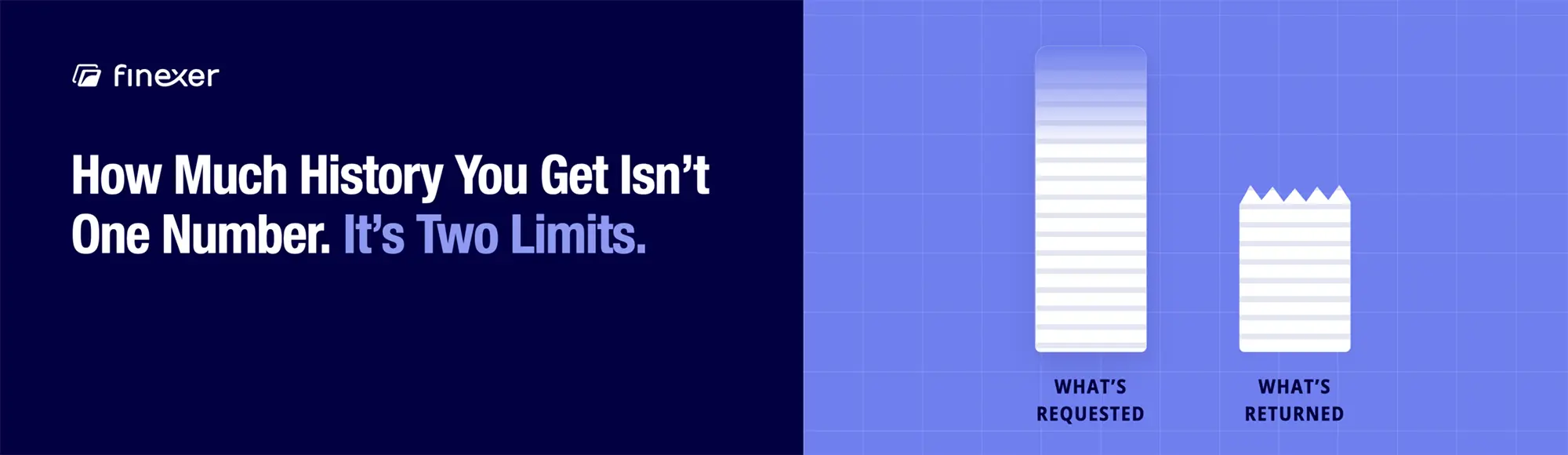
Open banking transaction history depends on two limits: what the provider requests and what the connected bank supports. Finexer can request up to seven years through retro_date, but actual depth varies by bank, with some returning around two years. Some banks also restrict older transactions to a short period after consent.
How much historical data can Open Banking provide?
There is no single UK-wide look-back period that applies to every bank. A provider may request a particular date range, but the bank controls the historical banking data it makes available.
As for Finexer, the API can request up to 7 years using retro_date. That figure is a request limit and not a promise that every account will return seven years. Some connected banks provide less history, including around two years.
Why does bank support affect transaction history?
Banks differ in the amount of historical information they expose through their Open Banking interfaces.
Think of historical access as two stages:
| Factor | What It Means |
|---|---|
| Provider request | The API asks for transactions from a chosen date. |
| Bank response | The bank returns the historical period it supports. |
A provider cannot turn a two-year bank response into 7 years of historical banking transaction data. Platforms should therefore treat the returned period as account-specific rather than assume one fixed range.
Is there a time limit for retrieving older transactions?
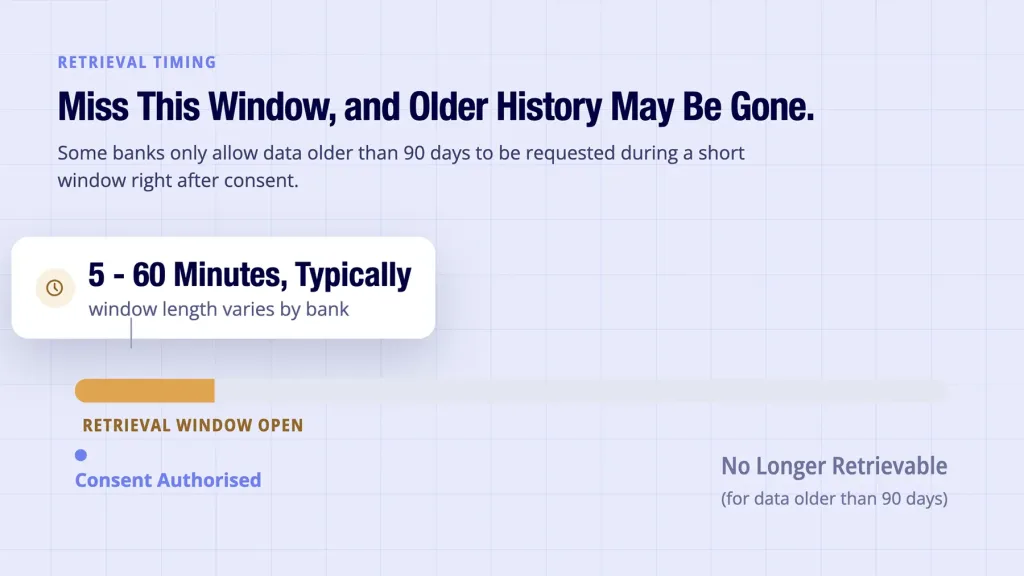
Yes. Some banks only allow transactions older than 90 days to be retrieved during a short window, typically five to 60 minutes after consent authorisation.
This timing rule is separate from the duration of consent. Customers must reconfirm consent with the AISP at least every 90 days, but that does not mean consent itself expires after 90 days.
A platform that needs deep history should request it at the right point in the connection journey. Waiting may mean older transactions are no longer available.
How should a platform request older transactions?
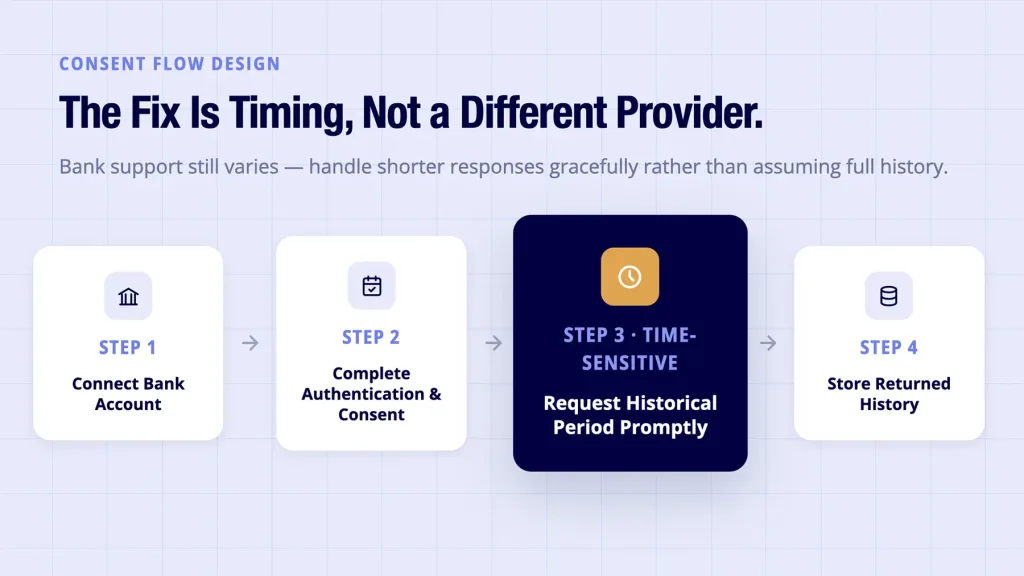
If historical data matters, build the connection flow around the bank’s retrieval rules.
- Ask the user to connect their bank account.
- Complete bank authentication and consent.
- Request the required historical period promptly where the bank imposes a retrieval window.
- Store the returned history according to the platform’s data requirements.
- Handle shorter bank responses without presenting the requested period as guaranteed.
When choosing an api for banking transactions, look beyond the maximum request period and ask how the provider handles bank-specific historical access.
How do Open Banking providers compare?
Providers differ in geographic focus, product scope and infrastructure model. Historical data is only one selection factor.
| Provider | General Positioning |
|---|---|
| Finexer | UK-focused Open Banking infrastructure, with AIS and PIS |
| TrueLayer | UK-founded Open Banking provider covering data and payments |
| Yapily | API-focused Open Banking infrastructure across European markets |
| Plaid | Large financial-data connectivity platform with strong US coverage |
| Tink | European Open Banking and financial-data infrastructure |
| Salt Edge | Global Open Banking infrastructure, with AIS and PIS across a broad international footprint |
Bank support still affects the result. Platforms should assess UK bank coverage, historical retrieval behaviour, consent flows and API requirements together.
For teams comparing financial data providers UK, compare historical behaviour with bank coverage and consent flows.
What does Finexer provide for historical banking transaction data?
Finexer’s Data product provides consent-based, read-only access to UK bank account information through AIS. It can return account, balance and transaction data, subject to bank support.
Finexer’s documented historical transaction depth reaches up to 7 years through retro_date, while the Knowledge Base states that some banks return around two years. Some banks also apply the short retrieval window for data older than 90 days.
You can review Finexer’s banking transaction data API to assess its Data product for historical data.
What is the key takeaway?
Open Banking does not provide one fixed transaction-history period across UK banks.
The three points to remember are:
- The provider determines what historical period it requests.
- The bank determines what historical period it returns.
- Some banks require older data to be requested shortly after consent.
For platforms building reporting, reconciliation or account-data features, planning around these differences can prevent gaps in historical records.
Can historical transaction data be used for financial reporting?
Yes. Historical transaction data can support reporting workflows by giving platforms a record of account activity over a defined period. The available period still depends on what the connected bank makes accessible through its Open Banking interface.
Can a platform retrieve historical transactions from multiple bank accounts?
Yes, where the relevant accounts are connected and the banks provide the requested history. Each account can return a different period, so platforms should handle historical data on an account-by-account basis rather than assume identical coverage.
Does Open Banking historical data include categorised transactions?
Not necessarily. Transaction categorisation depends on the provider and the data services being used. Platforms should distinguish between the transaction information supplied through AIS and any additional categorisation or enrichment applied afterwards.
Can previously retrieved transaction history be refreshed later?
Yes, a platform can request updated transaction data when the account connection remains available and the bank supports the relevant request. However, a later refresh does not guarantee that the same historical depth will be available under every bank’s retrieval rules.
Need historical banking transaction data without assuming every bank returns the same period? Finexer’s Data API can request historical transactions while accounting for bank-specific limits.
Explore with AI
About the Author

Ravi Ranjan
Ravi Ranjan is Co founder & CEO of Finexer