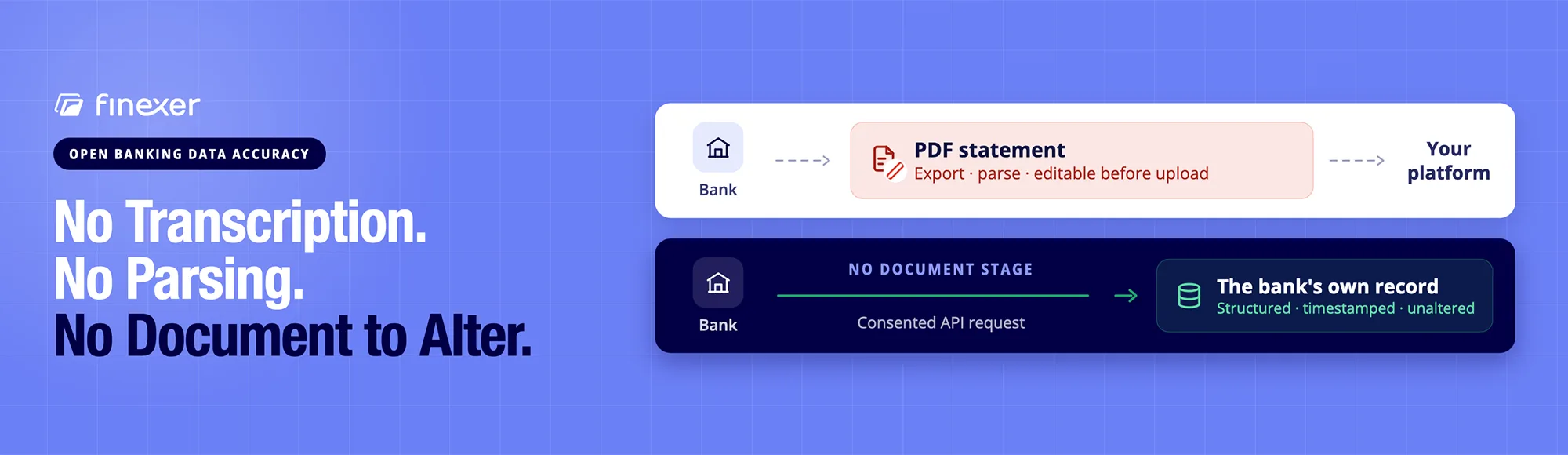
Open Banking data comes from the bank’s own record, so there is no transcription or parsing step and no document that can be altered before it reaches you.
An uploaded statement, by contrast, has already passed through a PDF export and often a parsing tool before a platform ever sees the numbers. Each of those steps is a place where banking data accuracy can slip, and none of them are visible to the person relying on the final figure.
Contact UsUploaded Statement vs API Data: What Actually Differs?
| Provider type | Examples | Approach |
|---|---|---|
| Data-only (AISP) | Moneyhub Enterprise | Provides standard Open Banking account and transaction data, with the level of enrichment varying by provider. |
| Combined AIS and PIS | TrueLayer, Yapily, Salt Edge | Combines account information services with payment initiation through a single API. |
| Combined AIS and PIS, enrichment-focused | Finexer, Tink | AIS and PIS, with strong emphasis on categorisation and transaction enrichment alongside data access. |
The API route removes an entire category of error that has nothing to do with the bank itself and everything to do with what happens to the data after it leaves the bank. It does not remove the need to interpret what the data means, which matters more than it first appears.
Where Does PDF Parsing Lose Accuracy?
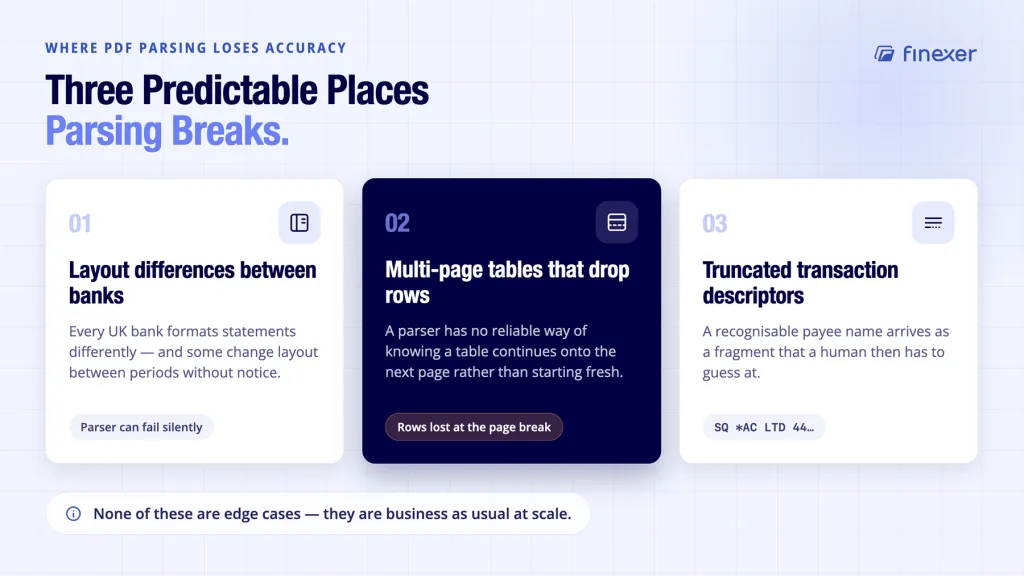
PDF parsing loses accuracy at three predictable points: layout differences between banks, multi-page tables and truncated transaction descriptors.
Every UK bank formats its statements differently, and some change their layout between statement periods without notice. A parser tuned for one layout can misread another entirely or fail silently and return a blank field instead of an error.
Tables that span several pages frequently drop rows at the page break as the parser has no reliable way of knowing that a table continues onto the next page rather than starting fresh. Transaction descriptors get cut off mid-string, turning a recognisable payee name into a fragment a human has to guess.
None of these are edge cases, rather they are business as usual for PDF parsing at scale across thousands of statements from dozens of different banks.
What Does API Data Still Need Before It’s Usable?
API data still needs enrichment before it becomes fully usable because standard Open Banking data is written for bank systems and not for a person trying to recognise who was paid.
Bank transaction data arrives structured and accurate, but a descriptor such as a truncated merchant code still needs turning into a name, category and legal entity before a finance team can act on it without stopping to interpret it manually.
Is API Data Always the Better Choice?
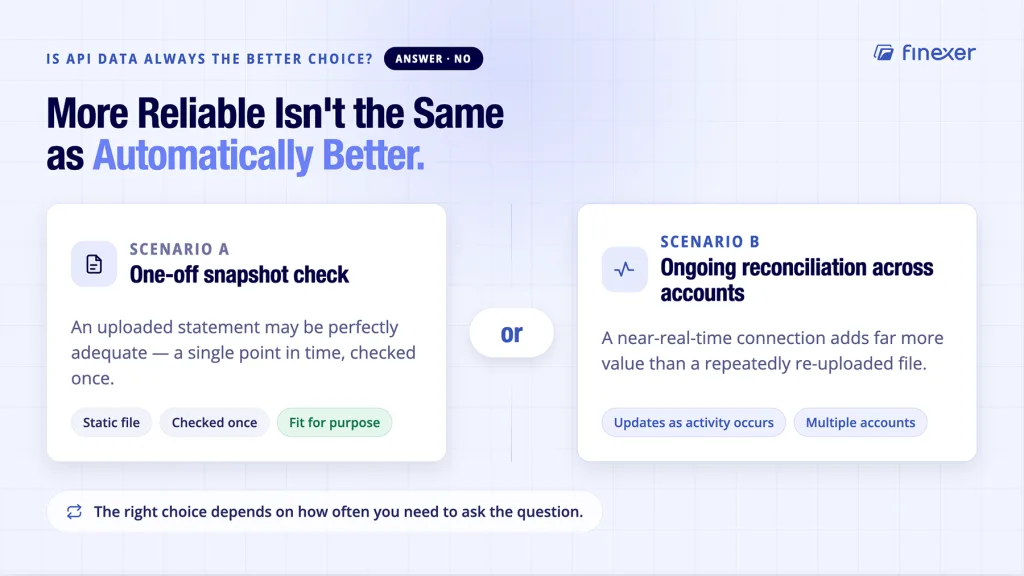
No. API data is more reliable than an uploaded statement, but that is not the same as being presumed to be or automatically better for every use case.
A platform that only needs a snapshot for a one-off check might find an uploaded statement perfectly adequate. A platform running ongoing reconciliation, or checking data through third party banking apps against multiple accounts, gets far more value from a near-real-time connection than a repeatedly re-uploaded file.
What Drives Open Banking Data Accuracy Between Providers?
Not every Open Banking provider treats data accuracy and enrichment the same way.
| Provider Type | Examples | Approach |
|---|---|---|
| Data-only (AISP) | Moneyhub Enterprise | Standard Open Banking structured data, enrichment varies by provider |
| Combined AIS and PIS | TrueLayer, Yapily, Salt Edge | Structured data plus payment initiation from one API |
| Combined AIS and PIS, enrichment-focused | Finexer, Tink | AIS and PIS, with strong emphasis on categorisation alongside data access |
The accuracy of the underlying data is largely a function of the bank connection itself and not of the provider. What varies more between providers is what happens to that data next. It would be remiss not to mention that Finexer’s banking data API is also worth considering, given its additional payment initiation capabilities.
Can Open Banking data be edited before I receive it?
No. It comes directly from the bank’s own record through a consented API request, with no document stage where it could be altered.
Does Open Banking data include every transaction?
It returns the full transaction set available for the connected account and period, unlike PDF exports, which can drop rows across page breaks.
Is Open Banking data considered more trustworthy because it’s regulated?
Yes, in the sense that it is consented and regulated by definition. The more useful distinction for accuracy purposes is real-time versus static and not whether it counts as trustworthy.
Do I still need to check the data manually?
Standard Open Banking data often need enrichment to become recognisable merchant names, so there is usually scope for some interpretation step usually remains, even with accurate underlying data.
See the Difference in Your Own Data. Manual statement uploads introduce parsing errors that near-real-time banking data avoids entirely.
Explore with AI
About the Author

Yuri
Yuriy Yakushko is a fintech founder and software engineer with over 20 years of experience building financial technology. He’s passionate about creating scalable, secure infrastructure that helps businesses modernise how they access financial data and manage payments.