Does open banking work for business accounts? Yes. Open banking for business accounts covers business current accounts alongside personal ones in the UK, so a platform can read business account, transaction, and balance data and initiate payments from them, with the account holder’s consent.
Most content on open banking UK access skips this distinction entirely, treating business and personal coverage as identical. They are not, and the difference matters if you’re building a product that touches business bank accounts.
Key Takeaways
- Yes. Open banking for business accounts works in the UK today, covering high-street, challenger and business-only providers.
- Business accounts differ from personal ones on one point specifically: consent, which must come from an authorised signatory and can involve multiple approvers.
- Finexer covers almost all UK banks across account types, including business accounts.
- Business account access unlocks reconciliation, cash position visibility, and payment initiation, not just read-only data.
- Finexer’s Data and Payments products work across business accounts with consent handling built in, not bolted on.
Does Open Banking Work for Business Bank Accounts?
Open banking for business accounts is live and regulated across the UK’s major banks, business-only providers and challengers. The mechanics match personal open banking: AIS for account, balance and transaction data, PIS for payments, both requiring consent. What changes is who gives that consent.
What Makes Open Banking for Businesses Different From Personal Accounts?
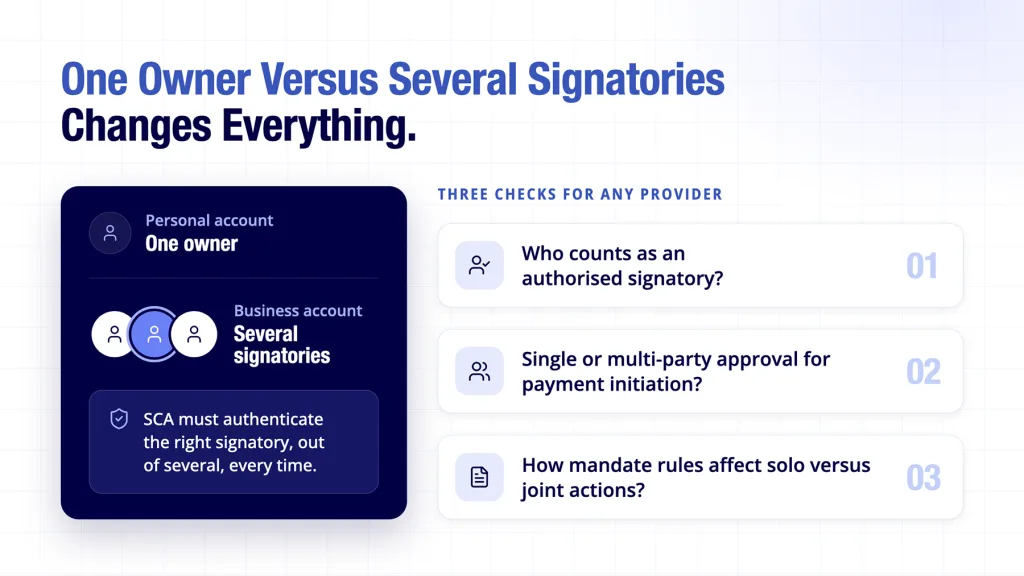
The core difference in open banking for businesses is consent structure. A personal account has one owner who authorises access. A business current account often has multiple authorised signatories, and some banks require more than one signatory to approve before a platform can connect or initiate a payment.
Three things to check for any business account integration:
- Who counts as an authorised signatory for that specific account?
- Whether the bank requires single or multi-party approval for payment initiation?
- How mandate rules affect which actions a signatory can take alone versus jointly?
This is also where Strong Customer Authentication gets more complex. A personal account authenticates one person. A business account may need to authenticate the right signatory, out of several, correctly, every time.
How Much Business Account Coverage Does Open Banking Have in the UK?
Coverage claims for open banking for businesses are usually quoted as one blended number that rarely confirms whether business accounts are actually included.
- Finexer’s coverage spans almost all UK banks, including business current accounts and challenger banks.
Confirm this for any provider: A bank count that doesn’t separate business from personal coverage isn’t a real measure of open banking for business accounts.
What Do Open Banking Benefits for Businesses Actually Unlock?
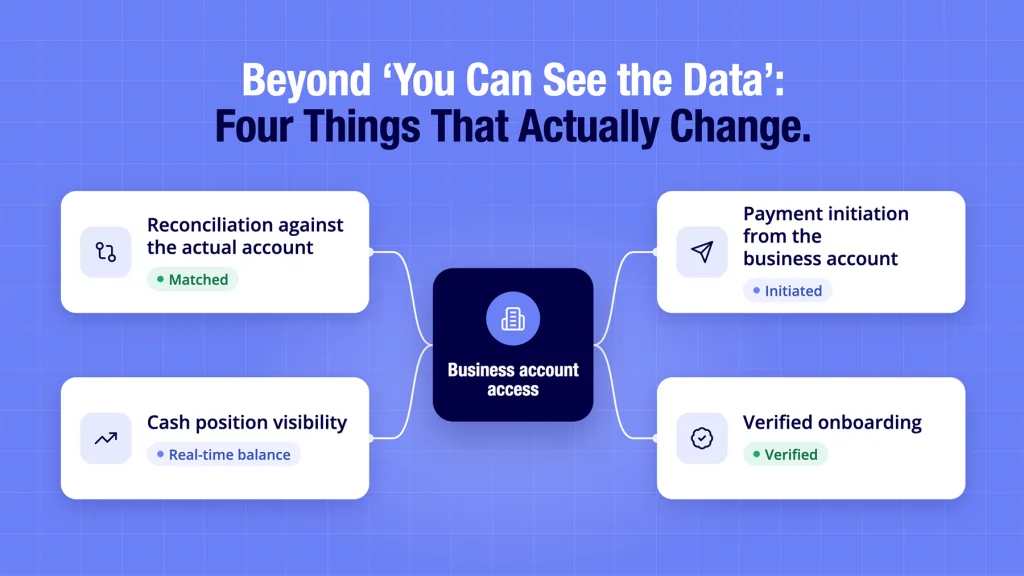
Real open banking benefits for businesses go beyond “you can see the data.” The open banking benefits for businesses that matter operationally show up in four places specifically:
- Reconciliation Against the Actual Account: Matching transactions to the business’s real bank feed rather than a manual export. See our guide to reliable bank feeds for how this works in accounting platforms.
- Cash Position Visibility: Real-time balances instead of a snapshot from yesterday’s statement.
- Payment Initiation from the Business Account: Open banking payments sent directly from the account itself, covered in more depth in our guide to open banking APIs for B2B payments.
- Verified Onboarding: Confirming the business account and its holder before a platform relies on it.
From April 2026, Making Tax Digital for Income Tax becomes mandatory for businesses turning over more than £50,000, which turns these open banking benefits for businesses into a compliance requirement rather than a convenience.
With 5.7 million SMEs making up 99.85% of the UK business population, open banking UK access at this scale touches most of the country’s business banking relationships at once. Open banking payments, specifically, are the piece most platforms underbuild, treating initiation as an afterthought to the data layer instead of an equal capability.
How Does Business Account Consent Actually Work?
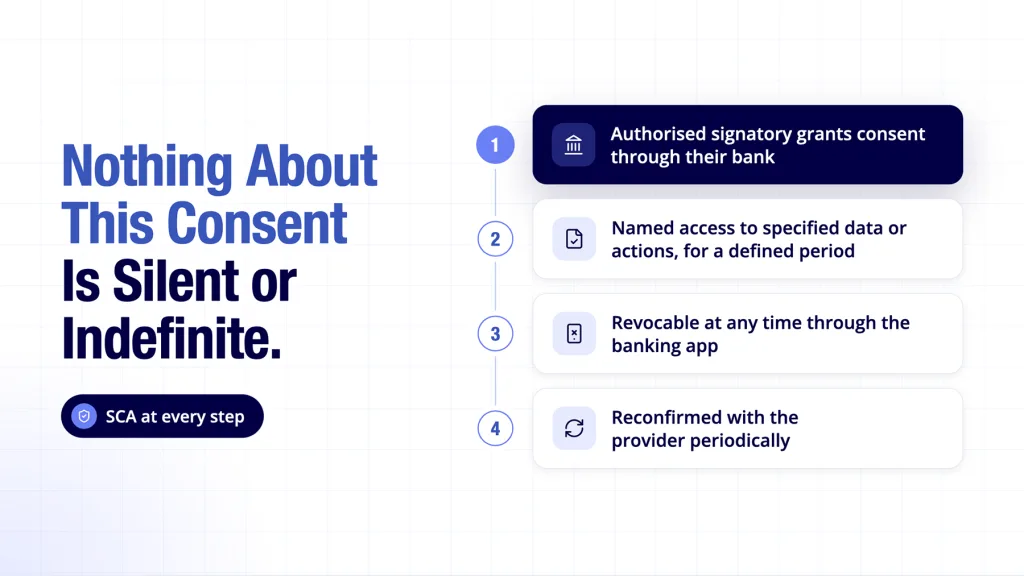
Open banking data sharing for a business account starts when an authorised signatory grants consent through their bank, following the same basic journey as a personal account with additional signatory rules.
The customer must reconfirm consent with the AISP at least every 90 days, while bank-level re-authentication is only required in permitted circumstances. Read more on how open banking data sharing works in practice, including revocation and renewal.
What the business owner is actually agreeing to? Named access to specified account/balance/transaction data or payment actions, for a defined period, revocable at any time through their own banking app, authenticated through Strong Customer Authentication at every step. This is core to open banking for businesses done properly, and nothing about that consent is silent or indefinite.
Who Uses Open Banking for Business Accounts?
Open banking for businesses shows up differently by ICP. Four open banking examples cover most real deployments of open banking for business accounts:
| ICP | What Business Account Access Solves |
|---|---|
| Accounting & ERP | Live bank feeds for reconciliation, replacing manual statement imports |
| Payroll & Invoicing | Payment initiation and status tracking against the business account |
| Proptech | Rent collection and landlord account visibility |
| Utility Billing | Business-account payment collection at scale |
Where Does Finexer Fit for Open Banking for Business Accounts?
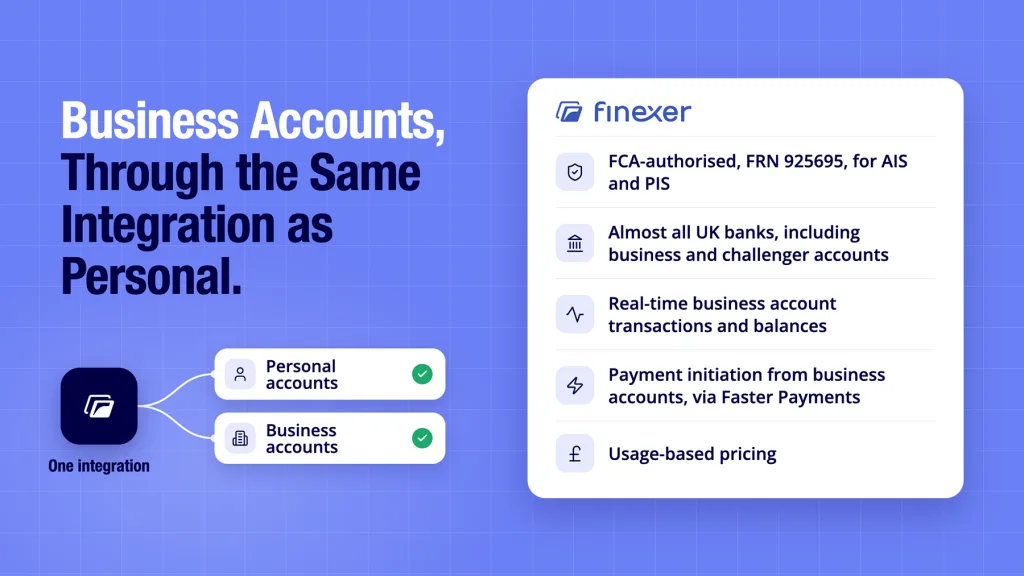
Business accounts aren’t an edge case for Finexer, unlike much open banking for businesses content assumes. The open banking benefits for businesses are covered the same way personal accounts are, through one integration.
| Capability | Detail |
|---|---|
| Coverage | Most of the UK banks, including business and challenger accounts |
| Data access | Real-time business account transactions and balances |
| Payments | Initiation from business accounts, instant via Faster Payments |
| Authorisation | FCA-authorised (FRN 925695) for AIS and PIS |
| Pricing | Transparent pricing with no hidden charges |
Real-time data and payment initiation across business accounts are available through Finexer’s bank data API, the same integration used for personal accounts, with no separate product to add on. For teams building on this at platform level, our B2B open banking guide covers the wider picture, and general open banking advantages are covered in our open banking for businesses guide.
Bottom Line
Open banking for business accounts works today across UK high-street, challenger and business-only providers, but coverage and consent rules differ from personal accounts in ways most guides skip. The real open banking benefits for businesses come from matching the provider to your actual account type, not from bank count alone.
The distinction that matters is signatory-based consent, not raw bank count. Before choosing a provider, confirm its business account coverage specifically, check its listing in the open banking directory, and verify how it handles multi-signatory mandates.
Finexer covers business accounts through the same FCA-authorised integration used for personal accounts, with most UK bank coverage and consent handling built in from the start.
Can open banking access business bank accounts?
Yes. Open banking for business accounts, and the open banking benefits for businesses that come with it, covers business current accounts across most major UK banks, challengers and business-only providers, using AIS and PIS, with consent from an authorised signatory.
What is open banking UK coverage for business accounts specifically?
Coverage varies by provider, and general figures often blend personal and business accounts. Confirm business-specific coverage directly. Finexer’s coverage spans almost all UK banks across both account types.
One FCA-authorised API for business account data and payments, with signatory-aware consent built in.
Explore with AI
About the Author

Ravi Ranjan
Ravi Ranjan is Co founder & CEO of Finexer