Corroborate With Bank Data
Real-time account data supporting your own checks.
A client says, “The money is mine.” That is not a source of wealth explanation. It is the beginning of one.
Compliance teams must connect the client’s story to evidence that fits the transaction and risk profile.
TL;DR: Source of wealth asks how someone built their overall wealth. Source of funds asks where money for a transaction came from. Strong files connect the explanation, evidence and relevant banking activity and then record why the evidence was sufficient.
Source of Wealth vs Source of Funds
These terms answer different questions.
| Check | Question | Typical Evidence |
|---|---|---|
| Source of wealth | How did the client accumulate wealth? | Employment records, company accounts, sale documents, probate records, investment statements |
| Source of funds | Where did the transaction money come from, and how did the client obtain it? | Bank statements, sale proceeds, loan documents, gift evidence, savings history |
HMRC defines source of funds around the specific money used for a transaction, while source of wealth concerns the economic, business or commercial activities that generated wider wealth. (GOV.UK)
A client could have wealth built through a company sale but fund a property purchase from savings. The sale may explain the wealth. The savings account and its history help explain the funds.
A bank statement can show where money sits without explaining how the client acquired it.
Source of Wealth Examples: Evidence by Wealth Type
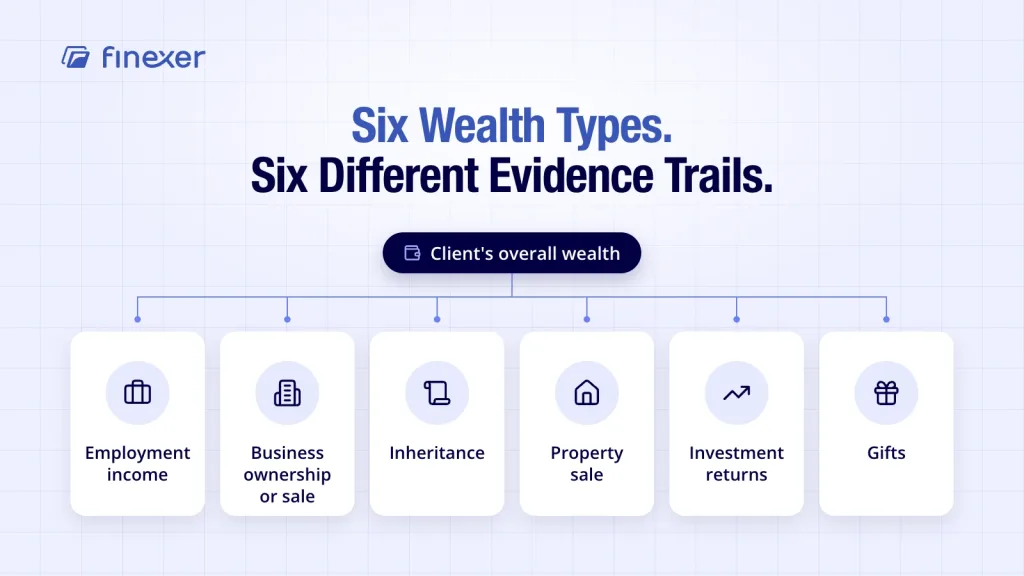
Employment income
Useful evidence includes employment records, payslips, tax documents and bank statements showing salary credits.
The aim is to connect occupation and earnings with the wealth claimed.
Business ownership or sale
Possible evidence includes company accounts, ownership records, dividend records, sale documents, completion statements and bank records showing proceeds.
HMRC lists audited accounts showing business profits among potential supporting documents. (GOV.UK)
Inheritance
Evidence may include probate documents, estate accounts, solicitor or executor correspondence, and bank records showing inherited proceeds.
HMRC specifically identifies estate accounts showing an inheritance as potential evidence.
Property sale
Relevant evidence can include sale documents, completion statements, Land Registry information and bank records showing sale proceeds.
Investment returns
Evidence could include investment or broker statements, dividend records, sale confirmations, tax records and bank records showing proceeds.
HMRC includes documents confirming investment returns among potential source of wealth evidence.
Gifts
Potential evidence includes a gift letter or deed, donor identity evidence, bank records showing the transfer and evidence of the donor’s source of funds where risk calls for it.
“The money came from my parents” identifies an immediate source but may not explain wider provenance.
Examples of Source of Wealth: What Good Evidence Looks Like
Consider a client buying a £900,000 property after selling a business. A useful file could connect company ownership, accounts, sale documents, completion records and bank activity showing the proceeds and their movement toward the purchase.
That is stronger than a statement showing £900,000 in an account.
HMRC says firms should assess whether explanations and evidence are sensible and feasible, consider what statements show and document their rationale.
Source of Wealth and Source of Funds Examples
Follow the money through the transaction.
| Scenario | Source of Wealth | Source of Funds |
|---|---|---|
| Business owner buys property | Business profits and dividends | Personal savings |
| Client inherits £500,000 | Inheritance | Inherited cash |
| Investor sells shares | Investment growth and returns | Share-sale proceeds |
| Parent funds a purchase | Family wealth | Gift |
| Retiree buys property | Employment and pension wealth | Pension lump sum |
For property transactions, HMRC says source of funds and wealth may need verification on a risk basis, with higher-level checks in specified higher-risk situations. (GOV.UK)
Where Banking Data Helps
Banking data can corroborate parts of the story, but it does not replace the firm’s assessment.
Banking data may show salary credits, dividends, sale proceeds, savings patterns, donor transfers and funds held in the client’s account.
A bank account verification check can help confirm account-holder details. Transaction data can then add context.
But banking data has limits. It may show £250,000 arriving from another account without establishing why it was paid or whether the wider explanation is credible.
A Risk-Based Review Process
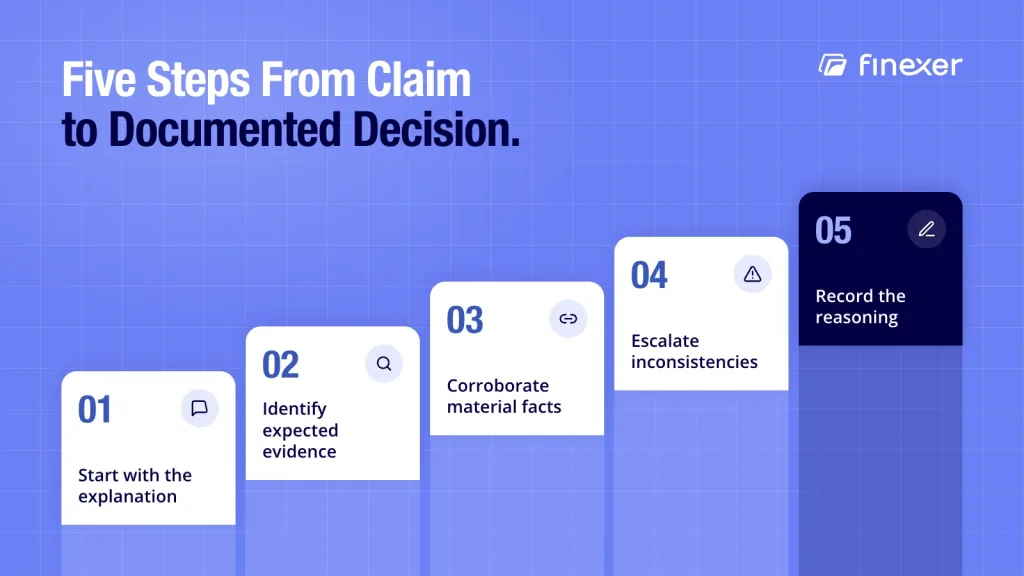
A practical review can follow five steps:
1. Start with the explanation. Record how the wealth arose, and identify the transaction.
2. Identify expected evidence. Match the claim to documents that could support it.
3. Corroborate material facts. Compare documents with relevant banking activity.
4. Escalate inconsistencies. Third-party payments, unusual changes or conflicting evidence may call for further scrutiny.
5. Record the reasoning. Document what was reviewed, accepted or unclear, and why the assessment was reached.
The Law Society says scrutiny should reflect the risk profile of the client or matter, with greater scrutiny in higher-risk due diligence situations. (Law Society)
For estate agents, cash purchases, unusual payment patterns, third-party funding and unexplained financial changes can increase risk. (GOV.UK) See our guide to aml checks for estate agents for sector context.
Accountancy firms can review aml software for accountants when assessing technology requirements. Where relevant, see aml registration.
Common Evidence Failures
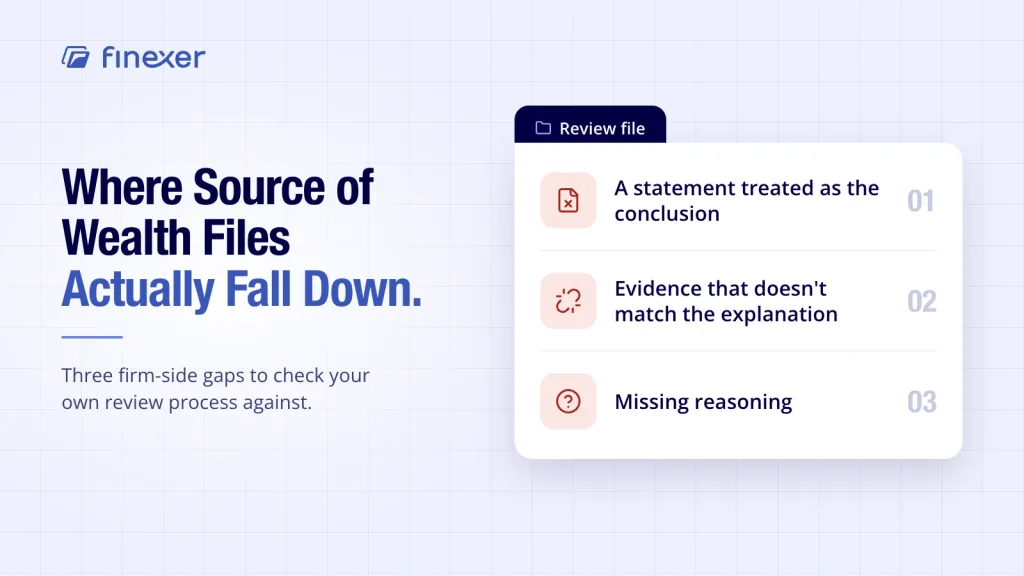
A statement is treated as the conclusion. A statement can corroborate funds in an account, but it does not automatically explain their origin.
The evidence does not match the explanation. A client cites business profits, but the file contains no business records and account activity differs.
The reasoning is missing. A reviewer should understand why the firm accepted the evidence. HMRC highlights record keeping and documented rationale.
How Finexer Supports Source of Wealth Checks
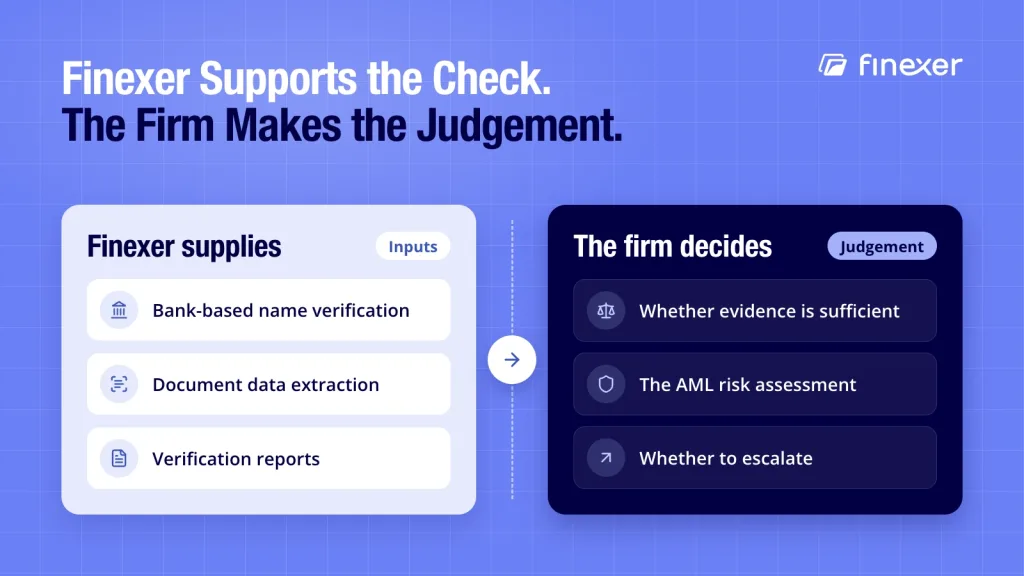
Finexer does not perform a firm’s AML assessment. Its Verification product supports evidence gathering with:
- Bank-based name verification
- Document data extraction
- Verification reports
This can help a platform or professional firm corroborate account ownership and extract information from submitted documents before its own compliance team reviews the evidence.
Finexer’s banking data can also provide account and transaction information through its API. See Finexer’s bank data API.
Finexer is FCA-authorised (FRN 925695) and provides UK Open Banking infrastructure. It does not provide PEP screening, sanctions monitoring, automated AML/KYC, adverse media screening or beneficial ownership registry checks.
Verification supports a firm’s own checks; it does not, by itself, satisfy the firm’s AML obligations.
Finexer vs Specialist Compliance Platforms
| Provider Type | Typical Strength | Fit |
|---|---|---|
| Source-of-funds specialists | Bank-data collection, questionnaires and reports | Firms wanting a packaged SoF workflow |
| Accountancy-focused platforms | Financial data analysis and reports | Accountancy practices |
| Broader CDD platforms | Identity, screening and due diligence | Firms seeking multiple functions |
| Infrastructure providers | Banking data and verification components | Platforms building their own workflows |
Thirdfort offers source-of-funds collection through Open Banking or document upload, questionnaires and reports. Armalytix offers bank-data and document-based source-of-funds reporting for professional firms.
What Firms Should Take Away
The strongest source of wealth examples follow a clear logic: claim, evidence, corroboration and recorded reasoning.
Employment income may call for payslips and salary credits. A business sale may need accounts, sale documents and proceeds. Inheritance may require estate records. Property sales, investments, gifts and pension payments each create their own documentary trail.
The practical test is as to whether another reviewer can understand the reason why the firm independently accepted the explanation, based on the evidence and risk profile.
Can the source of wealth be based on more than one activity?
Yes. A client may have accumulated wealth through employment, business ownership and investments. The firm should assess the explanation in context and decide what evidence is proportionate to risk.
Does the source of wealth have to account for every asset?
No. HMRC says source of wealth does not require an account of every asset. The objective is to build a rationale for why the client has the stated level of wealth and how it was accumulated.
Can public information support a source of wealth assessment?
Yes. HMRC identifies credible open-source information as potential evidence where a client’s wealth is in the public domain. The firm should assess its reliability and relevance.
Who decides whether evidence is sufficient?
The firm remains responsible for the compliance judgement. Technology providers can collect, verify and organise information, but the firm must apply its policies, risk assessment and professional judgement.
See how Finexer’s Verification product supplies bank-based name verification and document data extraction to support your firm’s source of wealth evidence.
Explore with AI
About the Author

Ravi Ranjan
Ravi Ranjan is Co founder & CEO of Finexer