
Client Accounts, Always Current.
Near-real-time visibility of client account movements.
A landlord’s rent sits in your client account for three days before you pay it out. If your agency folded tomorrow, would that money be safe?
TL;DR: Client money protection is not optional paperwork, it is the legal line between a landlord getting their money back and losing it outright. Every letting agent in England handling client money must belong to an approved scheme, full stop.
This guide names the current client money protection providers, what membership actually demands and why the agents who sail through an audit are usually the ones whose client account reconciles daily, not monthly.
This article reflects publicly available guidance on client money protection as of publication. Rules and approved scheme lists can change, so agents should confirm current requirements directly with gov.uk or their own adviser before acting on anything here.
What Is the Client Money Protection Requirement?
Letting agents in England who hold client money must belong to a government-approved client money protection scheme, full stop.
This has applied since 1 April 2019 under the Client Money Protection Schemes for Property Agents Regulations. Agents must also display their membership certificate, both in their offices and on their website, and provide a copy to anyone who reasonably requests it.
The rule applies to letting agency work and property management work carried out in England specifically. Scotland and Northern Ireland handle client money protection differently, and Wales runs its own version through Rent Smart Wales, so an agency operating across borders cannot assume one scheme covers every branch.
The requirement sits alongside other agent obligations, including affordability check rent processes carried out before a tenancy even begins.
What Does Client Money Protection Actually Cover?
Client money protection compensates landlords and tenants if an agent misappropriates their money or becomes insolvent.
Client money includes rent, holding deposits, security deposits before they reach a tenancy deposit scheme and money paid in advance for bills or repairs. If an agency collapses owing that money to clients, an approved scheme steps in to pay it back, up to the scheme’s protected limit.
The requirement exists because, before 2019, there was no legal obligation for an agent to protect money it held on a landlord’s behalf. An agency could go under, and landlords simply lost whatever rent was sitting in the client account at the time. Client money protection closes that gap by making membership of an approved scheme mandatory, rather than optional, good practice.
Who Are the Approved Client Money Protection Providers?
There are currently six government-approved client money protection providers agents can join.
| Scheme | What It Requires of Members |
|---|---|
| Client Money Protect | Separate client account, annual declaration, certificate display |
| Money Shield | Client account segregation, ongoing compliance checks |
| Propertymark | Membership tied to wider Propertymark professional standards |
| RICS | Available to RICS-regulated firms handling residential lettings |
| Safeagent (formerly NALS) | Client account rules plus a wider code of practice |
| UKALA Client Money Protection | Aimed at landlord and letting agent association members |
This list can change if a scheme’s approval is withdrawn or a new one is added, so verify it against gov.uk before treating it as final.
The schemes are not interchangeable in practice. Some, like RICS and Propertymark, tie client money protection to a wider set of professional standards an agency must already meet.
Others operate as standalone providers focused specifically on the client money requirement. Which one suits a given agency often comes down to what other professional memberships it already holds.
What Must Agents Do to Stay Compliant?
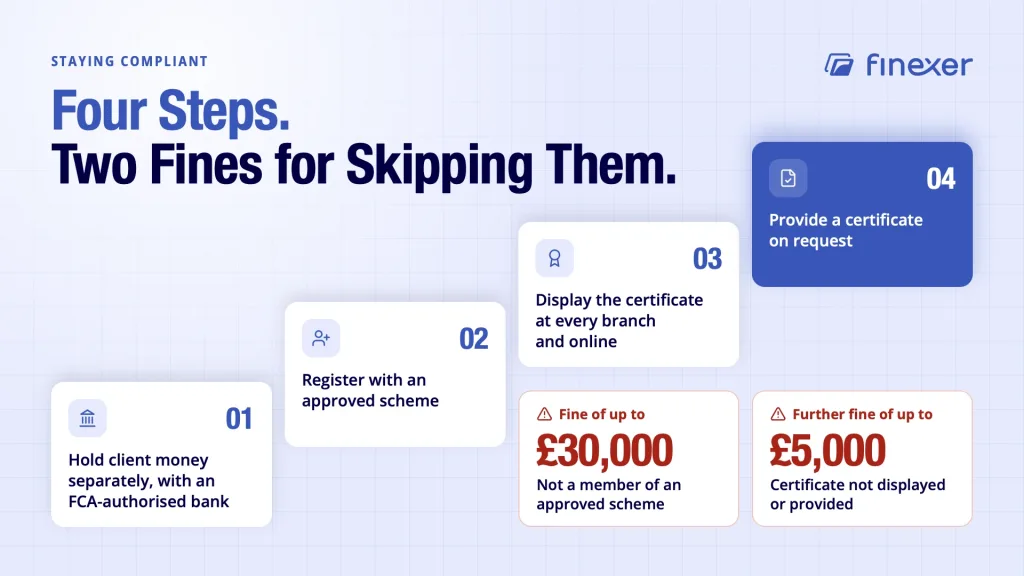
Agents must join an approved scheme, hold client money in a separate client account, display their membership and produce a certificate on request.
- Hold client money in an account with an FCA-authorised bank or building society, separate from office money.
- Register with one of the approved client money protection providers and pay the required membership fee.
- Display the scheme certificate at every branch and on the agency website.
- Provide a copy of the certificate to any client or prospective client who asks.
Failure to belong to a scheme can attract a fine of up to £30,000. Failure to display or provide a certificate can add a further £5,000.
The financial penalty is rarely the whole story. Portals and referral partners increasingly ask for scheme membership details before listing a property or accepting a referral, and landlords comparing agents often ask directly. An agency that cannot produce a current certificate loses instructions before a fine ever comes into it.
How Should Client Accounts Be Handled in Practice?
Client money protection assumes that client and office money are never mixed and that the client account reconciles regularly enough to catch problems early.
Good practice means checking the client account against what is owed to landlords and tenants on a set schedule, not just when a scheme audit is coming up. Agents managing this manually, through rental property accounting software paired with monthly bank statement downloads, often only discover a discrepancy weeks after it happened.
Most schemes expect records that show, for any given day, exactly what each landlord and tenant is owed and what the client account actually holds. That means keeping a clear audit trail alongside the reconciliation itself, not just a bank balance that happens to look right on the day a scheme asks for it.
Where Does Reconciliation Discipline Support Compliance?
Reconciliation discipline means being able to show, at any point, that client account balances match what is actually owed to landlords and tenants.
That is a different standard from reconciling once a month and hoping nothing moved in between. Ongoing rent reconciliation against current account data catches a mismatch the same week it happens and not at the next audit.
How Do Banking Data Providers Compare on This?
Not every Open Banking provider gives a platform the same visibility into client account movements.
| Provider Type | Examples | What It Offers a Letting Platform |
|---|---|---|
| Data-only (AISP) | Moneyhub Enterprise | Account and transaction visibility, no payment initiation |
| Payments-led (PISP) | GoCardless, Volt.io | Payment collection, limited account data depth |
| AIS and PIS | TrueLayer, Yapily, Finexer, Salt Edge | Both account visibility and payment initiation from one integration |
None of these replaces scheme membership. It simply determines how current the underlying account data is when an agent needs to check it, which matters more the moment a scheme or a landlord asks a hard question about a specific balance.
Where Does Finexer Fit In?
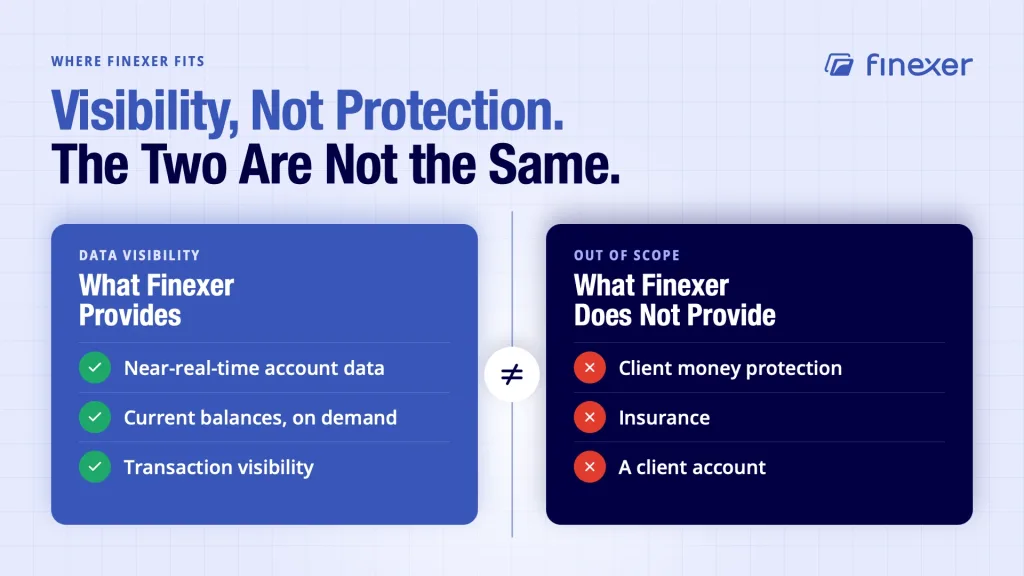
Finexer does not provide client money protection, insurance or a client account. That gap does not close through infrastructure, and no Open Banking provider can close it as the regulation specifically requires scheme membership and not a data feed.
What Finexer Data gives platforms is near-real-time visibility of the client account itself: account, balance and transaction data pulled directly from the bank rather than reconstructed from a monthly statement.
That does not replace scheme membership. It supports the reconciliation discipline that membership assumes, by making current balances checkable at any point rather than pieced together after the fact.
- Near-real-time client account balance and transaction visibility
- Account data separate from office money, checkable on demand
- Built for Proptech and letting agent platforms specifically
- FCA-authorised infrastructure (FRN 925695) underneath the data layer
Letting agent platforms and property management SaaS tools are the ICP that fits, not landlords or tenants directly, and not agents shopping for a scheme itself.
Do all letting agents need client money protection?
Only agents who hold client money need to join a scheme. Agents who never handle rent or deposits directly are not required to belong to one although most letting agents do hold client money at some point.
What happens if an agent isn’t a member of an approved scheme?
The agent risks a fine of up to £30,000 for non-membership and a separate fine of up to £5,000 for failing to display or provide a certificate on request.
Is client money protection the same as tenancy deposit protection?
No. Tenancy deposit protection covers deposits specifically once they are registered with a scheme. Client money protection covers the wider pool of money that an agent holds before it reaches that stage or that never reaches a deposit scheme at all.
Can Finexer help an agency choose a client money protection scheme?
No. Finexer supplies banking data visibility and not scheme selection or advice. Agents should compare providers directly and confirm requirements with their own adviser.
See Client Account Data as It Actually Moves
Manual monthly reconciliation leaves a gap between what an agent believes is in the client account and what is actually there.
Finexer’s Data product gives platforms near-real-time client account visibility, so that gap stays closed.
Explore with AI
About the Author

Clare Pearson
Clare Pearson is a senior payments professional with extensive experience across the global financial services and payments industry. She specialises in Open Banking, payment infrastructure, and financial technology transformation, with expertise spanning product delivery, operational strategy, regulatory compliance, and large-scale payments programmes. Clare currently serves as a Non-Executive Director at Finexer and a panel member for the Payment Systems Regulator (PSR), advising on the development of payment systems policy and innovation