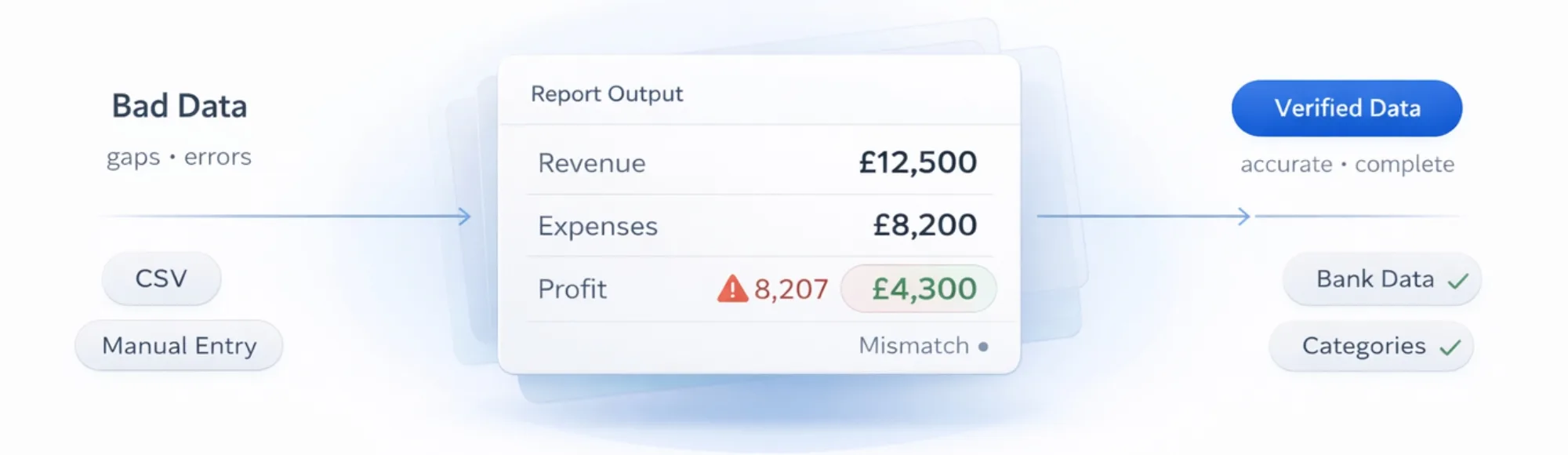
Wrong data in. Wrong reports out.
Bank-verified transaction data for accurate financial reporting workflows.
Business financial reporting does not fail because of the reporting tool.
It fails because the transaction data feeding the tool is incomplete, miscategorised, or manually maintained – and reports built on that data reflect the errors, not the reality.
The P&L shows a margin that does not match cash flow. The expense report has categories that nobody trusts. The balance sheet does not reconcile at month-end. The tool is working exactly as designed. The problem is upstream.
In my work building data infrastructure for accounting and ERP platforms at Finexer, this is the most consistent pattern I see. Reporting finance failures trace back to a data input problem that no reporting layer can correct.
TL;DR
Business financial reporting accuracy depends entirely on the quality of the transaction data it is built on. The four core financial reports – P&L, balance sheet, cash flow statement, and management accounts – all require accurate, categorised, continuously maintained transaction records. When those records are built on CSV imports, manual entries, or periodic bank statement uploads, gaps and errors propagate into every report. Finexer’s FCA-authorised AIS provides continuous bank-verified transaction data with merchant IDs and category codes – giving accounting and ERP platforms accurate inputs before reports are generated.
Key Takeaways
What are the four types of business financial reports?
The four core business financial reports are: the profit and loss statement (income and expenses over a period), the balance sheet (assets, liabilities, and equity at a point in time), the cash flow statement (inflows and outflows of cash), and management accounts (internal performance reports used for decision-making).
Why does business financial reporting produce wrong outputs?
Business financial reporting produces wrong outputs when the underlying transaction data carries errors – miscategorised expenses, timing gaps from periodic imports, duplicate entries, or manually entered figures that have not been verified against actual bank records. The reporting tool processes whatever data it receives accurately.
What is the core problem in reporting finance at the data layer?
The core problem is that most platforms collect financial data through methods that cannot be verified against actual bank activity – CSV exports, PDF uploads, and manual entry. Each method introduces gaps or errors that carry through to every report built on that data.
How does bank-verified transaction data improve financial reporting accuracy?
FCA-authorised AIS retrieves transaction data directly from the bank – date, amount, and category confirmed at source. Reports built on bank-verified data reflect actual financial activity rather than an approximation assembled from periodic imports and manual corrections.
What Are the Four Core Business Financial Reports?
What Does Each Financial Report Actually Show?
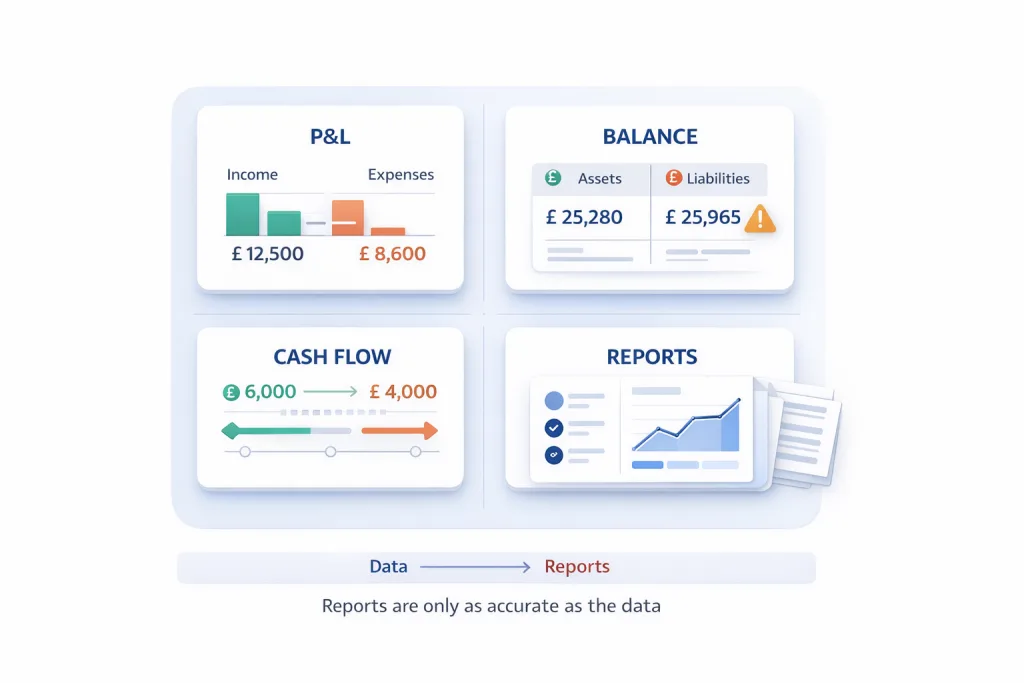
Business financial reporting covers four core statements that every accounting SaaS and ERP platform produces:
The profit and loss statement shows income and expenses over a period – usually monthly or quarterly. It is the most directly affected by categorisation errors, as miscategorised expenses distort both the revenue and cost lines.
The balance sheet shows assets, liabilities, and equity at a specific date. Reconciliation failures – caused by import timing gaps and duplicate entries – show up here as unexplained discrepancies between the ledger and actual bank balances.
The cash flow statement tracks cash inflows and outflows. Transactions missing from the digital record due to import gaps produce understated cash positions that do not match the actual bank account.
Management accounts are internal reports used for decision-making on performance, liquidity, and budget tracking. They are only as reliable as the underlying transaction categorisation.
Business financial management guide for accounting and ERP platforms covers how each financial report feeds into platform-level financial management workflows and decision-making.
“The question I always ask accounting platform teams when they report issues with their financial outputs is: where does the transaction data come from? The answer almost always explains the reporting problem. The report is correct. The inputs were not.” – Yuri, Finexer
Why Do Business Financial Reports Go Wrong?
What Data Problems Break Financial Reporting?

Business financial reporting failures follow a consistent pattern. The tool is correct. The data it processes is not.
Three input problems produce the majority of business financial reporting errors:
Miscategorised transactions – unclear bank descriptions matched to the wrong expense category. The P&L shows the wrong cost line. VAT calculations are incorrect. Budget tracking is unreliable. Every report that uses that category inherits the error.
Import timing gaps – CSV exports capture a point in time. Transactions between exports are missing until the next import cycle. Cash flow statements built on incomplete data understate actual activity. Balance sheet reconciliation fails because the ledger does not match the bank.
Manual entry errors – figures entered manually are unverifiable against actual bank records. Duplicate entries inflate costs. Missed transactions understate income. Each error carries forward into the financial period’s accumulated record.
According to how inaccurate financial statements compound from data errors, these input-layer problems compound across every downstream report – and become harder to trace as the period progresses.
| Data Input Problem | How It Enters | Which Report It Breaks | Bank Data Fix |
|---|---|---|---|
| Miscategorised transaction | Unclear bank description matched to wrong rule | P&L cost lines, VAT calculations, budget tracking | Merchant IDs and category codes applied at source |
| Import timing gap | CSV export misses transactions between windows | Cash flow statement, balance sheet reconciliation | Real-time AIS webhooks deliver each transaction as it occurs |
| Manual entry error | Incorrect figure entered, duplicate, or missed | All reports – error carries into every downstream output | Bank-sourced data removes manual entry layer entirely |
| Quarter-end reconstruction | Bank statements collected retrospectively | Management accounts, period comparisons | Continuous AIS feed maintains record throughout the period |
What Does Accurate Business Financial Reporting Actually Require?
Why Better Reporting Tools Do Not Fix Data Problems?
When business financial reports are wrong, the instinct is to upgrade the reporting tool. Better dashboards. More granular reports. Custom views.
This does not fix the problem. Reporting finance accuracy is determined before the tool runs – at the data input stage.
Reporting tools produce accurate outputs from accurate inputs. They cannot correct upstream data errors. A more sophisticated P&L report built on miscategorised transactions produces a more sophisticated wrong answer.
The fix is at the input layer – before the data reaches the reporting tool. That means verified transaction data, continuous record maintenance, and category codes applied at the transaction level rather than inferred from unreliable description strings.
Financial reporting tools for UK accounting platforms covers how reporting tools connect to data sources and why the source quality determines output reliability.
How Does Finexer Fix Business Financial Reporting at the Data Layer?
What Does Finexer’s AIS Provide for Reporting Finance Accuracy?
The problem: business financial reporting fails when input data carries categorisation errors, timing gaps, and manual entry mistakes. Finexer’s FCA-authorised AIS solves this by retrieving transaction data directly from the bank – delivering accurate, categorised records before they reach the accounting or ERP system.
- Direct bank retrieval – transactions sourced from the bank, not client-prepared documents or CSV exports
- Real-time webhooks – each transaction delivered as it occurs, no import timing gaps
- Merchant IDs and category codes per transaction – correct expense categorisation from source
- Structured JSON – consistent schema across almost all major UK banks
- Up to 7 years of transaction history – complete historical records for period comparisons
- Consent logs and access timestamps – full audit trail per retrieval
- Multi-account access in one consent flow – full financial picture across all client accounts
Business finance management for accounting SaaS platforms covers how accurate transaction data feeds into broader financial management workflows beyond reporting.
“Business financial reporting problems are almost never about the reporting tool. They are about the data the tool is processing. Accurate, bank-verified transaction data with consistent categorisation produces accurate reports – not because the reporting logic is better, but because the inputs are correct.” – Yuri, Finexer
What I Feel
Accounting platforms spend significant time configuring reports. Choosing which metrics appear. Designing management account layouts. Building P&L structures.
All of that is wasted if the transaction data underneath it is wrong.
The report is the last step. It is only as good as every data decision that came before it. Fixing reporting finance output quality means fixing reporting finance input quality first.
Common Use Cases
Accounting SaaS Platforms
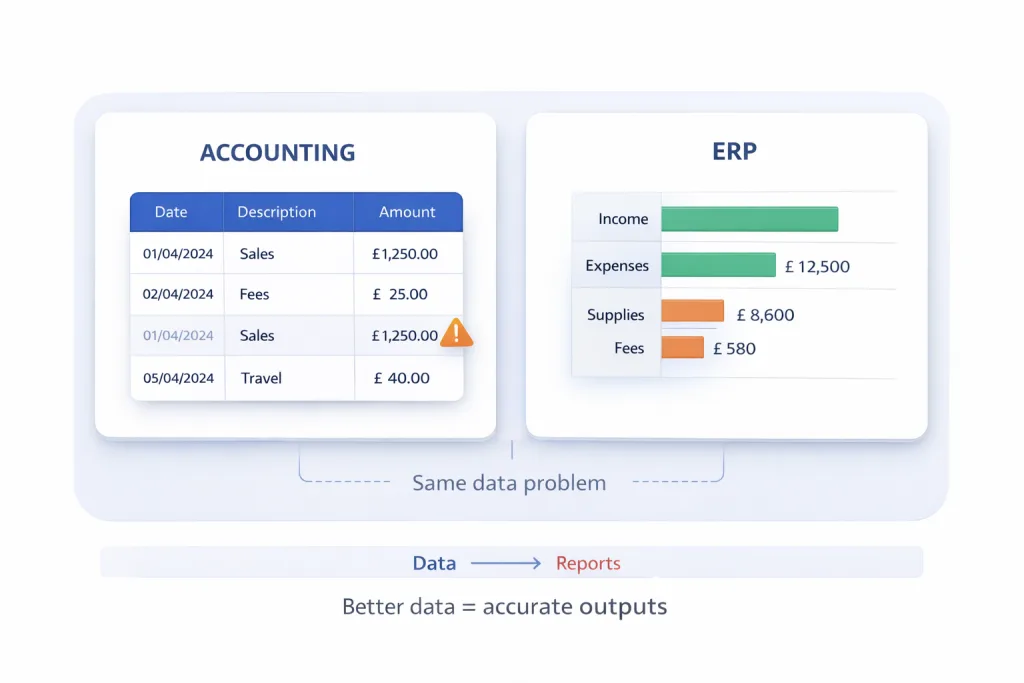
Client financial reports built on CSV imports and manual entries accumulate data errors that surface at month-end as reconciliation failures and unexplained variances. Finexer’s AIS delivers continuous bank-verified transaction data with category codes per client account – so reports reflect actual financial activity, not an approximation assembled from periodic imports.
ERP Platforms
ERP financial modules generating management accounts and period reports for high-volume clients need reliable transaction categorisation across all expense lines. Finexer’s merchant IDs and category codes applied at the transaction level eliminate the miscategorisation that produces wrong cost lines in P&L reports and budget tracking.
What is business financial reporting and what reports does it include?
Business financial reporting covers the preparation and submission of a company’s financial performance data. The four core reports are the profit and loss statement, balance sheet, cash flow statement, and management accounts. Each depends on accurate, categorised transaction records – errors in input data carry into all four outputs.
Why does reporting finance produce wrong outputs even with correct software?
Reporting finance tools process whatever data they receive accurately. Wrong outputs come from wrong inputs – miscategorised transactions, import timing gaps, and manual entry errors that enter the data layer before the reporting tool sees them. Upgrading the reporting tool does not fix upstream data quality problems.
How does bank transaction data improve business financial reporting accuracy?
FCA-authorised AIS retrieves transaction data directly from the bank with merchant identifiers and category codes per transaction. Reports built on this data reflect actual bank activity rather than approximations assembled from CSV imports – eliminating the categorisation errors and timing gaps that produce wrong financial report outputs.
Build accurate business financial reports on verified bank transaction data.
About the Author

Yuri
Yuriy Yakushko is a fintech founder and software engineer with over 20 years of experience building financial technology. He’s passionate about creating scalable, secure infrastructure that helps businesses modernise how they access financial data and manage payments.