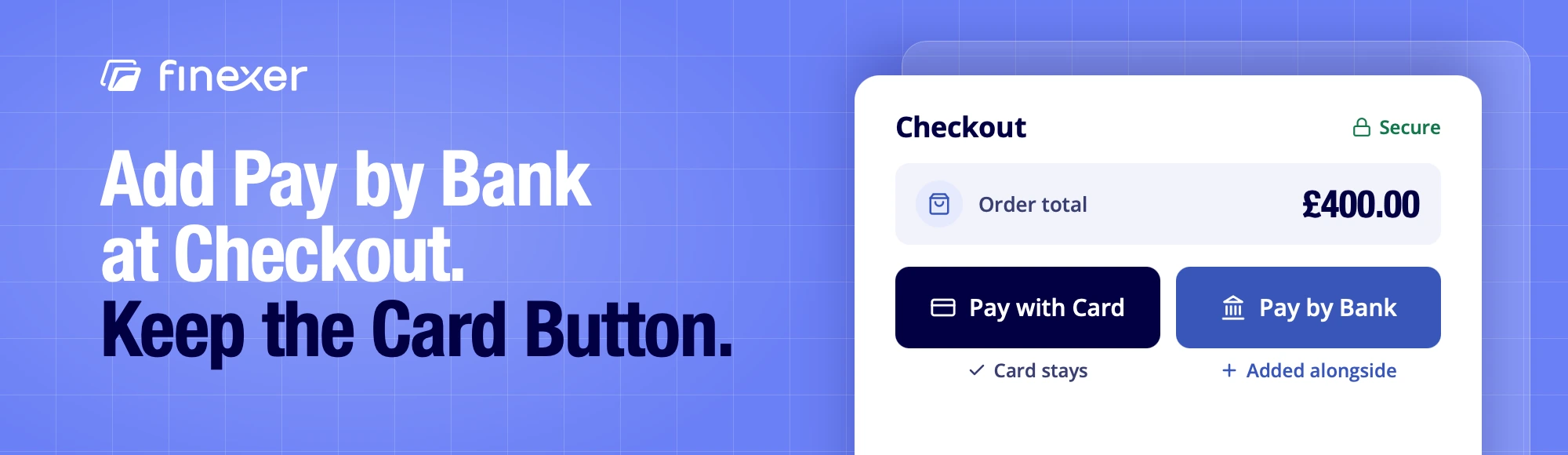
Add Pay by Bank at Checkout.
No interchange, instant settlement, SCA built in.
Every card declined at checkout is a sale that walked. Every interchange fee on a large basket is a margin that never existed in the first place.
TL;DR: An e-commerce payment gateway is the plumbing between your storefront, the card networks and your acquirer. Picking one badly costs you conversion, cash flow and a chunk of every transaction. This guide compares the recognisable UK options on pricing model, integration and settlement, then covers the one thing most merchants forget to add once the e-commerce payment gateway is live.
Finexer works with EPOS and online merchants who have already made peace with cards and are now asking a sharper question: what should sit alongside them. Everything below reflects that vantage point, not an e-commerce payment gateway sales pitch.
What Does a Payment Gateway for E-Commerce Actually Do?
An e-commerce payment gateway authorises and routes card payments between your shop, your acquirer and the card networks.
It sits between the checkout page and the rest of the payment chain, encrypting card details, sending the authorisation request and returning an approval or decline in seconds. Without one, a storefront cannot legally or practically accept card payments online.
The e-commerce payment gateway itself does not move money. It talks to your acquirer, who holds the merchant relationship with the card networks, and the acquirer settles funds into your account according to whatever schedule you have agreed. Confusing the two roles is a common mistake when comparing providers as some companies act as both.
What Should You Evaluate in an E-Commerce Payment Gateway?
Price is the headline, but it is rarely where merchants actually lose money. An e-commerce payment gateway that looks cheap on the rate card can still cost more once integration time, settlement delay and chargeback handling are added up.
- Supported payment methods. Cards are the baseline. Wallets and alternative methods vary by e-commerce gateway, and adding one later is not always straightforward.
- Pricing model, including interchange treatment. Flat-rate pricing bundles interchange in; interchange-plus separates it out, which usually costs less at volume but is harder to predict month to month.
- Settlement timing. How many days until funds actually land in your account, which affects cash flow more than most merchants budget for.
- Checkout experience. Hosted page, embedded fields or a full custom build, each with a different development cost and conversion trade-off.
- Platform integrations. Native support for Shopify, WooCommerce or a custom stack changes your development cost significantly.
- Chargeback handling and PCI scope. Who carries liability, and how much PCI DSS compliance work falls on your own team versus the provider?
A merchant evaluating on price alone and looking for the cheapest online payment gateway often misses the fact that settlement speed and integration cost can outweigh a small percentage difference in fees.
How Do the Recognisable UK Gateways Compare?
| Gateway | Pricing Model | Integration | Settlement |
|---|---|---|---|
| Stripe | Interchange-plus, published rate card | Extensive platform and custom API support | Typically next-day, varies by account |
| Worldpay | Interchange-plus, negotiated at volume | Strong enterprise and EPOS integration | Varies by agreement |
| Checkout.com | Interchange-plus, enterprise-focused | API-first, developer-heavy setup | Negotiated per merchant |
| Adyen | Interchange-plus, unified commerce focus | Single platform across online and in-person | Varies by region and agreement |
| SumUp | Flat-rate, quick onboarding | Fast setup, smaller merchant focus | Typically next business day |
Pricing and terms change regularly across all five, so treat this as a starting shortlist and confirm current rates directly with each provider before deciding.
What Do Merchants Add Alongside Cards?
Cards remain necessary for most storefronts. Almost no UK merchant drops them entirely.
What changes is what sits next to them. Digital wallets add a faster checkout for mobile buyers. Among the wider set of alternative payment options, Pay by Bank has moved from a marketing line to a real line item as it changes the cost mix rather than just the checkout button count.
The broader landscape of online payment systems extends past checkout too, into how EPOS systems handle in-person equivalents of the same account-to-account (A2A) methods.
Where Does Pay by Bank Actually Fit?
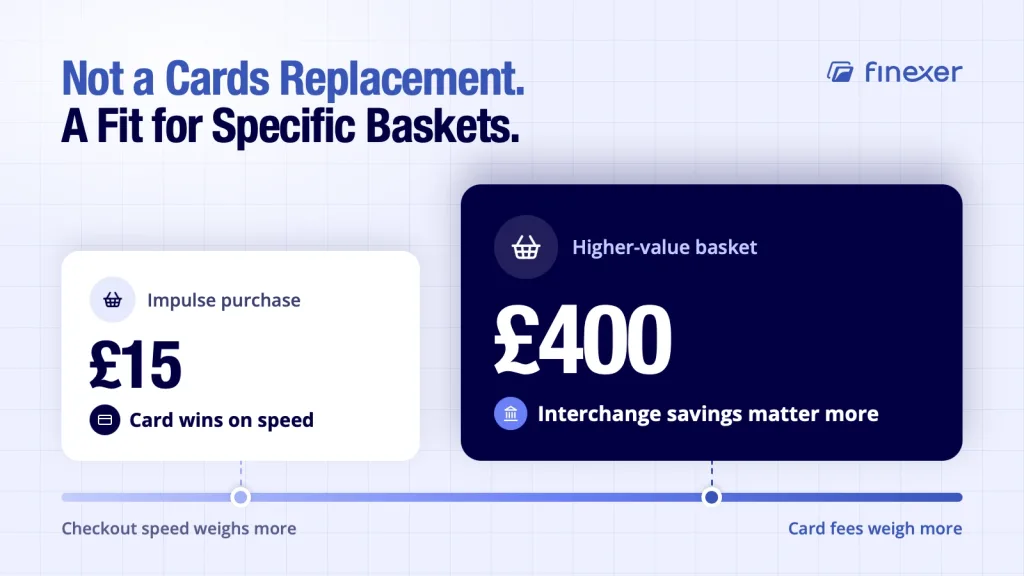
Pay by Bank fits best on higher-value baskets, repeat customers and anywhere card interchange is material to margin.
It is not a cards replacement. For a £15 impulse purchase, a customer’s saved card is faster than authenticating with a bank app, and friction at that price point costs more in abandoned carts than it saves in fees.
For a £400 basket, or a subscription customer checking out for the tenth time, the economics flip as interchange on higher-value transactions adds up fast and a repeat customer has already proven they will complete the extra step.
This is where Open Banking for payments earns its place next to a card button rather than instead of one.
How Do Pay by Bank Providers Compare?
Not every UK Open Banking provider approaches Pay by Bank the same way.
| Provider | Focus |
|---|---|
| TrueLayer | AIS and PIS combined, skews enterprise and large fintech |
| GoCardless | Payments-led, strongest in recurring collection rather than one-off checkout |
| Yapily | AIS and PIS combined, broader European coverage than UK-specific |
| Finexer | AIS and PIS combined, UK-focused, direct one-to-one bank connection, with multiple data pulls and refreshes |
Where Does Finexer Fit In?
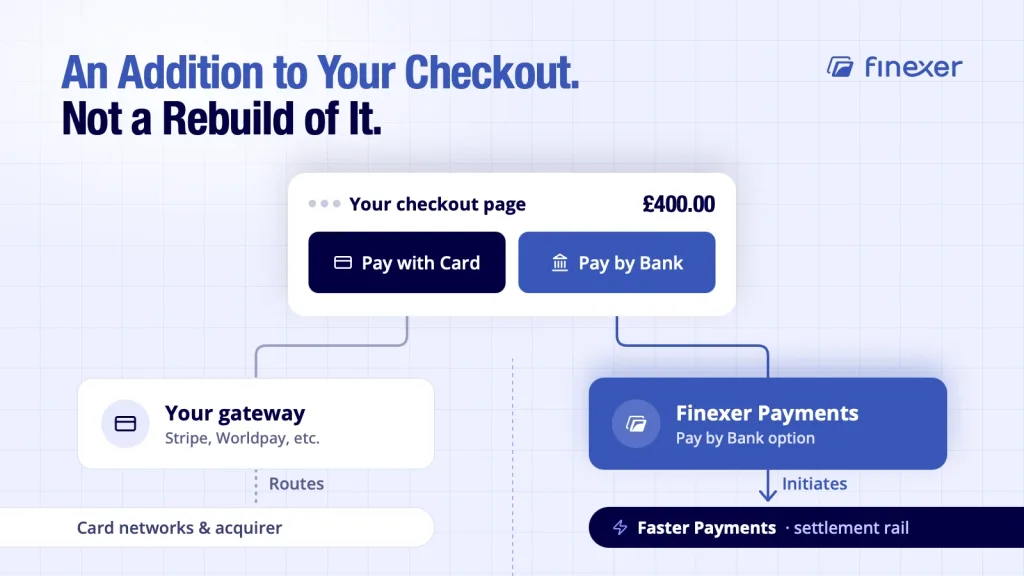
Finexer is not a payment gateway for e-commerce, an acquirer or a card processor. That distinction matters more here than almost anywhere else in this guide.
Finexer Payments is the Pay by Bank option merchants run alongside their existing gateway and not instead of it. The customer authenticates with strong customer authentication (SCA) inside their own banking app, and Finexer initiates a payment that settles via Faster Payments, with no card interchange on that transaction.
For a merchant that is already committed to a gateway for the reasons covered above, this is an addition to the checkout page and not a rebuild of it. The card button stays. Pay by Bank sits next to it as a second option, live where the numbers justify offering it.
- Runs alongside an existing payment gateway for e-commerce and not as a replacement
- SCA handled inside the customer’s own banking app
- No card interchange on Pay by Bank transactions
- Fits EPOS, online merchants and Utility Billing checkout flows
Do I need to remove cards to add Pay by Bank?
No. Pay by Bank runs alongside your existing gateway and card options, not instead of them.
Is Pay by Bank only useful for large purchases?
It is strongest on higher-value baskets and repeat customers although any merchant paying material interchange can benefit from offering it as an option.
Does Finexer replace my payment gateway?
No. Finexer is not a gateway, acquirer or card processor. It adds an Open Banking payment method alongside your existing setup.
How does settlement speed compare to card payments?
Finexer initiates payments that settle via Faster Payments, which is separate from your gateway’s own card settlement timing, and which varies by provider and agreement.
See Pay by Bank Running Alongside Your Gateway
See how Finexer adds a Pay by Bank option alongside your existing gateway, removing card interchange on the baskets where it costs most.
Explore with AI
About the Author

Ravi Ranjan
Ravi Ranjan is Co founder & CEO of Finexer