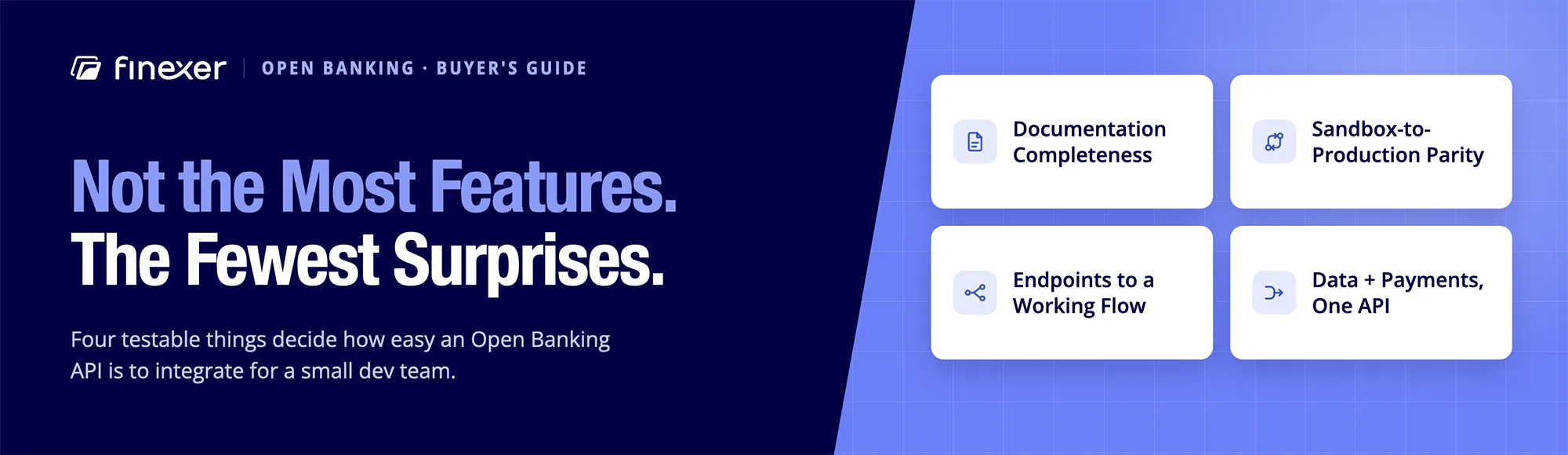
Ease of integration comes down to four things: documentation completeness, sandbox-to-production parity, how many endpoints you need for a working flow, and whether one integration covers both data and payments. The easiest open banking api for a small team isn’t necessarily the one with the most features. It’s the one that gets a working flow live with the fewest surprises.
What makes an Open Banking API easy to integrate for a small team?
A small team rarely has the capacity to work around unclear documentation or a sandbox that behaves differently to production. The easiest open banking api to work with tends to share four traits: documentation that matches the actual API behaviour, a sandbox environment that closely mirrors production, a small number of endpoints needed to reach a working flow, and a single integration covering data and payments rather than two separate ones.
What to test before committing build time?
| What to Test | What a Good Answer Looks Like |
|---|---|
| Documentation completeness | Every endpoint used in a working flow is documented with real request and response examples |
| Sandbox-to-production parity | Sandbox behaviour matches production closely enough that testing there is meaningful |
| Endpoints needed for a working flow | A small, clearly defined set, not a sprawling API surface for a simple use case |
| Data and payments in one integration | One SDK and one set of credentials, not two separate products to stitch together |
Testing these four points before writing production code is a better use of a small team’s time than reading feature comparisons.
Time to first successful call as a practical benchmark
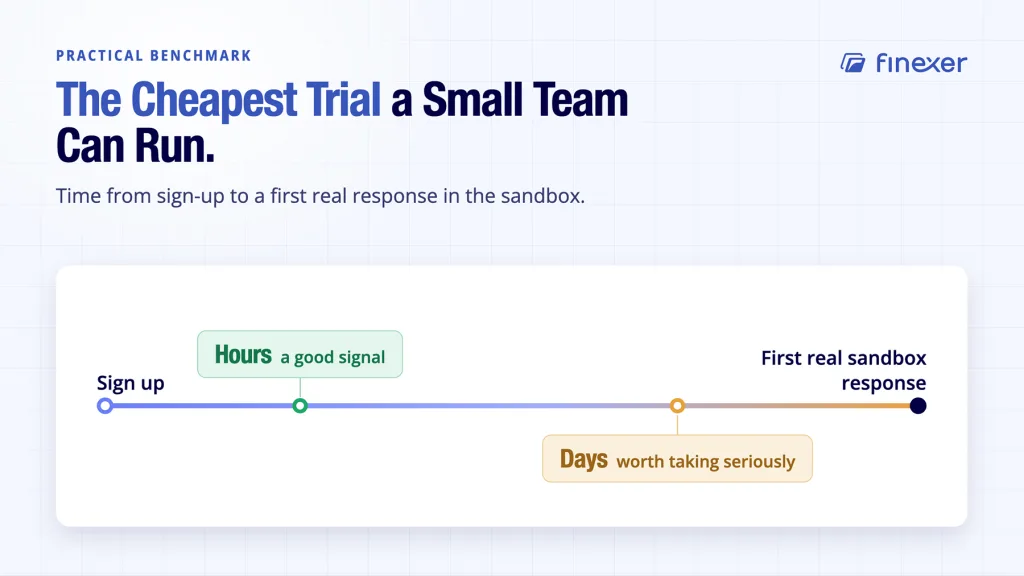
A useful, practical benchmark is how long it takes a developer to make a first successful call in the sandbox, from signing up to receiving a real response. If this takes days rather than hours, that’s a reasonable signal about what the rest of the integration will feel like. This benchmark also works well as a genuine trial: it costs a small team almost nothing to test before committing to a longer build.
What actually slows small teams down after integration starts?
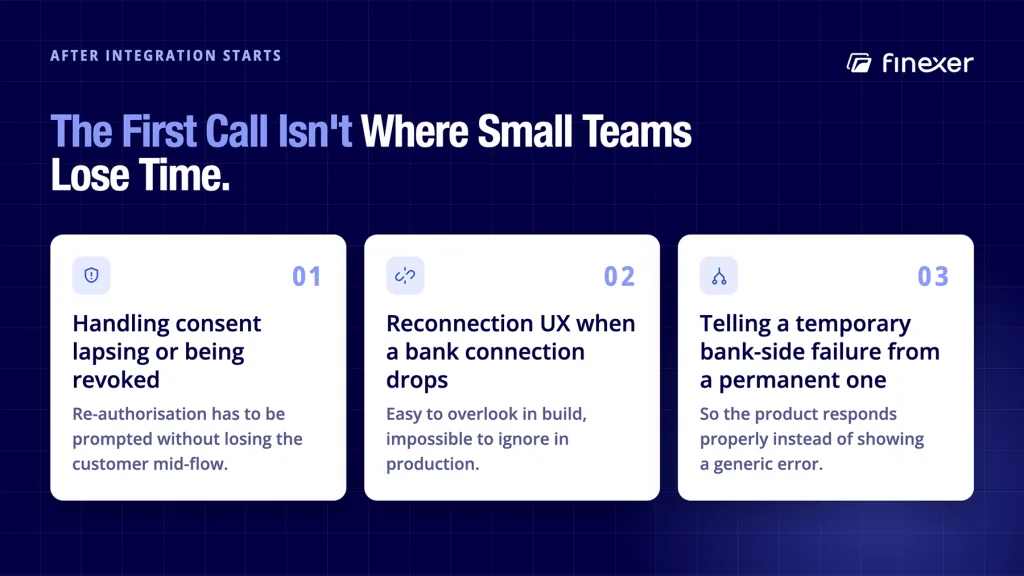
The first successful call is rarely where small teams lose time. What actually causes delays later is:
- Consent lifecycle handling: Knowing when a customer’s authorisation needs reconfirming under the 90-day SCA reauthentication cycle, and how to prompt reconnection without losing the customer mid-flow.
- Reconnection UX: Designing what happens when a bank connection drops or a token expires, which is easy to overlook until it happens in production.
- Error taxonomy: Understanding the difference between a temporary bank-side failure and a permanent one, so the product can respond appropriately instead of showing a generic error.
Providers rarely document these clearly, which is why testing the sandbox directly matters more than reading a features page. Our related guide on open banking API use cases covers the kinds of flows small teams typically build once integration is underway.
How does Finexer support a small team’s integration?
Finexer provides one integration covering AIS, PIS and Verification, so a small team isn’t building and maintaining separate connections for data, payments and identity checks. A sandbox environment is available for testing before any production commitment, and hands-on onboarding support is provided directly rather than through documentation alone.
This connectivity sits behind Finexer Connect, the regulated layer used across account data access, payment initiation and verification. If you’re comparing this against other providers on your shortlist, our guide to open banking solution providers sets out the wider selection criteria, and if Atoa is one of them, our breakdown of Atoa pricing may be a useful reference point.
Bottom line
The easiest open banking api for a small team is the one that survives direct testing, not the one with the best marketing page. Test documentation, sandbox parity, endpoint count and consent handling before committing build time, and use time to first successful call as your practical benchmark.
See how Finexer’s UK-exclusive focus provides almost all bank coverage without multi-market complexity.
Explore with AI
About the Author

Ravi Ranjan
Ravi Ranjan is Co founder & CEO of Finexer