
Cut the Cost Behind the Till.
Pay by Bank and take that reconciliation.
Your EPOS systems can tell you what you sold.
It cannot, by itself, tell you whether the payment method behind that sale is costing more than it needs to.
That is the gap most EPOS buying guides leave untouched.
TL;DR: The right EPOS system is not simply the one with the longest feature list. UK retailers and hospitality operators need to assess the software, hardware, integrations, payment model, settlement process and contract together. The payment layer can materially change the cost of every transaction after the till has already done its job.
This guide is written from the perspective of the payment and financial infrastructure behind EPOS platforms. Finexer works with B2B platforms in the EPOS, retail technology and hospitality technology space, where payment costs and reconciliation sit alongside the operational requirements of the till.
The comparison below focuses on the buying criteria that matter when selecting an EPOS system rather than presenting Finexer as an EPOS vendor. Finexer is an FCA-authorised Open Banking infrastructure provider, not EPOS software or till hardware.
“The till is only one part of the buying decision. The payment layer determines what happens after the sale.”
1. Start With the EPOS System That Fits Your Business
There is no single best EPOS system for every UK business.
A café with three staff, a multi-site retailer and a full-service restaurant have different operational requirements.
The first decision is therefore sector fit.
| EPOS option | Typically suited to | What to assess |
|---|---|---|
| Square | Smaller retail, cafes and mixed businesses | Entry cost, ease of setup, payments and reporting |
| SumUp | Smaller retailers and lower-volume businesses | Hardware, transaction rates and software requirements |
| Epos Now | Retail and hospitality | Till hardware, inventory, integrations and contract |
| Lightspeed | Retail and hospitality, including multi-site operations | Inventory, reporting, integrations and total subscription cost |
| Shopify POS | Retailers already operating online | Ecommerce integration and combined software cost |
| Specialist hospitality EPOS | Restaurants, pubs and larger hospitality operations | Table management, kitchen workflows, ordering and reporting |
This is a starting point, not a league table.
Independent UK comparisons published in 2026 show a market where providers differ materially in software fees, hardware costs, transaction charges, contract structures and sector focus. Published prices also change, so any quote should be checked before signing.
For a wider look at epos companies, compare the provider against your actual operating model rather than choosing on brand recognition alone.
2. Check the Hardware Before You Check the Features
An EPOS system is more than software.
Depending on the business, the hardware may include the following:
- Till or touchscreen terminal
- Barcode scanner
- Receipt printer
- Cash drawer
- Customer-facing display
- Card terminal
- Kitchen printer or display
- Mobile ordering device
The question is not whether a provider sells all of these.
It is whether the hardware setup fits the way your staff actually work.
A restaurant may need handheld ordering and kitchen integration. A shop may prioritise barcode scanning and stock control. A multi-site retailer may care more about central reporting than a traditional cash drawer.
Also check what happens if you want to change payment providers later.
Some EPOS models are closely tied to their own payment arrangements, while others give merchants more choice. That distinction can affect your long-term payment costs.
3. Compare the EPOS System Benefits Against Your Actual Workflow
The epos system benefits that matter are the ones that remove work or give managers information they can act on.
The core benefits usually include the following:
- Inventory accuracy: Sales data can update stock records as transactions occur.
- Multi-site visibility: Managers can compare locations without collecting separate reports.
- Staff management: Permissions, shifts and sales activity can be managed from the same system.
- Accounting integration: Sales information can feed into accounting workflows rather than being re-entered.
- Reporting: Managers can examine sales by product, location, employee or period.
- Order management: Hospitality businesses can connect ordering, tables and kitchen workflows.
But a feature only matters if your business will use it.
A retailer that never sells online does not need to prioritise ecommerce functionality over stock control. A restaurant with complex kitchen operations should not choose an EPOS because its entry subscription happens to be cheaper.
The better question is: Which system removes the most operational work from your specific business?
4. Look Beyond the Subscription: Calculate the Cost of Taking Payment
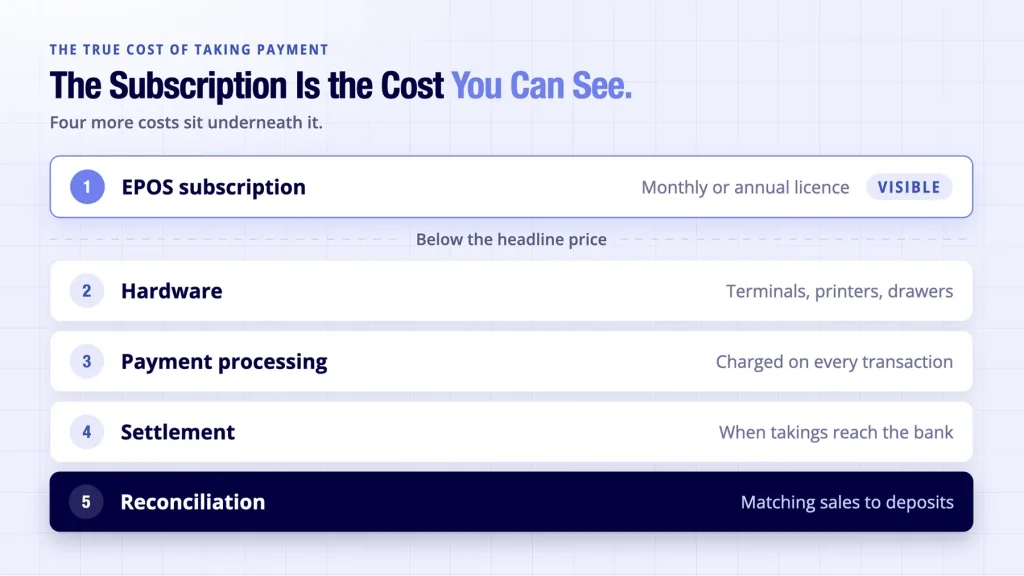
This is where EPOS comparisons often become incomplete.
The software subscription is visible.
The cost of taking payment is spread across several different charges and operational effects.
Think of the payment cost stack as the following:
EPOS subscription + hardware + payment processing + settlement + reconciliation
A system that looks inexpensive at the software level can still produce a higher overall cost if its payment arrangement carries higher transaction charges or restricts your choice of processor.
The four costs to compare are as follows:
1. Software
Check the monthly or annual EPOS subscription and what sits behind the headline price.
Some functions may belong to higher tiers or paid add-ons.
2. Hardware
Compare the initial purchase, leasing arrangement, replacement terms and number of terminals required.
A single till and a ten-terminal operation have very different hardware economics.
3. Payment processing
This is the cost attached to each transaction.
For card payments, that can include processing and card-related charges. Your actual rate depends on the provider, card mix, transaction volume and commercial agreement.
4. Settlement
Ask when takings reach the business bank account and how the settlement process works.
A payment method that gives you funds sooner can affect working capital, particularly for businesses with high daily transaction volumes.
That makes payment choice a financial decision, not just a checkout decision.
5. Compare Card Payments with Pay by Bank
Cards remain central to UK retail and hospitality.
But they are not the only payment method an EPOS platform can support.
Pay by Bank uses account-to-account (A2A) payments. The customer authorises the payment through their bank, and the payment is initiated through a regulated PIS provider.
This can give merchants another payment method alongside cards.
For businesses assessing their payment mix, the important question is not whether Pay by Bank should replace every card transaction. It is whether offering another payment route can reduce payment costs for an appropriate share of transactions.
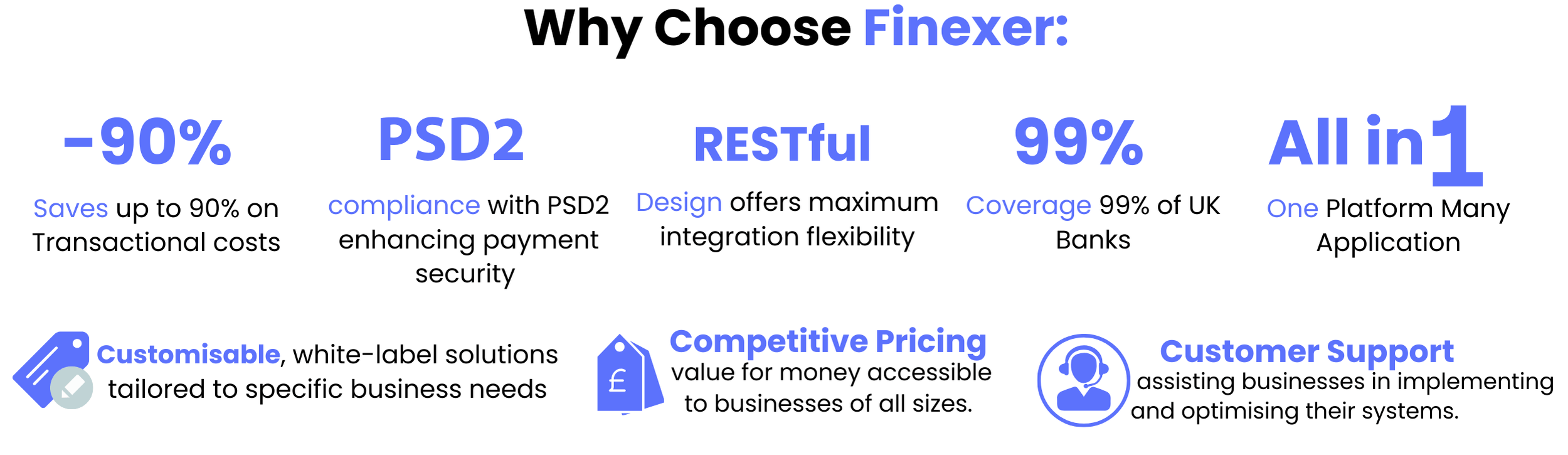
Finexer’s internal product guidance states that Pay by Bank can save up to 90% in transactional costs compared with card processing because PIS payments do not carry card interchange fees. That figure relates specifically to payment processing costs and should not be treated as a blanket saving on total EPOS expenditure.
You can also compare other touchless payment options when deciding how different payment methods fit into the checkout.
For more context on open banking payments, the key distinction is that Pay by Bank is a payment method, while the EPOS remains the system managing the sale.
6. Check How Your Takings Reconcile With the Bank
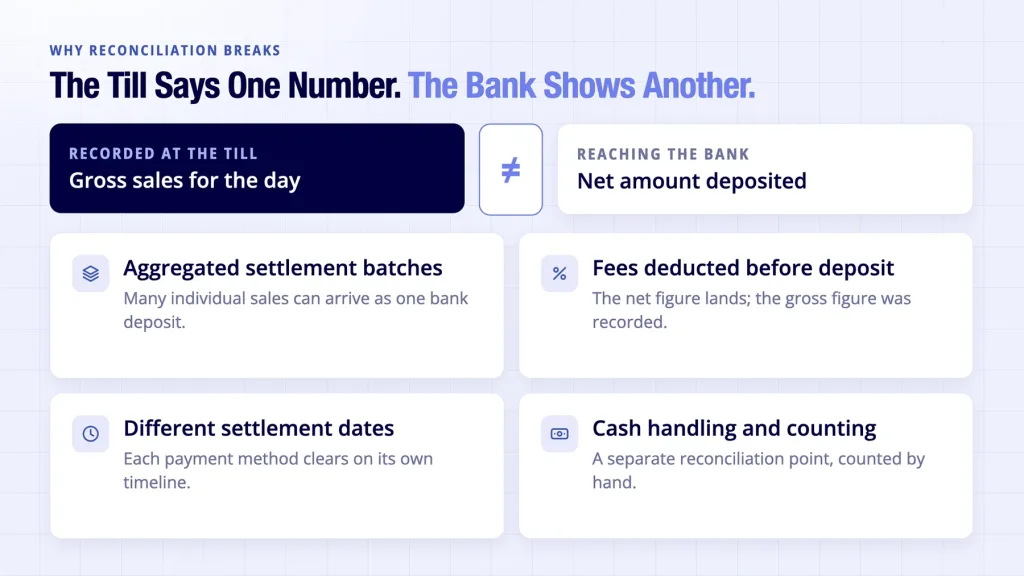
The sale appearing in the EPOS does not necessarily mean the same figure appears as a single matching deposit in the bank.
This is one of the less obvious costs of payment operations.
A day’s sales may contain the following:
- Card transactions
- Pay by Bank transactions
- Cash
- Refunds
- Payment fees
- Multiple settlement batches
- Different settlement dates
Card payments can also arrive as aggregated settlements rather than one bank transaction for every individual sale.
Fees may be deducted before settlement, making the amount reaching the bank different from the gross amount recorded at the till.
Cash creates another reconciliation point because the physical takings have to be counted, recorded and deposited.
This is why payment reconciliation matters when evaluating an EPOS and its payment setup.
The question for the buyer is straightforward:
Can finance teams connect what the EPOS says was sold with what actually reached the bank?
If the answer involves spreadsheets, manual exports and repeated investigation, the payment setup deserves as much attention as the till.
7. Check These Six Requirements Before Signing
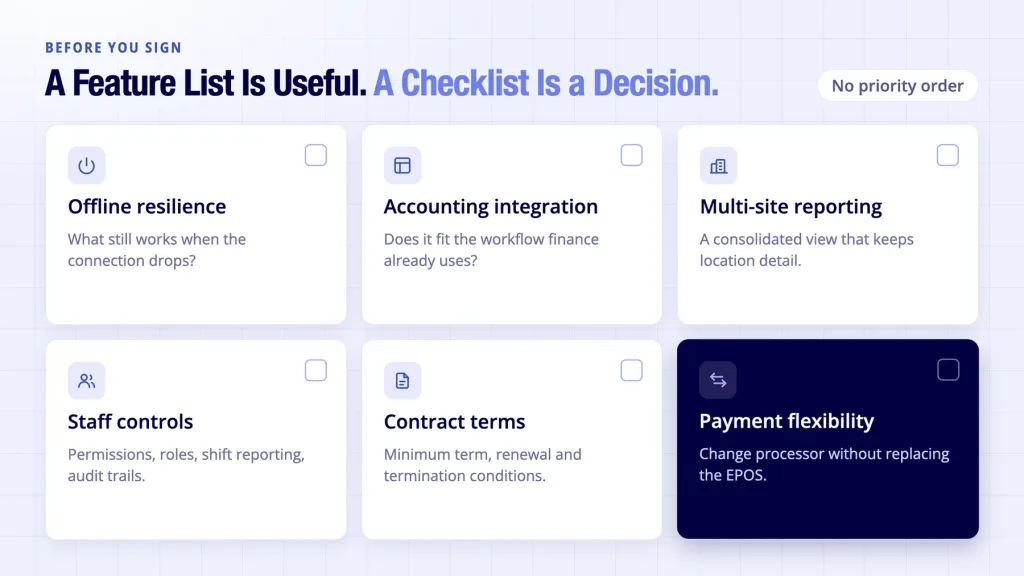
A feature comparison is useful.
A buying decision needs a checklist.
Offline resilience
What happens if the internet connection fails?
Check what the system can continue doing and how transactions are handled when connectivity returns.
Accounting integration
Confirm that the EPOS can connect to the accounting software your finance team already uses.
Do not assume that an integration listed in a sales presentation covers your exact workflow.
Multi-site reporting
If you operate several locations, check whether managers can see consolidated performance while retaining location-level detail.
Staff controls
Look at permissions, user roles, shift reporting and audit trails.
Contract terms
Check the minimum term, renewal arrangements, hardware commitments, termination conditions and payment-processing obligations.
Payment flexibility
Find out whether you can change processor or add another payment method without replacing the EPOS.
That last point can become important as your transaction volume grows.
How the Main UK EPOS Options Differ
There is no reason to pretend that the leading systems are interchangeable.
Current UK comparison research generally places Square and SumUp towards the smaller-business end of the market, while Lightspeed is more suited to businesses with deeper inventory or multi-site requirements. Epos Now sits across retail and hospitality, while Shopify POS has a natural fit for retailers already using Shopify for ecommerce. Specialist hospitality systems focus more heavily on restaurant workflows.
The practical comparison looks like this:
| Buying priority | What to look for |
|---|---|
| Low upfront commitment | Lower-cost hardware and usage-based software |
| Retail inventory | Barcode, stock, purchase and product management |
| Multi-site retail | Central reporting and location management |
| Restaurant operations | Tables, ordering, kitchen workflows and staff management |
| Online + physical retail | Ecommerce and EPOS data working together |
| Payment choice | Ability to support different payment methods and processors |
| Finance operations | Clear settlement information and reconciliation workflows |
The provider with the longest feature list is not automatically the best fit.
The better choice is the system that matches the operating model while leaving enough flexibility around payments and finance.
Where UK Open Banking Fits Into an EPOS Architecture
UK Open Banking is not an alternative to an EPOS.
It can sit alongside the EPOS as part of the payment- and banking-data layer.
There are two relevant Open Banking services:
AIS, or Account Information Service, provides account, balance and transaction data with customer consent.
PIS, or Payment Initiation Service, initiates a payment from a customer’s bank account after the customer approves it. AIS reads data. PIS moves money. The two must not be conflated.
For EPOS platforms, PIS is the relevant mechanism when adding Pay by Bank to a checkout.
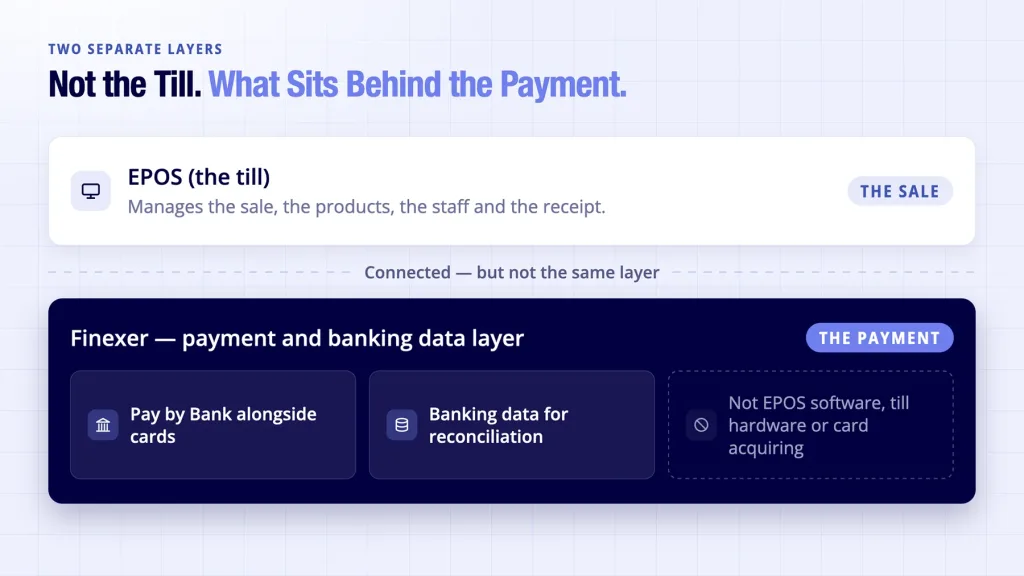
The EPOS manages the sale.
The payment infrastructure initiates the bank payment.
The banking data layer can then provide information that helps the platform understand what has reached the receiving account.
For platform teams comparing open banking providers, the important buying criteria include the provider’s regulatory status, UK bank connectivity, API model, payment capability, implementation requirements and commercial model.
Finexer: The Payment Layer Behind the EPOS
The problem for an EPOS platform is not choosing a till.
It is giving merchants more control over payment costs while helping them connect payments with what actually reached the bank.
Finexer does not provide EPOS software, till hardware or card acquiring.
Instead, Finexer provides Open Banking infrastructure that B2B platforms can integrate into their own products. Its PIS capability initiates Pay by Bank payments that settle via Faster Payments, while its AIS capability provides banking data for workflows that need account and transaction information.
For an EPOS platform, that creates a narrower and more useful proposition:
- Pay by Bank: Add an account-to-account payment method alongside cards.
- Payment cost: Pay by Bank avoids card interchange fees, with savings of up to 90% in transactional costs compared with card processing.
- Banking data: Use account and transaction data to support payment and reconciliation workflows.
- UK coverage: Almost all UK bank coverage across high street, challenger and business accounts.
- Regulatory basis: FCA-authorised AISP and PISP, FRN 925695.
- Commercial model: Contact us for API pricing.
- Integration: Finexer provides the API layer rather than an end-user EPOS product.
The distinction matters.
Finexer is not the till. It is the infrastructure an EPOS platform can build into its payment and banking workflows.
If Pay by Bank and bank-connected reconciliation are part of your product roadmap, see Finexer Payments.
Four Questions to Ask an EPOS Provider Before You Sign
1. Can I use more than one payment method?
Ask whether the system supports cards, Pay by Bank and other payment methods without forcing you into a single processing arrangement.
2. What will I pay at my expected transaction volume?
Ask for the complete payment cost, not just the EPOS subscription.
Request the transaction charges, hardware costs, contract terms and any payment-related fees in writing.
3. How do settlements appear in the bank?
Ask whether settlements are aggregated, how fees appear and what information your finance team receives for reconciliation.
4. What happens if I change the payment provider?
Your EPOS may remain in place for years.
The payment arrangement may need to change sooner as your transaction mix, costs and customer preferences change.
A system that gives you room to change the payment layer can be easier to manage over its lifetime.
The Bottom Line
Choosing among EPOS systems is not only a question of which till has the best feature list.
It is a decision about software, hardware, payments and financial operations together.
For UK retailers and hospitality businesses, the payment method deserves particular scrutiny because its cost continues after the EPOS has recorded the sale.
The strongest buying decision is therefore the one that works backwards from the full cost of taking payment, the operational workflow and the reconciliation process.
That is where Pay by Bank and UK Open Banking can have a role, without pretending that either replaces the EPOS itself.
Want to cut the cost behind the till?
See how Finexer can give an EPOS platform a Pay by Bank option and banking data for payment and reconciliation workflows.
Explore with AI
About the Author

Ravi Ranjan
Ravi Ranjan is Co founder & CEO of Finexer