Stop inaccurate statements at the data layer.
Bank-verified transaction feeds for accounting SaaS and ERP platforms.
Inaccurate financial statements are not usually caused by one big mistake. They are caused by many small data inconsistencies that compound quietly across automated workflows.
A transaction is imported with the wrong category. A duplicate entry passes reconciliation because the amounts match. A manual correction fixes one record but not the linked entries downstream. By month-end, the P&L reflects data that nobody deliberately falsified – but that does not reflect actual financial activity.
In my work building accounting integrations at Finexer, this is where inaccurate financial statements originate. Not in deliberate misreporting. In the data input layer where errors enter and propagate.
TL;DR
Inaccurate financial statements in accounting SaaS and ERP platforms typically originate from three compounding data problems: manual entry errors that survive automated workflows, import-based data gaps between CSV export windows, and miscategorised transactions that carry through to reports. Bookkeeping errors at the input layer are amplified – not corrected – by automation. Finexer’s FCA-authorised AIS provides bank-verified transaction feeds that replace manual and import-based inputs with direct bank data, removing the error layer before it reaches the accounting workflow.
Key Takeaways
What makes financial statements inaccurate at platform scale?
Inaccurate financial statements at scale result from data input errors that automated workflows treat as correct. Once a bookkeeping error enters the system, every report, reconciliation, and tax submission built on that record inherits the inaccuracy. Scale amplifies the problem – it does not catch it.
Why do bookkeeping errors compound across automated accounting workflows?
Automation processes data consistently – including consistent errors. A miscategorised transaction imported on day one is reconciled, reported, and carried forward as a correct entry. The error compounds with every workflow that consumes it downstream without independent verification.
What is the root cause of data inconsistency in accounting SaaS platforms?
The root cause is unverified data entry. CSV imports, manual journals, and PDF statement uploads are processed without independent verification against actual bank records. Any error in the source document enters the system and is treated as fact.
How does bank-verified transaction data reduce inaccurate financial statements?
Bank-verified transaction data via FCA-authorised AIS is retrieved directly from the bank – not prepared by the client or exported from a third-party system. The data reflects actual account activity. Errors introduced by manual handling are eliminated before they reach the platform.
Why Do Bookkeeping Errors Enter Accounting Systems Undetected?
What Makes Manual Data Inputs Unreliable?
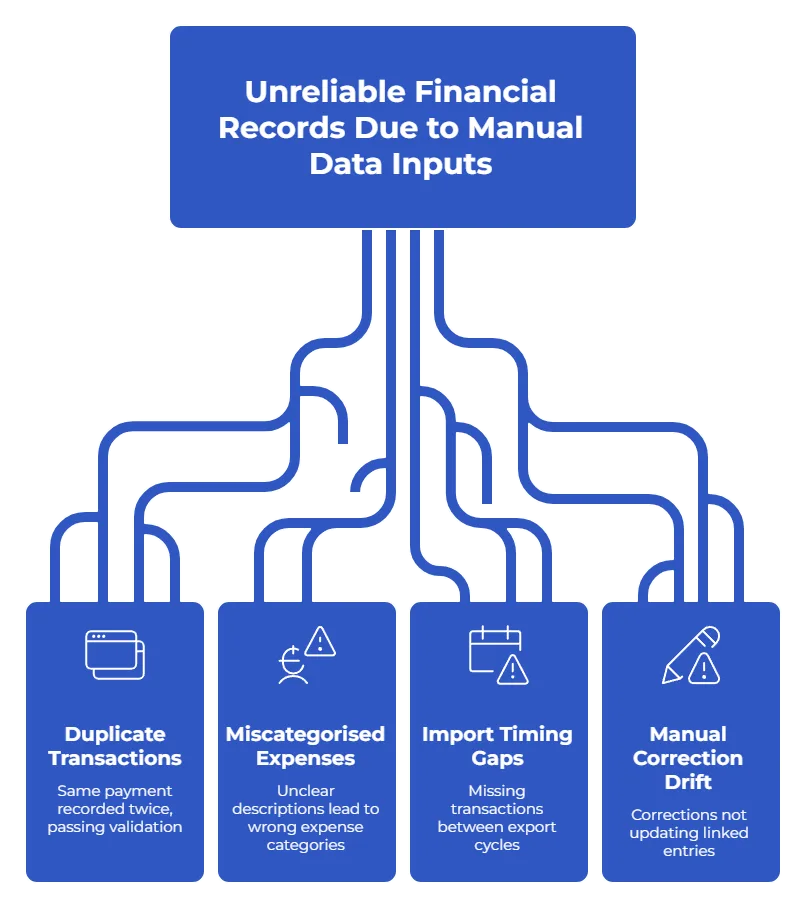
Bookkeeping errors enter accounting platforms through four input-layer gaps – each invisible to the system that processes them.
Duplicate transactions – the same payment recorded twice when a manual entry runs alongside an automated import. Both pass validation because amounts are individually correct.
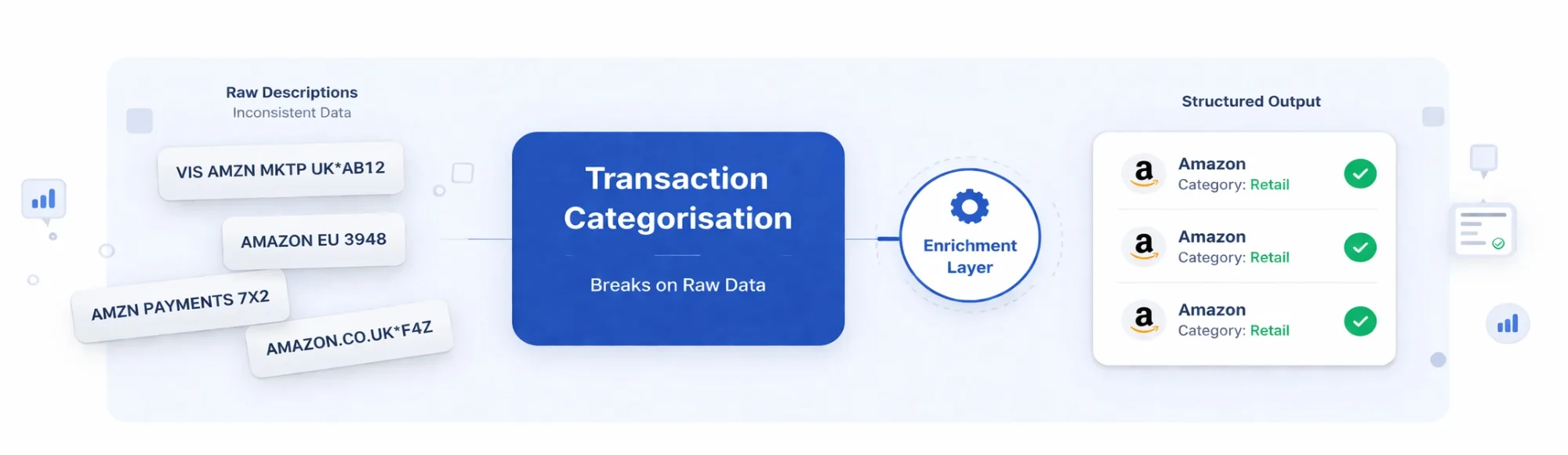
Miscategorised expenses – unclear bank descriptions matched to the wrong rule, carrying the wrong category into expense reports and VAT calculations.
Import timing gaps – CSV exports capture a snapshot. Transactions between exports are missing until the next import cycle.
Manual correction drift – a correction applied to one record that does not update linked entries, creating inconsistency across the same data set.
HMRC requires businesses to keep financial records for a minimum of 6 years. Errors from year one carry through every subsequent audit submission built on the same data set.
According to automated bookkeeping using Open Banking APIs, each of these errors is preventable when transaction data is sourced directly from the bank.
“The accounting platforms I work with that produce the most inaccurate financial statements are not using bad software. They are using good software fed by bad data. The statements reflect what was entered – not what actually happened.” – Yuri, Finexer
What Is the Business Impact of Inaccurate Financial Statements?
Why Does Automation Amplify Errors Rather Than Catch Them?
Automation processes data consistently – including consistent errors. A bookkeeping error that survives import is reconciled, reported, and carried forward as correct by every downstream workflow.
The business impact is compounding. A miscategorised supplier payment flows into the wrong expense line on the P&L, into the wrong VAT category on the tax return, and into the wrong budget allocation for the next period. One input error creates three compliance exposures.
The Open Banking Limited 2025 Impact Report confirms over 13 million UK users now access financial services via Open Banking – reflecting how rapidly bank-verified data is replacing manual imports as the standard input layer for financial platforms.
Financial reconciliation using verified bank data covers how reconciliation workflows that run on unverified inputs consistently produce inaccurate results.
| Bookkeeping Error Type | How It Enters | Business Impact | Bank Data Fix |
|---|---|---|---|
| Duplicate transaction | Manual entry alongside automated import | Inflated expenses or revenue in every downstream report | AIS delivers each transaction once – no parallel import channel |
| Miscategorised expense | Unclear bank description, wrong rule match | Wrong VAT, P&L line, and tax submission across the same record | Merchant IDs and category codes resolve classification at source |
| Import timing gap | CSV snapshot misses mid-window transactions | Understated balances and incomplete reports until next import | Real-time webhooks deliver each transaction as it occurs |
| Manual correction drift | Single record corrected, linked entries not updated | Inconsistency across reconciliation, audit trail, and reporting | Bank-sourced data requires no manual correction – correct at entry |
What Does Fixing Inaccurate Financial Statements Actually Require?
Why Fixing Reports Downstream Does Not Solve the Problem?
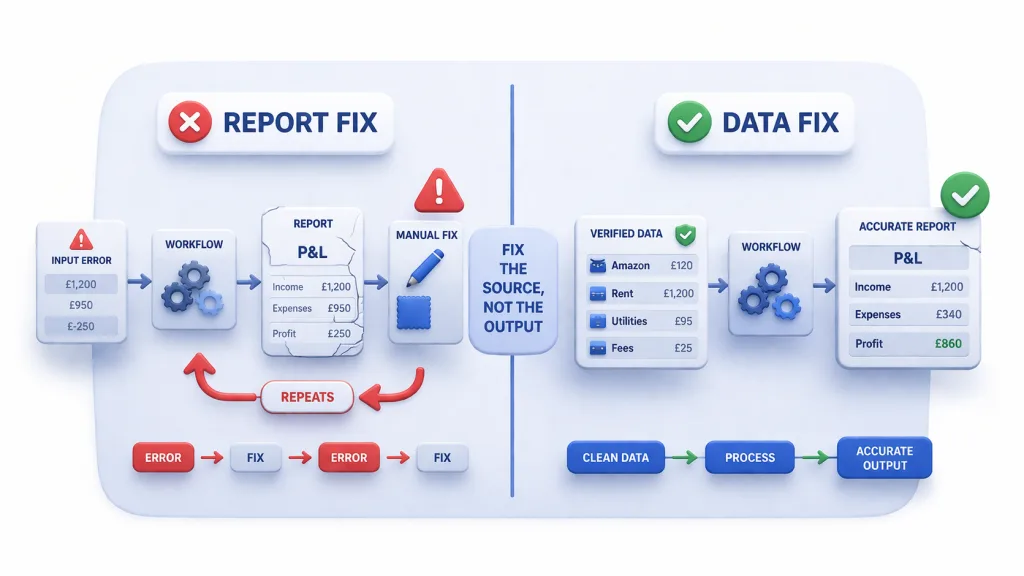
Most teams treat inaccurate financial statements as a reporting problem. They review outputs, find discrepancies, and apply month-end corrections.
The corrections fix the statement. They do not fix the input layer that produced it.
The same bookkeeping errors produce the same inaccuracies the following month. The fix is not better reporting – it is better data entering the system. That means replacing manual and import-based inputs with a verified source that cannot be altered before it reaches the platform.
Real-time bank feeds for accounting platforms covers how continuous AIS bank feeds compare to periodic CSV imports for accounting statement accuracy.
How Does Finexer’s AIS Prevent Bookkeeping Errors at Source?
What Does Finexer’s AIS Provide for Accounting Accuracy?
The problem: manual entries, CSV imports, and PDF uploads introduce bookkeeping errors that compound across automated accounting workflows. Finexer’s FCA-authorised AIS retrieves transaction data directly from the client’s bank under consent – delivering bank-verified records with no manual handling in between.
- Direct bank retrieval – transactions sourced from the bank, not client-prepared documents
- Real-time webhooks – each transaction delivered as it occurs, no import gaps
- Merchant IDs and category codes – reduces miscategorisation at entry
- Structured JSON – consistent schema across almost all major UK banks
- Up to 7 years of transaction history – complete record for audit
- Consent logs and timestamps per retrieval – full audit trail from source
- Multi-account in one consent flow – full portfolio without account-by-account imports
“Inaccurate financial statements are an input problem. Bank-verified AIS data is the fix. When transaction data reflects what actually happened in the account, the statements built on top of it are accurate by design.” – Yuri, Finexer
Financial data extraction API for accurate accounting workflows covers how API-based extraction compares to document-based methods for statement accuracy.
What I Feel
Accounting platforms invest heavily in reconciliation logic, reporting dashboards, and month-end workflows.
Almost none invest equally in the data quality layer that feeds all of it.
If the input is wrong, every output built on it is wrong. No amount of reconciliation sophistication changes that. The fix is upstream – not downstream.
Common Use Cases
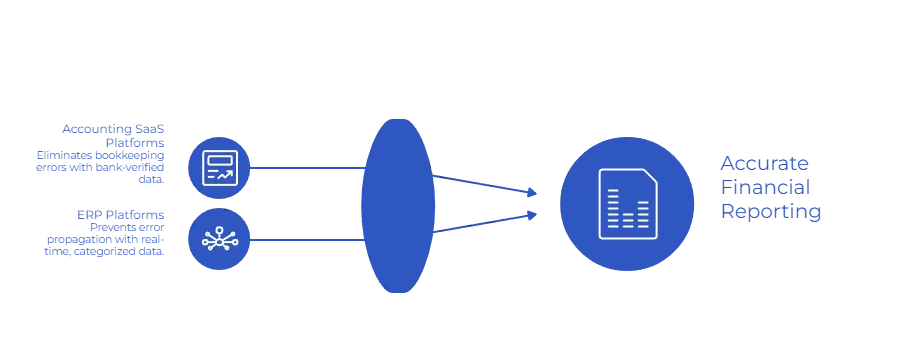
Accounting SaaS Platforms
Client accounts accumulate bookkeeping errors across manual entries and CSV imports – producing inaccurate financial statements that require month-end correction. Finexer’s AIS delivers bank-verified transaction data per client account, removing the manual input layer where errors originate.
ERP Platforms
ERP financial modules processing high transaction volumes cannot catch input-layer errors before they propagate to reports. Finexer’s real-time AIS feeds with merchant IDs and category codes deliver accurate, categorised transaction data at source – reducing error propagation across downstream reporting.
What are the most common bookkeeping errors that cause inaccurate financial statements?
Duplicate transactions, miscategorised expenses, timing gaps from periodic imports, and manual correction drift. Each error enters at the data input stage and compounds across every report and submission built on that record – making input data quality the primary driver of statement accuracy.
How do you handle discrepancies in financial statements?
Discrepancies should be traced back to the originating transaction record and corrected at source. For platforms, the reliable fix is improving input data quality – replacing manual entries and CSV imports with bank-verified transaction feeds that eliminate common bookkeeping errors before they reach the accounting workflow.
How does real-time bank data reduce bookkeeping errors in accounting platforms?
FCA-authorised AIS retrieves transaction data directly from the bank as transactions occur. There are no import gaps, no manual handling, and no client-prepared documents. Each transaction arrives with merchant ID and category code – reducing the miscategorisation and duplication errors that produce inaccurate financial statements.
Build accurate financial statements on verified bank transaction data.
About the Author

Yuri
Yuriy Yakushko is the Founder of Finexer, an FCA-authorised Open Banking platform that enables businesses to access real-time bank data and Pay-by-Bank payments through secure API infrastructure. With more than 20 years of experience in fintech and software engineering, he focuses on building scalable financial technology that helps businesses modernise payments and financial data workflows.