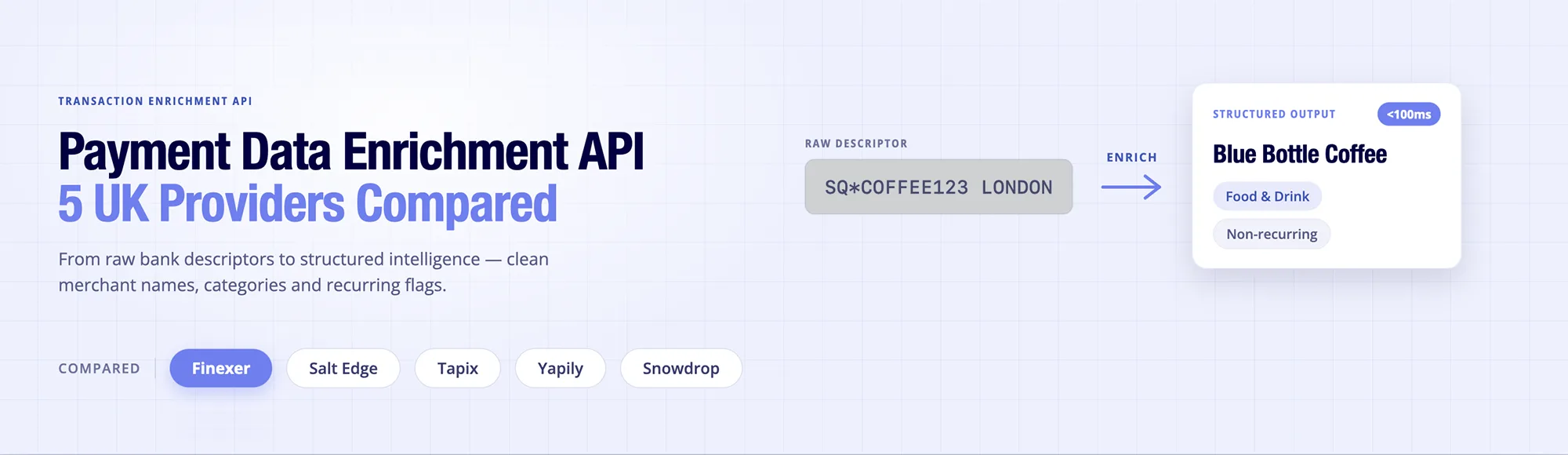
Your accounting platform receives 50,000 bank transactions daily. However, your bank descriptions arrive as cryptic codes that are hard to decipher. Your finance team can’t tell if it’s office supplies, cloud services, or equipment. They spend hours manually categorising transactions. Reconciliation slows down. Support tickets increase because users see unclear merchant names in their feeds.
Payment data enrichment solves this. According to OpenBankingTracker’s 2026 transaction enrichment report, platforms deploying payment data enrichment reduce manual reconciliation effort by 65% and improve categorisation consistency across UK bank formats.
For UK platforms evaluating payment data enrichment API providers, the decision involves comparing merchant database size, categorisation accuracy, recurring-payment detection, and integration speed.
This guide compares five leading UK-based payment data enrichment API providers on architecture, accuracy benchmarks, and use-case fit.
Want to evaluate payment data enrichment solutions for your platform? Let’s discuss accuracy requirements, bank connectivity, and integration timeline.
What Is Payment Data Enrichment?
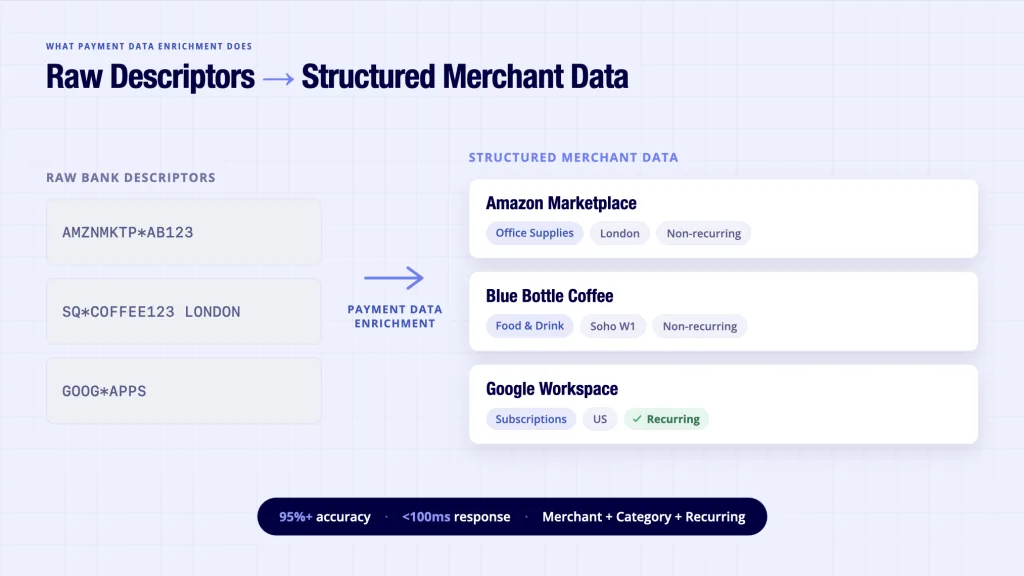
Payment data enrichment transforms raw bank transaction descriptors into clean, structured data. Instead of cryptic codes of bank descriptions, a payment data enrichment API returns: Amazon Marketplace, Office Supplies, London, UK.
For accounting platforms, payment data enrichment does three things:
- Merchant Normalisation: Instead of cryptic codes like “AMZNMKTP”, “AMAZON.CO.UK”, and “AMZN MKT”, all resolve to a single merchant identity- Amazon.
- Categorisation: Transactions automatically assign to spending categories (Office Supplies, Travel, Subscriptions).
- Recurring-Payment Detection: Flags salary deposits, subscription charges, and regular payments for cash-flow analysis.
Without payment data enrichment, reconciliation requires manual mapping. With it, the maximum number of transactions auto-categorise, freeing finance teams from cumbersome manual processes.
Why Payment Data Enrichment Matters for UK Platforms?
Payment data enrichment API providers deliver two benefits: operational efficiency and feature capability.
Operational Efficiency: According to recent research, payment data enhancement can reduce operational costs by 20% to 40% within the first year alone. These savings result from reduced manual interventions and payment rejections, faster reconciliations, and lower costs associated with compliance errors and chargebacks.
Feature Capability: Payment data enrichment enables features impossible with raw data. Cash-flow analytics, supplier spend analysis, subscription tracking, and AML-ready merchant intelligence all depend on clean transaction categorisation.
For accounting software, it automates invoice matching. For fintech apps, it powers budgeting and financial insights.
Five UK Payment Data Enrichment API Providers Compared
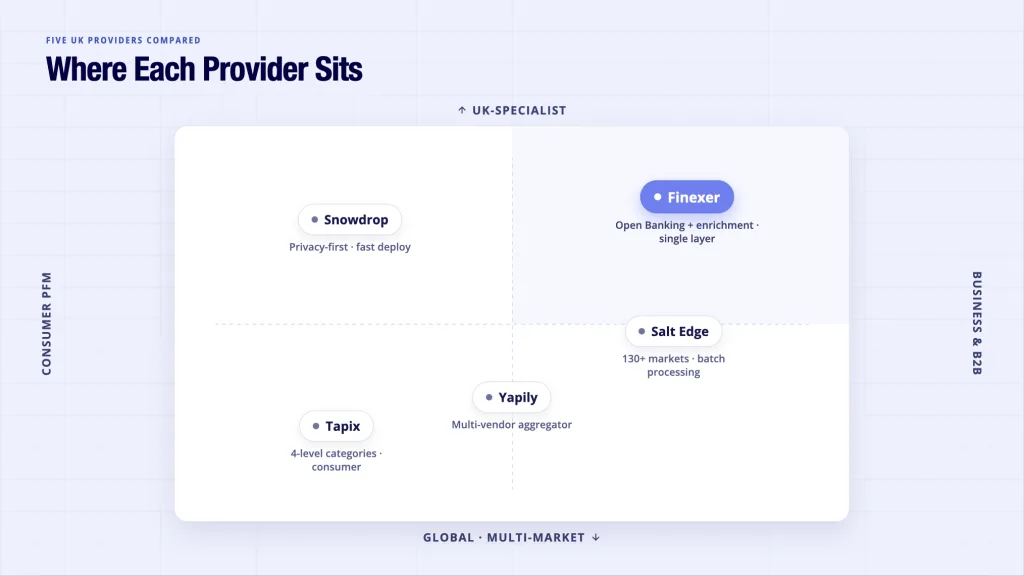
When evaluating data enrichment tools for your platform, accuracy and merchant database size are primary differentiators. Here’s how five leading providers compare:
Finexer
Finexer is an FCA-authorised (FRN925695) Account Information Service Provider (AISP) delivering payment data enrichment through Finexer’s Transaction Enrichment API. The platform covers 100M+ merchants with 95%+ categorisation accuracy across UK bank descriptor formats.
For deeper technical implementation details, see our guide on transaction data enrichment API integration patterns for UK financial platforms.
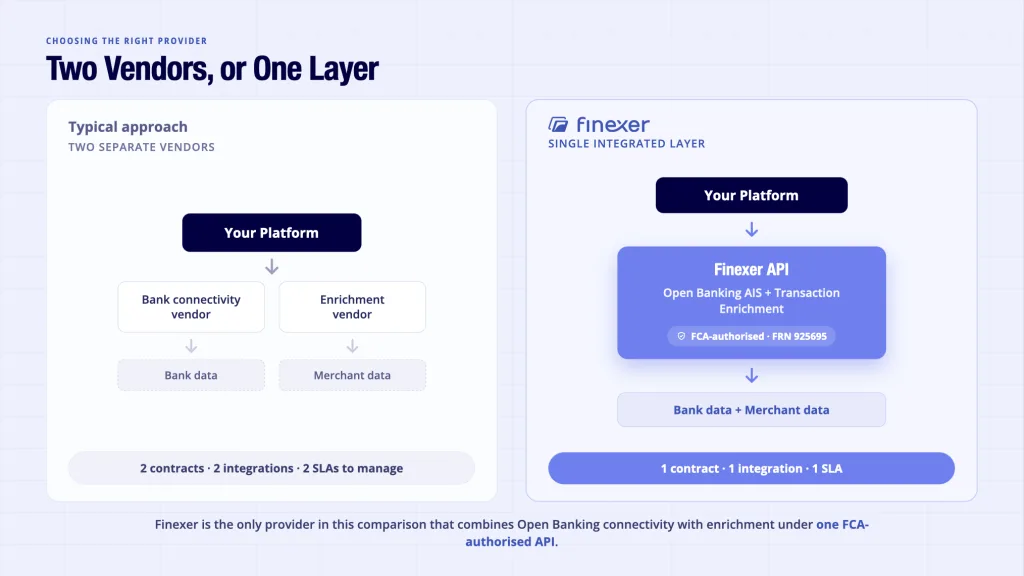
Architecture advantage: Finexer integrates Open Banking connectivity with enrichment in a single layer. Your platform retrieves verified bank transaction data and structured merchant intelligence via one API. Sub-100ms processing latency enables real-time reconciliation and reporting.
Best for: Accounting SaaS, cash-flow analytics platforms, and lending platforms performing affordability assessment. UK-focused platforms benefit from Finexer’s native UK bank coverage and FCA regulation.
Trade-off: Finexer does not provide consumer categorisation templates (like PFM budgeting). It provides structured merchant data; your platform controls downstream categorisation logic.
Salt Edge
Salt Edge’s payment data enrichment API provider solution combines rule-based logic and machine learning to achieve maximum categorisation accuracy. It has a broader merchant database that covers global transactions within the UK.
Architecture advantage: Salt Edge offers granular taxonomy (different categories split into personal and business) and batch categorisation API, enabling high-volume processing. For an in-depth SME-focused enrichment comparison, platforms can review business-specific categorisation needs separately.
Best for: Platforms building multi-geography solutions where the UK is one market among several. SME lending platforms are performing an affordability assessment.
Trade-off: Batch API has 100-item request limits, so high-volume workflows require careful batching architecture. Merchant data depth is lighter than that of dedicated enrichment-first providers.
Tapix
Tapix provides payment data enrichment through a 4-layer categorisation model with maximum claimed accuracy and a variety of unique merchants in its database, processing vast monthly transactions.
Architecture advantage: Four-level category hierarchy (e.g., Transportation breaks into taxis, public transit, bikes, e-scooters) enables granular spending insights suitable for consumer PFM.
Best for: Consumer fintech and PFM apps where transaction transparency and category depth drive user engagement.
Trade-off: Strong on consumer categorisation but less focused on SME business transaction categorisation, where the same transaction means different things to the payer and payee.
Yapily
Yapily aggregates multiple enrichment vendors into one layer, eliminating the need to contract separately. Advanced ML models trained on billions of transactions across the UK and Europe enable accurate categorisation regardless of geography.
Architecture advantage: Single integration covers both consumer and SME enrichment. Ideal for platforms serving mixed user bases.
Best for: Platforms requiring consumer and business enrichment from one vendor without managing multiple contracts.
Trade-off: As an aggregator, Yapily depends on underlying vendor reliability. Merchant data depth is controlled by underlying providers, not directly by Yapily.
Snowdrop
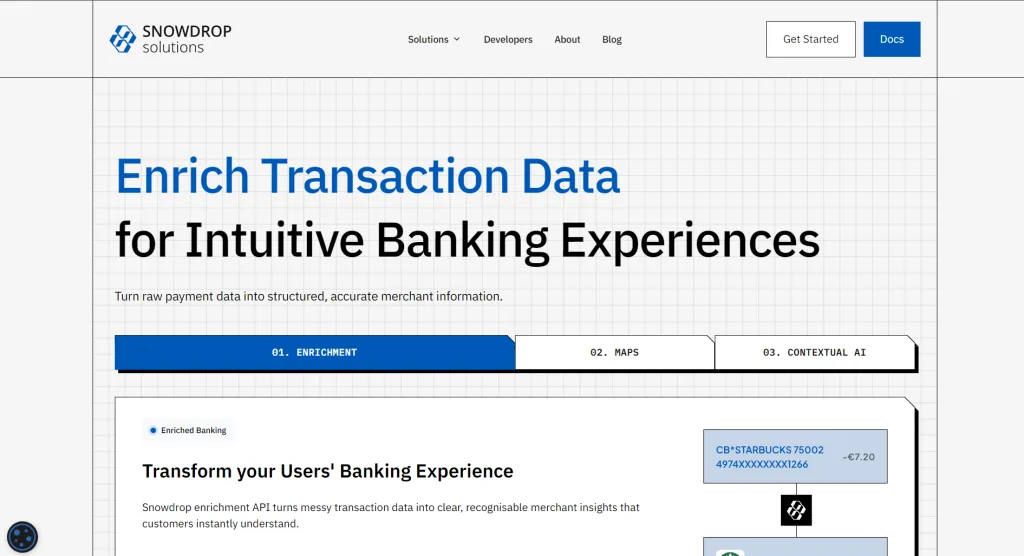
Snowdrop focuses on merchant identification accuracy with highly effective geolocation accuracy at the street level. Privacy-by-design architecture requires only a raw transaction string, no PII.
Architecture advantage: Zero PII requirement reduces compliance risk. Fast integration appeals to resource-constrained teams.
Best for: Platforms prioritising speed-to-deploy and privacy compliance over category depth.
Trade-off: Lighter on category granularity than dedicated enrichment-first providers. Focus is on merchant identification rather than spending categorisation.
Comparison of the 5 UK Data Enrichment Providers
A quick comparison of leading payment data enrichment API providers shows how their architecture, strengths, and trade-offs differ depending on your platform’s requirements.
| Provider | Architecture advantage | Best for | Trade-off |
|---|---|---|---|
| Finexer | Combines Open Banking connectivity and enrichment in a single API – real-time reconciliation and reporting from one integration. | UK accounting SaaS, cash-flow analytics, and lending affordability platforms. | Focuses on structured merchant enrichment rather than pre-built consumer budgeting categories. |
| Salt Edge | Batch processing and detailed transaction taxonomy for large-scale enrichment workflows. | Multi-market fintechs and SME lending platforms operating across multiple countries. | Batch limits require orchestration for high-volume workloads. Merchant enrichment less specialised. |
| Tapix | Four-level categorisation model for granular spending insights (e.g. Transportation → taxis, public transit, bikes). | Consumer fintech and PFM apps where category depth drives user engagement. | Strong on consumer categorisation; less focused on SME business transaction categorisation. |
| Yapily | Aggregates multiple enrichment vendors – single integration covers consumer and SME enrichment. | Platforms serving mixed consumer and business user bases without managing multiple contracts. | Enrichment quality depends on underlying vendor reliability and their merchant data depth. |
| Snowdrop | Privacy-by-design – requires only a raw transaction string, no PII. Fast integration. | Platforms prioritising speed-to-deploy and privacy-conscious financial services. | Lighter on category granularity. Focus is merchant identification over spending categorisation. |
Evaluating Payment Data Enrichment API Providers: Key Questions
When comparing payment data enrichment API providers, evaluate these dimensions:
Accuracy: Does the provider publish categorisation accuracy benchmarks for UK bank transaction formats? Industry standard is 95%+ for major merchants; rule-based enrichment typically reaches 60-70% on long-tail merchants.
Merchant Coverage: How many unique merchants? UK-focused platforms need 90%+ coverage of your customer base’s actual transaction patterns, not headline merchant counts.
Recurring Detection: Does the provider identify salary, subscriptions, and regular payments? This capability is critical for lending affordability and cash-flow analysis.
Integration Speed: Can your platform go live in 3-5 weeks? Integration speed varies by provider architecture and your team’s capacity.
Open Banking Integration: Does payment data enrichment integrate with your bank connectivity layer or require separate contracts? Finexer’s unified layer reduces vendor management.
What is payment data enrichment, and why do platforms need it?
Payment data enrichment converts raw bank transaction strings into clean, structured data, including merchant name, spending category, and recurring-payment flags. Platforms need it because raw bank data prevents automated reconciliation, categorisation, and financial insight generation.
How does payment data enrichment differ between consumer and business use cases?
Consumer enrichment prioritises spending categorisation and merchant logos for budgeting tools. Business enrichment prioritises supplier identification, expense categorisation, and counterparty recognition for accounts payable and lending workflows. The same provider may excel at one and underperform the other.
Which payment data enrichment API providers are FCA-authorised?
Finexer is FCA-authorised as an Account Information Service Provider (AISP) under PSD2. Salt Edge holds PSD2 AISP licensing. Most other enrichment-only providers are not FCA-regulated because they do not access bank data directly; they enrich transaction data you provide.
How long does it take to integrate payment data enrichment?
Integration typically takes 2-5 weeks, depending on the provider, your platform’s architecture, and testing requirements. Finexer and most providers offer sandbox environments enabling testing within 1 week. Production deployment adds 1-4 weeks for compliance sign-off and transaction volume validation.
Can payment data enrichment handle international transactions?
Yes, all five providers handle international transactions. UK focus varies: Finexer and Salt Edge specialise in UK formats. Tapix and Yapily handle multi-geography. Accuracy on international merchants is typically 5-10% lower than domestic due to lower merchant database coverage outside home markets.
Choosing the Right Payment Data Enrichment API
Choosing a payment data enrichment provider isn’t just about merchant database size or categorisation accuracy. It’s about finding a solution that fits your platform’s architecture, supports your reconciliation workflows, and scales as transaction volumes grow.
Whether you’re building an accounting platform or a fintech product, factors like Open Banking integration, recurring payment detection, webhook support, and implementation effort should all influence your decision.
For UK platforms looking to combine bank connectivity and transaction enrichment through a single integration, Finexer offers an FCA-authorised approach that brings both capabilities together. Rather than managing separate providers for bank data and enrichment, platforms can access structured transaction intelligence through one API, helping simplify integration and ongoing operations.
To explore how Finexer’s payment data enrichment API fits your product architecture, use cases, and integration requirements.
The Finexer team will walk through your technical needs and help you determine whether it’s the right fit for your platform.
Explore with AI
About the Author

Yuri
Yuriy Yakushko is a fintech founder and software engineer with over 20 years of experience building financial technology. He’s passionate about creating scalable, secure infrastructure that helps businesses modernise how they access financial data and manage payments.