
Payment status tracking. Bank-confirmed transaction data. Reconciliation-ready.
Open Banking PIS and AIS for billing platforms, ERP systems, and finance operations teams.
The payment went out. The status says “processing.” That was Tuesday.
It is Thursday. The supplier has not confirmed receipt. The finance team is manually checking the bank portal. The reconciliation file is waiting on a confirmation that has not arrived.
This is not an edge case. It is the standard payment tracking experience for most finance teams using modern software.
At Finexer, I work with billing platforms, ERP systems, and finance operations teams that have built elaborate workarounds for this problem. Status dashboards that refresh every 30 minutes. Automated emails asking suppliers to confirm receipt.
Spreadsheets that track which payments are pending, which are settled, and which need chasing. None of it is payment tracking. It is payment chasing.
Payment tracking at the operational level means knowing – per payment – what happened after the payment left the platform. Not a status field that says “sent.” Actual bank transaction data confirming settlement.
“Most platforms solve for sending payments. Very few solve for knowing what happened to them after. That gap is where finance teams spend their time.” – Yuri, Finexer
TL;DR
Payment tracking breaks when payment status and bank transaction data are disconnected. A payment can show “sent” in your system while the bank has not yet confirmed settlement. Modern online payment tracking requires per-payment webhook confirmation, bank-verified transaction data, and reconciliation-ready outputs – not status labels that reflect what the platform initiated, rather than what the bank confirmed.
Key Takeaways
What is payment tracking?
Payment tracking is the operational visibility layer between initiating a payment and confirming it reached the recipient’s account. It includes payment status updates, bank-confirmed transaction data, exception alerts for failed or delayed payments, and reconciliation-ready transaction records. Most platforms provide the first. Few provide the rest.
Why does online payment tracking break in practice?
Because most payment tracking systems reflect the platform’s own records – not the bank’s. A payment shows “completed” when the platform sent it, not when the bank confirmed receipt. That gap can be hours or days. For finance teams reconciling at period-end, it means working on data that does not reflect what the bank confirmed.
What does modern payment tracking actually need?
Bank confirmation per payment via webhook, not polling. Structured transaction data from the receiving bank, not just the sending platform. Consistent payment references that connect the outgoing payment to the incoming bank credit. And reconciliation-ready outputs that finance teams can use without manual reformatting.
How does Open Banking improve payment tracking?
Open Banking PIS initiates payments and receives webhook confirmation per transaction when settlement progresses. Open Banking AIS retrieves bank-confirmed transaction data from the receiving side. Together, they connect the outgoing payment to the bank-confirmed credit – giving finance teams actual settlement visibility rather than platform-generated status labels.
Why Does Payment Tracking Still Break?
What Creates the Payment Visibility Gap?
The problem is structural, not technical.
Most payment systems are designed around payment initiation – sending money from A to B. The tracking layer is an afterthought. A status field. A webhook that fires when the payment leaves the platform. A dashboard that shows “in progress” until someone manually updates it.
That design works when you send ten payments a month. It stops working when you send a thousand.
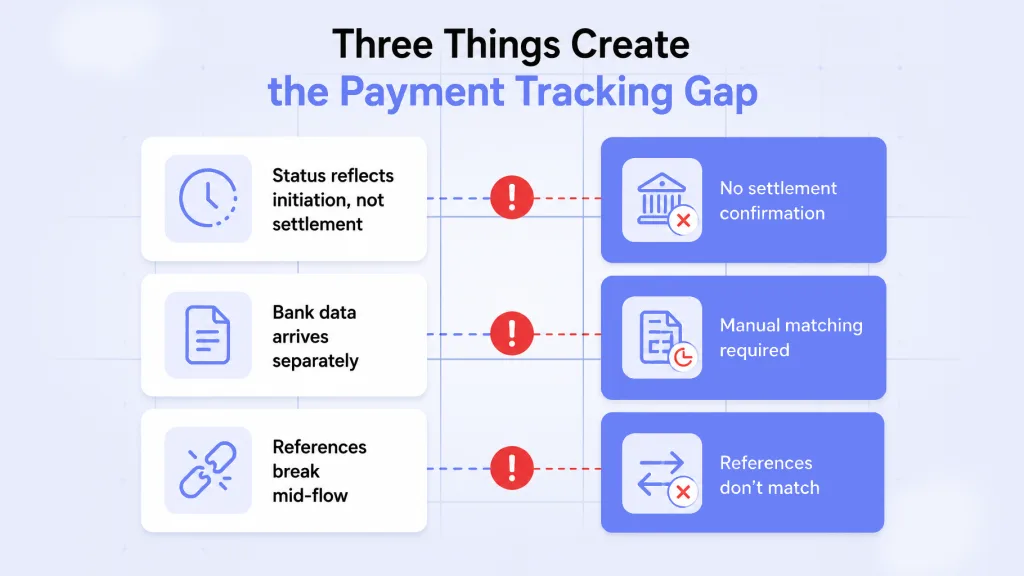
Three things create the payment tracking gap:
- Status reflects initiation, not settlement. When a platform marks a payment “sent,” it means the instruction left the platform. It does not mean the bank has confirmed receipt. In most payment workflows, those two events can be hours or days apart. The finance team sees “sent.” The supplier has not received anything.
- Bank data arrives separately. The bank statement – the most reliable source of confirmed settlement data – arrives as an end-of-day export, a CSV download, or a next-morning batch file. It is not connected to the outgoing payment record. Matching them is a manual task.
- References break mid-flow. A payment goes out with a reference. That reference may be truncated, reformatted, or dropped entirely by intermediary banks before it reaches the recipient’s account. The finance team tries to match an outgoing reference to an incoming credit. They do not match. Someone investigates.
For billing and payment platforms evaluating how real-time transaction infrastructure supports operational visibility, the real-time transaction monitoring guide covers how API-based transaction feeds differ from batch bank data in supporting operational workflows.
What Does Operational Payment Tracking Actually Look Like?
How Should the Payment Lifecycle Connect to Tracking Data?
| Payment Lifecycle Stage | Standard Platform Tracking | Bank-Connected Tracking |
|---|---|---|
| Payment initiated | Status: Sent. No further data until bank responds. | Status event: Initiated – timestamp, reference, amount logged at platform |
| Payment in progress | Status: Processing. No visibility into bank routing. | Status event: In progress – payment progressing through payment network |
| Settlement confirmed | Status updated manually or via next-day batch file | Status event: Completed – bank-confirmed, reference and timestamp available |
| Failed payment | Discovered in next-day statement review or supplier query | Status event: Failed – reason code returned, near-immediate notification |
| Reconciliation | Manual matching of outgoing records to bank statement export | Reference flows outgoing to incoming – structured matching input |
| Audit trail | Platform log only – no bank-side confirmation record | Per-payment log with reference, bank status, and timestamp |
The gap between columns two and three is not a technology gap. It is a data connection gap.
Standard payment tracking shows what the platform did. Bank-connected tracking shows what the bank confirmed. For finance teams responsible for period-end close, only the second is operationally useful.
Settlement timelines vary depending on payment type and network. UK Faster Payments settle near-immediately. International payments to supported recipients take longer depending on the routing network and banking partner. Good payment tracking infrastructure makes both visible per payment – with the appropriate qualifier on each.
For API-driven payment platforms evaluating how payment infrastructure affects tracking capability, the payment integration via API guide covers how Open Banking payment infrastructure compares to card gateways on settlement confirmation speed and tracking data richness.
Where Does Payment Tracking Break Most Visibly?
What Are the Operational Costs of Poor Payment Visibility?
The finance team is always the last to know.
A billing platform processing 300 monthly invoices can manage with manual payment tracking. Someone checks the bank portal each morning. Unconfirmed payments get chased by email. The reconciliation spreadsheet gets updated manually. At 300 invoices, this takes time but it works.
At 3,000 invoices, it is a half-time role. At 30,000, it is a department.
Three places where poor online payment tracking creates the most visible operational friction:
- Invoice payment confirmation. B2B billing platforms need to know when an invoice payment has settled – not when the customer sent it – before releasing goods, services, or the next order cycle. Platform-generated status updates do not give this. Bank-confirmed settlement data does.
- Payout reconciliation for marketplaces. Marketplace and creator platforms disbursing earnings to sellers or affiliates need both payment confirmation and reconciliation data per recipient. When payment tracking relies on end-of-day bank exports, the reconciliation cycle runs on yesterday’s data. Disputes, failed payouts, and duplicate payments are discovered late.
- Supplier payment workflows for ERP systems. ERP platforms managing supplier payments need per-payment confirmation data that connects to open purchase orders. Without bank-confirmed payment tracking, AP teams manually match bank statement entries to purchase orders – a process that scales poorly with volume.
“Payment tracking is not a reporting feature. It is an operational dependency. When it breaks, reconciliation breaks, cash position breaks, and the finance team starts spending its time on investigation rather than analysis.” – Yuri, Finexer
For platforms processing high volumes of outbound payments and looking to understand how payment tracking infrastructure supports operational scale, the Finexer bulk payment services guide covers how per-payment tracking works across bulk payout runs.
How Does Finexer Support Operational Payment Tracking?
What Does Finexer’s Payment Tracking Infrastructure Provide?
Finexer is not an ERP system. It does not build accounting software, manage ledgers, or replace financial operations tooling.
Finexer provides FCA-authorised Open Banking PIS and AIS – the payment initiation and bank data infrastructure that billing platforms, ERP systems, and finance operations teams use to connect payment initiation to bank-confirmed transaction data.
PIS – payment initiation with tracking at every stage:
- Pay by Bank via Faster Payments – near-immediate settlement for UK bank-to-bank payments
- Bulk Payout – per-recipient references embedded at initiation, status notification per payment
- Payment Links – shareable per-invoice links with reference pre-filled
- Webhook status notifications per payment at each stage – initiated, in progress, completed, or failed – with reason codes on failure
- Pre-payment validation – sort codes and account details checked before funds move, reducing failed payment rates
AIS – bank-confirmed transaction data:
- Transaction and Invoice Tracker – structured bank transaction data delivered per payment at settlement
- Merchant IDs and counterparty data at source – consistent across almost all major UK banks
- Up to 7 years of transaction history for reconciliation and exception resolution
- Consistent JSON format – same structure regardless of which UK bank processed the payment
Finexer Dashboard – operational visibility layer:
- View payment status per transaction: initiated, settling, settled, failed
- Reconciliation file auto-generated per payout run, exportable to accounting software
- Unique reference ID and audit log per payment – traceable at period-end without manual reconstruction
Settlement timelines and network coverage depend on recipient location and payment routing. UK Faster Payments settle near-immediately. Payments to supported EU and global recipients depend on the underlying payout network and banking partner routing. Finexer provides status visibility at the initiation layer, with webhook confirmation delivered per payment as it progresses.
- Usage-based pricing, no setup fees, deployment measured in weeks
- FCA-authorised (FRN 925695), connects to almost all major UK banks
For a detailed view of Finexer’s payment dashboard and transaction visibility capabilities, the Finexer Dashboard page covers the full product scope for payment monitoring and payout management.
What I Feel
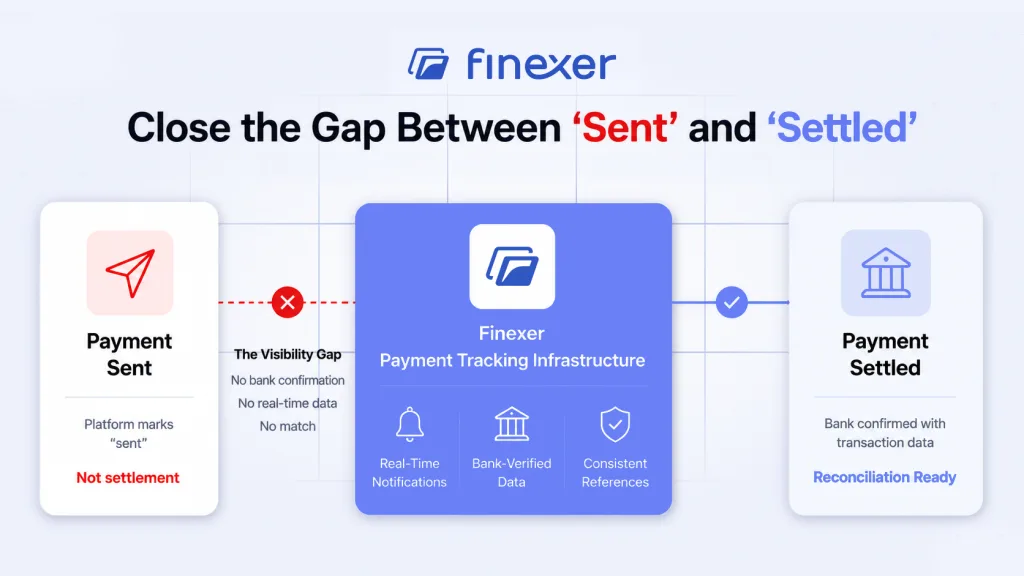
Most finance platforms have a payment tracking page. It shows a list of payments and a status column.
That status column is almost always wrong – or at least incomplete. It shows what the platform sent. Not what the bank received. Not when the settlement cleared. Not whether the reference made it through intact.
The gap between “sent” and “settled” is where finance teams live. Chasing confirmations. Manually reconciling. Explaining to suppliers why the payment shows “processed” but has not arrived.
Online payment tracking that closes this gap does not require a better status page. It requires connecting payment initiation to bank transaction data – so that “settled” means the bank said so, not just the platform.
Common Use Cases
Billing and Payment Platforms
Payment tracking for B2B billing connects invoice payment confirmation to bank-verified settlement data. When a customer pays an invoice, the platform receives status confirmation when the bank processes the payment – not a status update based on the customer’s bank transfer instruction. The invoice closes on bank confirmation, not platform assumption.
ERP and Accounting Systems
Supplier payment tracking in ERP connects outgoing payment records to bank-confirmed credits via consistent references. AP reconciliation runs against structured settlement data rather than manual bank statement exports. Period-end close reflects confirmed settlements, not pending platform records.
Marketplace and Creator Platforms
Payout tracking for marketplace disbursements provides per-recipient settlement confirmation. When earnings are disbursed to sellers or creators, each payout generates a status update and a reconciliation record. Payment disputes reduce significantly when tracking is at the bank-confirmation level rather than the platform-sent level.
Finance Operations Teams
Finance ops teams managing multi-source payment flows use the Finexer Dashboard to view payment status across initiated, settling, settled, and failed states. Reconciliation files export per run. Failed payment reason codes surface near-immediately rather than in next-morning bank statement review.
What is online payment tracking?
Online payment tracking is the operational visibility layer that shows what happens to a payment after it leaves a platform – through settlement, bank confirmation, and reconciliation. Most systems track what the platform initiated. Operational payment tracking also captures what the bank confirmed, with individual payment status updates, failure notifications, and structured reconciliation data.
How do businesses track payments in real time?
By connecting payment initiation to bank-level confirmation via webhook notifications. When a payment initiates, progresses, and clears, each stage fires a webhook with a status update and the payment reference. Finance teams receive near-real-time status per payment rather than waiting for end-of-day bank statement exports.
Why do payment confirmations get delayed?
Three reasons: the bank has not yet processed the payment (settlement timing varies by payment type and network), the payment failed silently with no notification to the sending platform, or the reference did not survive the transfer intact and the payment cannot be matched. Each requires different handling – which is why per-payment status data matters.
How does payment tracking support reconciliation?
When the same reference that initiates a payment returns with the bank confirmation, the reconciliation layer has structured inputs it can use. Payment tracking that provides consistent references, individual payment status events, and structured transaction data significantly reduces the manual matching overhead that end-of-day bank exports require.
See how Finexer connects payment initiation to bank-confirmed transaction data for operational payment tracking.
About the Author

Yuri
Yuriy Yakushko is a fintech founder and software engineer with over 20 years of experience building financial technology. He’s passionate about creating scalable, secure infrastructure that helps businesses modernise how they access financial data and manage payments.