
Spending, Properly Identified.
Merchant and category resolved at 95%+ accuracy, on every transaction, in real time.
A bank descriptor that reads “REF8827 TESCO STORES 4471” tells your product team nothing useful. Spending data is supposed to fix that. Most of it, on its own, doesn’t.
TL;DR: Spending data is the outbound slice of a user’s transactional data: what they actually spent, where and on what. On its own it’s a list of unexplained transfers. Enriched with a merchant, category and confidence score, it becomes something a budgeting screen, an affordability view or an expense report can use without a human cleaning it up first.
This guide draws on Finexer’s work as an FCA-authorised Open Banking infrastructure provider (AISP and PISP, FRN 925695), supplying real-time banking data and enrichment to UK platforms across accounting, wealthtech, proptech and utility billing.
“At Finexer, I work with UK platforms across payroll, lawtech and accounting, and the same question comes up every time a team tries to ship a spending feature,” says Yuri, Co-founder and Technology Lead, Finexer. “Is the merchant name actually usable, or does someone still have to clean it up by hand.”
What Spending Data Actually Shows You
Spending data shows where and how money leaves an account, at transaction level, with the merchant and category already identified.
It’s a specific slice of a customer’s transactional data: real-time banking data, pulled through Open Banking once a customer has approved access. On its own, an unprocessed transactional data record only carries what the bank’s system logged for its own purposes.
That’s the gap enrichment closes. It takes a line that says “REF8827 TESCO STORES 4471” and returns something a product screen can actually display: Tesco, Groceries, high confidence.
What a usable spending data record contains:
| Field | What it tells you |
|---|---|
| Date | When the transaction happened |
| Amount | How much moved |
| Direction | Money in or money out |
| Merchant | Who the transaction was with, resolved from the original descriptor |
| Category | What kind of spend it was |
| Balance context | The balance immediately before and after |
Turning a Bank Descriptor Into a Merchant Name
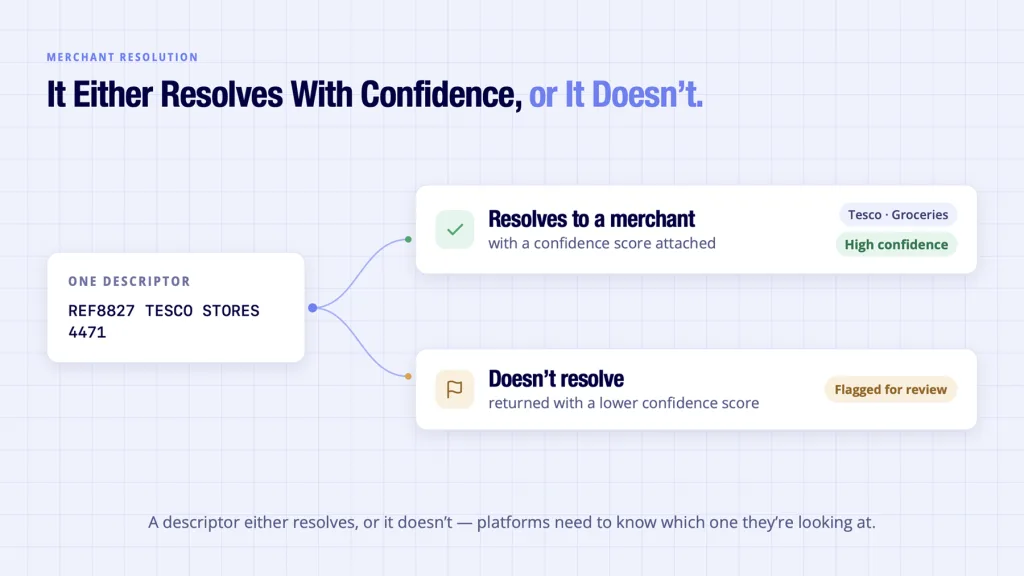
A merchant’s name doesn’t come from the bank. It comes from a data enrichment api matching the descriptor against a merchant database and returning a verified name, category and confidence score.
This isn’t a case of fixing something broken. Bank transaction data is accurate; it’s written for the bank’s own systems, not for a budgeting app’s UI. Enrichment adds a layer of intelligence on top, not a repair job underneath.
“The mechanics matter more than people assume,” says Yuri, who works on Finexer’s data architecture. “A descriptor either resolves to a merchant with a confidence score attached, or it doesn’t. Platforms need to know which one they’re looking at before they show it to a user.”
Spending Data vs Transactional Data: Where the Line Sits
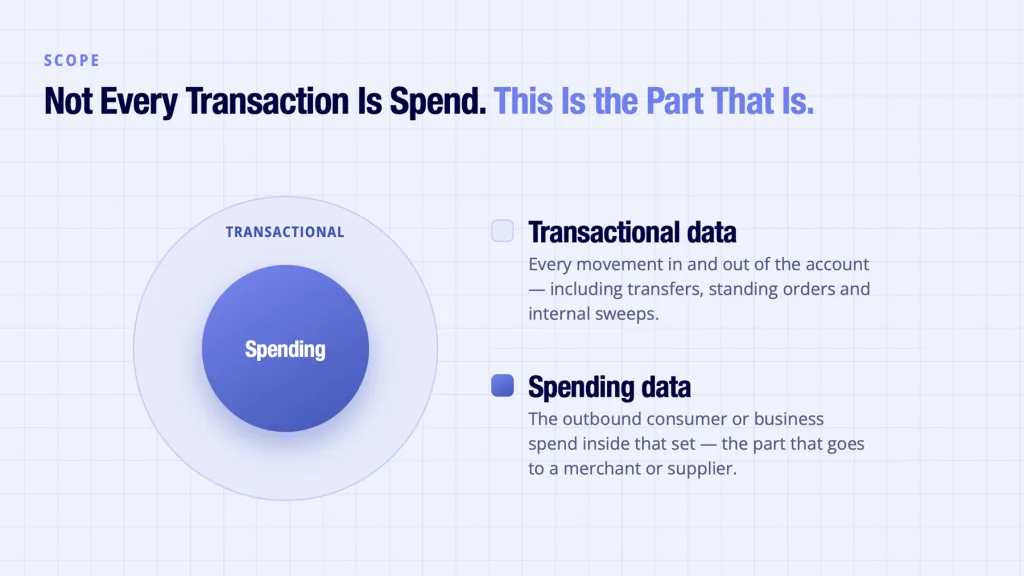
Transactional data is the wider set: every movement in and out of an account, including transfers, standing orders and internal sweeps between a customer’s own accounts.
Spending data is narrower. It’s the outbound consumer or business spend inside that set, which is the part that actually represents money going to a merchant or supplier.
Most content treats these two terms as interchangeable. They aren’t. A platform that reads “transactional data” and builds against it wholesale will pull in transfers that a budgeting feature was never meant to show.
The Data Quality Bar That Decides Whether It Ships
Three things decide whether spending data is usable in a customer-facing product: merchant identification accuracy, category consistency and latency.
Get any one of these wrong and the feature becomes something a support team has to explain rather than something a user trusts. A category that flips between “Groceries” and “Retail” for the same merchant erodes confidence fast.
This is a different problem to whether the underlying data itself is clean. That question and how transaction data quality is assessed before enrichment even starts are covered in more depth elsewhere. What matters here is what comes out on the other side.
What UK Platforms Actually Build With It
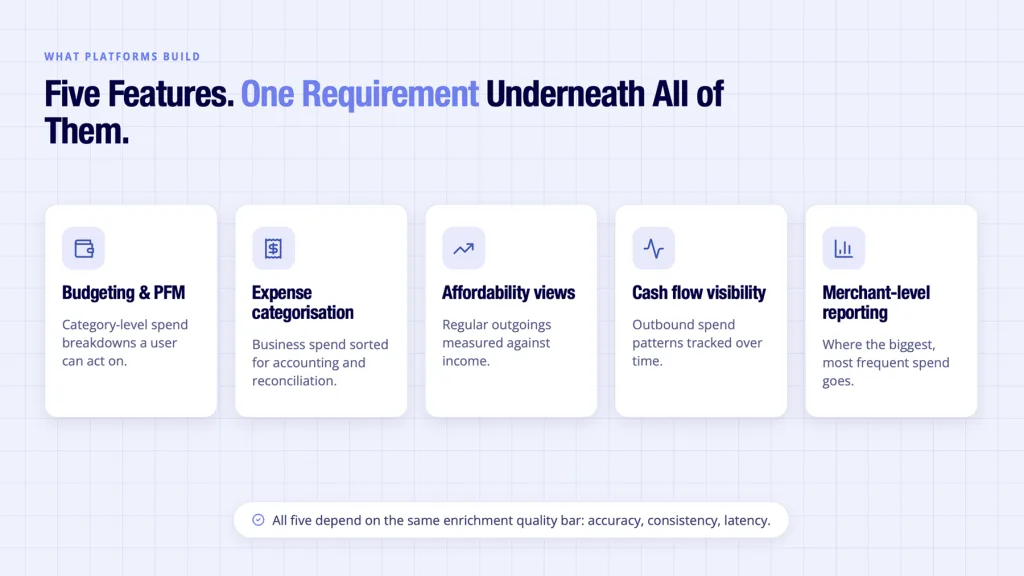
Once merchant and category are resolved, spending data supports a specific, recognisable set of product features:
- Budgeting and personal financial management: category-level spend breakdowns a user can actually act on
- Expense categorisation: automatically sorting business spend for accounting and reconciliation, including expense management automation workflows
- Affordability views: a picture of regular outgoings against income, built from category-level spend rather than unprocessed line items
- Cash flow visibility: tracking outbound spend patterns over time, not just a point-in-time balance
- Merchant-level reporting: identifying where the biggest and most frequent spend is actually going
Consent and How Long Access Lasts
None of these work without the customer agreeing to it first. A user authenticates directly with their bank, approves what’s being shared and for how long and can withdraw that consent at any time.
The scale of this is no longer small. UK Open Banking recorded 18.81 million active user connections in June 2026 alone (Open Banking Limited), which gives some sense of how much transactional data platforms are now managing under consent.
Finexer never sees the customer’s bank password. The bank authenticates the user directly, and the platform only receives what the customer has explicitly agreed to share.
Who’s Already Building This
Accounting & ERP: reconciliation tools use enriched spending data to match transactions against invoices without manual descriptor cleanup.
WealthTech: advisory platforms use category-level spend to build a client’s financial picture, including corporate financial advisory services that need a clear view of outgoings before making a recommendation.
Proptech: letting agent and property management platforms use spend patterns to support affordability views for prospective tenants, alongside income verification.
Utility billing: energy and telecom platforms use category data to understand the household spend context around payment collection.
How Finexer’s Data Product Fits
Platforms building spending features run into the same wall: the underlying transaction feed is accurate but not descriptive enough to show a customer directly.
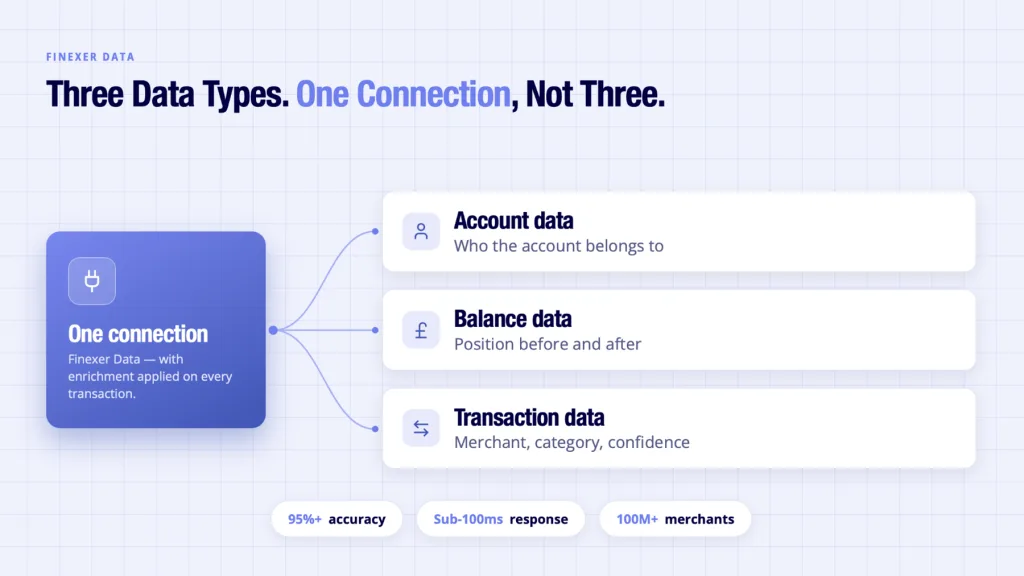
Finexer’s Data product, with enrichment layered on, resolves this by returning merchant name, category and a confidence score against every transaction rather than a bare bank descriptor. Finexer Data covers account data, balance data and transaction data from a single connection, so a platform isn’t stitching together separate feeds.
For this specific problem, three things matter:
- Merchant identification at 95%+ accuracy, sub-100ms response, across a 100M+ merchant database
- 99% UK bank coverage across high street, challenger, and business accounts
- FCA-authorised infrastructure, so the enrichment layer sits on regulated access, not a scraped or unofficial feed
Where Finexer Sits Against Other UK Providers
Most UK Open Banking providers with both data and payments capabilities, TrueLayer, Yapily, Tink, and Plaid among them, offer some form of transaction categorisation as part of a wider platform.
The differences tend to show up in focus rather than in whether the feature exists at all. Tink, now part of Visa, is strong on data enrichment and European coverage; Plaid’s product set is primarily built for the US market, with UK presence still growing. TrueLayer positions itself as an enterprise-scale platform with strong developer documentation.
Finexer’s enrichment sits inside a UK-first, transparently priced product built specifically for platforms that need merchant-level spending data without adopting an enterprise pricing model designed for a different market.
Does spending data cover business accounts or only personal ones?
Both, provided the account holder has given consent. Platforms use business account spending for expense and reconciliation tools, and personal account spending for budgeting features, depending on the ICP they’re building for.
Does enriched spending data work across all UK banks?
Coverage extends across almost every UK bank, including high-street names, challengers and business accounts. Coverage isn’t identical for every institution, so it’s worth checking specific bank support for a given use case.
How is spending data different from card network transaction data?
Card network data only captures spend that runs through a card scheme. Spending data pulled via Open Banking covers the full picture, including card payments, bank transfers, direct debits and standing orders, straight from the account itself.
What happens when a merchant can’t be confidently identified from the descriptor?
Quality enrichment returns a lower confidence score instead of guessing. That lets a platform flag the transaction for review, rather than displaying a merchant name that might be wrong.
See how Finexer’s enriched banking data resolves merchant and category on every transaction, so your platform can ship spending features customers actually trust.
Explore with AI
About the Author

Ravi Ranjan
Ravi Ranjan is Co founder & CEO of Finexer