
Most platform teams meet open banking through a single product ticket: verify a bank account, pull transactions into a dashboard, or collect a payment without card fees. You choose a vendor for that job. A few months later, a second ticket arrives, and that vendor doesn’t cover it.
That’s why this list ranks open banking solution providers rather than standalone APIs. These vendors bundle account data (AIS), payments (PIS), verification and data enrichment under one contract, so the second ticket doesn’t require a second vendor.
Key takeaways
- Open banking solution providers bundle AIS, PIS, verification and enrichment in one integration; API-only vendors cover a single layer.
- UK open banking passed 16.5 million live user connections in January 2026, with 145 regulated firms competing for your shortlist (OBL).
- Bundling matters more in 2026: commercial variable recurring payments go live this year, and data-only stacks will need a payments migration.
- Shortlist on four things: UK coverage, what’s bundled, onboarding time, and pricing model.
What is an open banking solution provider, and how is it different from an API provider?
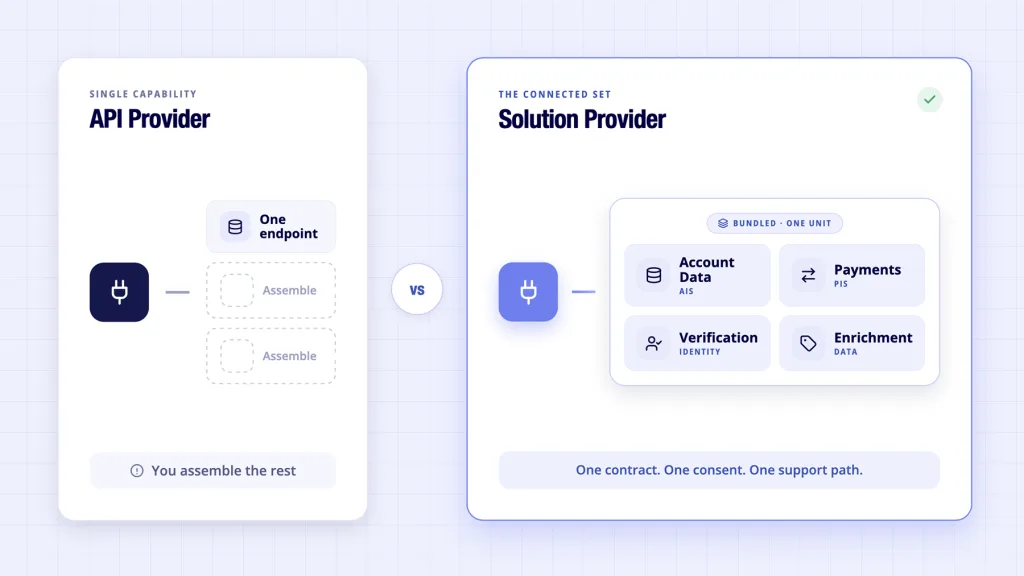
The distinction between an API provider and an open banking solution lies in the scope. An API provider gives you one effective capability; open banking solution providers give you the connected set.
- API provider: One regulated capability, usually account information services or payment initiation, delivered as an endpoint. You assemble the rest.
- Solution provider: AIS, PIS, bank account verification and data enrichment under one FCA authorisation, one consent journey, one support path.
Common open banking examples make this concrete: an accounting platform needs bank feeds (AIS), invoice collection (PIS) and supplier verification. That’s three products from an API vendor, or one integration from a solution provider.
What should UK platforms compare open banking api solutions on?
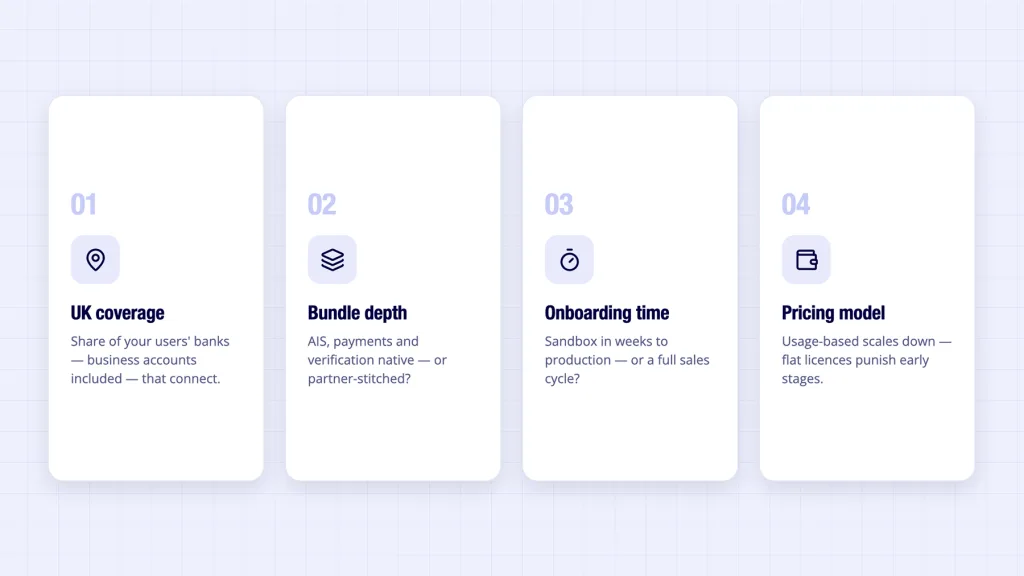
Before any demo, agree the criteria. Our API banking platform guide covers evaluation in depth; the short version is four questions.
The Four Filters
Below are the four filters that you could apply to compare OB API solutions:
- UK coverage: What share of your users’ banks, including business accounts, is supported?
- Bundle depth: Are account information services, payments, and verification native, or partner-stitched?
- Onboarding time: Sandbox today, or after a sales cycle? Weeks to production, or quarters?
- Pricing model: Usage-based pricing scales with a growing platform; per-seat or flat licences punish early stages.
Apply the filters to every candidate equally; open banking solution providers often differ most in the areas their websites cover least.
Which are the best open banking solution providers in the UK for 2026?
Six open banking solution providers appear most often on UK shortlists this year. The providers below were selected based on FCA-regulated Open Banking capabilities, product breadth (AIS, PIS, verification, and enrichment where applicable), UK market relevance, and publicly available documentation.
1. Finexer: UK-first Full Stack for SMEs and Platforms
Finexer is an FCA-authorised (FRN 925695) provider built specifically for UK platforms, bundling three products in one integration:
- Data: real-time account information services with transaction categorisation and balance enrichment built in
- Payments: payment initiation for pay-by-bank checkout, payouts and collections
- Verification: instant bank account verification for onboarding and KYC support
Why does it feature?
99% UK bank coverage, usage-based pricing, white-label consent screens, and 3–5 week onboarding. For the data layer in detail, see Finexer’s AIS API. Best for UK SaaS, accounting, proptech and payroll platforms that want the full stack without enterprise minimums.
Beyond its core AIS, PIS and Verification capabilities, Finexer offers several features that help platforms simplify integration, improve operational visibility, and scale Open Banking services:
- Up to 7 years of transaction history across almost all major UK banks.
- Bulk payment initiation with per-payee status tracking for operational visibility.
- Invoice-linked payment requests with webhook status updates and AIS-based payment matching.
- Merchant-level data enrichment with 95%+ transaction categorisation accuracy and a 100M+ merchant database.
- PCI DSS-compliant infrastructure, alongside FCA authorisation, for compliance-focused businesses.
- Direct bank integrations with no third-party intermediaries, reducing integration complexity.
2. TrueLayer: Enterprise Payments at Scale
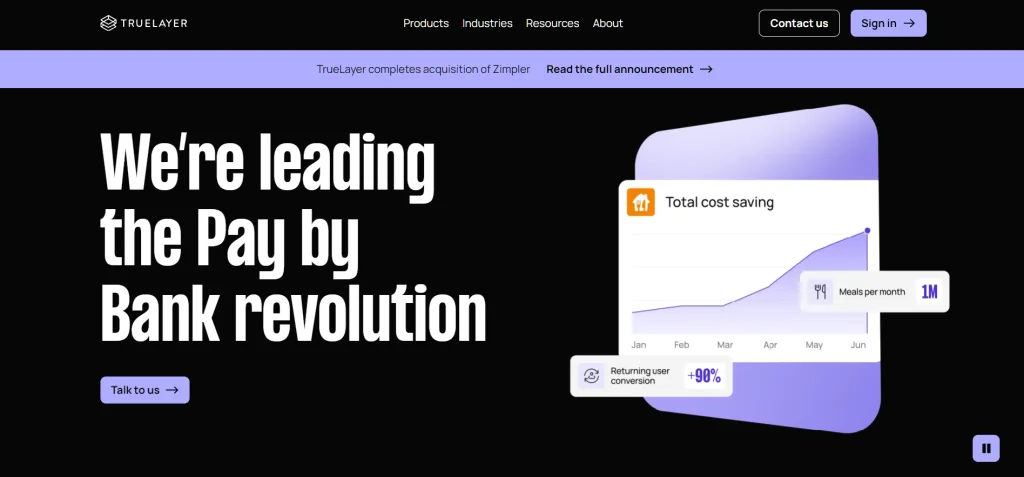
The TrueLayer open banking suite spans payments, payouts, data and verification, with a deep e-commerce and iGaming presence. Best for enterprises with high payment volumes; TrueLayer open banking pricing and onboarding are suited for complex payment operations.
3. Yapily: White-label Infrastructure
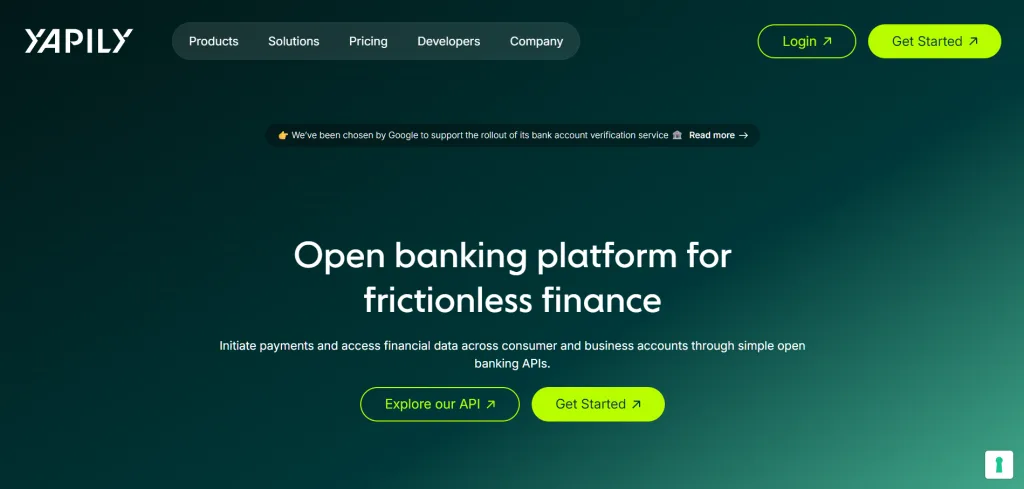
Yapily open banking infrastructure keeps its open banking api solutions API-only by design: no user-facing layer, full white-label control, broad European connectivity plus hosted consent tooling. Best for teams with engineering capacity that want Yapily open banking rails underneath their own user experience.
4. Tink: Pan-European Reach under Visa
Tink’s open banking api solutions pair wide European bank connectivity with mature data enrichment and money-management tools. Best for platforms whose roadmap crosses the Channel and who value Visa-scale stability.
5. Salt Edge: Global Coverage and Compliance
Salt Edge connects to thousands of banks worldwide and offers compliance-focused products alongside AIS/PIS. Best for platforms serving customers beyond Europe.
6. GoCardless: recurring collections first
GoCardless approaches open banking from bank debit: Direct Debit plus Instant Bank Pay, with bank data via its Nordigen acquisition. Best for subscription and invoice-led businesses where recurring collection is the core job.
How do the open banking solution providers compare at a glance?
Here is one table comparing the six open banking solution providers, showing capabilities as bundled by default.
| Provider | AIS | PIS | Verification | Enrichment | Sweet spot |
|---|---|---|---|---|---|
| Finexer | ✔ | ✔ | ✔ | ✔ (included) | UK SMEs & platforms |
| TrueLayer | ✔ | ✔ | ✔ | ✔ | Enterprise payments |
| Yapily | ✔ | ✔ | ✔ | Partial | White-label builds |
| Tink | ✔ | ✔ | ✔ | ✔ | Pan-European |
| Salt Edge | ✔ | ✔ | ✔ | ✔ | Global coverage |
| GoCardless | ✔ | ✔ | ✖ | Partial | Recurring collections |
For a criteria-scored deep dive on several of these vendors, see our Open Banking providers compared guide.
How much do open banking API solutions cost in the UK?
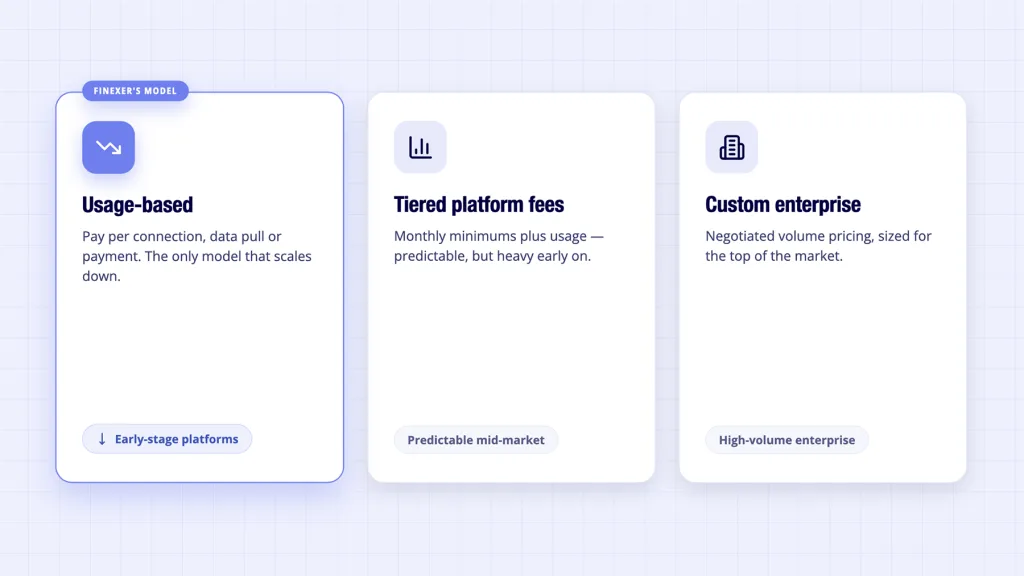
Pricing is where many shortlists run into trouble. Most open banking api solutions price one of three ways:
- Usage-based: Pay per connection, data pull, or payment. This scales down well for early-stage platforms (Finexer’s model).
- Tiered platform fees: Monthly minimums plus usage. Predictable for enterprises, but often heavy for startups.
- Custom enterprise contracts: Negotiated volume pricing, typical at the TrueLayer/Tink end of the market.
A helpful question for every vendor: What would we pay at 1,000 open banking users, and at 50,000? The answer shows who the open banking API solutions were designed for.
The bottom line
There is no universal best open banking solution provider UK-wide, only the right bundle for your stack. Run the four filters, ask for the 1,000-vs-50,000 pricing answer, and shortlist the vendors whose bundle covers your next three product tickets, not just this one.
What’s the difference between a solution provider and an API provider?
Standalone open banking api solutions sell a single capability, data or payments, as an endpoint. Open banking solution providers bundle account information services, payment initiation, verification and enrichment under one contract and consent journey. Fewer vendors, fewer integrations, one accountability path when a bank connection fails.
What exactly is bundled in a full-stack offer?
Typically four layers: AIS (balances and transactions), PIS (pay-by-bank and payouts), bank account verification (ownership and name checks), and data enrichment (categorisation, running balances). Typical open banking examples of a bundle in use: bank feeds, invoice collection and supplier checks through one consent journey. Some open banking api solutions include consent management and webhooks as standard; others price them separately, so it’s worth asking early.
Which UK providers offer the full stack?
From this list of open banking solution providers: Finexer, TrueLayer, Tink and Salt Edge bundle all four layers; Yapily covers data and payments with partial enrichment; GoCardless focuses on collections with data via Nordigen. For most UK open banking use cases, at least three of the six will fit, and the four filters above narrow it down quickly.
Why does bundling matter more in 2026?
Two reasons. Commercial variable recurring payments launch in the UK this year, so data-only stacks will need a payments build sooner than planned. And with 145 regulated firms live as of January 2026, vendor consolidation (fewer, deeper open banking solution providers) is how platforms keep integration overhead flat while open banking users keep growing.
See how Finexer’s bundled stack fits your platform. Sandbox access is free, and onboarding takes 3 to 5 weeks.
Explore with AI
About the Author

Ravi Ranjan
Ravi Ranjan is Co founder & CEO of Finexer