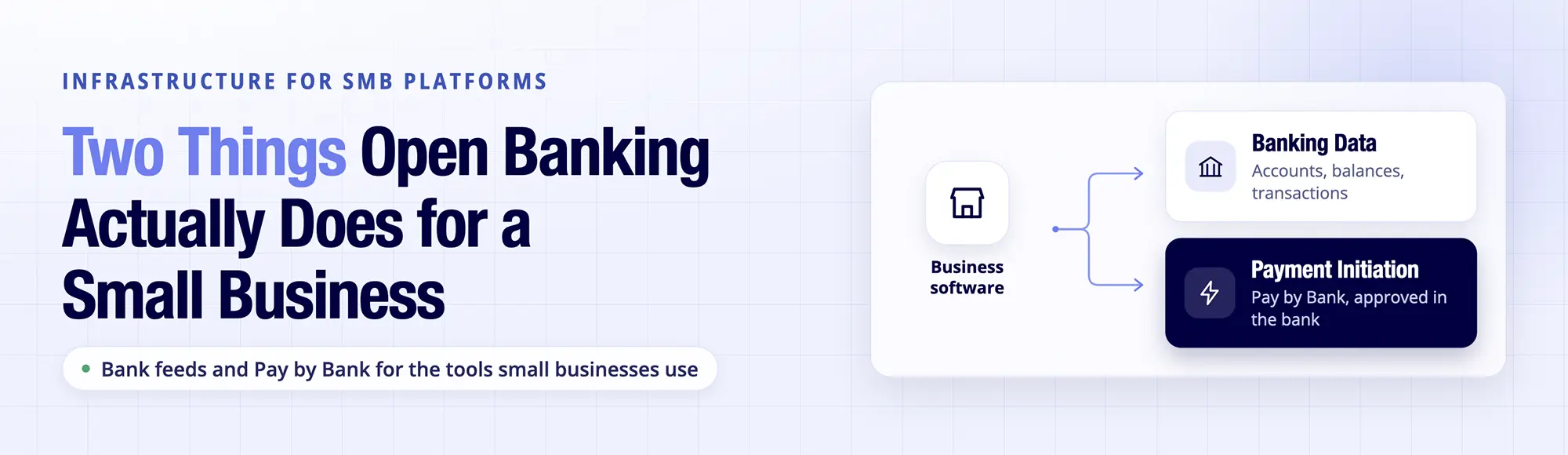
Infrastructure for SMB Platforms
Bank feeds and Pay by Bank for the tools small businesses use.
A small business does not need another financial dashboard. It needs fewer things to do.
If bank transactions can reach the accounting system automatically and customers can pay directly from their bank account, two recurring finance tasks become part of the software rather than another item on the owner’s list.
That is the practical case for open banking for small businesses. It is less about financial technology as a concept and more about removing unnecessary steps from collecting, recording and reconciling money.
For the wider context, see our guide to open banking for businesses.
Open Banking gives small businesses two useful capabilities: access to their own banking information and the ability to initiate account-to-account payments with customer consent.
For smaller firms, the value often appears in accounting feeds, cash visibility, payment collection and reconciliation rather than in another standalone banking product.
This article reflects Finexer’s work as an FCA-authorised Open Banking infrastructure provider supporting platforms that build banking data and payment capabilities into accounting, invoicing and other business software. Finexer is infrastructure for those platforms, rather than a product sold directly to small businesses. The firm is authorised for account information and payment initiation services under FRN 925695.
The useful question for a small business is not whether it needs Open Banking. It is where Open Banking can remove a task it currently performs by hand.
What Does Open Banking Give a Small Business
The most useful way to understand open banking for small business is to split it into two functions.
| Open Banking Capability | What It Does for a Small Business |
|---|---|
| Banking data | Feeds account, balance and transaction information into connected software |
| Payment initiation | Lets customers approve A2A payments without entering card details |
| Reconciliation | Gives software current banking information to match payments and transactions |
| Cash visibility | Gives finance teams a current view of money entering and leaving accounts |
The first function is about reading banking data. The second is about initiating payments.
Together, they can connect the movement of money with the accounting record that describes it.
Open Banking is already operating at significant scale in the UK. In June 2026, the ecosystem recorded 40.16 million Open Banking payments and 2.81 billion API calls, according to Open Banking Limited.
For a small business, that matters because Open Banking is no longer something that exists only in specialist fintech products. It increasingly sits inside the accounting and payment software businesses already use.
Reading Banking Data Without Manual Uploads
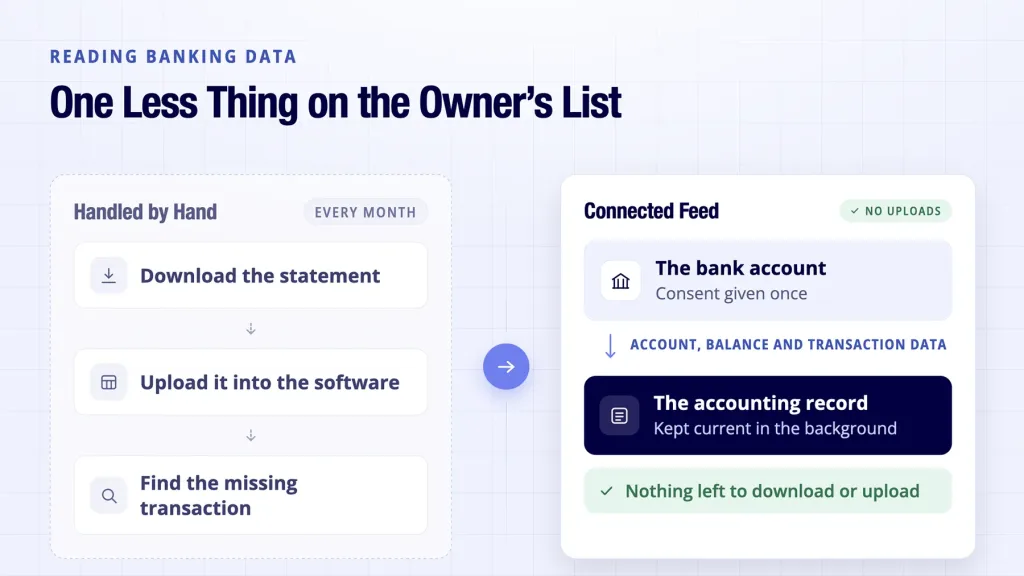
Small businesses frequently depend on accounting software to understand cash flow, record transactions and prepare accounts.
The problem starts when the accounting system and the bank operate as separate destinations.
Someone may need to download statements, upload files, check transactions or investigate why a payment has not appeared against the expected record.
Open Banking can connect the two sides through account information services.
The relevant data typically includes the following:
- Account data
- Balance data
- Transaction data
This is where bank feeds become useful. A connected feed can bring banking activity into accounting software rather than relying on periodic manual uploads.
For a small business owner, the benefit is not the API itself. It is having accounting records that reflect banking activity without making statement downloads another recurring task.
Small Business Payment Processing Is the Other Half
Banking data tells a business what has happened. Payment initiation helps determine how money gets collected.
This is where small business payment processing becomes particularly relevant.
Card payments remain important, but they are not the only way a business can collect money. Pay by Bank lets a customer approve a payment through their own banking environment rather than entering card details.
The underlying category is account-to-account, or A2A, payment initiation.
The customer selects Pay by Bank, chooses their bank and authorises the payment. The regulated payment initiation provider connects the merchant to the bank, while the payment settles through Faster Payments. Open Banking Limited describes this as a payment initiated through checkout and authorised through the customer’s bank.
For businesses, the attraction is the payment experience and the economics around it.
| Consideration | Card Payment | Pay by Bank |
|---|---|---|
| Customer authorisation | Card details or wallet | Bank authentication |
| Payment category | Card payment | A2A payment |
| Card details required | Usually | No |
| Settlement rail | Card scheme infrastructure | Faster Payments |
| Recurring use | Established | Depends on the payment use case |
| Integration | Payment provider required | PISP or platform with PIS capability |
A business therefore needs to consider Pay by Bank as part of its wider small business payment processing strategy and not as a replacement for every payment method.
Recent market activity also shows the direction of travel. In July 2026, Sage and GoCardless announced Pay by Bank availability within Sage Business Cloud Accounting.
Where Open Banking Payment Initiation Fits
Open banking payment initiation is the mechanism that turns Pay by Bank from a concept into an executable payment.
A small business normally does not build this connection itself. Its accounting, invoicing, checkout or payment platform can integrate with a regulated provider that handles the bank connectivity and payment initiation layer.
That distinction matters.
A PISP initiates a payment with the customer’s consent. It does not own Faster Payments or operate the underlying payment network.
Businesses evaluating providers should therefore ask the following questions:
- Which banks can customers use?
- How is customer consent handled?
- What payment status does the platform receive?
- How are failed payments surfaced?
- Can the payment carry a useful reference?
- Does the provider support the business’s software architecture?
For a deeper explanation of the mechanism, see payment initiation service.
What Changes for Small Business Payment Processing?
The strongest case for Open Banking is operational rather than theoretical.
Consider a business that sends an invoice and waits for payment.
With a traditional process, the customer pays, the money reaches the account and the finance team later identifies the transaction and records it.
With Pay by Bank embedded in the invoicing or checkout platform, payment initiation becomes part of the customer journey.
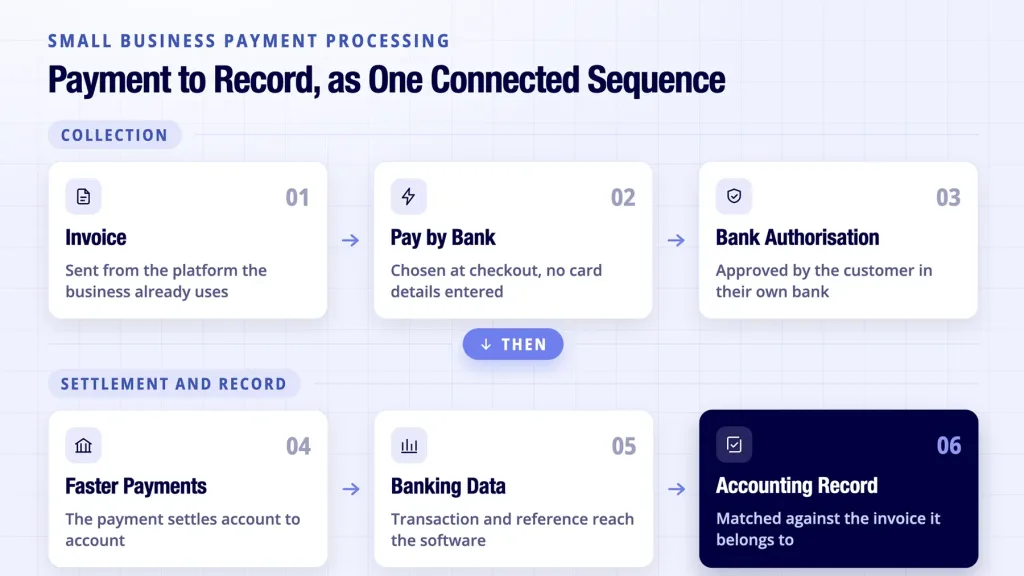
That creates a more connected sequence:
Invoice → Pay by Bank → Bank authorisation → Faster Payments settlement → Banking data → Accounting record
This can reduce the gap between the payment event and the financial record.
It also gives software platforms more scope to provide payment references, status information and reconciliation workflows within the same product.
For businesses assessing online payment systems, the question should therefore go beyond “Can customers pay?” It should also ask “What happens after they pay?” See online payment systems for the wider UK payment landscape.
Reconciliation Is Where the Two Halves Meet
Payment collection is only half the finance task.
Once money reaches the account, someone still needs to associate it with the invoice, customer or accounting entry.
This is where banking data becomes important.
A payment reference can provide one matching signal. Current transaction data provides another. Together, they give the platform information it can use to connect the payment event with the corresponding financial record.
The platform still controls the reconciliation workflow and its exception rules.
That distinction matters because a failed match should not be treated as a successful reconciliation merely because a payment was initiated.
A well-designed workflow can instead identify exceptions for review while routine transactions continue through the accounting process.
What Does a Small Business Actually Need to Get Started?
Most small businesses do not need to become Open Banking specialists.
In practice, they are more likely to encounter Open Banking through software they already use, such as accounting, invoicing, EPOS and payment platforms.
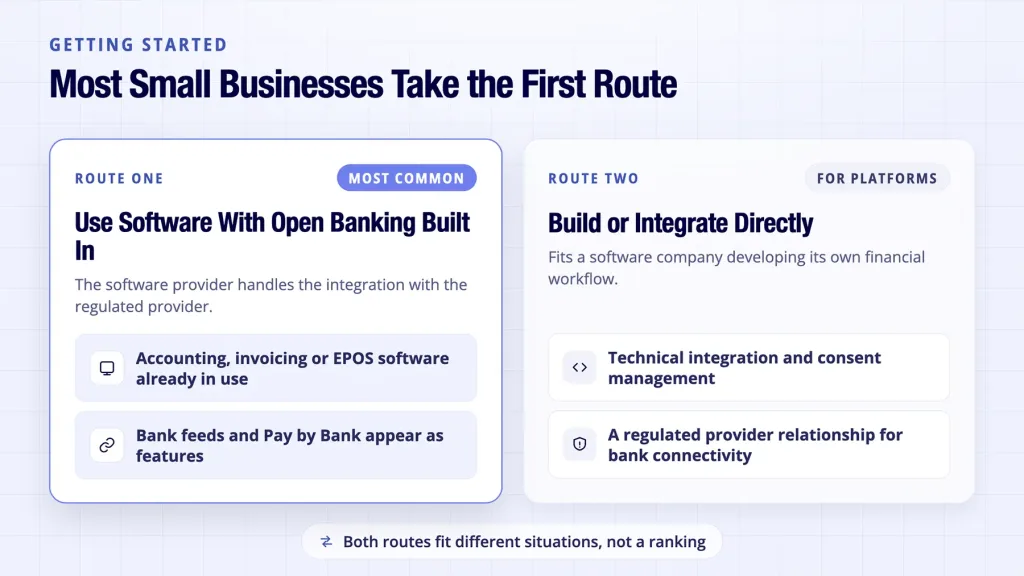
There are two routes:
Use software with Open Banking built in
This is usually the most practical option for a small business. The software provider handles the integration with the regulated Open Banking provider.
Build or integrate directly
This makes more sense for a software company developing its own financial workflow. It requires technical integration, consent management, bank connectivity and the appropriate regulatory arrangement or regulated provider relationship.
For the small business itself, the important questions are as follows:
- Does the software connect to the business’s bank?
- Can it bring banking activity into the accounting workflow?
- Does it support Pay by Bank where relevant?
- Can payment references support reconciliation?
- What happens when a payment fails or cannot be matched?
Where Finexer Fits
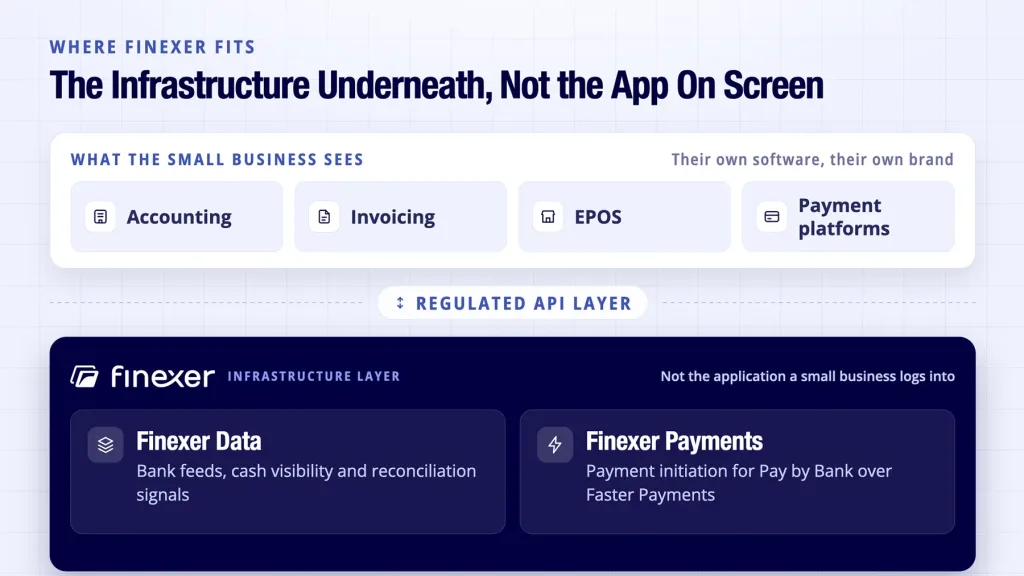
Finexer does not sell an Open Banking product directly to small businesses.
It provides the infrastructure that accounting, invoicing, EPOS and other platforms can build into their products.
That makes Finexer’s role different from the software a small business sees on screen.
Finexer Data provides the banking data layer that platforms can use for feeds, cash visibility and reconciliation workflows.
Finexer Payments provides payment initiation for Pay by Bank, with payments settling through Faster Payments. The platform receiving the API response controls the customer experience, workflow and business logic.
Finexer maintains the following:
- Almost all UK banks covered
- FCA-authorised account information and payment initiation services
- Banking data covering accounts, balances and transactions
- Payment initiation for platforms building Pay by Bank experiences
The distinction is deliberate. Finexer is the infrastructure layer underneath the platform and not the application the small business logs into.
How Open Banking Compares With Other Payment Approaches
Small businesses rarely choose payments in isolation. They usually need several methods.
| Payment Method | Best Suited To | Main Consideration |
|---|---|---|
| Cards | Retail and online checkout | Familiar customer experience |
| Direct Debit | Recurring collections | Good fit for scheduled payments |
| Pay by Bank | One-off A2A payments | Direct bank authorisation |
| Bank transfer | B2B and manually initiated payments | Reconciliation can require more work |
| Cash | Physical businesses | Manual handling and recording |
The right mix depends on the business model.
A retailer may prioritise cards and Pay by Bank, while a subscription business may rely heavily on Direct Debit, whereas a professional services firm may combine invoices, bank transfers and Pay by Bank.
That is why open banking for small business should be viewed as an additional capability rather than a universal replacement for existing payment methods.
The Platform Opportunity Behind Small Business Adoption
The biggest opportunity may not sit with the small business itself.
Accounting platforms can add banking data; invoicing platforms can add Pay by Bank; EPOS providers can add A2A collection and ERP platforms can connect payments with financial records.
For these providers, Open Banking becomes infrastructure that supports several functions through the same product experience.
The customer does not need to understand the underlying APIs.
They simply see a bank feed, a payment option or a reconciliation record inside software they already use.
That is the practical value of open banking for small business: the technology becomes part of an existing workflow instead of another system for the business owner to manage.
Is Open Banking suitable for a very small business?
Yes, particularly when it is already built into accounting, invoicing or payment software. The business does not normally need to manage the underlying Open Banking integration itself.
Does Pay by Bank replace card payments?
No. Pay by Bank is another payment method. Businesses can offer it alongside cards, Direct Debit and other payment options according to their customer and payment requirements.
Does Open Banking require a business to change banks?
No. Open Banking connects authorised services to supported bank accounts with customer consent. It does not require the business to move its banking relationship.
Is Open Banking only useful for collecting payments?
No. Account information can also support banking feeds, transaction visibility, cash management and reconciliation workflows. Payment initiation is only one part of the wider capability.
For a small business, Open Banking becomes valuable when it removes a specific operational task.
Banking data can reduce manual statement handling. Pay by Bank can add another route for collecting money. Payment references and transaction data can help connect payment activity with accounting records.
The more important decision, however, often belongs to the software platform serving the small business.
That platform needs the right banking infrastructure underneath it, with regulated access to data and payment initiation rather than another disconnected financial application.
Build the banking capability into the software small businesses already use.
See how Finexer supports accounting, invoicing and payment platforms with banking data and Pay by Bank infrastructure.
Explore with AI
About the Author

Ravi Ranjan
Ravi Ranjan is Co founder & CEO of Finexer