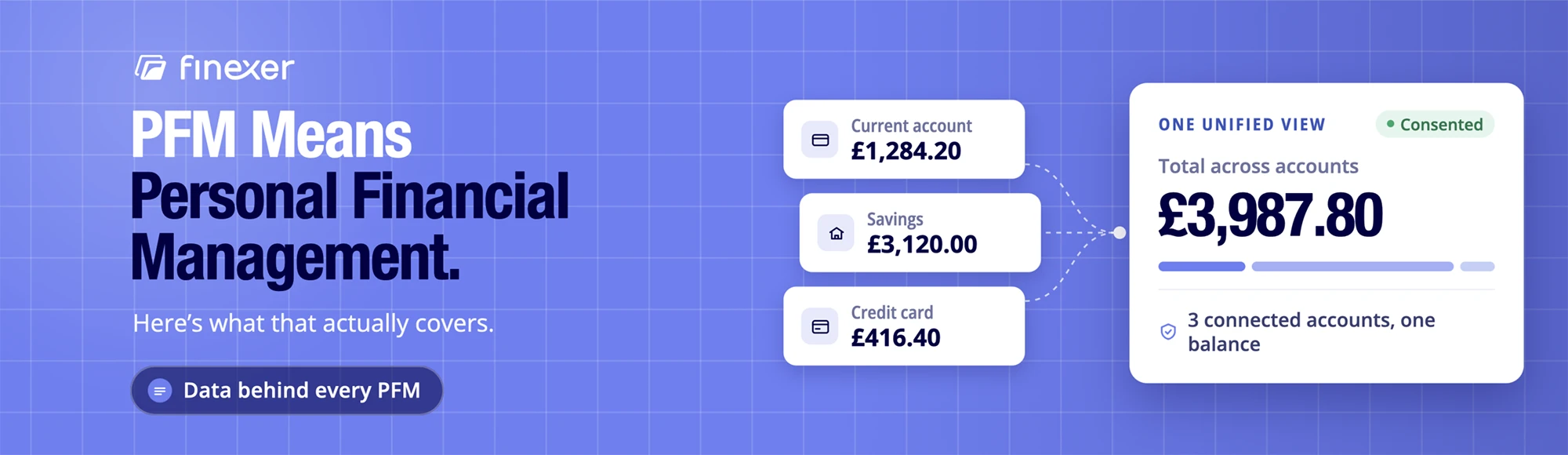
Data Behind Every PFM:
Consented banking data with merchant and category already resolved.
Type “pfm meaning” into Google at 11pm, and you would most probably stare at a spreadsheet, wondering why, just why, three different apps show three different balances.
TL;DR: PFM stands for Personal Financial Management. The tools belonging to this category pull a person’s accounts into one, uninterrupted view, label the spending and flag that which is on the anvil. None of those work without consented banking data underneath, the part glossed over by most explainers.
This piece is written from inside the plumbing and not the app store. Finexer is the FCA-authorised layer whose data enrichment API supplies the consented banking data and merchant on which these features are built, so the mechanics below come from direct product experience.
What Does PFM Mean?
PFM means Personal Financial Management: software that shows someone their money across accounts, sorts transactions into categories and tracks progress against a budget.
It is not one app. It is a feature set that shows up inside banking apps, standalone budgeting tools and business finance dashboards.
Does PFM Stand for Anything Else?
Outside finance, PFM has other meanings entirely, from project and facilities management terms to unrelated technical acronyms.
However, in a banking or fintech context, Personal Financial Management is the only meaning everyone must know.
What a PFM Tool Actually Does
A working PFM feature does the following four things well:
- Pulls balances from every connected account onto one screen
- Sorts transactions into categories such as groceries, transport and subscriptions
- Tracks spend against a budget the user has set
- Forecasts upcoming bills on the basis of recurring payment history
If you miss any one of those, the tool becomes a glorified statement viewer, not PFM.
How PFM Works Behind the Scenes
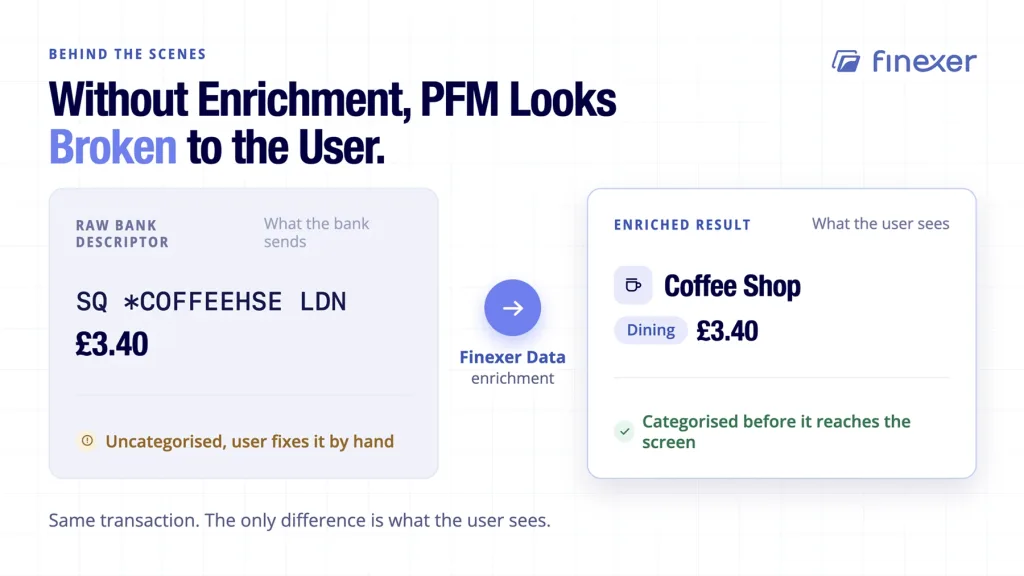
None of the above is possible without two key ingredients: a consented connection to the user’s bank and a way to meaningfully interpret that which comes back.
The connection, on its part, relies on spending data pulled directly from the account with the customer’s explicit permission and refreshed in a regular cycle rather than exporting in fits and starts.
What arrives from the bank is accurate but built for bank systems and not for an enterprise that is budgeting. A transaction line reading “SQ *COFFEEHSE LDN” requires to be converted into “Coffee Shop” and be assigned a spending category before a user can trust it.
This is where enrichment does the actual work, and it is why unprocessed transaction data by itself seldom looks its part as a finished article to an end user.
PFM for Business Accounts
The same principles apply once you swap a personal current account for a business one.
Finance teams use business PFM for cash visibility across multiple accounts, category-based control over spending and early warning on upcoming expenditure, rather than budgeting for a household.
What a Platform Needs Before Building PFM
The following three things distinguish a PFM feature that functions on an ongoing basis from one that is cast away after a month:
- Consented, refreshable access to UK financial data across the accounts a user connects
- Categorisation that is accurate enough for users to stop manually correcting it
- Ideal refresh frequency and regularity, which keeps balances current and not stale even by a day
Several UK providers supply bits and pieces of this. Salt Edge and Moneyhub Enterprise offer data access at scale, with Moneyhub being especially strong in Open Finance breadth across the spectrum of pensions and wealth accounts. Neither of them builds a PFM interface itself, with platforms still building the screen that sits atop.
Where Finexer Fits
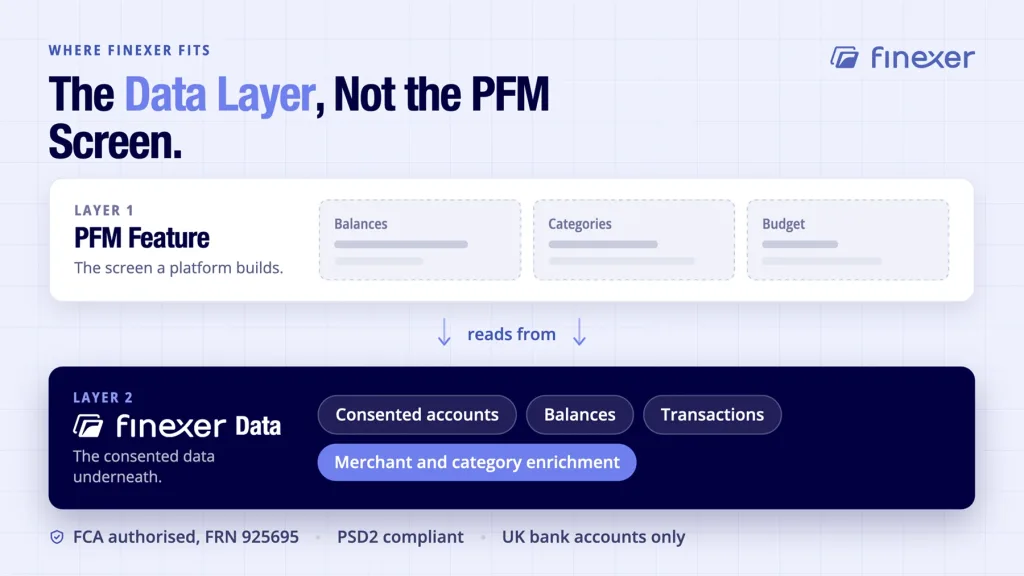
Platforms building their interface without dependable enrichment means that categorisation is visibly incorrect to the user on day one, and the entire feature loses trust drops in a downward spiral.
Finexer’s Data product supplies the consented account, balance and transaction data from which a feature such as this reads, coupled with Finexer Data enrichment resolving merchant names and spending categories before they get to the screen.
“Platforms rarely fail at the PFM idea. They fail when the categories underneath it look incorrect in the very first week a user connects an account,” says Ravi Ranjan, Finexer is FCA-authorised (FRN 925695) and PSD2-compliant and works exclusively with UK bank accounts across the board.
Is PFM the same as a budgeting app?
A budgeting app is, for the most part, a single piece of PFM. Complete PFM even provides coverage of combining accounts across providers, categorisation and forecasting and not just budgeting.
Does a PFM tool need my online banking password?
No. A PFM feature built properly uses a consented Open Banking connection and is premised on the user authenticating directly with their own bank and not the app.
What else can PFM stand for?
Beyond finance, PFM could refer to project management, facilities management and other unrelated technical terms, which is entirely context-specific.
Is the data behind a PFM tool regulated in the UK?
Yes. Every UK provider supplying account or transaction data must be FCA-authorised to read it, under the Payment Services Regulations 2017.
See how Finexer supplies the consented, enriched banking data that PFM features depend on, so categorisation looks right from the first connection.
Explore with AI
About the Author

Ravi Ranjan
Ravi Ranjan is Co founder & CEO of Finexer