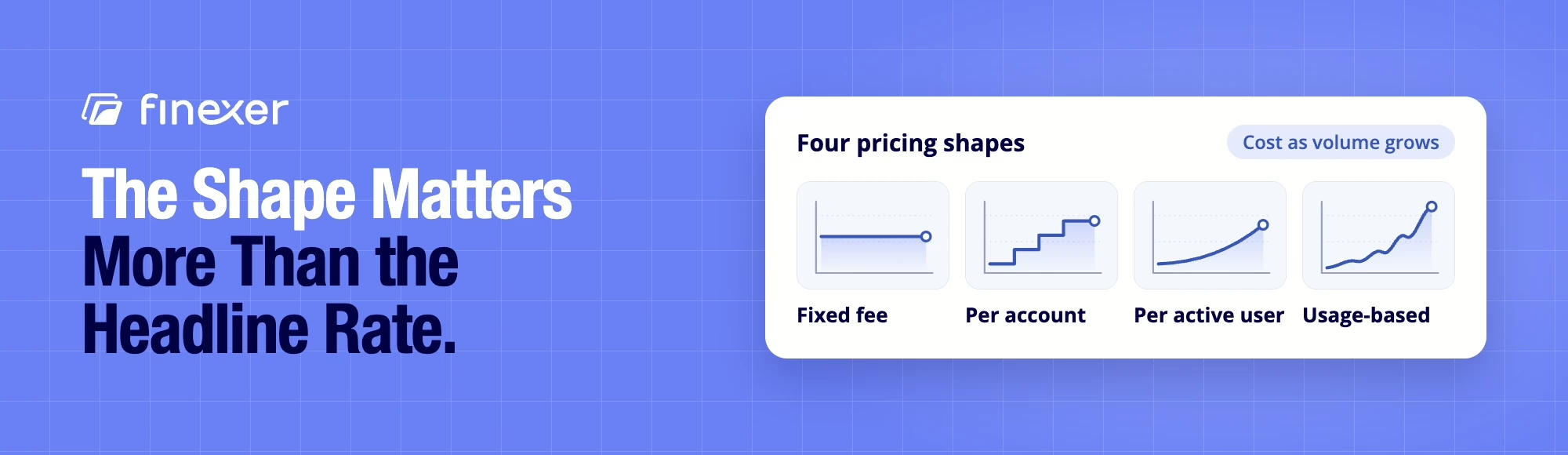
UK Open Banking providers price in four broad ways: a fixed monthly platform fee, a charge per connected account, a charge per active user, or usage-based pricing that tracks actual API calls.
Open banking pricing models differ mainly in how they scale with volume, not in what they claim to include, so the right one for you depends on your own volume shape rather than the headline rate on a pricing page.
The four pricing models UK Open Banking providers use
- Fixed monthly platform fee. A flat charge regardless of usage, which is predictable but can be poor value at low volume and effectively free additional capacity at high volume.
- Per connected account. A charge based on how many customer accounts are actively connected, which scales directly with your customer base rather than their activity level.
- Per active user. Similar to per-account pricing, but tied to users who actually interact with the connection in a given period, rather than every account ever connected.
- Usage-based pricing. A charge that tracks actual API calls or transactions, which scales with real activity rather than account count.
None of these open banking pricing models is inherently better. Each fits a different volume pattern, which is why the shape of the model matters more than the number attached to it.
How each model shape scales with volume
| Pricing Model | Low-Volume Business | Growing Business | High-Volume Business |
|---|---|---|---|
| Fixed monthly fee | Flat, can feel expensive relative to usage | Flat, becomes better value as usage rises | Flat, most cost-efficient at scale |
| Per connected account | Scales with customer count | Scales steadily with customer growth | Scales linearly, can grow large at scale |
| Per active user | Scales with genuine engagement | Tracks real usage growth closely | Scales with active base, not dormant accounts |
| Usage-based | Low cost at low activity | Scales directly with API call volume | Can rise sharply if call volume spikes |
The shape that suits you depends on whether your cost driver is customer count, active engagement, or raw call volume, not on which model has the lowest starting rate.
The questions that actually decide your bill
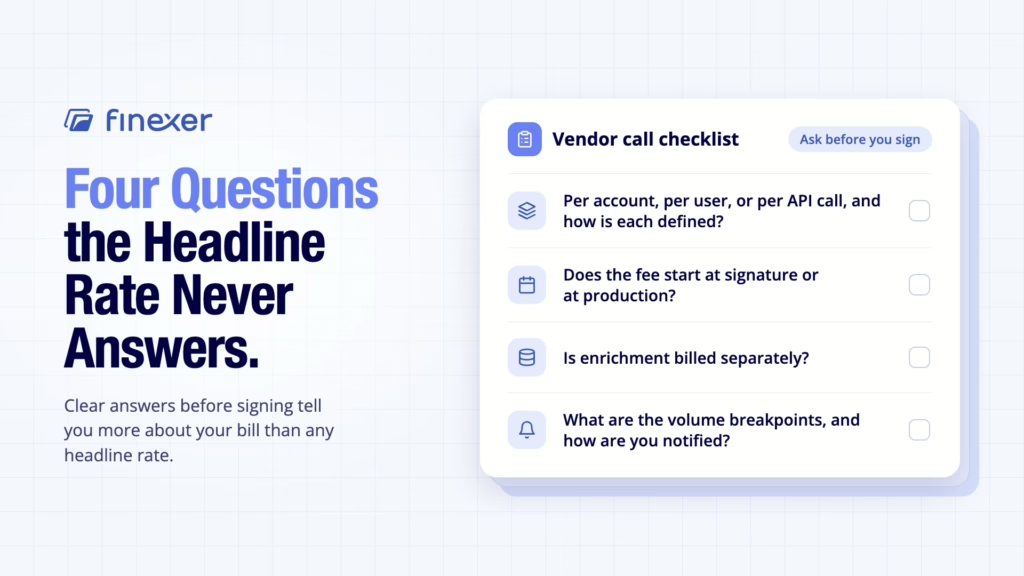
These are the questions that consistently come up when a business is comparing open banking pricing models on a vendor call, because the headline rate rarely tells the full story:
- Is the charge per connected account, per active user, or per API call, and how is each of those defined?
- Does the monthly fee start at contract signature, or only once you reach production?
- Is data enrichment billed separately from core account access and payment initiation?
- What are the volume breakpoints where the price per unit changes, and how are you notified when you cross one?
Getting clear answers to these four questions before signing tells you more about your actual bill than any comparison of headline rates.
What sits outside the headline pricing model?
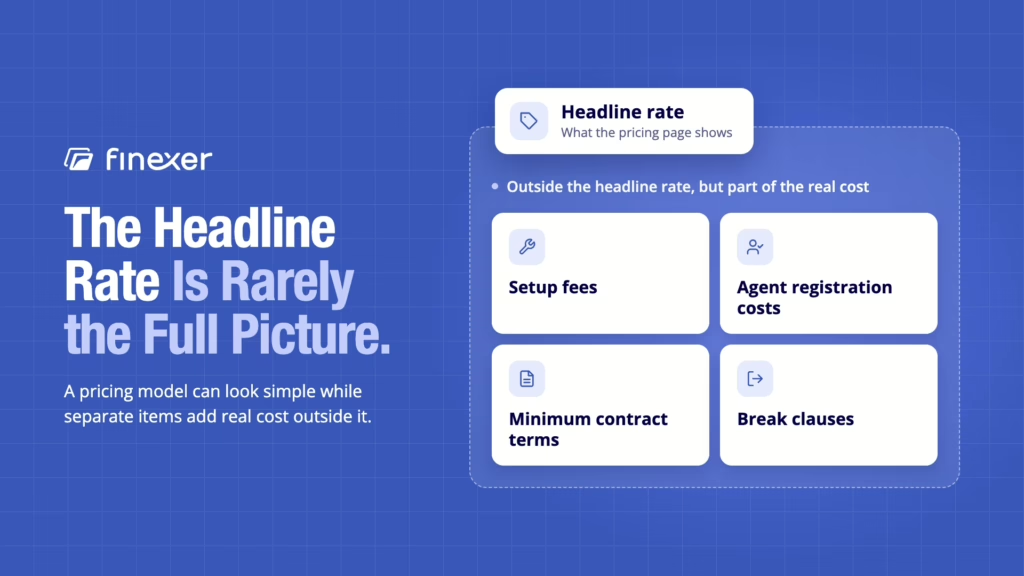
The pricing model itself is rarely the full cost picture. It’s worth checking separately for setup fees charged before any usage begins, agent registration costs if you’re using an agent route rather than your own FCA authorisation, minimum contract terms that lock in a commitment period, and break clauses that determine what it costs to exit early.
A provider’s headline pricing model can look simple while these separate items add real cost outside it.
If you want the broader picture of what “affordable” actually means across the market, our guide to affordable open banking covers that territory directly, and our page on open banking pricing looks at pricing considerations more broadly.
How does Finexer’s pricing model work?
Finexer offers transparent pricing with no hidden charges. For a full breakdown suited to your specific volume and requirements, contact the Finexer team directly.
In practical terms, this means:
- No hidden charges beyond what’s agreed upfront
- Clarity on cost before you commit, rather than discovering exclusions after go-live
- One integration covering data, payments, and verification, so pricing isn’t split across separate contracts for each capability
This sits behind Finexer Connect, the regulated connectivity layer underneath every Finexer product. If Yapily is part of your comparison, our breakdown of yapily pricing may be a useful reference point.
Bottom line
There’s no single best open banking pricing model, only the one that matches your own volume shape. Work out whether your cost driver is account count, active users, or call volume before comparing rates, and ask about breakpoints, setup fees and contract terms before you sign.
Talk to Finexer about a pricing model that fits your volume, not just the headline rate.
Explore with AI
About the Author

Ravi Ranjan
Ravi Ranjan is Co founder & CEO of Finexer