Build vs buy transaction categorisation looks like an easy call until, six months into building your own engine, you’re still tagging edge cases by hand.
Here’s the real cost of each path, before you commit engineering time to either one.
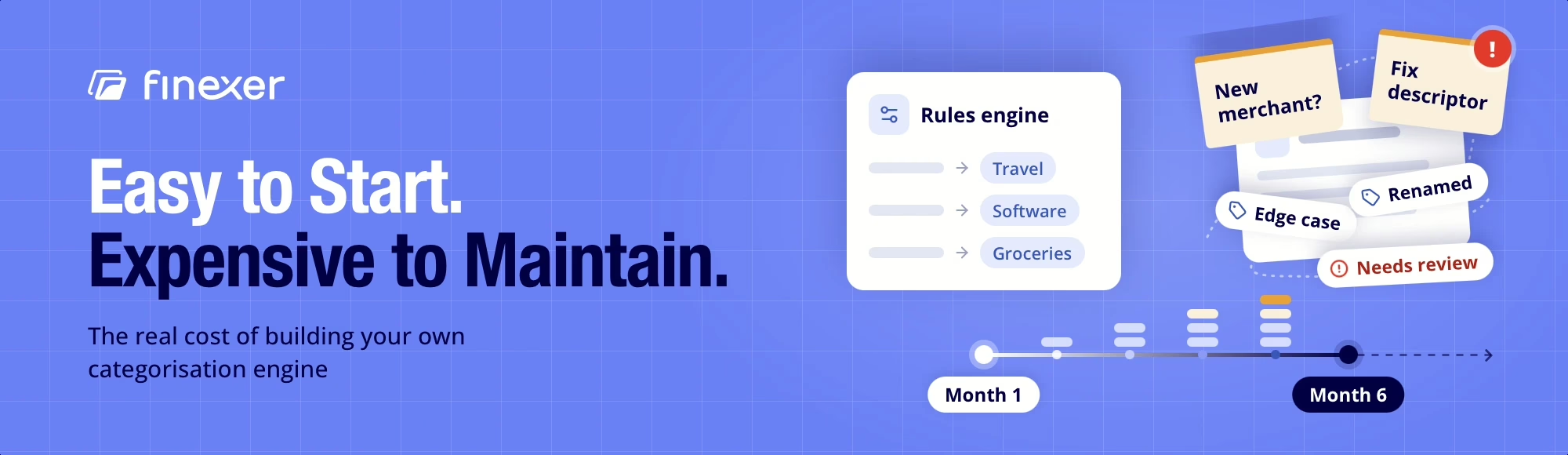
In build vs buy transaction categorisation, building an engine is straightforward to start and expensive to maintain. The initial rules-based version gets you to roughly usable accuracy. The gap between usable and production quality, covering new merchants, changed descriptors and long-tail edge cases, is where the real engineering cost sits.
The build vs buy transaction categorisation decision usually comes down to five variables. The table below sets out the build vs buy transaction categorisation trade-offs side by side.
| Factor | Build in-house | Buy (dedicated transaction enrichment) |
|---|---|---|
| Time to usable accuracy | Weeks for a first rules-based pass | Immediate, production-grade from day one |
| Ongoing maintenance | A dedicated team tracking merchant and descriptor changes | Handled by the provider, included in the feed |
| Merchant database upkeep | Manual additions as new merchants appear | Pre-trained database, updated continuously |
| Edge cases | Grow indefinitely; the long tail never closes | Covered by an existing large-scale database |
| Accuracy ceiling | Plateaus without constant retraining | 95%+ accuracy maintained by the provider |
The build vs buy transaction categorisation question comes up most often for accounting platforms and cloud accounting software vendors adding automated reconciliation, where accuracy directly affects how much manual review a bookkeeper still has to do.
What Does Build vs Buy Transaction Categorisation Look Like on the Build Side?
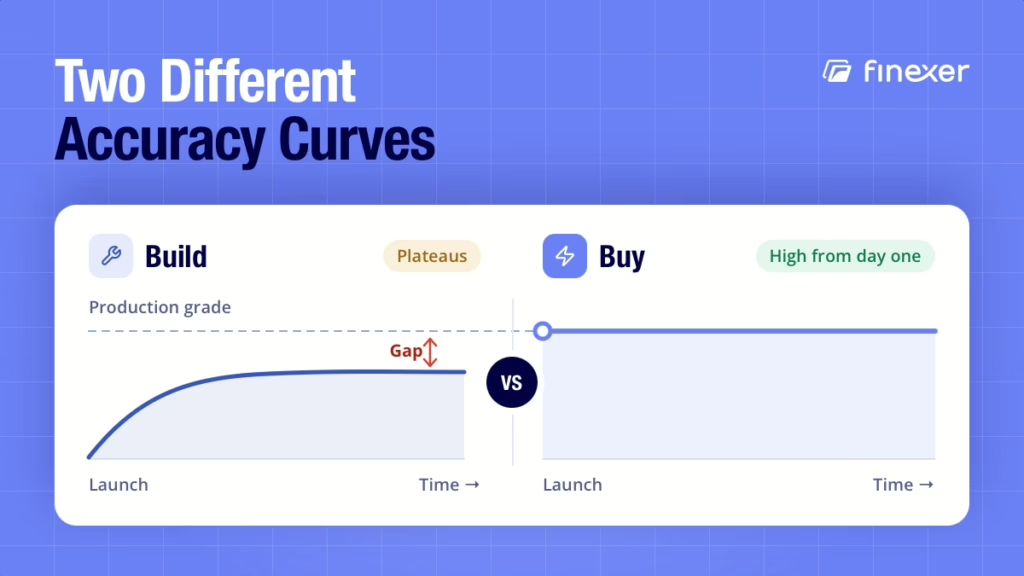
On the build side of build vs buy transaction categorisation, a first version ships quickly. Match on merchant name, apply a handful of keyword rules, and most transactions get a category assigned.
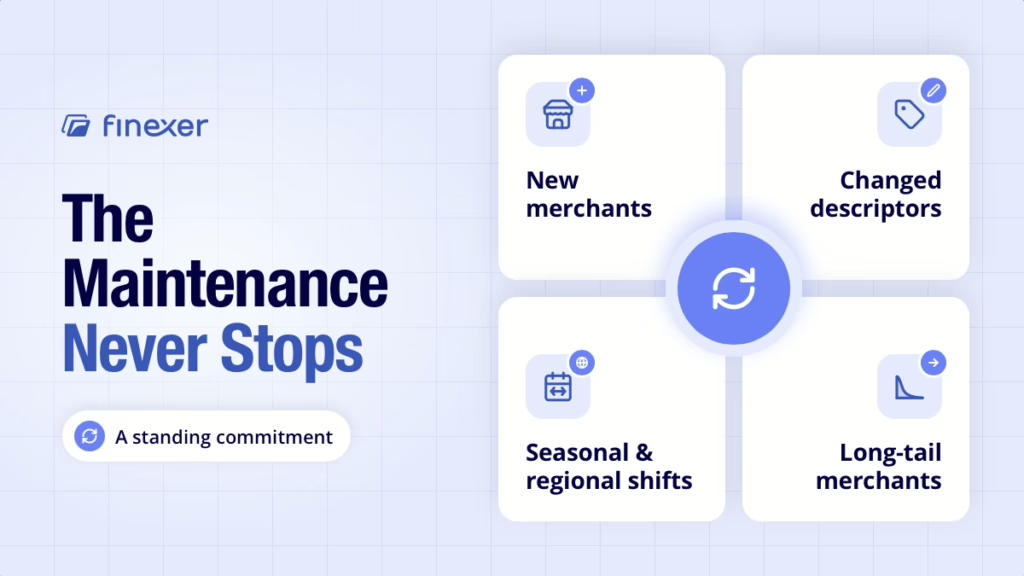
The problems start once real transaction data hits the system at scale. Four things need constant attention after launch, and they shape build vs buy transaction categorisation more than the first release does:
- New merchants appearing weekly, each needing a category assigned by hand
- Changed descriptors, whenever a merchant rebrands or a payment processor updates its naming
- Seasonal and regional variation in spending patterns
- Long-tail merchants that never generate enough volume to justify a dedicated rule
None of this stops once the first version ships. A transaction categorisation engine isn’t a project with an end date; it’s a standing commitment that sits on someone’s roadmap indefinitely.
The team that built the transaction categorisation engine is rarely the team that maintains it. Ownership tends to drift to whoever is on call when a merchant category breaks in production, which is usually a support or finance engineer rather than the original author.
That handover is where accuracy quietly starts to slip, because the person fixing an edge case at 5pm on a Friday isn’t the person who understood the original rule set.
When Does Building In-House Actually Make Sense?
In build vs buy transaction categorisation, building makes sense in two narrow cases. A highly specific vertical vocabulary that a general-purpose database won’t cover well is one. Categorisation itself being your product’s core differentiator is the other.
A construction supply platform with industry-specific line-item codes or an expense management tool built specifically to sell categorisation intelligence both fit this pattern. In both cases, the team building its own transaction categorisation engine is choosing to own a domain problem that no general-purpose database will ever solve well for them.
For most platforms outside these two cases, transaction categorisation is infrastructure, not the product itself, and infrastructure is usually worth buying rather than maintaining. The build vs buy transaction categorisation question worth asking internally is blunt: “Would a client ever choose your platform because of how you categorise transactions, or only notice if you got it wrong?”
How Do Other Providers Approach Transaction Enrichment?
Several Open Banking providers now offer transaction enrichment alongside their banking data, either within the data product or as an additional layer from the same provider. For a buyer, the practical point is that categorisation no longer has to come from a separate specialist vendor.
That matters for the build vs buy transaction categorisation decision. When transaction enrichment comes from the same provider as the data feed, the buy path stops meaning a second vendor relationship to manage.
It also changes the build vs buy transaction categorisation comparison a team should actually be running. The real choice usually isn’t an in-house transaction categorisation engine versus a standalone enrichment vendor; it’s building versus a provider that offers enrichment alongside the account and transaction feed a platform needs anyway.
What Does Finexer’s Enrichment Product Include?
Finexer offers transaction enrichment as an additional layer on top of its Data product, with 95%+ categorisation accuracy and sub-100ms response across a 100 million+ merchant database. Finexer is FCA-authorised, FRN 925695.
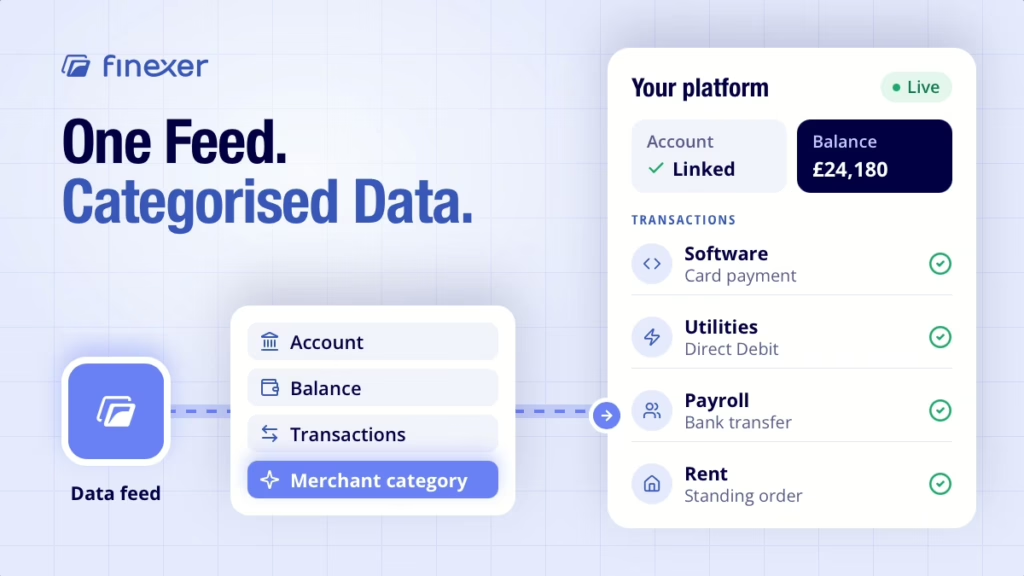
Each transaction returns an identified merchant name, legal entity, spending category, billing pattern, location data, transaction type and confidence score. Coverage spans card payments, Direct Debits, bank transfers and standing orders.
Finexer Enrichment works with Finexer’s banking data API, so platforms can add categorised transactions to the account, balance and transaction data they already receive from Finexer, without sourcing a second vendor.
For a platform’s engineering team, that turns build vs buy transaction categorisation into a narrower question: does the enriched output fit the product when tested on its own transactions? Answering that frees the team to spend its time on the reconciliation logic that actually differentiates the product.
How long does it take to build a usable in-house categorisation engine?
A first rules-based version can ship within weeks. Reaching production-grade accuracy across new merchants, changed descriptors and long-tail edge cases takes considerably longer, and the work never fully stops, because merchants and payment processors keep changing after launch. Plan for a standing maintenance effort rather than a one-off project.
Is buying always cheaper than building long term?
Not always. Buying is usually cheaper when categorisation is not your core product, because the provider absorbs merchant database upkeep and retraining. If categorisation is the product itself, in-house control can justify the ongoing cost. Compare the full cost of a maintenance team against provider fees over several years, not just the first release.
Does categorisation accuracy vary by transaction type?
Yes. Card payments and standing orders are generally easier to categorise than one-off bank transfers, which often carry less structured reference data. Test any engine, built or bought, on your own mix of transaction types, because a headline accuracy figure can hide weaker results on the payment types your platform sees most.
Can a build vs buy decision change later?
Yes. Many platforms buy to launch quickly, then revisit building only once categorisation becomes a genuine differentiator rather than background plumbing. Keep your category mapping and exception rules in your own code, so switching approach later means changing the source of enriched data rather than rebuilding your reporting logic.
Manual transaction review slows down every reconciliation cycle your platform runs. Finexer Enrichment, an additional layer on Banking Data, categorises transactions in real time so your team reviews exceptions, not everything.
Explore with AI
About the Author

Yuri
Yuriy Yakushko is a fintech founder and software engineer with over 20 years of experience building financial technology. He’s passionate about creating scalable, secure infrastructure that helps businesses modernise how they access financial data and manage payments.