FCA-Authorised AISP | Consented bank data with enrichment built in.
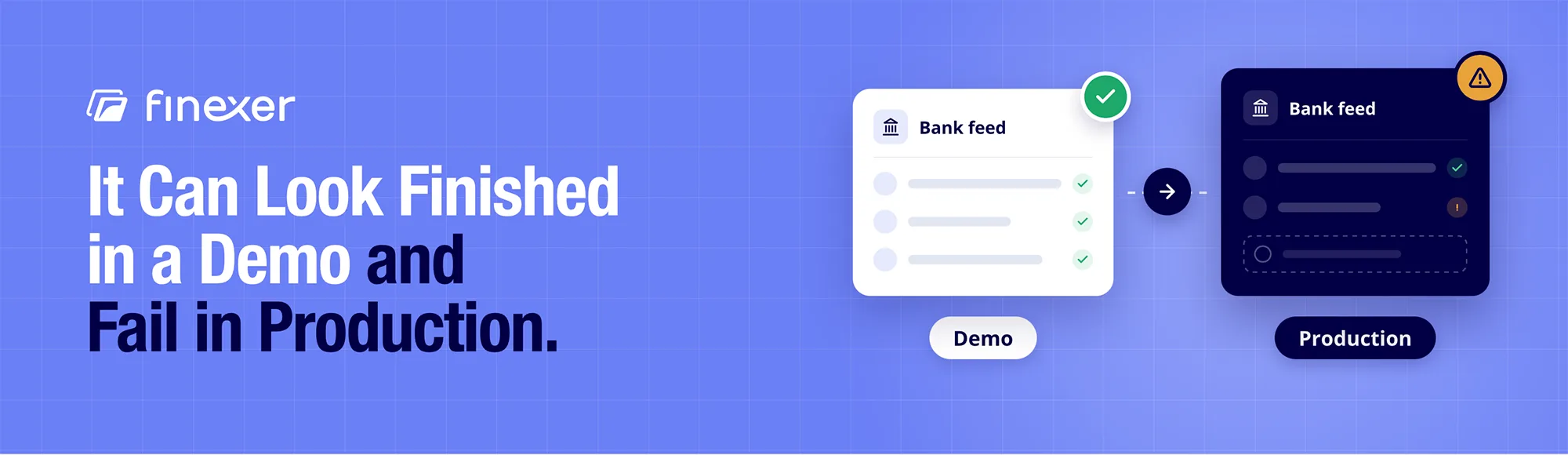
Your bank-feed project can look finished in a demo and fail in production.
Unsupported accounts, awkward re-authentication or unreliable events can turn a promising integration into an operations problem. Choosing an account information services provider is a product decision and not a checkbox.
TL;DR: Choose the provider that fits your account mix and workflow. Check FCA authorisation first, then coverage, data quality, consent handling, webhooks, onboarding and pricing.
Account information service providers fit different requirements.
A practical view from the infrastructure layer
Finexer works with B2B platforms where AIS becomes part of another product, from accounting workflows to property technology. That perspective changes the evaluation question: the broadest footprint is not automatically the best fit.
UK Open Banking already operates at a serious scale. In July 2026, Open Banking Limited reported 2.936 billion successful API calls, average API response time of 330 milliseconds and 99.54% successful calls.
These figures describe the ecosystem and not one provider but show why production performance deserves scrutiny.
What an account information services provider actually does
An account information services provider is authorised to access a customer’s bank account information after consent. AIS is read-only. It can provide account, balance and transaction data, but it does not initiate payments.
If your roadmap also needs payment initiation, check whether the supplier has separate PISP authorisation. For the terminology distinction, see aisp vs pisp.
The technical layer matters too. A useful aisp open banking setup should give your application structured data, predictable consent states and event notifications without separate bank connections.
Seven tests for your AISP shortlist
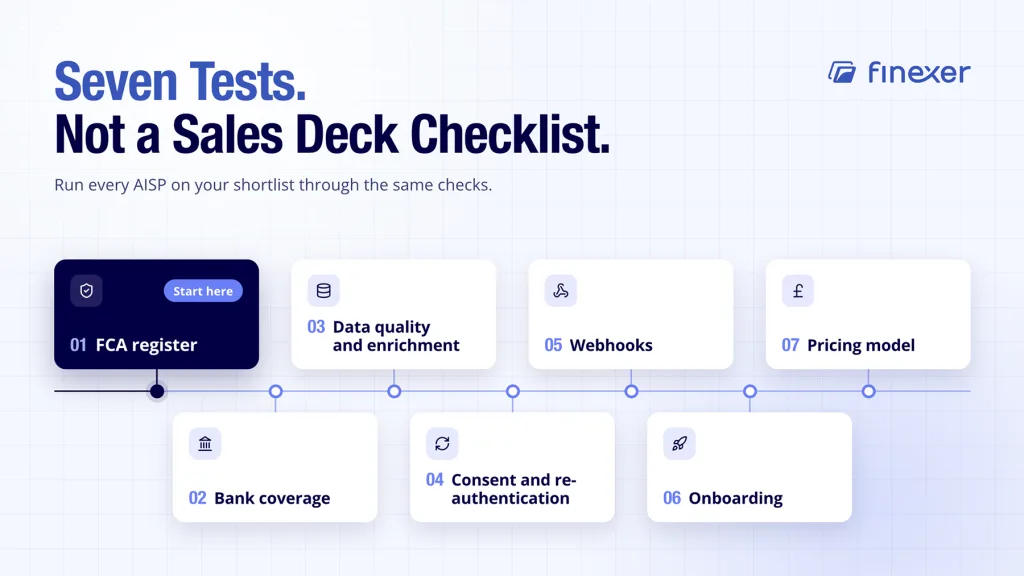
Check the FCA register
Start with authorization and not sales claims. Confirm that the provider appears on the FCA register and that its permission covers the service you intend to offer.
Also ask who holds the regulatory relationship. A platform can display AIS data as a registered agent of an authorised AISP when the arrangement meets the relevant requirements.
Test the bank coverage you need
“Bank coverage” is too broad. Split it by customer profile and account type.
Check:
- Personal current accounts
- Business accounts
- Savings accounts
- Debit and credit-card accounts
- The banks your existing users request
Ask how unsupported accounts are handled before launch.
Inspect data quality and enrichment
Review account, balance and transaction fields, historical depth, references and status handling.
Ask whether enrichment sits inside the AIS proposition or needs another integration. Merchant identification and categorisation can add useful context for products that need more than transaction descriptions.
Examine consent and re-authentication
Ask how users grant consent, how status reaches your application, what happens after revocation and how reminders work.
The 90-day rule needs precision. Customers must reconfirm consent with the AISP at least every 90 days, but that doesn’t mean consent itself simply expires after 90 days or that the entire bank connection journey repeats.
Treat webhooks as a product capability
Ask which events trigger webhooks, how payloads identify the account or transaction, and what happens after delivery failure.
Do not stop at “we have webhooks”. Test them in the sandbox. An AIS API can return good data yet create overhead if your application cannot react reliably when data changes.
Put onboarding under the microscope
Ask for the path from agreement to the first production connection. Identify technical dependencies, testing requirements and ownership.
Strong APIs can still become a launch bottleneck if onboarding does not match your schedule. Ask for milestones.
Understand the pricing model
Ask whether pricing is per connection, per data pull, or usage-based, and how that scales as your platform grows.
Ask whether a data refresh in a direct one-to-one bank connection counts as a billable API call, whether endpoints carry different charges and how sandbox usage is treated.
How provider models differ
| Provider Model | Typical Fit | What to Scrutinise |
|---|---|---|
| AIS specialist | Data-led products | PIS availability if the roadmap expands |
| AIS + PIS provider | Platforms needing data and payments | UK depth, commercial model and API scope |
| European provider | Multi-country products | UK-specific coverage and compliance |
| Vertical specialist | Focused workflows | Flexibility beyond the core use case |
TrueLayer, Yapily, Tink, Plaid and Token.io are combined AIS and PIS providers. Salt Edge is an AIS and PIS provider with a global footprint. Armalytix focuses on accountancy audit data, while Moneyhub Enterprise has a broader Open Finance orientation.
The question is not “who is best?”. Rather, it is “which model matches the product?”. A Europe-wide provider may suit a multi-market roadmap, while a UK-first provider may suit UK-focused products.
Questions to ask on the vendor call
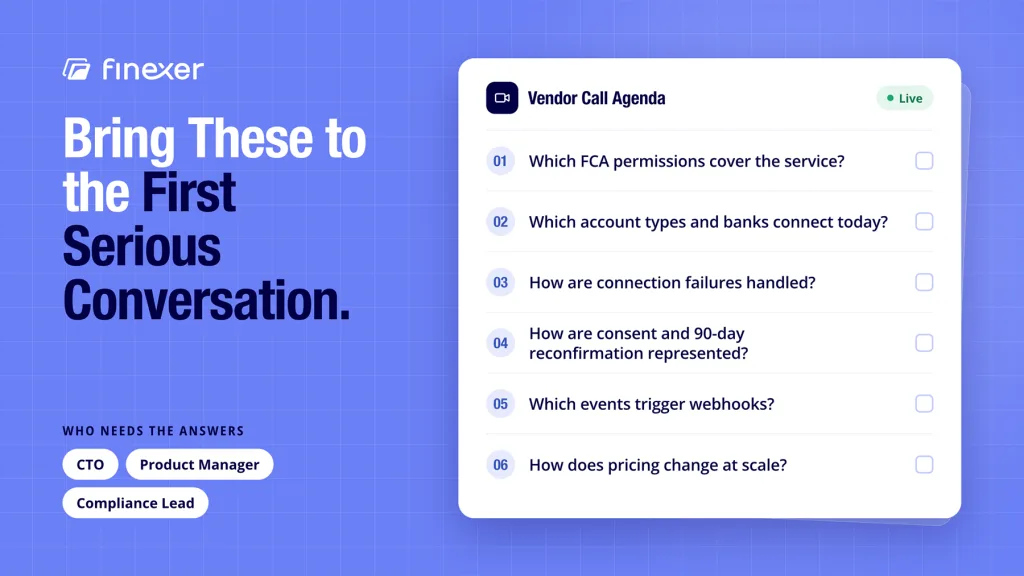
Bring these to the first serious conversation:
- Which FCA permissions cover the service?
- Which account types and banks can users connect today?
- How are unsupported banks and connection failures handled?
- What transaction history can the API return?
- How are consent, revocation and 90-day reconfirmation represented?
- Which events trigger webhooks?
- What does onboarding require?
- How does pricing change at scale?
The answers should give a CTO, Product Manager or Compliance Lead enough detail to assess the supplier.
Where Finexer fits
For platforms prioritising UK AIS infrastructure, Finexer provides the regulated layer beneath the product. Finexer is an FCA-authorised AISP and PISP, FRN 925695, so its AIS service provides consented banking data while PIS remains a separate payment capability.
The Data product returns account, balance and transaction data. For more context, Finexer Data adds merchant identification and categorisation.
Key points:
- Almost all UK banks covered across high street, challenger and business accounts
- Contact us for pricing
- White-label integration
- 3–5 weeks of hands-on onboarding support
Advisory platforms can also use AIS within corporate financial advisory services workflows.
Does an AISP need separate authorisation from a platform?
Not necessarily. A platform can operate as a registered agent of an authorised AISP when the arrangement meets relevant requirements. A technical provider that does not provide AIS may also fall outside AISP authorisation.
Can an AISP access investment or pension accounts?
Not by default. Access depends on what a bank exposes through a supported Open Banking interface. Treat investment accounts and SIPPs as procurement questions.
How much transaction history should an AIS provider offer?
There is no single number because depth depends on the connected bank and interface. Ask for a demonstration using your customers’ account types.
Should an AISP provide enrichment in the same integration?
That depends on the product. Standard AIS data may suit reconciliation, while merchant identification and categorisation can help products needing transaction context. Treat enrichment as a separate capability.
Finexer’s FCA-authorised AIS. We deliver consented bank data with merchant identification and categorisation across almost all major UK banks.
Explore with AI
About the Author

Ravi Ranjan
Ravi Ranjan is Co founder & CEO of Finexer