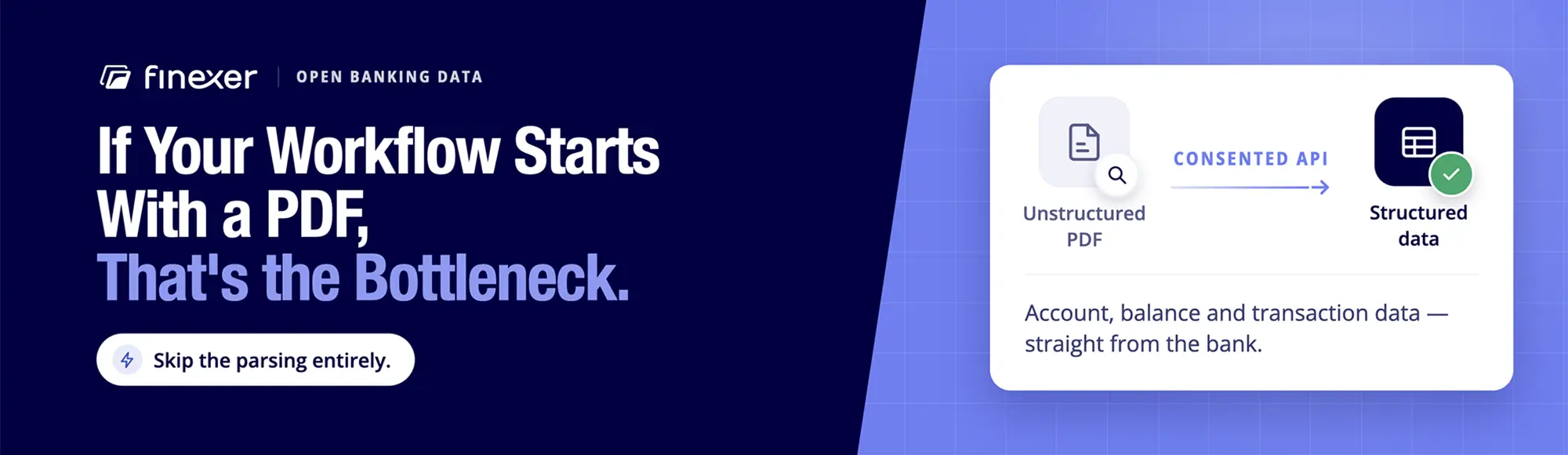
Skip the Parsing Entirely
Structured transaction data straight from the bank.
If your finance workflow starts with a PDF, the PDF may already be the bottleneck.
For finance teams, accountants and platform builders, data can come from manual entry, CSV, PDF parsing, OCR or a consented bank connection.
TL;DR
Extract one historic document when needed. Connect to the bank when you need current transaction data repeatedly.
Direct Open Banking access starts with structured account, balance and transaction data shared with user consent.
AIS provides read-only access to account, balance and transaction data, with user consent and bank authentication.
The five ways to get data from bank statements
Choose based on the available source.
| Method | Accuracy | Effort | Freshness | Audit Trail |
|---|---|---|---|---|
| Manual entry | Low to medium | High | Low | Good if controlled |
| CSV export | Medium to high | Medium | Periodic | Good |
| PDF parsing | Variable | Medium | Periodic | Good if retained |
| OCR | Variable | High | Periodic | Good if retained |
| Direct API access | High for structured fields | Initial integration | Ongoing | Strong consent record |
Manual entry
A person reads bank statements and enters dates, amounts, descriptions and balances. It works for small historical samples but becomes harder as volumes rise.
CSV export
CSV gives software clearer rows and columns than a PDF, but someone still has to download, upload and map the file and repeat the process.
PDF parsing
PDF extraction converts a document into machine-readable rows, but the parser must infer structure from presentation. A table can look clear to a person while storing text in an awkward order.
OCR
OCR helps with scanned bank statements or PDFs without a usable text layer. It adds another interpretation step, so dates, amounts and references can be misread.
Direct API access
A consented Open Banking connection changes the source rather than improving the document parser. The platform receives structured banking data through Finexer’s API for bank transactions after the user authenticates with the bank and gives consent.
Why PDF and OCR extraction become fragile
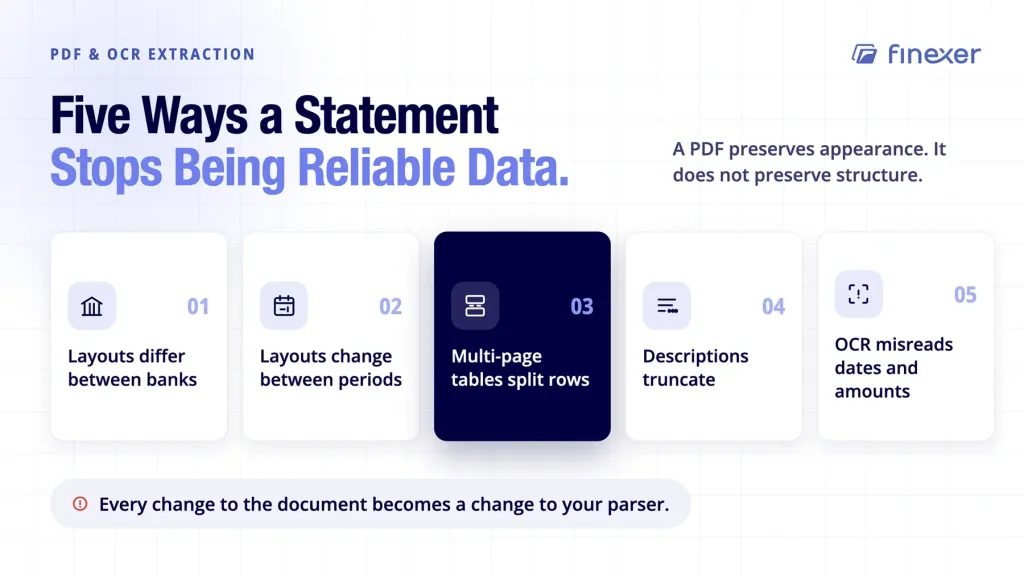
PDFs preserve appearance better than data structure.
That creates recurring problems when teams extract data from bank statements at volume:
- Bank layouts differ between institutions.
- A bank can change its statement layout between periods.
- Multi-page tables can split rows across pages.
- Descriptions and references can wrap, split or truncate.
- OCR can misread dates, amounts and references.
A parser can return valid output that still needs review.
Finexer’s discussion of screen scraping provides context on the shift from older, credential-based approaches to consented API access.
What direct bank access gives you instead
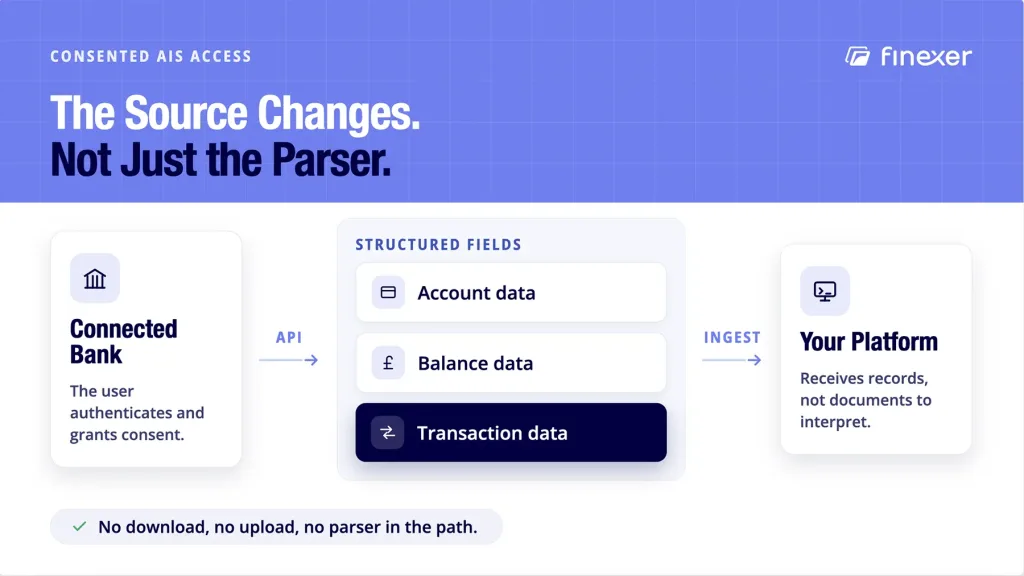
Direct access starts with banking data rather than a document.
With consented AIS access, a platform can receive the following:
- Account data
- Balance data
- Transaction data
A finance platform can ingest transaction data through an API instead of waiting for users to download bank statements, upload files and repeat the process each period.
This is the architecture behind a modern bank feed for accounting platforms.
The bank authenticates the user, the user grants permission, and the regulated provider passes permitted data to the platform.
When statement extraction is still the right answer
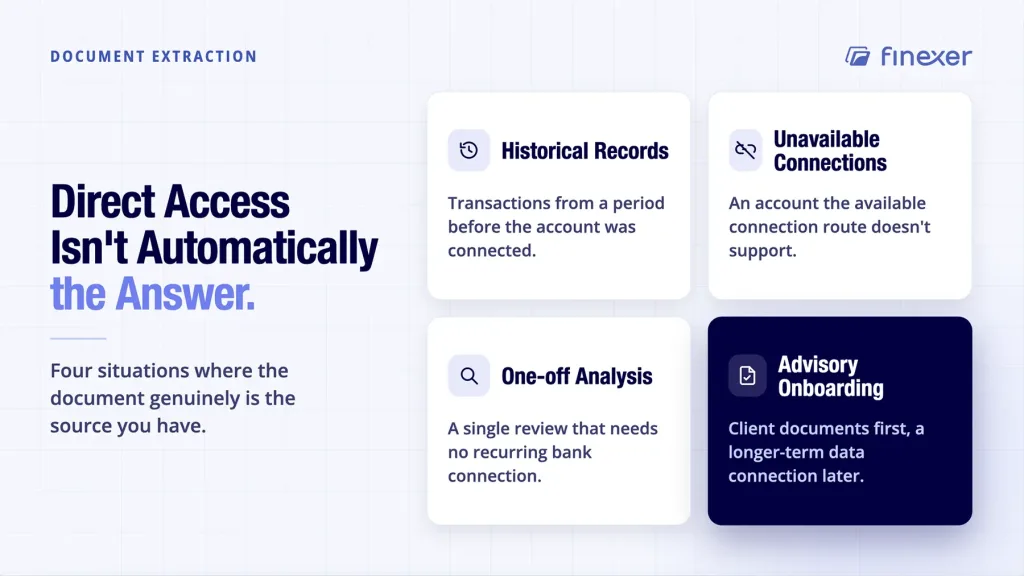
Direct access is not automatically the answer.
Historical records: You may need transactions from a period before the account was connected.
Unavailable connections: A particular account may not be supported by the connection route available.
One-off analysis: An accountant reviewing one set of bank statements may not need a recurring bank connection.
Advisory onboarding: Financial advisory services can begin with documents supplied by a client before a longer-term data connection is established.
Use document extraction when the document is the source you have. Use direct bank access for an ongoing data stream.
Extraction is only half the data problem
Getting rows out of bank statements does not make them ready for a finance workflow.
Descriptions can vary by bank. A merchant may appear under a trading name, location code, processor or shortened reference.
That is where transaction data enrichment becomes relevant. Enrichment adds merchant and category context after the banking data has been obtained.
| Source Output | Finance Workflow May Need |
|---|---|
| “TESCO 0123 LDN” | Tesco, groceries, debit |
| “ABC PAYROLL LTD” | ABC Payroll Ltd, salary, credit |
| “BACS 82391028” | Supplier or payroll reference, payment type |
Extraction answers, “What does the document or source contain?” Enrichment answers, “What does this transaction mean in the workflow?”
How major API providers compare
Direct banking access is not unique to Finexer. TrueLayer, Yapily and Plaid also document transaction APIs.
| Provider | Publicly Documented Capability |
|---|---|
| TrueLayer | Accounts, transactions, balances and regular payments |
| Yapily | Accounts, balances, transactions and identity data |
| Plaid | Transaction history, merchant and category information, update webhooks |
| Finexer | Account, balance and transaction data through FCA-authorised AIS |
TrueLayer documents transaction fields including description, amount, category and merchant name. Yapily documents consented transaction retrieval. Plaid documents transaction history, merchant and category data, plus update webhooks.
For a buyer, compare whether the provider can supply needed banking data without making the document the centre of the workflow.
What should platforms look for?
Score the method against the workflow:
- Source quality: Are there structured records, or is it document interpretation?
- Freshness: Is there a periodic file or continuing account access?
- Historical depth: Is there enough history for onboarding and reporting?
- Bank coverage: Can customers connect their banks?
- Consent and auditability: Can access and permissions be evidenced?
- Data usability: Are key fields consistent?
- Exceptions: What happens when extraction or connection fails?
Finexer: replace recurring statement parsing with direct banking data
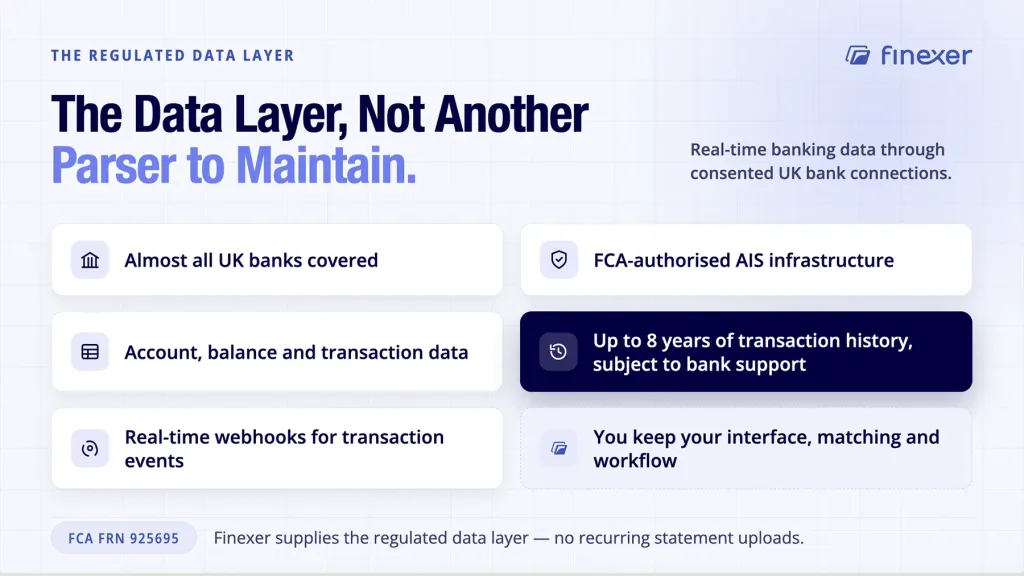
Recurring finance workflows should not depend on documents when the underlying banking data can be accessed directly.
Finexer’s Data product provides real-time banking data through consented UK bank connections. Platforms retain their own interface and workflow.
For accounting and ERP platforms, transaction data can enter without recurring bank statement uploads.
Finexer provides:
- Almost all UK bank covered across high street, challenger and business accounts
- FCA-authorised AIS infrastructure, FRN 925695
- Account, balance and transaction data through consented connections
- Transaction history of up to 7 years, subject to available bank data
- Real-time webhooks for transaction events
Finexer supplies the regulated data layer; the platform controls the interface, matching and workflow.
Use cases where the difference matters
Accounting and ERP
Accounting platforms often inherit bank statement uploads. A direct connection can replace recurring downloads with a bank feed for reconciliation and reporting.
Proptech
Property platforms may need banking data for income verification. A consented connection can provide it without repeatedly requesting bank statements.
Utility billing
Direct banking data can support payment tracking and reconciliation without making statement collection the primary source.
The decision in one table
| Your Situation | Consider |
|---|---|
| One historic PDF | PDF extraction or OCR |
| Batch of old statements | PDF or CSV extraction |
| Repeated monthly imports | Direct bank connection |
| Ongoing transaction visibility | Direct API access |
| Historical plus current data | Combine extraction with Open Banking |
| Merchant context needed | Add enrichment after data access |
Use both when needed. Extract data from bank statements when documents are the available source; use direct access for ongoing data.
Can I extract data from bank statements without OCR?
Yes. A parser can extract text when a PDF has a usable text layer. OCR matters for scanned statements.
Are bank statements enough for automated reconciliation?
Not necessarily. Records may still need categorisation or matching rules.
Is CSV better than PDF for bank statement extraction?
Usually. But CSV still depends on downloading and importing the file, so it suits recurring workflows less well.
When should a platform use Open Banking instead of statement extraction?
Use Open Banking for recurring access to current-account, balance or transaction data with consent. Use extraction for historical records, unsupported connections and one-off analysis.
The best way to extract data from bank statements is sometimes not to extract it from bank statements at all.
If the workflow depends on recurring current banking activity, direct consented connectivity moves the data source closer to where it originates.
For platforms, the better question is not “How do we parse this document?” but “How do we receive and use the banking data for our product needs?”
Ask that before building another statement parser.
See the Data API
See how Finexer delivers structured, categorised transaction data through consented bank connections, removing statement parsing from your workflow.
Explore with AI
About the Author

Ravi Ranjan
Ravi Ranjan is Co founder & CEO of Finexer