
Spot Payment Failure Before Revenue Slips Away.
Know when a payment succeeds, fails or needs attention, with visibility into every collection and support for recurring bank payments that are not affected by card expiry.
A customer doesn’t cancel their subscription.
They still want your service. They still have money in their account.
Yet the payment never arrives.
An expired card, a cancelled Direct Debit mandate or an abandoned banking app authorisation can quietly interrupt recurring revenue without anyone noticing until weeks later. By then, recovering the payment may also mean recovering the customer.
Most businesses eventually discover that payment failure isn’t one isolated problem. It’s a collection of repeatable events that happen across different payment methods, each with its own cause and each calling for a different response.
TL;DR: Most payment failures happen for predictable reasons rather than random ones. Expired cards, insufficient funds, cancelled mandates and abandoned authorisations account for a large share of failed collections across the UK. Understanding why a payment failed is the first step towards reducing lost revenue, avoiding unnecessary customer churn and choosing a payment system for small businesses that provides meaningful visibility into every transaction.
Why you can trust this guide: This article draws on Finexer’s experience as an FCA-authorised Open Banking provider (AISP and PISP, FRN 925695), together with publicly available industry research and operational practices used across UK payment platforms serving sectors such as EPOS, payroll, utility billing and accounting software.
“The businesses that manage payment failure successfully aren’t the ones that never experience failed payments. They’re the ones that know why a payment failed and can respond before it becomes lost revenue.” – Ravi, Finexer
Why Payment Failure Happens More Often Than Many Businesses Realise
A payment failure rarely happens without a reason.
Behind almost every unsuccessful collection is a specific event that interrupted the payment journey before money reached its destination. Sometimes the customer’s card has expired. Sometimes the account lacks sufficient funds. In other cases, the customer simply leaves the banking app before approving an Open Banking payment.
Understanding these causes matters because different payment methods fail in different ways.
Instead of treating every failed transaction as the same operational problem, it helps to recognise where each payment method is most likely to encounter difficulty.
| Payment method | Common causes of payment failure |
|---|---|
| Card payments | Expired cards, insufficient funds, issuer declines, abandoned 3D Secure authentication |
| Direct Debit | Insufficient funds, cancelled mandates, incorrect account details |
| Bank payments (Open Banking) | Abandoned banking app authorisation, incorrect account details |
Notice that there isn’t one universal reason behind payment failures.
Cards, Direct Debit and Open Banking payments each have their own strengths and their own operational risks. That is why the most effective response begins with identifying the actual cause instead of repeatedly retrying every failed transaction in exactly the same way.
Many businesses discover this only after examining several months of failed collections and recognising the same patterns appearing again and again.
The Cost of Payment Failures Goes Beyond the Transaction
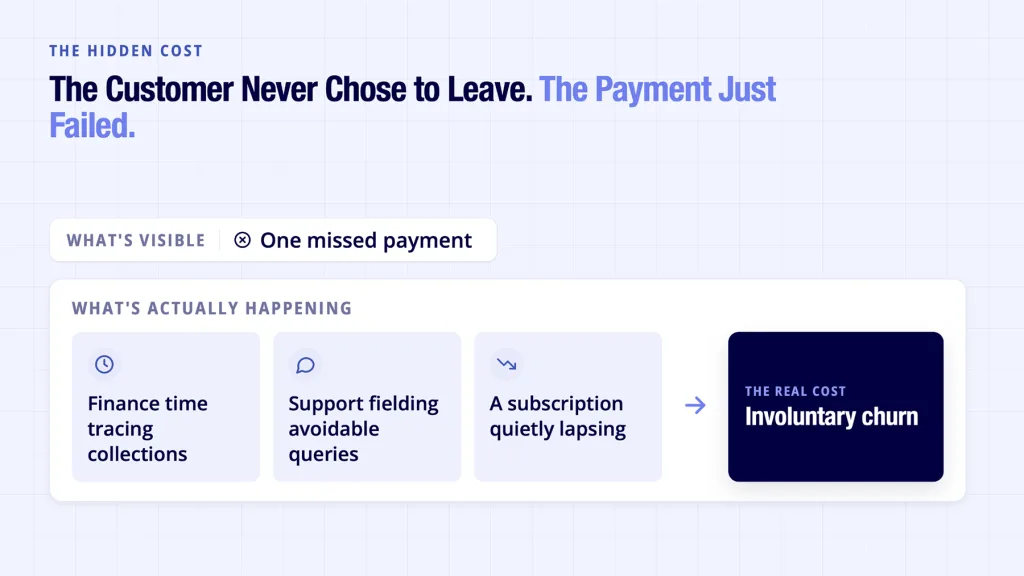
The immediate effect of a payment failure is easy to see: the payment doesn’t arrive.
The wider effect is often much harder to spot.
A subscription may lapse without the customer intending to leave. A supplier payment may need to be processed again. Finance teams spend time tracing failed collections instead of completing month-end work. Customer support receives enquiries that could have been avoided if the failure had been identified sooner.
For businesses that collect recurring payments, these individual incidents can gradually become a source of involuntary churn. The customer never chose to stop paying; the payment simply failed along the way.
If you’d like to understand how recurring bank payments can help reduce this particular type of revenue loss, Finexer’s guide to VRP payments provides a more detailed explanation.
Not every payment failure has the same commercial impact, but repeated failures can affect cash flow, customer retention and day-to-day operations if the underlying causes remain hidden.
Why Small Businesses Feel Payment Failures More Acutely
Large organisations can often absorb occasional failed collections without immediate consequences.
Smaller businesses usually have much less room for error.
When a handful of subscription renewals fail or several invoices remain unpaid because of avoidable payment issues, the effect can be felt across monthly cash flow. Time that could have been spent serving customers instead goes into contacting payers, updating payment details and attempting collections again.
That is why choosing a payment system for a small business involves much more than comparing transaction fees.
The lowest advertised processing cost does not always represent the lowest overall cost if payment failures occur regularly or remain unnoticed until reconciliation.
When comparing payment systems, consider questions such as:
- Does the platform explain why a payment failed?
- Can finance teams identify failed payments as they happen?
- Does it support recurring payment methods that are not affected by card expiry?
- Does reporting separate different failure reasons instead of grouping them together?
- Can customers update payment details without unnecessary effort?
These questions often have a greater operational impact than a small difference in transaction pricing.
Businesses evaluating card readers, for example, frequently compare SumUp pricing before deciding which payment provider best suits their needs.
Likewise, many retailers and hospitality businesses are also assessing QR Code Payment UK options as an alternative way to accept customer payments without relying solely on traditional card terminals.
Although these products solve different business needs, they all benefit from clear reporting when payment failures occur.
Seeing Payment Failure Earlier Changes What Happens Next
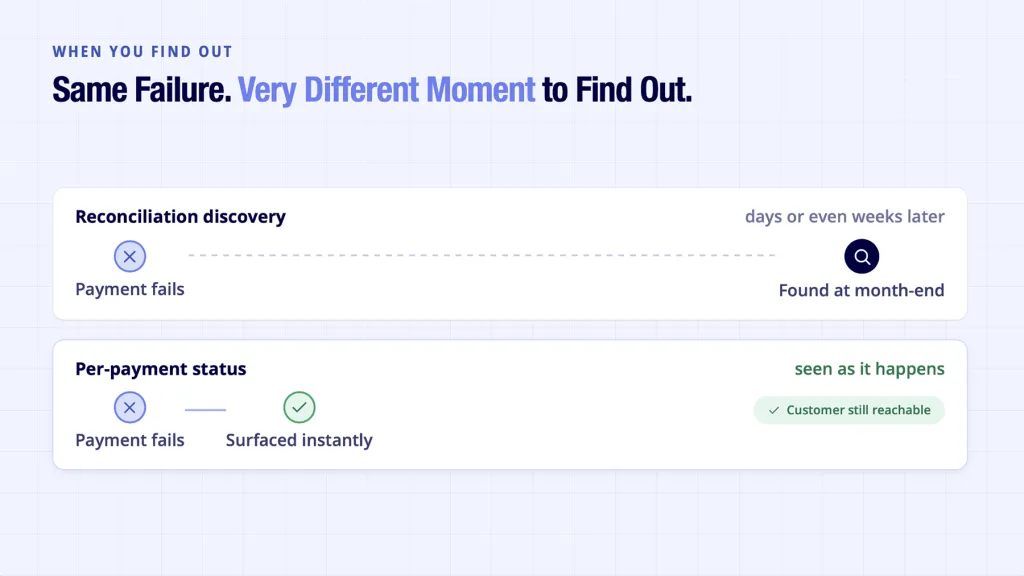
Many businesses don’t discover a failed payment until they reconcile accounts days or even weeks later.
By then, recovering the payment is often more difficult than if the issue had been identified immediately.
Early visibility gives finance and operations teams the opportunity to contact customers while the failed transaction is still recent, investigate recurring patterns and distinguish isolated incidents from wider operational issues.
This is one reason why many organisations are adopting tools such as a payment tracker, which provides visibility into the status of individual payments instead of relying entirely on end-of-month reports.
Knowing that a payment failed is useful.
Knowing why it failed is considerably more valuable because it determines what should happen next.
Fixes That Reduce Payment Failures
No single change will prevent every payment failure.
Different causes call for different responses, which is why businesses that monitor failure reasons often recover more payments than those that apply the same retry strategy every time.
The objective isn’t to stop every failed payment. That’s unrealistic.
The objective is to reduce avoidable payment failures by matching the response to the cause.
| Cause of payment failure | Practical response |
|---|---|
| Expired card | Prompt customers to update payment details before renewal where possible, or offer a bank-based recurring payment option |
| Insufficient funds | Retry collection around typical payday patterns rather than immediately after the first failure |
| Cancelled Direct Debit mandate | Ask the customer to create a new mandate before attempting another collection |
| Incorrect account details | Validate payment information before the first transaction instead of discovering errors after payment attempts fail |
| Abandoned authorisation | Make payment journeys clear and explain why customers need to approve the payment in their banking app |
Each of these actions addresses a different problem.
Retrying a payment repeatedly will not solve an expired card.
Likewise, asking a customer to update payment details won’t help if insufficient funds were the actual reason for the decline.
The closer businesses get to the underlying cause, the more effective their response becomes.
Why Open Banking Changes Some Payment Failure Patterns
Open Banking is sometimes described as a way to eliminate payment failure.
That overstates what it can do.
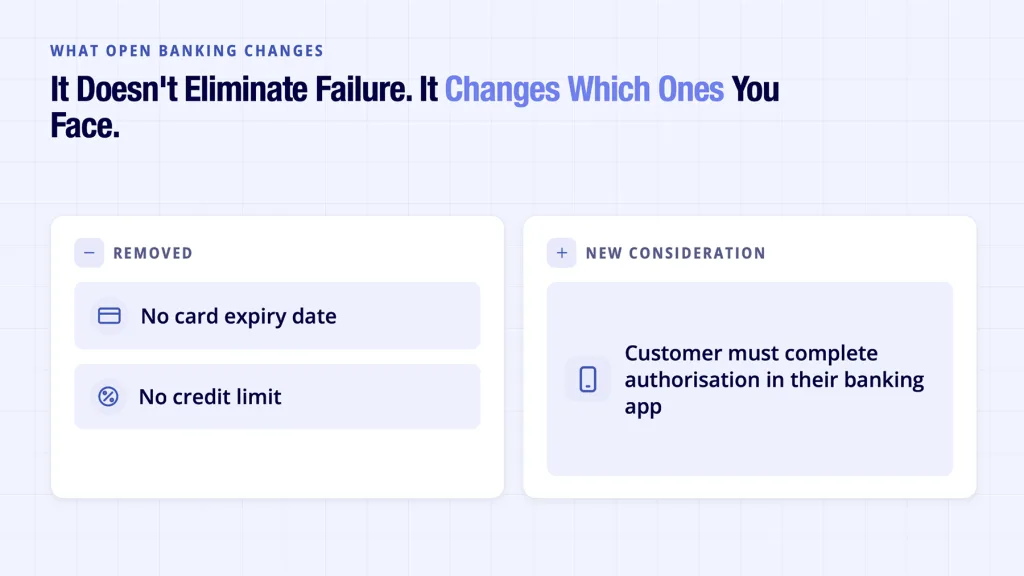
Open Banking changes which failures are likely to occur rather than removing failures altogether.
For recurring card payments, one of the most common reasons for failure is card expiry. Cards also encounter issuer declines and credit limit restrictions.
Bank-authorised payments work differently.
Because payments are authorised directly from the customer’s bank account, there is no card expiry date and no credit limit associated with a payment card.
That removes two common sources of payment failures.
However, another consideration takes their place.
Customers must authorise the payment within their banking application when required. If they leave the process before completing authorisation, the payment will not proceed.
Understanding this distinction is important.
Every payment method involves trade-offs, and businesses benefit more from understanding those trade-offs than from assuming one method solves every problem.
What Other Payment Providers Focus On
Businesses researching payment failure often encounter well-known payment providers before they discover Open Banking alternatives.
Most providers concentrate on different parts of the payment journey.
| Provider type | Primary focus | Typical approach to payment failure |
|---|---|---|
| Card processors | Card acceptance and merchant acquiring | Retry declined transactions, account updater services, fraud controls |
| Direct Debit providers | Recurring bank collections | Mandate management, payment retries, reporting |
| Digital payment platforms | Online and in-person payments | Payment acceptance across multiple channels |
| Open Banking providers | Bank-authorised payments | Bank-to-bank payments, payment visibility and account-based payment methods |
This difference in focus explains why businesses often compare several providers before deciding which approach best matches their payment model.
For example:
- A retailer relying mainly on in-store card payments may prioritise terminal features and transaction costs.
- A subscription business may place greater value on reducing failures caused by expired cards.
- A payroll platform may care most about visibility into payment status across thousands of outgoing payments.
Rather than asking which provider is “best”, businesses are usually better served by asking which payment approach addresses the problems they experience most often.
Where Finexer Fits
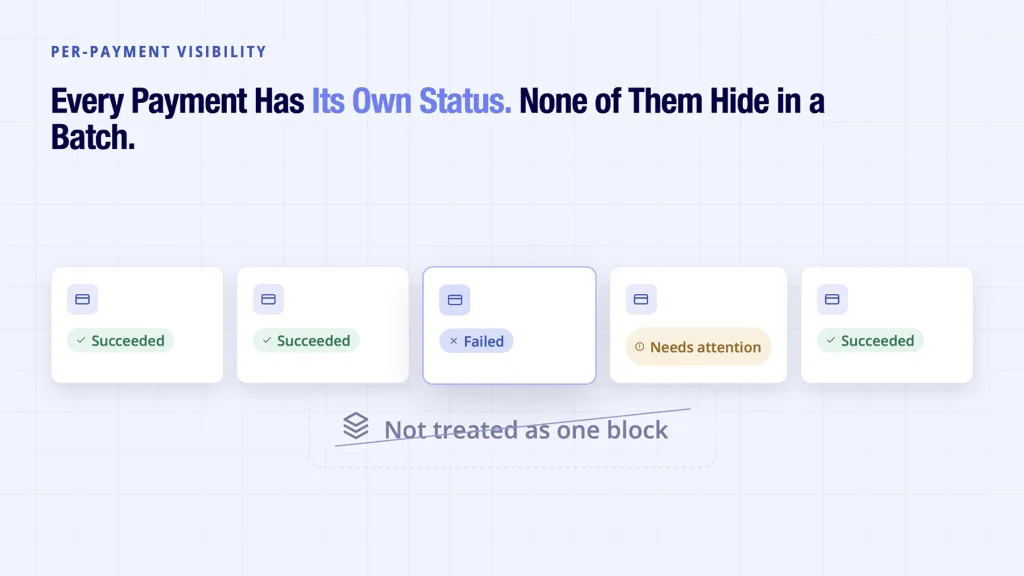
For organisations using Open Banking, visibility into individual payments can make failed collections easier to identify.
Instead of waiting until reconciliation highlights a missing payment, finance teams can see the status of each payment as it progresses.
This allows operational teams to investigate the cause while the transaction is still recent, rather than days later when additional work may already be required.
Finexer’s payments API returns payment status for individual transactions and supports recurring bank payments that are not affected by card expiry. It is designed to help platforms understand which payments require attention rather than treating every collection as a single batch process.
That distinction matters because identifying a payment failure promptly often dwetermines whether the issue becomes a quick customer interaction or develops into lost revenue, additional administration and avoidable customer dissatisfaction.
Where Payment Failure Matters Most
Every business accepts payments differently, but the consequences of payment failure often follow familiar patterns.
Here are a few examples.
| Business type | How payment failure appears |
|---|---|
| EPOS platforms | Declined customer payments at the point of sale, leading to interrupted purchases and additional staff intervention |
| Utility providers | Failed recurring collections across large customer bases, increasing payment recovery activity |
| Payroll platforms | Failed salary or contractor payments that require manual investigation before funds can be sent again |
| Accounting and invoicing software | Incorrect payment details delaying supplier settlements and increasing administrative work |
| Subscription businesses | Recurring revenue interrupted by expired cards, cancelled mandates or abandoned payment authorisations |
Although these sectors differ considerably, they all benefit from understanding why payments fail rather than simply recording that they did.
Recognising recurring patterns allows businesses to improve payment processes over time instead of repeatedly responding to the same operational issues.
Looking Ahead
Digital payments continue to change as businesses adopt new ways to collect and send money.
Cards remain central to many organisations. Direct Debit continues to support recurring collections across numerous sectors. Open Banking has introduced another payment option, particularly for businesses looking to reduce reliance on payment cards.
Whichever payment method a business uses, one principle remains consistent.
A payment failure should not remain unexplained.
Knowing the reason behind a failed payment allows businesses to respond appropriately, improve customer communication and identify operational trends that may otherwise remain hidden.
That understanding also helps when reviewing a payment system for small business.
Transaction fees are only one part of the picture. Visibility into payment status, meaningful reporting and clear failure information all contribute to how efficiently a business manages its cash flow and customer relationships.
Businesses that routinely examine the causes behind payment failures are generally better placed to reduce avoidable revenue loss than those that only review financial reports after the billing cycle has ended.
Why do payment failures increase as a business grows?
Growth usually means processing more payments across more customers, suppliers or subscriptions. Even if the percentage of failed payments stays the same, the total number of payment failures rises with transaction volume, making consistent monitoring and reporting increasingly valuable.
Are payment failures always caused by technical problems?
No.
Many payment failures occur because of everyday events rather than system faults. Customers replace payment cards, banks cancel Direct Debit mandates, account details change and payment authorisations are left incomplete. Identifying the reason behind the failure is more useful than assuming a technical issue.
Should businesses review payment failure trends regularly?
Yes.
Looking at payment failures individually helps resolve immediate issues, but reviewing them collectively can reveal recurring patterns. For example, repeated card expiry issues may suggest that customers would benefit from an additional recurring payment option, while frequent incorrect account details may point to weaknesses in onboarding or data entry.
Can one payment method prevent every payment failure?
No.
Every payment method has circumstances in which payments may fail. Cards, Direct Debit and Open Banking each have different characteristics, so understanding where each performs well and where challenges remain helps businesses choose the approach that best fits their payment model.
See Every Payment as It Happens. Knowing that a payment failed several days later often means the opportunity to resolve it has already become more difficult. Don’t wait until reconciliation to discover a payment failure
Explore with AI
About the Author

Yuri
Yuriy Yakushko is a fintech founder and software engineer with over 20 years of experience building financial technology. He’s passionate about creating scalable, secure infrastructure that helps businesses modernise how they access financial data and manage payments.