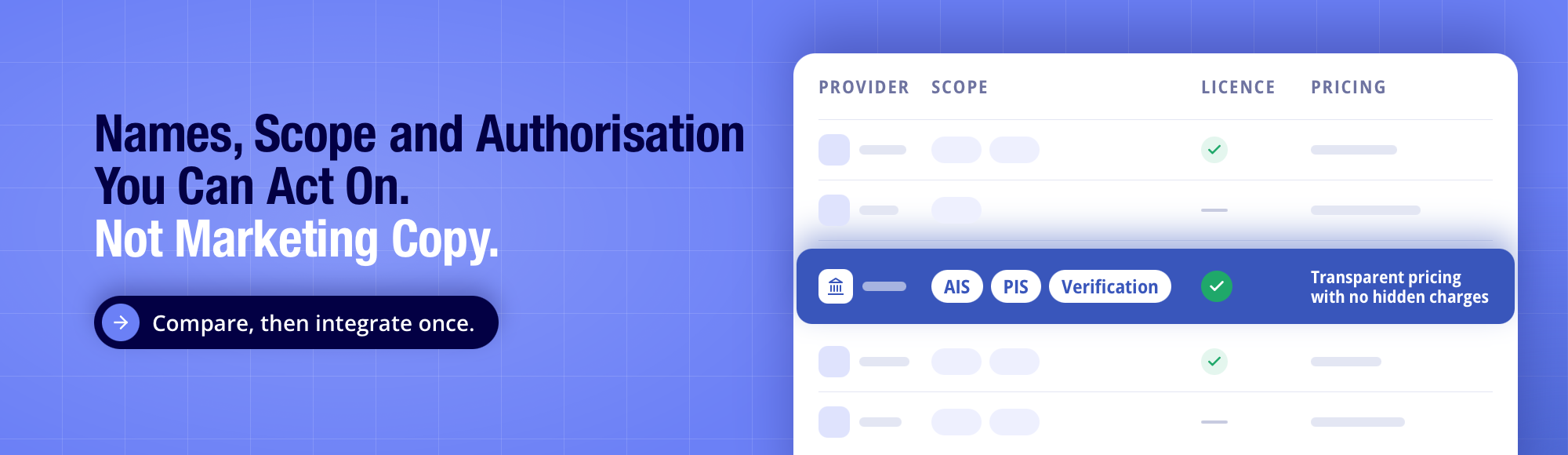
An open banking API list only earns its place on a shortlist if it gives you names, scope, and authorisation status you can act on, not marketing copy. Anyone researching open banking UK access eventually needs this exact comparison. This guide is exactly that: a comparison table of open banking API UK providers, what each one exposes, and how to read the table before you commit engineering time to any of them.
Key Takeaways
- This open banking API list is for shortlisting by what a provider actually exposes: AIS, PIS, verification, and UK authorisation status, not by brand recognition.
- Every UK-operating open banking API provider must be FCA-authorised, or operate under a licence held by its parent entity, to legally access account data or initiate payments.
- Coverage claims vary in what they actually measure. Confirm whether a number covers personal accounts, business accounts, or both.
- API scope differs by provider: some offer AIS only, some PIS only, and a smaller group offer both plus verification through one integration.
- Finexer holds its own FCA authorisation (FRN 925695) for AIS and PIS, with verification included in the same integration.
What Should an Open Banking API List Actually Show You?
A useful open banking API list shows three things for every entry: what the provider is authorised to do, what it actually exposes through its API, and which UK banks and account types it reaches. Anything less is a logo wall, not a shortlist.
Confirm what you’re actually comparing on this open banking API list before you look at pricing, since open banking UK access always starts with scope, not cost:
- AIS (Account Information Services): read-only access to balances, transactions and account details
- PIS (Payment Initiation Services): initiating a payment from a customer’s account, with consent
- Verification: confirming an account holder’s identity against real bank records
A smaller number of providers offer all three through one integration. Two quotes at a similar rate can be selling very different scope, so settle this first.
Open Banking API Providers: The Comparison Table
Every serious shortlist of open banking API providers starts here. The table below is built from each provider’s own published documentation and the Open Banking Tracker’s independent regulatory listings. Only publicly verifiable facts are included; where a claim could not be confirmed, that cell is left blank rather than guessed.
| Provider | API Scope | UK Authorisation | Notable Coverage Detail | Pricing Model |
|---|---|---|---|---|
| TrueLayer | AIS, PIS | FCA-authorised (FRN 901096) | Reaches around 70 UK institutions per Open Banking Tracker; among the first UK providers live with commercial VRP | Usage-based |
| Yapily | AIS, PIS | Yapily Connect Ltd, FCA-authorised (FRN 827001); also authorised via the Bank of Lithuania for EEA markets | Infrastructure-first, no consumer-facing UI; connects across UK and European banks | Base fee plus usage-based |
| Tink | AIS, PIS | UK-authorised; Visa-owned | Strong data enrichment and categorisation layered on top of AIS; broad UK and European coverage | Enterprise, contract-based |
| Plaid | AIS, PIS, verification | FCA-authorised as both AISP and PISP in the UK | AIS and identity/income verification are the primary UK use cases | Free sandbox tier, then volume-based |
| Finexer | AIS, PIS, verification | FCA-authorised (FRN 925695) | Coverage across most of the UK banks, including business and challenger accounts | Transparent pricing |
This table is a starting point, not a final answer. Confirm every authorisation status against the Financial Services Register directly before you rely on it, since permissions can change.
How to Read This Open Banking API List
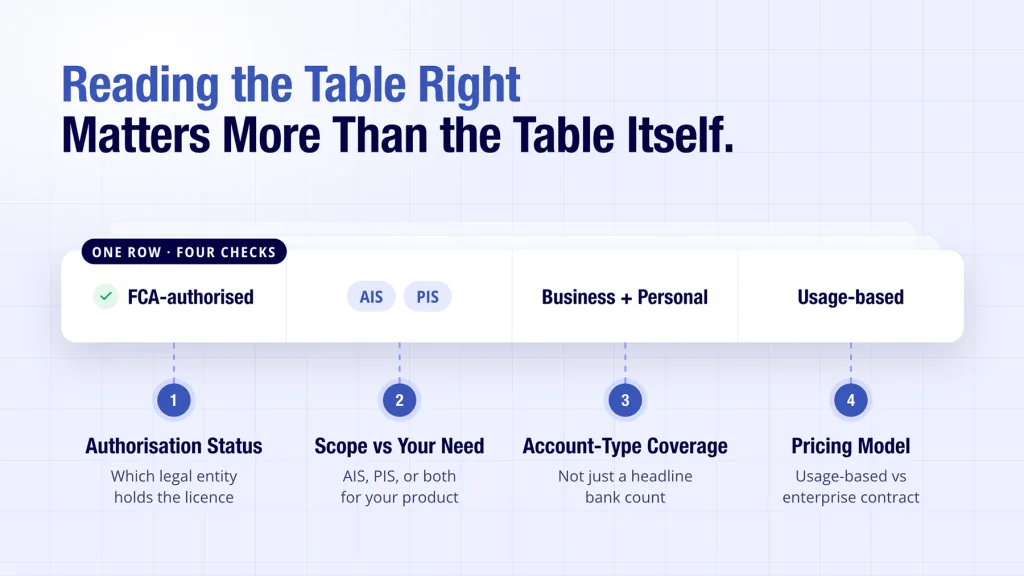
Reading the table correctly matters more than the table itself. This is where most buyers comparing open banking API UK options go wrong: they rank by bank count instead of by fit. Four things decide whether a row is actually relevant to you:
- Authorisation status. Confirm which legal entity holds the licence, and whether it covers AIS, PIS, or both. A provider operating under a parent’s EEA licence is not the same as one directly FCA-authorised.
- Scope versus your need. A provider strong on AIS but weak on PIS is the wrong pick for a payments-heavy product, however good its data API is.
- Coverage across account types. A high headline bank-count means little if it doesn’t include the business or challenger accounts your customers actually use.
- Pricing model. Transparent pricing (with no hidden charges) based on direct, one-to-one bank connections and customisation for growing platforms and enterprises alike.
Where Each Provider Type Fits
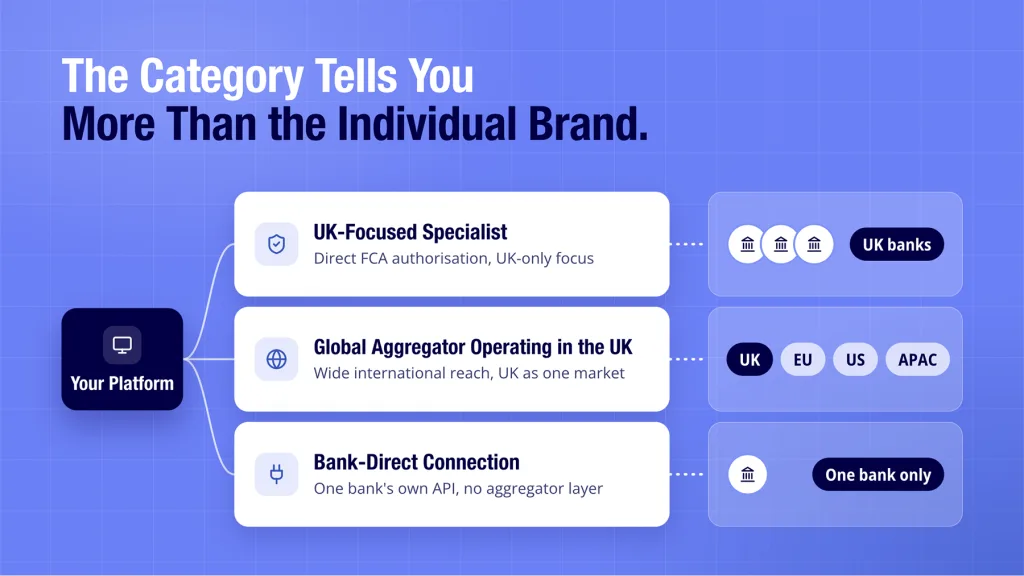
Open banking API providers on this list fall into three practical categories, and the category tells you more than the individual brand:
- UK-focused specialists hold their own direct FCA authorisation and concentrate engineering and support on UK banks specifically. Strongest fit for UK-only platforms that want a single point of accountability.
- Global aggregators operating in the UK bring wide international reach, with the UK as one market inside a larger platform. Strongest fit for teams expanding across several countries at once.
- Bank-direct connections skip the aggregator layer entirely and integrate with one bank’s own API. Strongest fit only for a narrow, fixed set of banks, since every additional bank means another integration to build and maintain.
If your platform needs bundled AIS, PIS, verification and enrichment as one packaged solution rather than comparing raw API access, our separate guide to open banking solution providers covers that comparison directly. This page stays focused on API access itself.
What Does Open Banking API Documentation Actually Need to Show?
Before you commit to any name on this list, check what its open banking API documentation actually gives your team. Weak documentation is the single biggest predictor of a slow, expensive integration, whatever the open banking API providers on your shortlist claim about coverage on their sales pages.
Look for:
- Authentication and consent-flow instructions, not just endpoint references
- Open Banking API examples with real request and response payloads
- Error codes with recommended handling, not just a status list
- Sandbox credentials that mirror production behaviour closely
- Webhook event definitions and retry guidance
- Bank-specific limitations, stated plainly rather than left for you to discover live
If your team wants concrete request and response patterns rather than a provider comparison, Open Banking API examples are covered directly in our dedicated Open Banking API examples guide.
Why Does the Open Banking Directory Matter for This List?
The Open Banking Directory, maintained by Open Banking Limited, is the authoritative record of which providers are authorised for open banking access in the UK. Every entry on a credible open banking API list should be checkable against it. If a provider is not listed there, or not listed under the entity actually running your integration, that is a reason to ask harder questions before signing anything.
Cross-referencing this open banking directory against the Financial Services Register gives you two independent sources confirming the same authorisation, rather than relying on a provider’s own claim about its regulatory status.
Selection Criteria Before You Shortlist Open Banking API Providers
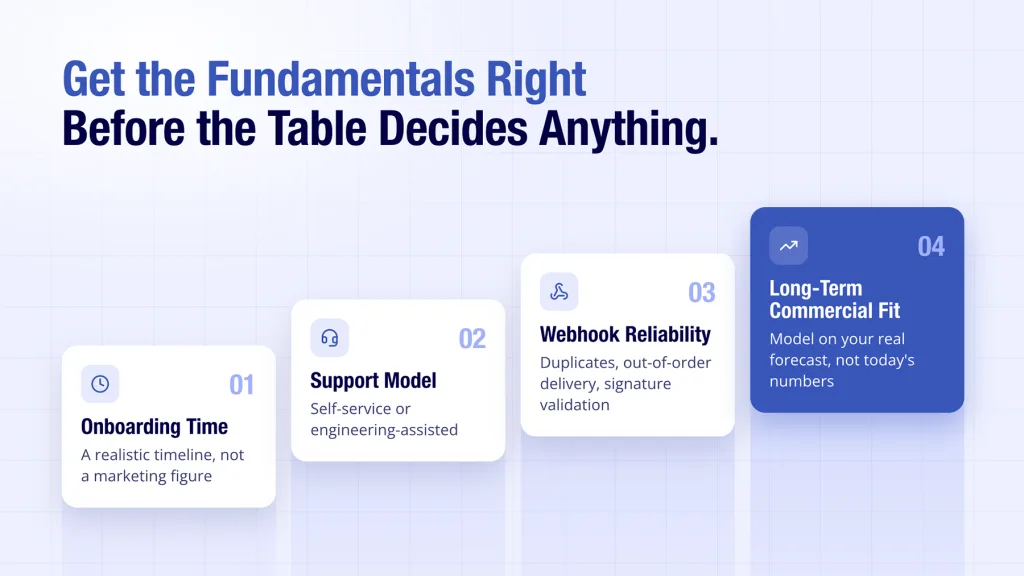
Beyond the table itself, a shortlist decision should weigh:
- Onboarding time. Ask for a realistic implementation timeline, not a marketing figure, and treat “weeks to go live” claims separately from any claim about regulatory approval timelines, which the provider does not control.
- Support model. Self-service documentation suits experienced teams. Engineering-assisted onboarding suits teams integrating open banking for the first time.
- Webhook reliability. Ask how duplicate events, out-of-order delivery, and signature validation are handled, since this is where production issues concentrate.
- Long-term commercial fit. A transparent pricing model with no hidden charges
Every one of these criteria applies whether you’re comparing two names or the full open banking UK market. Get the fundamentals right here before the table above decides anything for you.
For a narrative walkthrough of this same decision, rather than an enumerated list, our separate open banking providers guide covers the fuller decision process.
Where Does Finexer Fit on This List?
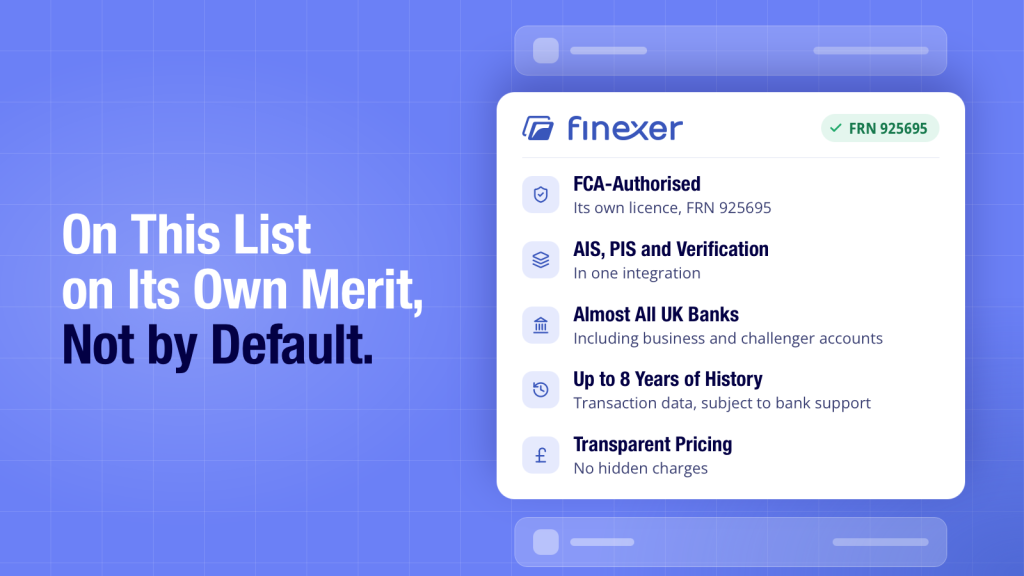
Finexer belongs on this list on its own merit: AIS, PIS and verification through one FCA-authorised integration (FRN 925695), rather than a bundled feature claim. Real-time transaction data, including up to 7 years of history, is available through Finexer Data. Its capabilities specifically:
| Capability | Detail |
|---|---|
| Authorisation | FCA-authorised (FRN 925695) for AIS and PIS |
| Bank coverage | Almost all UK banks, including business and challenger accounts |
| Data access | Real-time transaction data, up to 8 years of history, subject to bank support |
| Verification | Bank-based name verification within the same integration, not a separate product |
| Payments | Account-to-account via Open Banking, instant through Faster Payments for UK domestic flows |
| Pricing | Transparent pricing (no hidden charges) |
| Deployment | 2-3x faster than building direct bank connections in-house |
| Onboarding | 3-5 weeks of onboarding support to production |
For teams already using Tink and evaluating a UK-first alternative, our Tink alternatives guide covers that specific comparison. Finexer’s strongest fit is a mid-market fintech or SaaS platform that wants AIS, PIS and verification from one accountable provider, rather than stitching together separate integrations for each capability.
The Bottom Line
A genuinely useful open banking API list gives you scope, authorisation and coverage you can verify, not a ranked collection of logos. TrueLayer, Yapily, Tink and Plaid each cover open banking API UK access with different strengths in aggregation, infrastructure control, enrichment and verification.
Finexer earns its place on the same list with its own FCA authorisation, AIS, PIS and verification through one integration, and UK-first coverage. Confirm authorisation status directly, match scope to your actual need, and test documentation quality before you commit engineering time to any provider on this list.
How do I shortlist from an open banking API list?
Start with scope, not brand. Confirm which of AIS, PIS and verification each candidate actually offers, then check authorisation status against the Financial Services Register and the open banking directory directly. Narrow to two or three providers before running any sandbox tests.
What is the difference between open banking API providers and solution providers?
Open banking API providers give you raw access to bank data and payment initiation, which you build your own product logic around. Solution providers bundle that access with additional packaged capability, such as enrichment or verification workflows, as a more complete product. The right choice depends on how much you want to build versus buy.
Can I switch open banking API providers later?
Yes, but treat it as a migration project, not a simple key swap. Map existing customer consents, test the new provider’s coverage against your actual bank list, and run both providers in parallel briefly before fully cutting over.
Does open banking API documentation quality actually matter for provider choice?
Significantly. Thin documentation predicts a slower, more support-dependent integration regardless of how strong a provider’s underlying coverage is. Request real documentation access, not just a sales deck, before you shortlist.
Is a longer entry in the open banking directory a sign of reliability?
Not on its own. Directory listing confirms current authorisation, not performance or coverage quality. Use it to verify regulatory status, then judge reliability from documentation, sandbox testing, and direct references.
One FCA-authorised API for AIS, PIS and verification, built for UK platforms that want a single accountable provider.
Explore with AI
About the Author

Ravi Ranjan
Ravi Ranjan is Co founder & CEO of Finexer