
TL;DR: The open banking ecosystem is a network of banks, regulated third-party providers, technical standards and regulators that work together to let customers share financial data or initiate payments securely. Rather than focusing on security protocols or APIs alone, understanding the ecosystem means understanding how every participant, from customers and banks to the FCA and Open Banking Limited, contributes to a single connected framework.
Introduction: Search for “Open Banking ecosystem” and you’ll often find diagrams filled with acronyms, regulations and technical jargon. The problem is that most explain what Open Banking is without showing who makes it work.
If you’ve wondered why banks, regulators, fintechs and APIs all appear in the same conversation, or why terms such as AISP, PISP and ASPSP seem interchangeable, you’re not alone. Understanding the open banking ecosystem starts by understanding its participants and the role each one performs.
This guide explains the UK’s Open Banking landscape from the ground up. By the end, you’ll understand who the key players are, how information moves between them and why this collaborative model has become the foundation for modern financial services.
“When people first encounter Open Banking, they usually assume it’s a technology. It isn’t. It’s an ecosystem built on clearly defined roles, shared standards and customer consent. Once you understand who each participant is, the entire model becomes surprisingly straightforward.” Yuri, Technical Lead at Finexer
At Finexer, we work with organisations integrating Open Banking into accounting platforms, payment journeys and financial applications across the UK. One recurring observation stands out: teams rarely struggle with APIs themselves.
They struggle with understanding where every participant fits before implementation begins. This article reflects those conversations, explaining the ecosystem in the same order that engineering and product teams naturally learn it.
What Is the Open Banking Ecosystem?
The open banking ecosystem is the complete network of organisations, standards and regulations that enable customers to share financial information securely with authorised third parties.
Think of it less as a single technology and more as an operating model.
Banks provide access to financial data.
Customers decide who may access it.
Authorised providers retrieve or act on that data.
Regulators define the rules.
Technical standards ensure every participant speaks the same language.
Each participant performs a different role, but none operates independently.
Without banks, there is no financial data.
Without customers, there is no consent.
Without regulated providers, there are no practical applications.
Without standards, every bank would communicate differently.
The ecosystem exists because these participants work together rather than separately.
Why Was the Open Banking Ecosystem Created?
For many years, customers technically owned their banking information but had limited practical control over it.
If someone wanted to share transaction history with an accounting platform, a lending provider or a budgeting application, they often had two options:
- download PDF statements;
- export CSV files manually.
These approaches were slow, inconsistent and difficult to automate.
The UK’s implementation of the revised Payment Services Directive (PSD2), together with the Competition and Markets Authority (CMA), introduced a different approach.
Instead of customers moving financial information manually, authorised providers could retrieve it directly from participating banks, with the customer’s explicit consent.
The objective was not simply to introduce new technology.
It was to create greater competition, encourage innovation and give customers more control over their financial information.
Today, the open banking ecosystem supports everything from accounting software and affordability checks to payment initiation and financial management applications.
Who Are the Main Participants in the Open Banking Ecosystem?
Although dozens of organisations participate in Open Banking, they generally fall into five groups. Understanding these groups makes every later discussion about Open Banking significantly easier.
| Participant | Primary Role | Example Organisations | Handles Customer Money? |
|---|---|---|---|
| Customers | Grant or revoke consent to share banking data or authorise payments | Individuals and businesses | Yes |
| ASPSPs (Banks) | Hold customer accounts and provide secure API access after consent | Barclays, HSBC, NatWest, Monzo, Starling | Yes |
| AISPs | Retrieve account information such as balances and transaction history | Accounting platforms, budgeting apps, affordability tools | No |
| PISPs | Initiate bank-to-bank payments with customer authorisation | Pay by Bank providers, payment platforms | No |
| Financial Conduct Authority (FCA) | Regulates and authorises organisations participating in Open Banking | Financial Conduct Authority | No |
| Open Banking Limited (OBL) | Develops the technical standards that ensure interoperability across participants | Open Banking Limited | No |
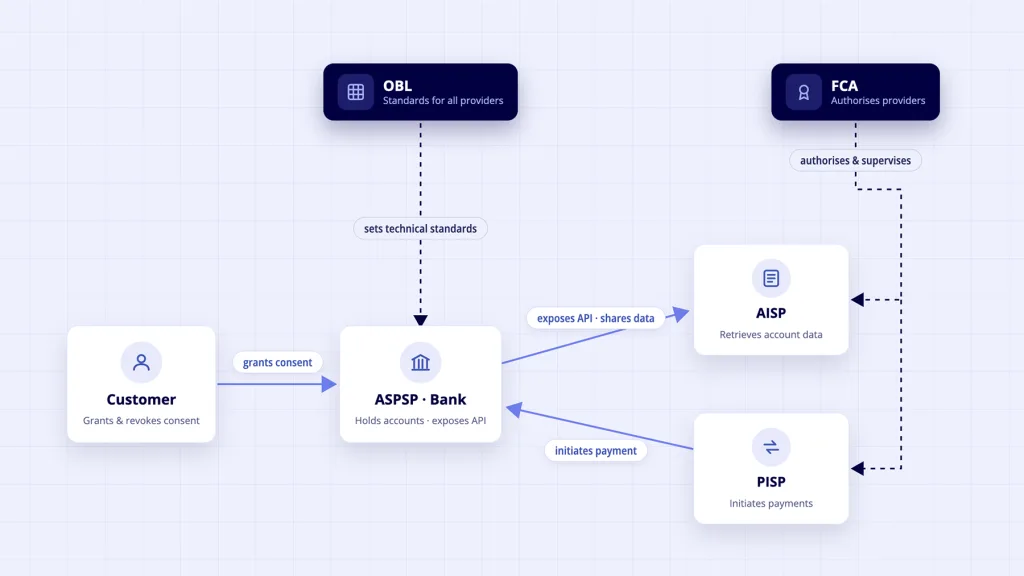
1. Customers
Every Open Banking journey begins with the customer.
Nothing happens until the customer chooses to authorise access.
Unlike traditional data sharing, Open Banking places the customer at the centre of the decision-making process.
The customer decides:
- which provider may access information;
- which accounts are shared;
- how long consent remains valid.
Without consent, no bank data is exchanged.
2. ASPSPs (The Banks)
The term ASPSP stands for Account Servicing Payment Service Provider.
The name sounds complicated.
The role is not.
An ASPSP is simply the financial institution that holds the customer’s account.
Examples include the following:
- Barclays
- HSBC
- Lloyds Bank
- NatWest
- Santander
- Nationwide Building Society
- Monzo
- Starling Bank
Within the open banking ecosystem, banks expose standardised interfaces that authorised providers can use once customer consent has been granted.
Rather than building separate integrations for every institution, standardisation allows providers to communicate more consistently across participating banks.
3. Third-Party Providers (TPPs)
The next group consists of regulated third-party providers.
These organisations build the applications customers actually use.
Rather than storing customers’ money, they build services around banking information and payment capabilities.
TPPs generally fall into two categories.
Account Information Service Providers (AISPs)
AISPs retrieve financial information after customer consent.
Typical information includes:
- account balances;
- transaction history;
- account holder details.
Accounting platforms, budgeting applications and affordability assessment tools frequently use this model.
If you’d like to explore this area in greater technical depth, our Open Banking API guide explains how these APIs expose banking information to authorised providers.
Payment Initiation Service Providers (PISPs)
PISPs perform a different function.
Instead of retrieving data, they initiate payments directly from a customer’s bank account after authorisation.
They never retrieve banking information simply because they initiate payments.
Likewise, AISPs never initiate payments simply because they retrieve data.
Although organisations may hold both permissions, the two services remain distinct within the regulatory framework.
Who Ensures the Ecosystem Works Consistently?
Having banks and third-party providers is only part of the picture.
An ecosystem also requires shared governance.
Without common standards, every bank would expose different APIs, different data formats and different authentication journeys.
Developers would have to integrate separately with every institution.
That would undermine one of Open Banking’s primary objectives: interoperability.
Two organisations play particularly important roles in maintaining consistency across the UK ecosystem.
The Financial Conduct Authority (FCA)
The FCA authorises and supervises organisations that participate in regulated Open Banking services.
It establishes the regulatory framework within which authorised providers operate, helping ensure that organisations accessing financial information meet defined regulatory requirements.
For customers, FCA authorisation provides confidence that providers operate within an established regulatory regime rather than accessing financial data informally.
Open Banking Limited (OBL)
While the FCA establishes regulation, Open Banking Limited (OBL) develops the technical standards that allow participants to communicate consistently.
These standards define areas such as:
- API specifications;
- customer consent flows;
- security requirements;
- interoperability guidelines.
Thanks to these common standards, providers spend less time adapting to individual bank implementations and more time building useful financial products.
CMA9 vs Voluntary Participants: Why Not Every Bank Joined the Same Way
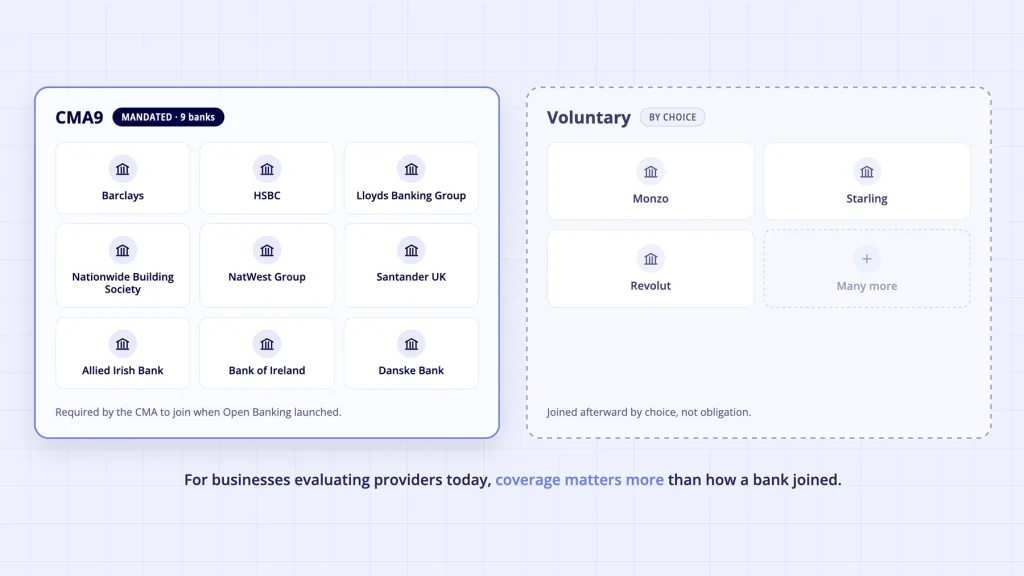
When Open Banking launched in the UK, not every bank entered the ecosystem under the same circumstances.
The Competition and Markets Authority (CMA) required the UK’s nine largest banking groups, commonly called the CMA9, to implement Open Banking standards as part of measures designed to increase competition in retail banking.
The CMA9 include the following:
- Barclays
- HSBC
- Lloyds Banking Group
- Nationwide Building Society
- NatWest Group
- Santander UK
- Allied Irish Bank (First Trust Bank in Northern Ireland)
- Bank of Ireland
- Danske Bank
Since then, many other banks and building societies have joined voluntarily.
This distinction matters because it explains why Open Banking initially centred on the UK’s largest institutions before expanding across much of the wider banking sector.
For businesses evaluating providers today, however, the practical question is less about how a bank joined and more about whether a provider supports the institutions their customers actually use.
How Data Flows Through the Open Banking Ecosystem
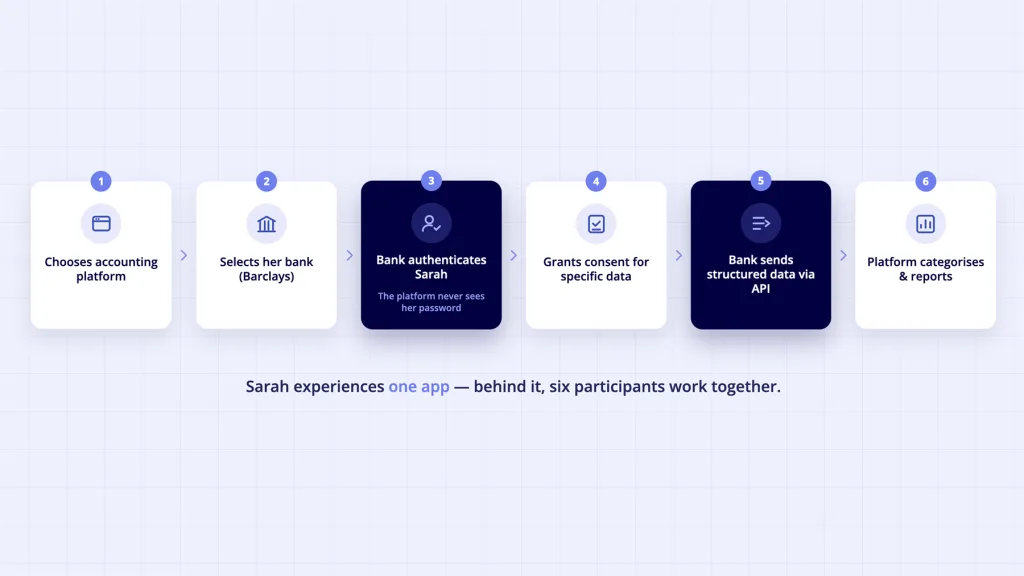
The structure becomes much easier to understand when viewed through a simple example.
Imagine Sarah owns a small design agency.
She wants her accounting software to retrieve transactions automatically instead of importing CSV files every Friday.
Here’s what happens.
Step 1: Sarah chooses her accounting platform
The accounting platform offers Open Banking connectivity.
Sarah selects Connect Bank Account.
Step 2: Sarah selects her bank
She chooses Barclays.
The accounting platform does not ask for her online banking password.
Instead, she’s redirected securely to Barclays.
Step 3: Barclays authenticates Sarah
Sarah logs in using Barclays’ own authentication process.
Only Barclays verifies her identity.
The accounting platform never handles her banking credentials.
Step 4: Sarah gives consent
Barclays explains exactly what information the accounting platform wants to access.
For example:
- account balances;
- transaction history;
- account details.
Sarah chooses whether to approve or decline.
Step 5: Data is shared securely
Once consent is granted, Barclays sends the requested information through standardised Open Banking APIs.
The accounting platform receives structured financial data rather than PDFs or exported spreadsheets.
Step 6: Sarah keeps using her software
The platform categorises transactions, assists reconciliation and generates reports using verified bank information.
Sarah experiences one accounting application.
Behind the scenes, several participants within the open banking ecosystem have worked together to make that experience possible.
What Makes the Open Banking Ecosystem Different?
Financial technology has existed for decades.
So why has Open Banking attracted so much attention?
Because it changes who controls financial information.
Historically, customers often shared banking credentials directly with third-party applications through techniques such as screen scraping.
This created obvious operational and security challenges.
Open Banking replaces that model with regulated access based on customer consent.
Instead of asking customers for passwords, authorised providers request permission.
Banks remain responsible for authentication.
Customers remain in control of access.
Providers receive only the information required for the agreed purpose.
The result is an ecosystem designed around explicit permission rather than credential sharing.
If you’re interested specifically in the security model behind this approach, our guide answering the question “is Open Banking safe” explores authentication, consent management and customer protection in greater detail.
What Should You Look for in Open Banking Infrastructure?
Whether you’re evaluating Open Banking for an accounting platform, ERP system or fintech application, several factors deserve attention beyond simple API availability.
Broad UK bank coverage
The ecosystem only delivers value if your users can connect the banks they actually use. Finexer connects to almost every UK bank including high street banks (including Barclays, HSBC, NatWest and Lloyds), challengers (including Monzo, Revolut and Starling) and business accounts.
Clear regulatory status
Confirm that the provider operates under the appropriate FCA permissions for the services being offered. Understanding whether you’re working with an AISP, a PISP or both helps avoid confusion later in the project.
Consistent data quality
Raw transaction descriptions differ significantly between financial institutions. Structured, normalised data reduces engineering effort and improves downstream applications.
Well-documented APIs
Good documentation shortens development time. Clear examples, predictable responses and comprehensive developer guidance often matter as much as the APIs themselves.
Reliable onboarding support
Technical integration rarely succeeds through documentation alone. Implementation support, testing environments and knowledgeable engineering teams can significantly reduce deployment time.
Where Finexer Fits Within the Open Banking Ecosystem
The open banking ecosystem depends on reliable connectivity between regulated providers and UK financial institutions.
This is the layer where Finexer operates. Finexer is an FCA-authorised (FRN925695) Open Banking infrastructure provider that enables B2B platforms to access verified bank data and initiate payments through a single API. Rather than building budgeting applications or accounting software, Finexer provides the infrastructure that enables businesses to connect securely with participating UK banks through a single integration.
For organisations building financial products, this removes much of the complexity involved in managing individual bank connections while remaining aligned with UK Open Banking standards.
If you’re exploring how connectivity works in practice, Finexer’s Connect infrastructure provides access to regulated Open Banking services through a unified API layer designed for UK financial applications.
What Is Open Banking Infrastructure?
Open banking infrastructure is the technical foundation that enables regulated participants within the Open Banking ecosystem to communicate securely.
It includes APIs, consent management, authentication flows, connectivity services and standardised data exchange between banks and authorised third-party providers.
While customers interact with budgeting apps, accounting software or payment journeys, they rarely see this infrastructure operating behind the scenes.
For software providers, however, it forms the backbone of every Open Banking implementation. Rather than integrating separately with numerous financial institutions, many organisations rely on infrastructure providers that simplify connectivity while remaining aligned with UK regulatory and technical standards.
For readers interested in the technical building blocks behind these integrations, our guide to AISP infrastructure explores how account information services are delivered through Open Banking APIs.
What is the difference between an ASPSP, an AISP and a PISP?
An ASPSP is the bank or financial institution that holds the customer’s account. An AISP retrieves account information with consent, while a PISP initiates payments after customer authorisation. Each performs a different function within the Open Banking ecosystem.
Why was the Open Banking ecosystem introduced?
The Open Banking ecosystem was introduced to increase competition, encourage financial innovation and give customers greater control over their financial data. It replaced manual document sharing and credential-sharing approaches with regulated, consent-driven data access.
Does every UK bank participate in Open Banking?
Most major UK banks participate, although not all joined in the same way. The CMA9 were required to implement Open Banking standards, while many other banks and building societies joined voluntarily over time.
How does Open Banking infrastructure benefit software providers?
Open banking infrastructure simplifies connectivity between software applications and participating banks. Instead of maintaining separate integrations with multiple institutions, developers can build against standardised interfaces that support secure data sharing and payment initiation.
Discover how Open Banking connectivity works behind the applications you already use, and explore the infrastructure that makes secure financial data sharing possible.
Explore with AI
About the Author

Yuri
Yuriy Yakushko is a fintech founder and software engineer with over 20 years of experience building financial technology. He’s passionate about creating scalable, secure infrastructure that helps businesses modernise how they access financial data and manage payments.