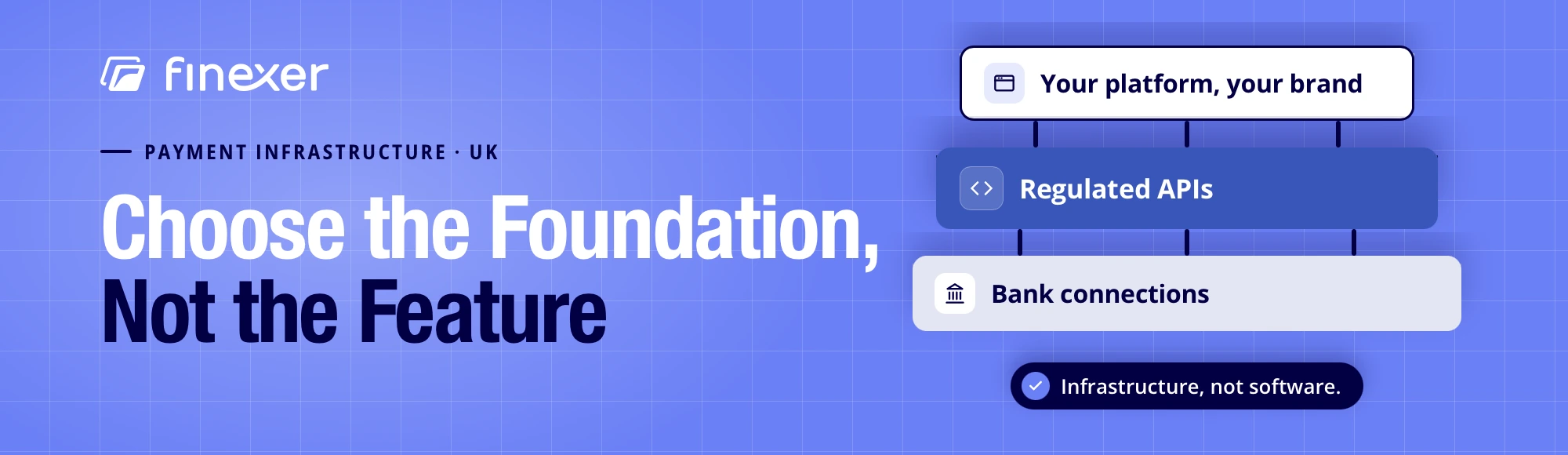
Payment infrastructure providers supply the regulated APIs and connectivity layers that another business builds its product on, which is what separates them from payment service providers that sell a finished payment product.
Most buyers conflate payment service providers with payment infrastructure providers. The difference is structural: a payment service provider sells a payment product. A payment infrastructure provider sells the foundation another business builds on. Getting this distinction wrong at the start of an evaluation leads to the wrong shortlist, a painful migration, and months of technical debt.
The UK is one of the world’s most developed markets for this infrastructure. UK Open Banking recorded 2.97 billion successful API calls in August 2026, while monthly payments now exceed 40 million, reflecting the growing scale of the ecosystem. The infrastructure underpinning those numbers is what this guide evaluates.
Key Takeaways
- Payment infrastructure providers sell regulated APIs and rails that platforms build on; payment service providers sell finished payment products
- The four categories to evaluate are card acquirers and gateways, Open Banking payment providers, Banking-as-a-Service providers, and payment orchestration layers
- FCA authorisation, white-label capability, API quality, and onboarding time are the evaluation criteria that matter most for infrastructure specifically
- Finexer is a UK Open Banking infrastructure provider (FRN 925695) operating as both AISP and PISP, not software, not a card processor
What Is the Difference Between Payment Infrastructure and Payment Software?
The most important question a platform buyer can ask is not “which provider has the best features?” It is “am I buying infrastructure or software?”
Payment infrastructure providers give you regulated access to underlying payment capabilities: bank connections, payment initiation, account data, verification. You build your product on top. The provider is invisible to your end user.
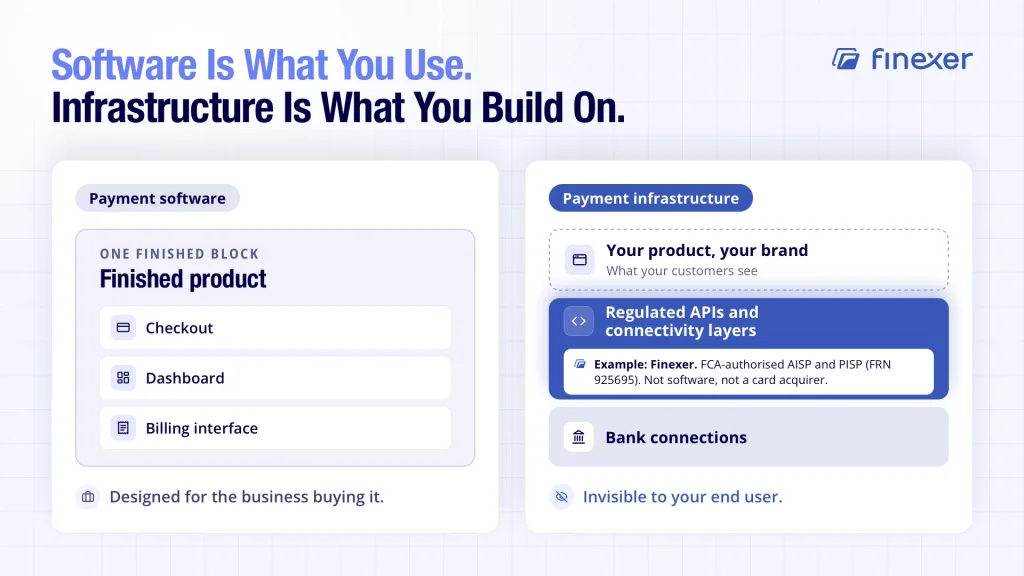
Payment software gives you a finished product: a checkout, a dashboard, a billing interface. It is designed for the business buying it, not for another business building on it.
Most payment processing companies in the UK operate in both lanes. The confusion is deliberate. For platform builders and embedded finance UK products, the infrastructure lane is the one that matters.
The key indicators are: does the provider offer a white-label option, do they have direct FCA authorisation you can rely on, and do they supply webhooks and event-driven APIs rather than finished UI components?
For a broader comparison of payment gateway vs PSP distinctions, see payment gateway vs psp.
What Are the Four Categories of Payment Infrastructure Providers?
Payment infrastructure providers in the UK fall into four functional categories. Most platforms need one or two. Few need all four.
| Category | What It Supplies | Who Uses It | Regulatory Basis |
|---|---|---|---|
| Card acquirers and gateways | Card acceptance, merchant settlement | E-commerce, retail, hospitality | FCA e-money/payment institution |
| Open Banking payment providers | PIS (payment initiation), AIS (account data) | Fintech, accounting, payroll, proptech | FCA AISP/PISP authorisation |
| Banking-as-a-Service (BaaS) | Accounts, ledgers, card issuing | Neobanks, embedded finance UK platforms | FCA e-money institution or bank licence |
| Payment orchestration | Multi-provider routing, fallback logic | High-volume merchants, large platforms | No separate licence; relies on underlying providers |
For open banking API providers specifically, see open banking solution providers.
For bulk payment initiation and payout capability, see bulk payouts.
How Do You Evaluate Payment Infrastructure Providers?
Evaluation criteria for payment infrastructure providers differ from software evaluation criteria. Forget feature counts. These are the seven criteria that determine whether the infrastructure holds up at production scale.
FCA authorisation
Verify on the FCA Register before anything else. Not the provider’s website badge. The FCA Register lists authorisation type, scope, and status. Payment service providers operating without valid FCA authorisation expose your platform to regulatory risk.
For Open Banking specifically, check whether the provider holds AISP, PISP, or both. For a comparison of what each authorisation covers, see what an AISP is.
White-label capability
For embedded finance UK products, your brand must be the customer’s experience. Payment infrastructure providers that cannot operate fully under your brand force a co-branded journey that undermines your product. Confirm white-label payments capability before the commercial conversation. See white label finance solutions for the evaluation criteria specific to this requirement.
API quality
API-first infrastructure is table stakes for platform use. Evaluate: Is there a sandbox before commercial commitment? Is documentation complete and up to date? Are there webhooks per event or batch-only responses? Is error handling documented with reason codes? Weak documentation at evaluation stage can signal support problems at scale
Uptime and status transparency
Open Banking Limited reports weighted availability of 99.80% across the CMA9 banks’ APIs for June 2026, which shows how reliable the underlying bank connections are. Ask each provider separately for its own platform uptime history and incident record.
Support model
Production incidents do not follow business hours. Understand the support model before signing:
- Is there a named technical contact?
- What is the escalation path for a live issue?
- What response time should you expect?
Pricing model
Payment infrastructure providers have provisions in ways that do not always scale proportionally. Usage-based pricing aligns cost with volume. Ask for the full cost picture in writing and test it against your realistic volume curve, not your target one. Check how cost behaves in slower months, and confirm there are no hidden charges.
Onboarding timeline
Regulated infrastructure takes longer to onboard than software. The fastest payment infrastructure providers support 3-5 weeks for technical onboarding. Enterprise-only providers can take 4-9 months. Understand the onboarding timeline before committing to a product launch schedule. For a direct view, see
Which Payment Infrastructure Providers Operate in the UK?
The following are payment infrastructure providers operating in the UK market in 2026. All information is sourced from public documentation and FCA Register entries.
TrueLayer
TrueLayer is an FCA-regulated Open Banking provider offering payment initiation and data APIs. It operates across the UK and Europe and is used by financial services firms and fintech platforms. It is one of the established open banking API providers in the UK market. Authorisation status is verifiable on the FCA Register.
Yapily
Yapily is an Open Banking infrastructure provider offering data and payment initiation APIs, operating across multiple European markets. It targets enterprise and mid-market platform clients. FCA-regulated as an AISP and PISP.
Stripe
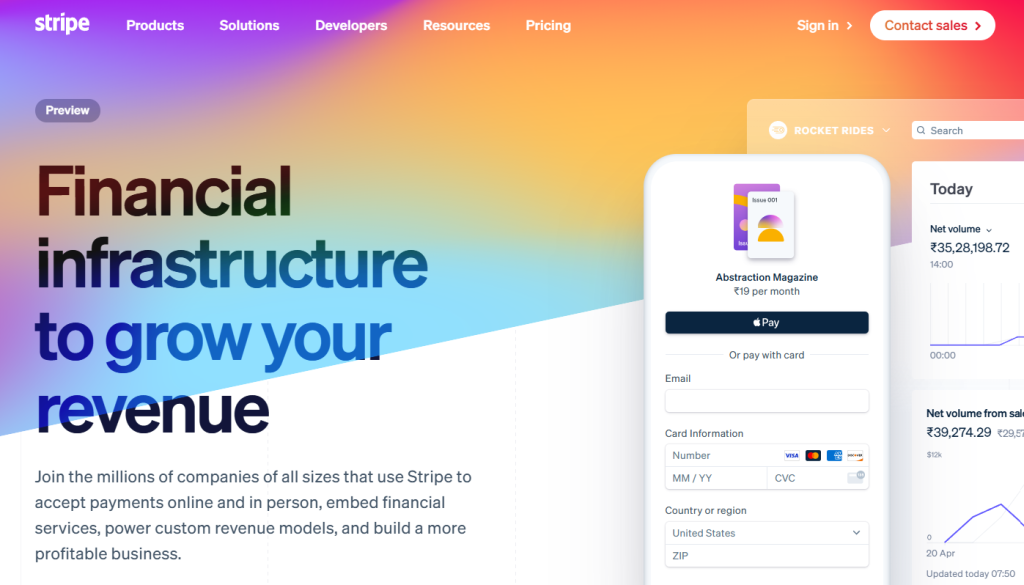
Stripe is a payment processing platform operating as a payment service provider and card acquirer. It offers API-first infrastructure for card acceptance, payment links, and billing. It holds FCA e-money institution authorisation. Stripe is primarily card-rail infrastructure; its Open Banking capability is limited compared with specialist open banking API providers.
Adyen
Adyen is an enterprise card acquirer and payment orchestration provider operating globally. It provides acquiring, payment methods, and point-of-sale infrastructure. FCA-authorised as an e-money institution. It targets large enterprise and marketplace clients and is not purpose-built for mid-market fintech infrastructure.
GoCardless

GoCardless is a Direct Debit and bank payment provider operating across the UK and Europe. It covers recurring payment collection via Bacs and SEPA, and has expanded into Open Banking payment initiation. FCA-authorised. It specialises in pull-based recurring payments rather than push payment initiation.
Finexer
Finexer is a UK Open Banking infrastructure provider, FCA-authorised as both an AISP and PISP (FRN 925695) under the Payment Services Regulations 2017. It provides AIS, PIS, Verification, Connect and Dashboard through a single API, with white-label options and direct one-to-one bank connections. Finexer also provides 3–5 weeks of hands-on onboarding support for scaleups, medium and enterprise businesses.
Here’s a quick comparison guide-
| Provider | Category | FCA Authorisation | White-Label | Best Fit |
|---|---|---|---|---|
| Finexer | Open Banking (AIS + PIS) | AISP + PISP (FRN 925695) | Yes | Mid-market SaaS, fintech platforms |
| TrueLayer | Open Banking (AIS + PIS) | AISP + PISP | Partial | Fintech, financial services |
| Yapily | Open Banking (AIS + PIS) | AISP + PISP | Partial | Enterprise, mid-market |
| Stripe | Card acquirer, payment platform | E-money institution | Partial | E-commerce, SaaS |
| Adyen | Card acquirer, orchestration | E-money institution | No | Large enterprise, marketplaces |
| GoCardless | Direct Debit, bank payments | Payment institution | No | Recurring payments, subscriptions |
Should a Platform Build or Buy Payment Infrastructure?
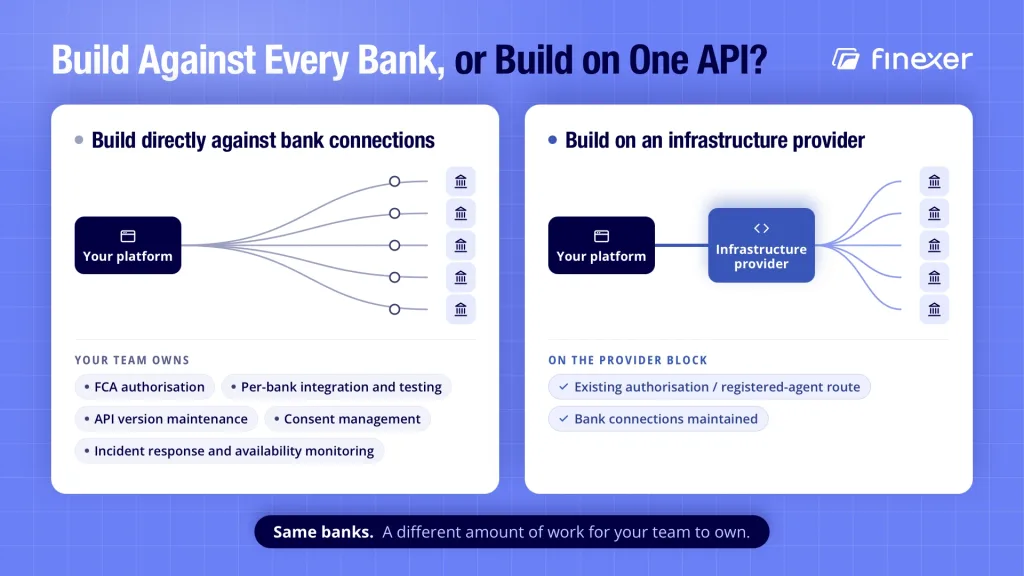
Building directly against bank connections instead of using an established payment infrastructure provider is a route some engineering teams consider. However, building in-house brings additional regulatory and technical responsibilities.
Operating as a regulated third-party provider requires FCA authorisation and ongoing compliance obligations. Alternatively, a platform may operate as a registered agent under an existing provider’s authorisation, rather than applying for its own authorisation. Technical connectivity to individual banks also requires integration, testing and ongoing maintenance.
Using an established payment infrastructure provider can reduce the regulatory and technical work involved in building directly. The build-vs-buy decision should therefore consider regulatory requirements, bank connectivity, ongoing maintenance and internal engineering resources- not just the initial API integration cost. For a closer look at the integration process, see bank API integration.
How Does Finexer Fit Into a Platform’s Payment Infrastructure Stack?
Platforms need Open Banking infrastructure that brings banking data and payments into their existing products without having to build and maintain individual bank integrations.
Finexer provides this Open Banking layer through direct one-to-one bank connections, with AIS, PIS and supporting capabilities available through Finexer Connect:
- Finexer’s PIS infrastructure delivers bulk payouts and payment initiation, settling instantly via Faster Payments, with per-payment status tracking and webhooks.
- Finexer’s AIS infrastructure delivers real-time banking data, including account, balance and transaction data, with up to seven years of transaction history where supported.
- Finexer’s direct one-to-one bank connections provide connectivity across its supported UK bank coverage.
- Finexer’s agent licensing enables platforms to work under Finexer’s authorisation rather than applying for their own.
- Finexer Connect manages the consent lifecycle, including consent reconfirmation and revocation.
- Finexer’s Verification capability supports bank-based name verification alongside identity checks.
- Finexer Dashboard provides reporting and an audit trail across Open Banking activity.
Finexer is FCA-authorised as both an AISP and PISP under FRN 925695, with white-label options and transparent pricing with no hidden charges.
Use cases by ICP
- Accounting and ERP: Real-time bank feeds, transaction enrichment, invoice matching
- Payroll and Invoicing: Bulk payment initiation with per-payee status tracking
- EPOS: Pay by Bank at point of sale, instant settlement
- Proptech: High-value payment initiation, bank-based identity verification
- Utility Billing: Payment links, VRP for recurring collection, AIS for customer data
Bottom Line
The payment infrastructure providers market in the UK has matured significantly. More than one billion Open Banking payments and 100 billion API calls have now been recorded since launch (Open Banking Limited, July 2026). For platforms choosing their infrastructure foundation, the evaluation starts with regulatory authorisation and ends with onboarding timeline.
Feature comparison comes last. The right payment infrastructure provider is the one that holds the permissions you need, integrates in the time your roadmap allows, and scales at the pricing model your volume supports. That decision is a foundation, not a feature.
What is the difference between payment infrastructure providers and payment processing companies in the UK?
Payment processing companies UK typically process card transactions, while payment infrastructure providers supply the APIs, rails and connectivity platforms build on. Open Banking, BaaS and payment orchestration are other forms of payment infrastructure.
What should I look for in fintech infrastructure providers?
When evaluating fintech infrastructure providers, check FCA authorisation, API quality, white-label capability, uptime and support. Also assess onboarding and pricing against your platform’s requirements and expected scale.
What are open banking API providers and how do they differ from other payment providers?
Open banking API providers provide regulated access to banking data and/or payment initiation through AISP and PISP permissions. Unlike card-based payment providers, they connect to bank rails for data access and account-to-account payments.
What is embedded finance UK and how do payment infrastructure providers support it?
Embedded finance UK integrates financial services such as payments and banking data directly into non-financial platforms. Payment infrastructure providers supply the underlying APIs, regulatory permissions and bank connectivity that enable these services.
Most infrastructure providers take months to onboard. Finexer’s technical onboarding assistance takes 3-5 weeks.
Explore with AI
About the Author

Ravi Ranjan
Ravi Ranjan is Co founder & CEO of Finexer