
Your Brand, Our Infrastructure
White-label data, payments and verification under your product.
Most product teams don’t revisit the build-versus-buy decision once they’ve made it. Whichever route a platform picks for bank data, payments or verification tends to get baked into the roadmap for years, which is exactly why it’s worth getting right the first time.
TL;DR: White label finance solutions let a platform offer bank data access, payments or verification under its own brand on infrastructure someone else has already built and had authorised. White label financial services sit between building direct and referring users away, keeping the brand while handing off the regulatory weight.
This guide draws on Finexer’s work as an FCA-authorised Open Banking infrastructure provider (AISP and PISP, FRN 925695), delivering white-label data, payments and verification to UK platforms across accounting, payroll and proptech.
“Teams usually come to us after trying to scope the build themselves first,” says Ravi, who works with UK platforms across payroll, lawtech and accounting. “The build estimate is rarely the problem. It’s realising that the authorisation timeline sits outside the platform’s control entirely.”
The Decision Underneath the Decision
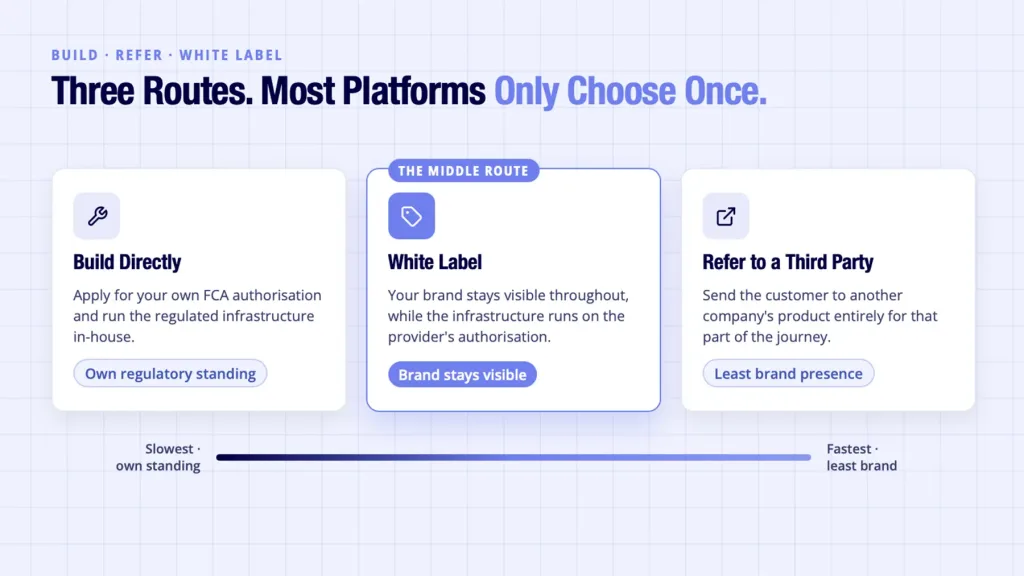
Every platform offering bank data, payments or verification is choosing one of three routes, whether that choice is made deliberately or by default.
Build directly means applying for FCA authorisation as an AISP or PISP and running the regulated infrastructure in-house. It’s the slowest route and the only one that gives a platform its own regulatory standing.
Refer to a third party means sending the customer to another company’s product entirely for that part of the journey. It’s the fastest route and the one that costs a platform the most brand presence at the point of transaction, similar to a checkout that redirects to another processor’s payment page, which is the kind of comparison that comes up when evaluating adyen pricing against other options.
A white label provider sits between the two: the platform’s own brand stays visible throughout, while the regulated infrastructure runs on a provider’s existing authorisation. This is the shape white label finance solutions take in practice, and it’s why platforms weighing white label financial services against the other two routes tend to land here once they’ve priced out the alternatives.
What Building Directly Actually Involves
Building directly isn’t primarily an engineering problem. The bank api integration work is often the smaller part of the timeline compared with the FCA application itself, which requires its own capital, compliance function and review period before a single live transaction can run.
That’s the part that catches most teams off guard. Engineering estimates for the integration itself are usually reasonably accurate; the regulatory timeline is the variable that’s much harder to control as it depends on the FCA’s own review process, rather than anything the platform’s team can accelerate.
Platforms that survey the market first, looking across a list of open banking api providers, often find that white label delivery is what separates a provider behind which a platform can launch quickly from one that still requires its own regulatory groundwork.
The scale of what’s already running on this infrastructure is worth knowing before comparing white label finance solutions on paper. UK Open Banking processed 40.16 million payments in June 2026 alone (Open Banking Limited), which says something about how proven the infrastructure underlying white label financial services already is, regardless of which specific provider a platform ultimately chooses.
What “Relying on the Provider’s Authorisation” Actually Means
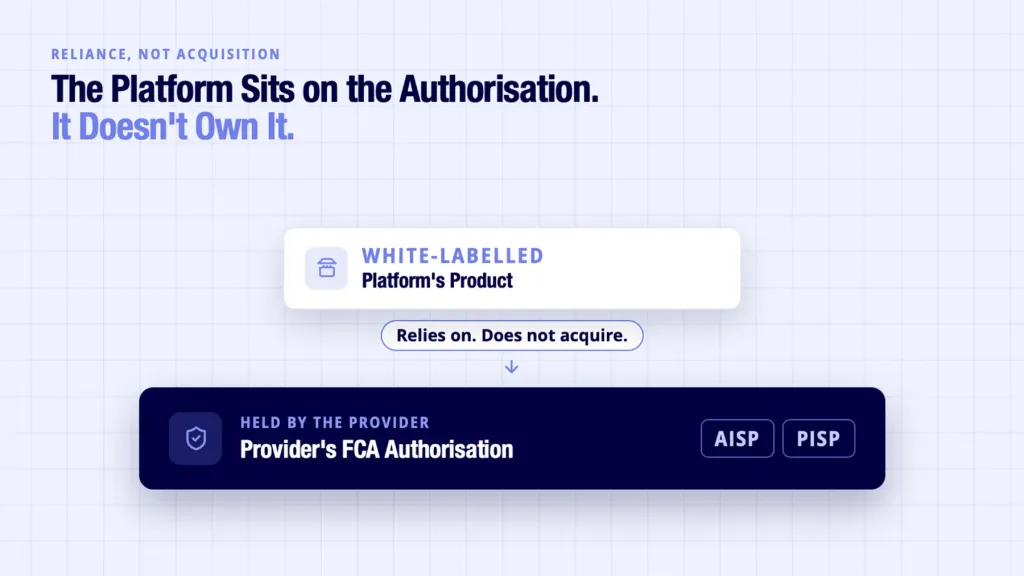
This is the part worth being precise about. White labelling means that the platform relies on the provider’s FCA authorisation. It does not mean the platform acquires that authorisation itself.
The provider holds the AISP and PISP permissions and carries the regulatory relationship with the FCA. The platform sits on top of that authorisation rather than obtaining its own, and white labelling doesn’t change that structure.
It’s a distinction that gets lost in how white label finance solutions are often marketed. The regulated activity inside a white label financial services offering still happens under a genuine FCA authorisation; it’s simply the provider’s authorisation carrying the weight, not a new one issued to the platform.
What this does and doesn’t cover varies by platform, particularly where a platform’s own activities go beyond simply embedding the provider’s regulated service. Firms should take their own regulatory advice on where that line sits for their specific product.
Where the Brand Actually Shows Up
White labelling doesn’t cover every part of a regulated flow uniformly. Some parts carry the platform’s branding fully; others are more fixed.
| What can be white labelled | What this looks like |
|---|---|
| Consent journeys | The screen that a customer sees approving bank data access or a payment, styled to the platform |
| Payment flows | Checkout and payout screens matching the platform’s own product |
| Verification checks | Identity and account checks presented inside the platform’s onboarding |
| Dashboard views | Transaction and status data shown inside the platform’s own interface |
What Actually Separates One Provider From Another
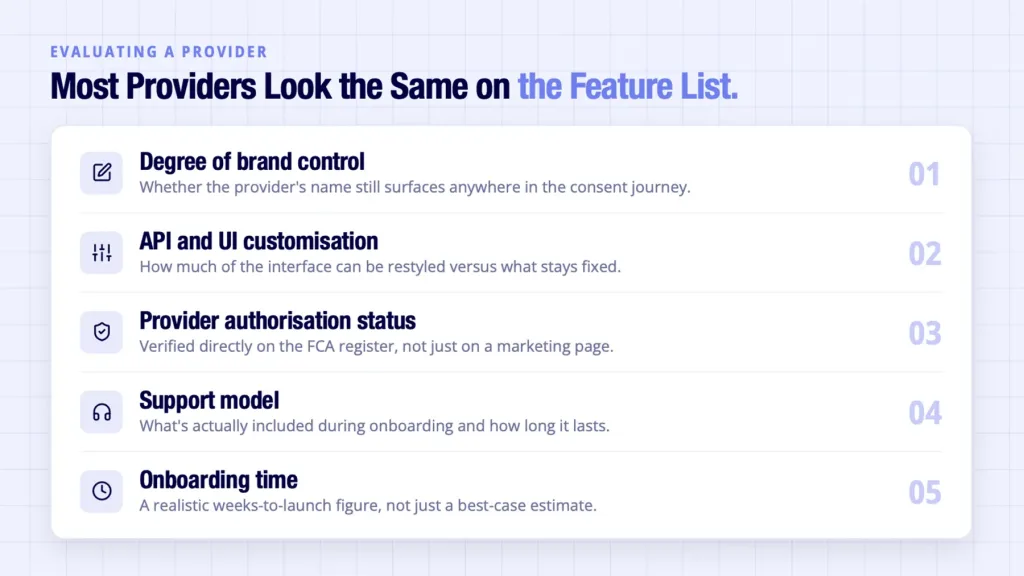
On paper, most white label providers look similar. Comparing open banking providers properly means going past the feature list into how much of the experience the platform genuinely controls.
- Degree of brand control: Whether the provider’s name still surfaces anywhere in the consent journey
- API and UI customisation: The extent to which the interface can be restyled versus that which stays fixed
- Provider authorisation status: Whether AISP and PISP authorisation is verified directly on the FCA register or just on the provider’s marketing page
- Support model: Features actually included during onboarding and how long they last
- Onboarding time: Whether it is a realistic weeks-to-launch figure or just a best-case estimate
Where This Shows Up by Platform Type
Accounting and ERP platforms white label data access to add bank feeds without building reconciliation infrastructure themselves.
Payroll and invoicing platforms white label payment initiation to run supplier and contractor payouts under their own brand.
Proptech platforms use white-label verification and payment flows for tenant referencing and rent collection.
EPOS platforms embed white-label Pay by Bank checkout without routing customers to an external payment page.
Across all four, the appeal of white label finance solutions is the same: the platform keeps the customer relationship under its own brand throughout, while the regulated mechanics run on infrastructure someone else has already built and had authorised.
Finexer’s White Label Delivery
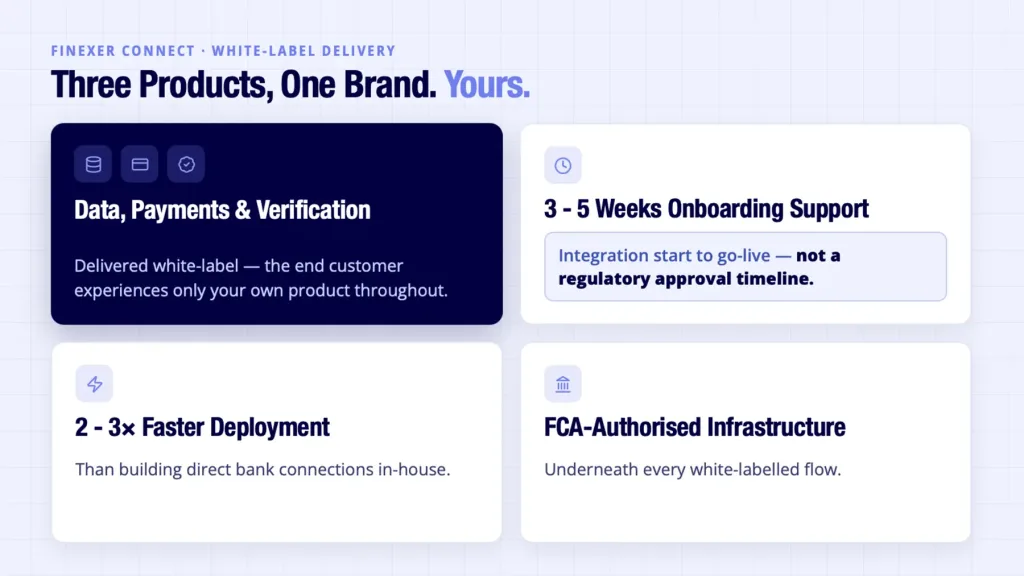
Platforms choosing white label over building directly are solving the same problem: offering a regulated capability under their own brand without carrying the authorisation burden themselves.
Finexer Connect delivers Data, Payments and Verification white-label, so the end customer experiences only the platform’s own product throughout.
- 3–5 weeks of onboarding support from integration start to go-live, which covers onboarding specifically and not a regulatory approval timeline
- Deployment 2–3x faster than building direct bank connections in-house
- FCA-authorised infrastructure underneath every white-labelled flow
Does choosing white label lock a platform out of ever getting its own authorisation later?
No. Some platforms deliberately use white labelling to launch quickly and pursue their own FCA authorisation once volume justifies the investment.
Is white label only worth it above a certain transaction volume?
Not necessarily. Smaller platforms often gain the most, since the fixed regulatory and engineering cost of building direct is harder to absorb at low volume.
Does a platform need its own compliance function to white label a provider?
Some compliance functions still matter for the platform’s own activities, but the specific AISP and PISP obligations sit with the provider rather than the platform under white label.
How is white label pricing typically structured compared to building directly?
White labeling tends to run on usage-based pricing with no infrastructure to maintain, whereas building directly carries licensing, compliance and engineering costs regardless of transaction volume. Most white label finance solutions price per transaction or per active user rather than charging a fixed platform fee, which keeps cost aligned with actual usage.
See how Finexer delivers white-label bank data, payments and verification under your brand, with 3–5 weeks of onboarding support and deployment 2–3x faster.
Explore with AI
About the Author

Yuri
Yuriy Yakushko is a fintech founder and software engineer with over 20 years of experience building financial technology. He’s passionate about creating scalable, secure infrastructure that helps businesses modernise how they access financial data and manage payments.