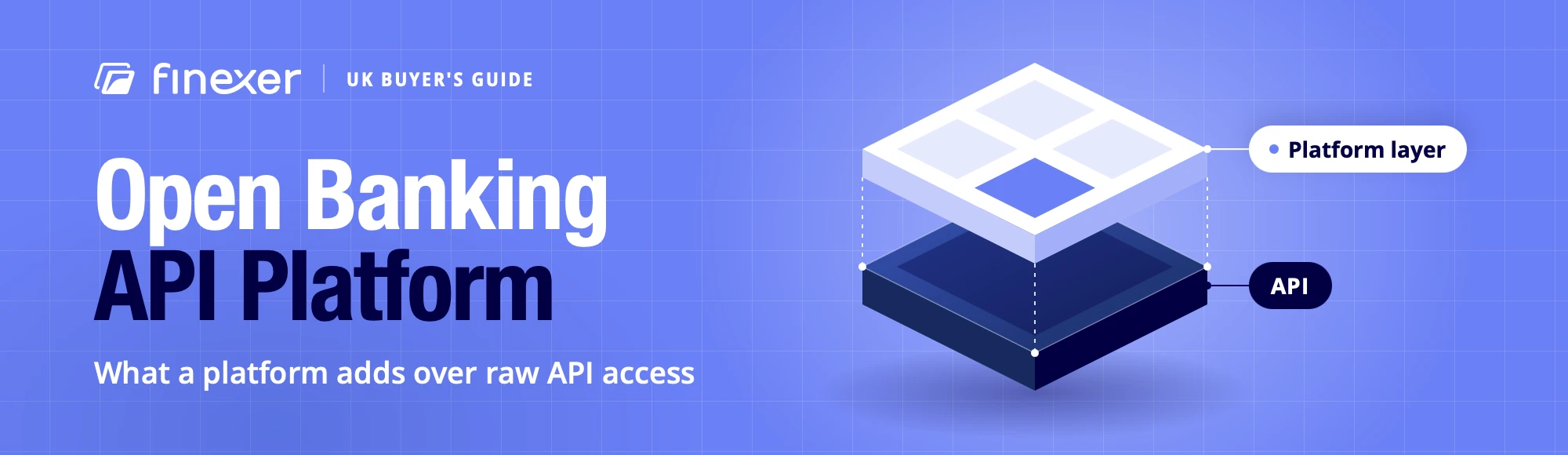
Does an open banking API platform give you more than raw API access? Yes. An open banking API platform bundles the API with the operational layer around it: consent management, connection monitoring, dashboard visibility and support.
Raw API access alone gives you a connection to build on. It doesn’t give you the tools to run that connection reliably once real customers depend on it. Open banking API UK buyers weighing this decision need to understand the gap before they build.
This guide covers exactly what a platform adds, who actually needs one, and how to evaluate open banking API solutions before you commit engineering time to either path.
Key Takeaways
- An open banking API platform bundles the API with consent management, monitoring, dashboard visibility, and support.
- Raw API access gives you the connection. A platform gives you the tools to run it in production without building them yourself.
- Teams with non-technical staff, compliance obligations, or a growing customer base usually need a platform.
- FCA authorisation status is independently verifiable on the Financial Services Register, and should be checked directly rather than taken from a provider’s own claim.
- Finexer combines AIS, PIS and Verification APIs with a Dashboard, backed by 3-5 weeks of onboarding support.
What Is an Open Banking API Platform?
An open banking API platform is a regulated API combined with the operational tools needed to run it in production: consent tracking, connection monitoring, a dashboard, and support. The API itself only handles requests and responses.
Everything a business needs to operate that connection safely at scale sits in the platform layer around it. For UK buyers, this distinction determines whether a small team can support a growing customer base without hiring purely to maintain infrastructure.
Providers offering AIS or PIS in the UK must be authorised or registered by the FCA under the Payment Services Regulations 2017. That authorisation is the same whether a business accesses a provider through a raw API or through a full platform interface. What differs is everything built around the regulated connection itself.
What Is the Difference Between an Open Banking API and a Platform?
The difference is what happens after the API call succeeds. A raw API returns data or confirms a payment. A platform adds the operational layer that tells a business whether that connection is healthy, whether consent is still valid, and what to do when something fails, without an engineer checking manually.
| Comparison Points | Raw API access | Open banking API platform |
|---|---|---|
| Consent tracking | You build it | Included |
| Connection monitoring | You build it | Included |
| Dashboard visibility | None | Included |
| Support model | Documentation only | Guided onboarding |
| Audit trail | You build it | Included |
This split matters for compliance specifically. The FCA’s own guidance on payment services requires authorised firms to maintain incident detection and reporting capability for the services they provide. A platform’s monitoring and audit trail exist to support exactly that obligation.
Building it from a raw API means the responsibility for meeting that standard sits entirely with the business consuming the API. For the raw mechanics of connecting to a bank, our guide to bank api integration covers that ground directly.
What Operational Layer Actually Matters in Production?
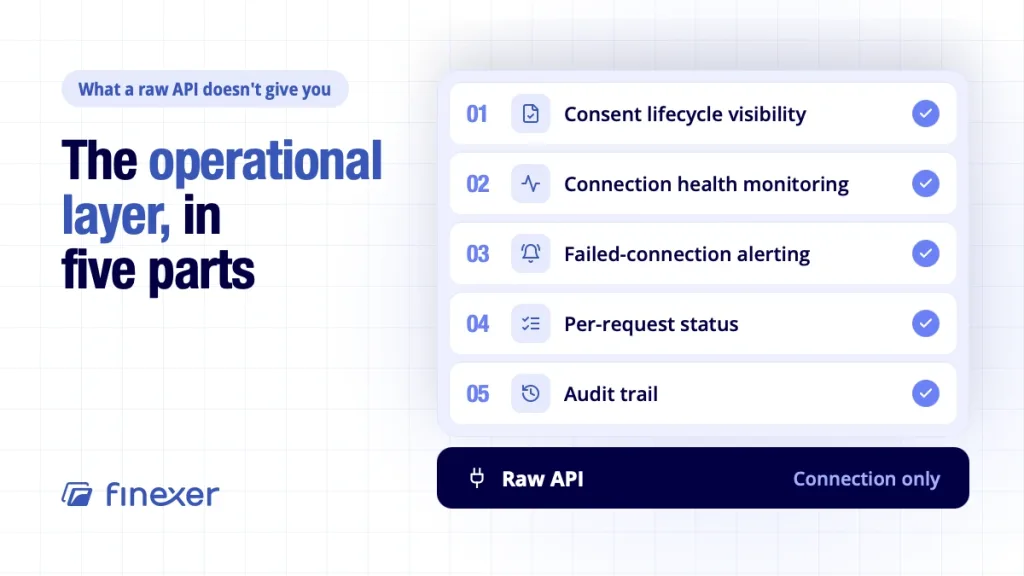
The key operational areas to consider are consent lifecycle status, connection health, failure alerts, individual request status, and audit visibility.
Together they answer the question a raw API cannot: not just whether a request succeeded, but whether the whole connection is trustworthy right now. Missing any one of these five is usually where a production incident starts.
- Consent lifecycle visibility: Knowing when a customer’s consent was granted, when it expires, and when it’s been revoked, without querying the API manually for every account.
- Connection health monitoring: Seeing which bank connections are working and which have degraded, before a customer reports a problem.
- Failed-connection alerting: A notification when a connection breaks, rather than discovering it through a support ticket days later.
- Per-request status: Clear visibility into whether a request succeeded, failed, or is pending, without parsing raw API responses.
- Audit trail: A record of what happened and when, needed for compliance review and dispute resolution.
Open banking API solutions worth paying for handle consent tracking and connection health monitoring by default. Open banking API solutions that skip this layer push all of that work onto your own engineering team.
When Do UK Businesses Need More Than Raw API Access?
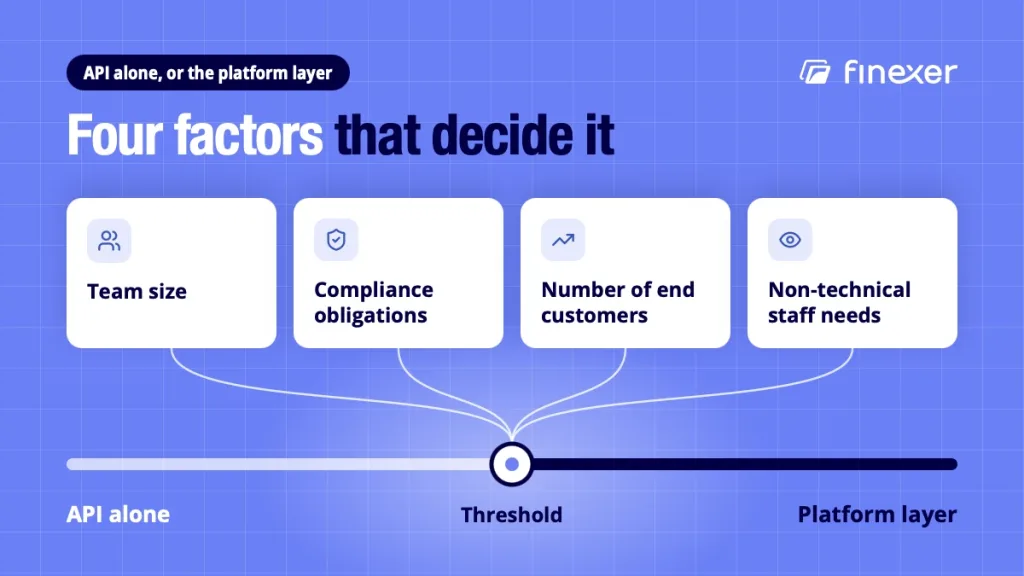
UK businesses typically need more than raw API access once they have non-technical staff who need visibility, formal compliance obligations, or a customer base large enough that manual checks stop being realistic.
This is the same threshold most open banking UK platforms hit as they scale. Below that threshold, a small technical team can often run a raw API connection directly. Above it, the operational layer usually becomes a full-time job by itself.
Four factors decide where that threshold sits:
- Team size: A small technical team can absorb building consent tracking and monitoring themselves. A growing team usually can’t sustain that work alongside product development.
- Compliance obligations: Regulated businesses need the audit trail a platform provides, since building one to an auditable standard is a real project on its own.
- Number of end customers: At low volume, manual checks are survivable. At scale, silent failures become expensive fast.
- Non-technical staff needs: If compliance, support, or operations staff need visibility into connections, a dashboard is the only realistic way to give it to them without a developer as a translator. White-label options matter here too, since staff and customers alike should see your brand, not the infrastructure underneath it.
Open banking API solutions marketed as pure infrastructure suit teams that want full control and have the resources to build the layer themselves. Most growing platforms don’t, and most open banking API solutions built for scale reflect that reality.
What Should You Check Before Choosing an Open Banking Platform in the UK?
Before choosing an open banking API platform in the UK, verify five things directly rather than from a provider’s marketing page: FCA authorisation status, dashboard capability, white-label availability, onboarding support, and pricing model. The first of these is not optional. Every UK provider offering AIS or PIS must appear on the FCA’s Financial Services Register, searchable by firm name or reference number.
| Criterion | What to check |
|---|---|
| Authorisation | Is the provider listed on the FCA Register for AIS, PIS, or both? |
| Dashboard | Does it show consent status, connection health, and audit trail, not just uptime? |
| White-label | Can the platform sit under your own brand? |
| Onboarding | Is there guided support, or documentation alone? |
| Pricing | Is it transparent pricing? |
For a full comparison of individual open banking API solutions by name, our open banking api list covers that shortlist directly. If you’re weighing bundled solutions more broadly, see our guide to open banking solution providers.
How Does Finexer Position as an Open Banking API Platform?
Finexer is an FCA-authorised Authorised Payment Institution, FRN 925695, a status independently verifiable on the Financial Services Register. That authorisation covers Account Information Services and Payment Initiation Services under the Payment Services Regulations 2017, the same regulatory basis every open banking UK provider operates under. Finexer is infrastructure for open banking API UK buyers specifically: regulated APIs combined with a Dashboard for visibility into consent, connections and requests, not software layered on top of someone else’s bank connections.
| Capability | Detail |
|---|---|
| APIs included | AIS, PIS and Verification in one integration |
| Dashboard | Consent status, connection health, request tracking |
| White-label | White-label finance solutions available |
| Authorisation | FCA-authorised (FRN 925695), verifiable on the FCA Register |
| Onboarding | 3-5 weeks of guided support |
| Pricing | Transparent pricing (no hidden charges) |
Real-time banking data flows through the same integration the Dashboard tracks, so what the interface shows reflects what’s actually happening on each connection.
The Finexer Dashboard is where that visibility lives day to day. Platforms that need to keep their own brand in front of customers can deploy Finexer with white label finance solutions. Buyers should confirm current authorisation status directly on the FCA Register rather than relying on any provider’s own description of its licensing, Finexer included.
Bottom Line
An open banking API platform gives you the API plus the operational layer most teams end up building anyway: consent tracking, connection monitoring, a dashboard and audit visibility.
Raw API access works for small technical teams with simple needs and spare engineering capacity. Most growing or regulated businesses need the platform layer instead. Verify FCA authorisation directly on the Financial Services Register before evaluating anything else.
Finexer provides AIS, PIS and Verification through one FCA-authorised integration (FRN 925695), with a Dashboard for real-time visibility and usage-based pricing that scales with your business.
What is an open banking API platform?
It’s an open banking API UK integration combined with the operational layer around it: consent tracking, connection monitoring, a dashboard and support. Raw API access alone doesn’t include these.
Do I need a platform or just an API?
It depends on team size, compliance needs and customer volume. Small technical teams can often start with an API. Growing or regulated businesses usually need a platform.
What should I check when evaluating an open banking API platform?
Check the FCA Register directly for authorisation status, then dashboard capability, white-label options, onboarding support and pricing model across the open banking API solutions on your shortlist. White-label options matter if your own brand needs to stay in front of customers throughout.
Is Finexer an open banking API platform or software?
Finexer is infrastructure: regulated APIs plus a Dashboard for visibility, authorised under FRN 925695. It’s not a software product built on someone else’s connections.
Does open banking UK regulation apply the same way to platforms and raw APIs?
Yes. The Payment Services Regulations 2017 apply to the underlying regulated activity, whether accessed through raw API calls or through a platform interface.
One FCA-authorised platform for banking data, payments and verification, with full visibility built in.
Explore with AI
About the Author

Ravi Ranjan
Ravi Ranjan is Co founder & CEO of Finexer